
GBT (Graph Build Tool) - A framework for coordinating and synchronizing graph-structured data.

Project description
Graph Build Tool (GBT)
Enterprise-Grade Graph Data Transformation & Schema Management



📖 What is GBT?
Graph Build Tool (GBT) is a transformative workflow framework designed specifically for graph databases (currently natively supporting Neo4j). Inspired by modern analytics engineering practices, GBT brings rigorous software engineering principles—such as declarative configurations, modularity, templatization, and version control—into graph data engineering.
Core Purpose: GBT empowers data engineers, graph developers, and analysts to build, maintain, and document graph schemas (DDL) and transform graph data (DML) reliably and efficiently. By defining your graph structures in declarative YAML and your transformations in templated Cypher/SQL, GBT reduces complexity and standardizes graph deployments across your organization.
🚀 Getting Started
Installation
Install gbt-core utilizing pip or your favorite Python package manager. To include Neo4j connector capabilities, install with the neo4j extra:
pip install "gbt-core[neo4j]"
If you are using Poetry (as used in this repository):
poetry add "gbt-core[neo4j]"
Quick Start
- Initialize a Project: Set up your project structure. (See the
example/directory for a reference structure includinggbt_project.yamland profile configurations). - Define Models: Create your node and relationship models inside the
models/directory using.sql,.cypher, andschema_*.ymlconfiguration schemas. - Run Transformations: Execute the CLI commands to parse, compile, and run your graph models:
gbt compile
gbt run --target neo4j
🏗 Architecture
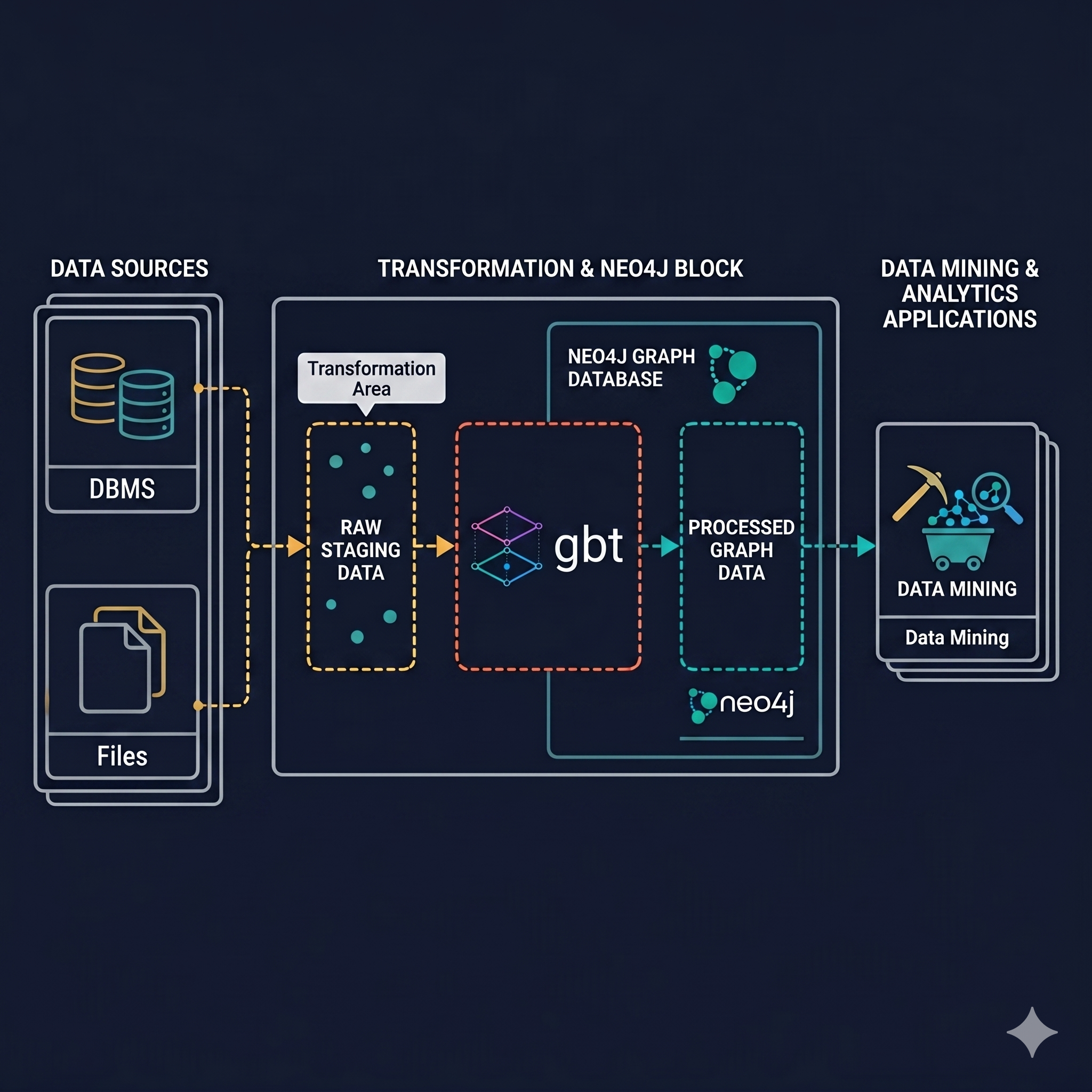
GBT strictly decouples Source Extraction and Destination Loading (Graph DB), heavily utilizing a locally compiled JSON Manifest as the Source of Truth.
✨ Key Features
- Neo4j Native Integration: A robust Bolt-protocol connector capable of handling complex network executions seamlessly.
- DDL Engine: Automated Schema Management supporting structural bounds and constraints defined purely in YAML configurations.
- DML Engine: Dynamic data manipulation supporting various materialization strategies including high-speed
UNWINDappend, strict merge, and surgical delete. - Jinja2 Templating: Leverage robust macros (
.cypher.j2) to build dynamic, reusable, and modular Cypher queries. - Memory-Safe Validation: Built-in schema validation preventing corrupted typings (e.g., String to Integer) from crashing the Graph runtime.
- Command Line Interface (CLI): Intuitive CLI application providing core commands like
gbt compile,gbt run, andgbt docs.
📚 Documentation
For in-depth architectural overviews, Core Engine details, Data Validation protocols, and templating cheat sheets, please serve the unified docs locally via MkDocs:
gbt docs
(You can also visit the official documentation website hosted on GitHub Pages once deployed).
🔮 Future Roadmap
The journey doesn't stop here. The future framework enhancements include:
- Multi-Graph Database Support: Expanding connector capabilities to AWS Neptune, Memgraph, TigerGraph, and more.
- Data Testing & Quality Checks: Declarative runtime testing to enforce unique entity constraints and referential integrity.
- Automated Data Lineage UI: A visual dashboard to explore the dependency graphs (DAG) of the models and relationships.
🤝 Contributing & License
Contributions, issues, and feature requests are welcome! Feel free to check issues page.
This project is licensed under the terms of the MIT license.


Download files
Download the file for your platform. If you're not sure which to choose, learn more about installing packages.
Source Distribution
Built Distribution
Filter files by name, interpreter, ABI, and platform.
If you're not sure about the file name format, learn more about wheel file names.
Copy a direct link to the current filters
File details
Details for the file gbt_core-0.1.2.tar.gz.
File metadata
- Download URL: gbt_core-0.1.2.tar.gz
- Upload date:
- Size: 39.1 kB
- Tags: Source
- Uploaded using Trusted Publishing? No
- Uploaded via: poetry/2.4.1 CPython/3.14.2 Darwin/23.4.0
File hashes
| Algorithm | Hash digest | |
|---|---|---|
| SHA256 |
c99284b5b98c9bd33c611faa789f643972f36a8e9931b3d0935ba0cd343700ea
|
|
| MD5 |
1721b981ff31d0ecddb4718ee8e52acf
|
|
| BLAKE2b-256 |
484f4791dfa8ae8e1a9c6f4381b55056af5ecb615a6cda94dc3aef08d3683231
|
File details
Details for the file gbt_core-0.1.2-py3-none-any.whl.
File metadata
- Download URL: gbt_core-0.1.2-py3-none-any.whl
- Upload date:
- Size: 59.6 kB
- Tags: Python 3
- Uploaded using Trusted Publishing? No
- Uploaded via: poetry/2.4.1 CPython/3.14.2 Darwin/23.4.0
File hashes
| Algorithm | Hash digest | |
|---|---|---|
| SHA256 |
4c8ce8d6f9ca534391bbae251772b3b57f336b235389338f7def4563a5150822
|
|
| MD5 |
1986e61d2528b02e0cb0c5c31c09529b
|
|
| BLAKE2b-256 |
03750831f3fb1c2e3e504273852719a87c22d1181021e561f0f1ee24a019db68
|






