

Reproducible sampling and cross-referencing of the full GDELT archive, on one machine.







Documentation · Getting started · CLI reference · Recipes
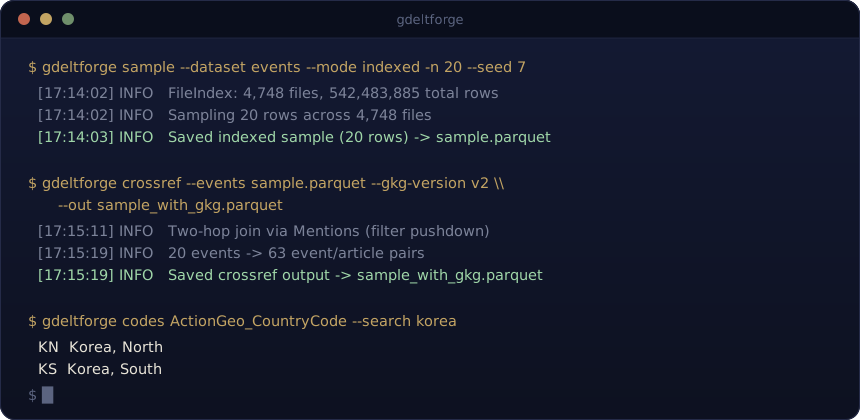
pip install gdeltforge
gdeltforge --help
GDELT publishes its full archive (Events since 1979, GKG 1.0 since 2013, GKG 2.1 and Mentions since 2015) as hundreds of thousands of raw files. Drawing a sample from it that another researcher can reproduce, and whose relation to the archive is known, is harder than it should be: GDELT's search APIs answer bounded queries (the DOC API, for instance, returns up to 250 articles from the last three months), and BigQuery's tables stay in Google's warehouse, not on your own disk.
GdeltForge is a command-line pipeline that downloads that archive, converts it to Parquet, repairs GDELT's documented errors, and draws seeded samples whose design (simple random, stratified by period or by column) is stated explicitly, on a single machine. It was written for research on representation learning over GDELT events; see Background and citing.
- Downloads the full archive: Events since 1979, GKG 1.0 since 2013, GKG 2.1 and Mentions since 2015
- Stores it as Parquet, as published (
convert) and repaired (clean) in separate directories - Repairs documented GDELT errors, keeping every row by default; audits every run
- Seeded sampling: simple random, by period, filtered, stratified
- Joins sampled Events to GKG, keeping the many-to-many structure
- Runs each stage (
scrape/convert/clean/sample/crossref) as its own command
Contents
- Why the Raw Archive
- Related Work
- Pipeline Design Principles
- Installation
- Project Structure
- Command Line Interface
- Usage Examples
- Logging System
- Limitations and Roadmap
- Contributing
- License
- Background and Citing
- Data Attribution
Stack







Why the Raw Archive
Of the ways GDELT offers its data (see Related Work for others), three matter here: its search APIs, BigQuery, and the raw archive, the one published as files to download.
GDELT API Limitations
GDELT's search APIs answer bounded queries about news coverage:
- the DOC API searches the last 3 months by default and returns up to 250 results per query
- the GEO API covers the last 15 minutes to 7 days
- the TV API reaches back to 2009, over television coverage
None of them returns the Events, Mentions or GKG tables themselves.
Google BigQuery Mirror Constraints
BigQuery holds the full history and answers SQL over it, within a free tier of 1 TiB of queries a month. Its tables are hosted by Google, not kept on your own disk, and some research workflows need a local, offline copy.
The Raw Bulk Archive
The raw GDELT archives contain hundreds of thousands of files (the Events directory alone about 5,000). Processing them requires:
- automated downloading
- streaming or chunked processing
- efficient columnar storage (Parquet)
- memory-safe filtering and sampling
GdeltForge performs these steps, one command per stage.
Related Work
Several other tools work with GDELT, each the better choice for some questions (a recent window, an analysis that fits in memory, SQL over the whole archive). GdeltForge focuses on two things. It treats sampling as a stage of its own: seeded designs that stream over the full archive on one machine and can be stated in a methods section. And it joins Events to GKG 2.1, which carries no event identifier, through Mentions, keeping the many-to-many relation between events and articles.
See Related Work for the other tools, what each is designed for, and when each fits better.
Pipeline Design Principles
The pipeline follows a single-responsibility, single-stage execution model. Each command performs exactly one transformation:

| Stage | Does |
|---|---|
scrape |
download raw GDELT CSV files (Events, GKG 2.1, GKG 1.0, or Mentions) |
convert |
transform CSV -> Parquet |
clean |
repair known GDELT errors and keep every row by default (rows missing a value are dropped only for the columns listed in clean.columns_to_check), shape the output, mark every file and audit every run |
sample |
reproducibly sample from Parquet files |
crossref |
join a sampled Events output back onto GKG |
Each stage is explicit:
- every operation is explicit
- no hidden steps
- each module is individually testable
- any stage can be re-run without affecting others
The same stages run independently per dataset (--dataset events, gkg-v2, mentions, ...); crossref is the one stage that reads two datasets at once, joining a sampled Events output against a GKG dataset processed the same way.
Each stage consumes the output of the previous one, enabling incremental execution, streaming-friendly operations, memory-efficient processing, simple debugging, and reusable intermediate data.
Installation
pip install gdeltforge
gdeltforge --help
No config file required to get started: GdeltForge falls back to a conservative built-in default (real ./data/... paths, no row/column filtering) and writes it to config/settings.yaml the first time you run a command with nothing else configured, so it works immediately in a fresh environment like a Colab session. See Configuration to customize it instead.
Installing from source (contributing, or an editable install)
This project uses uv for dependency management; uv sync builds and installs GdeltForge itself (editable), so the gdeltforge command becomes available inside the virtual environment.
# Install uv (if not already installed)
pip install uv

git clone https://github.com/Vinicius-Teixeirac/GdeltForge.git
cd GdeltForge

# Create virtual environment, install dependencies, and install GdeltForge itself
uv sync

# Activate the virtual environment
# Windows
.venv\Scripts\activate
# macOS / Linux
source .venv/bin/activate

# Verify the CLI is installed
gdeltforge --help
Optional, but worth doing for a real project rather than accepting the built-in default: copy the example config and adjust paths:
cp config/settings.example.yaml config/settings.yaml
Running the tests
The test suite is pure unit tests (no network access, no browser, no real GDELT data required) covering the scraping and conversion logic.
uv sync --group dev
uv run pytest
Project Structure
GdeltForge follows a standard src/ package layout, installable via uv sync / pip install.
Full source tree
project_root/
├── config/
│ └── settings.example.yaml # Annotated starting point; copy to settings.yaml and edit
│
├── src/gdeltforge/
│ ├── py.typed # PEP 561 marker: this package ships inline type hints
│ ├── cli.py # Argument parsing + subcommand dispatch
│ ├── launcher.py # The gdeltforge command's entry point: sizes polars' thread pool before polars loads, then runs cli
│ ├── __main__.py # python -m gdeltforge, through the same launcher
│ ├── _version.py # Generated at build time from the git tag (hatch-vcs); not hand-edited
│ │
│ ├── config/
│ │ └── default_settings.yaml # Bundled fallback config, used when no settings.yaml/--config is found at all
│ │
│ ├── data/
│ │ ├── cameo_codes.json # Bundled CAMEO/FIPS code -> name reference data, backs the `codes` command
│ │ └── places.parquet # Bundled place table: one place per (FeatureID, Lat, Long) GDELT wrote, backs clean.places
│ │
│ ├── aggregation/
│ │ └── aggregator.py # Concatenates a period's 15-minute files (GKG 2.1, Mentions, events-15min) into one per day/month/year
│ │
│ ├── conversion/
│ │ └── converter.py # CSV -> Parquet conversion logic
│ │
│ ├── crossref/
│ │ └── crossref.py # Events<->GKG join (direct for GKG 1.0, two-hop via Mentions for GKG 2.1)
│ │
│ ├── cleaning/
│ │ ├── cleaner.py # The clean stage: runs its steps on every file
│ │ ├── places.py # Loads the bundled place table for the places step
│ │ └── steps.py # The stage's steps, applied in one fixed order
│ │
│ ├── filtering/
│ │ └── filter.py # Deprecation shim: the pre-0.12 filter names, forwarding to cleaning/
│ │
│ ├── sampling/
│ │ ├── cameo_codes.py # Loads data/cameo_codes.json, groups columns by code family, backs the `codes` command
│ │ ├── indexer.py # File indexing for reproducible sampling
│ │ ├── rng.py # Random number generation helpers
│ │ └── samplers.py # Indexed, calendar, and filtered sampling
│ │
│ ├── scraping/
│ │ └── scraper.py # Downloader for Events, GKG 2.1, GKG 1.0, and Mentions
│ │
│ └── utils/
│   ├── branding.py # Terminal ANSI colors and the --version banner (brand system's terminal voice)
│   ├── concurrency.py # Sizes each worker's polars thread pools to its share of the machine, and caps concurrent reads (io.max_concurrent_reads)
│   ├── config.py # Config resolution (--config / env var / CWD / bundled default) and YAML loading
│   ├── io.py # File and chunked-IO helpers
│   └── logging.py # Central logging system
│
├── docs/assets/brand/ # Emblem, favicon, wordmark lockups, icon set, GitHub social preview
├── tests/ # pytest suite (unit tests, no network/browser required)
├── tools/ # Maintainer tools that build the place table, with the gazetteer references and repairs it cites
│
├── main.py # Backward-compatible shim: `python main.py <command>` still works
├── pyproject.toml # Package metadata, build backend, gdeltforge console-script entry point
└── README.md
Command Line Interface
Run pipeline stages using the installed console script:
gdeltforge <command> [options]
python main.py <command> [options] is kept as a backward-compatible equivalent, so existing scripts keep working unchanged. This alias only exists in a source checkout, not in the PyPI package installed above; gdeltforge itself always works either way.
| Command | Description |
|---|---|
scrape |
Download raw GDELT data (ZIP -> CSV) |
convert |
Convert downloaded CSV files to Parquet |
clean |
Clean converted Parquet: the data-quality stage (formerly filter) |
aggregate |
Concatenate the 15-minute datasets' files into one per day, month or year |
sample |
Efficient, reproducible sampling |
crossref |
Join a sampled Events output back onto GKG |
codes |
Look up valid CAMEO/FIPS codes across seven column families |
The CLI intentionally does not chain stages automatically. You run each stage explicitly to maintain full control.
By default the config is read from ./config/settings.yaml (relative to wherever you run the command from). To point at a config file anywhere else on disk, use --config /path/to/settings.yaml or set the GDELTFORGE_CONFIG environment variable, useful once GdeltForge is installed and invoked from outside the repo checkout. If none of those resolve to a real file, GdeltForge falls back to a built-in default instead of failing; see Configuration.
Usage Examples
Examples of the common workflows, one stage at a time.
Scrape Raw Data
Download the entire archive (--dataset is required on every command; see CLI Reference for the other six choices):
gdeltforge scrape --dataset events
Download only files within a date range (any combination of bounds is valid):
gdeltforge scrape --dataset events --start-date 2020-01-01 --end-date 2023-12-31
gdeltforge scrape --dataset events --start-date 2022-01-01          # from date onward
gdeltforge scrape --dataset events --end-date   2015-12-31          # up to date
The filter applies to all three file types the GDELT archive provides:
| File type | Example filename | Included when |
|---|---|---|
| Daily | 20200315.export.CSV.zip |
day falls within range |
| Monthly | 202003.zip |
month overlaps range |
| Yearly | 2020.zip |
year overlaps range |
Files already present in the download directory are skipped regardless of the date filter.
Downloads run concurrently (scraping.max_workers in config/settings.yaml, default 8) and are checksum-verified: the GDELT index publishes an MD5 per file, which the scraper captures and checks against each download after it completes. A mismatch is treated the same as a network failure: the file is discarded and retried up to scraping.retries times before being reported as failed, so a corrupted or truncated download never silently ends up in the dataset.
Link collection method: requests vs selenium
The scraper needs to read the file index at data.gdeltproject.org/events/ before it can download anything. That index turns out to be a plain, server-rendered HTML directory listing (not JS-rendered), so a headless browser is unnecessary overhead. scraping.method in config/settings.yaml controls which collector is used:
requests (default) |
selenium |
|
|---|---|---|
| How it works | Plain HTTP GET + regex over the HTML | Launches headless Chrome, waits for the DOM, reads <a> tags |
| Dependencies | Just requests (already required) |
Chrome install + a version-matched ChromeDriver + selenium/webdriver-manager (uv pip install '.[selenium]') |
| Measured speed | ~0.4s | ~16s (~40x slower) |
| Failure modes | None specific to this site | Breaks whenever Chrome auto-updates past the pinned ChromeDriver version (the original reason this option was added) |
| When to use | Always, unless the page below stops being static | Fallback only, in case GDELT ever switches this index page to a JS-rendered listing |
Both methods were verified to return an identical set of URLs (4,953 files). Timing was a single wall-clock run of each method's link-collection call only (_collect_gdelt_links_requests / _collect_gdelt_links_selenium, timed with time.perf_counter()), back-to-back against the live site on the same machine/network: it does not include the subsequent file downloads, which are identical for both methods. It's a one-off measurement, not an average over multiple runs, so treat the ~40x figure as indicative of the order of magnitude rather than a precise benchmark; the gap is structural (Chrome process startup + page-render wait vs. a single HTTP GET), so it should hold up under repeated measurement.
The site's TLS certificate doesn't match its hostname (it's served off a GCS bucket cert), so both methods intentionally skip certificate verification for this one connection; the actual file downloads happen over plain http://, which sidesteps the issue entirely.
Convert CSV to Parquet
gdeltforge convert --dataset events
Extracts all CSV files from the downloaded ZIP archives and converts them to Parquet files. Each ZIP is processed independently, so conversion runs across a pool of worker processes (converter.max_workers in config/settings.yaml; null, the default, uses all available CPU cores).
Optional: Hive partitioning for historical data
The GDELT archive distributes pre-2013 data in yearly and monthly ZIPs (e.g. 1979.zip, 200601.zip) rather than daily files. When you are working with the full archive (1979-present), keeping those as flat Parquet files means every query scans thousands of files. Enabling Hive partitioning routes those files into a structured directory tree, so filters on Year or MonthYear skip irrelevant files entirely.
This feature is off by default. To enable it, add the following to settings.yaml:
paths:
  # existing paths ...
  parquet_historical_directory: "./data/events/historical"
  cleaned_historical_directory: "./data/events/cleaned_historical"

converter:
  partitioning:
    enabled: true
    rules:
      - file_type: yearly    # e.g. 1979.zip
        by: ["Year"]
      - file_type: monthly   # e.g. 200601.zip
        by: ["Year", "MonthYear"]
With partitioning enabled, running gdeltforge convert produces two separate output areas:
data/events/
├── parquet/                  # daily files (2013-present), unchanged
│   ├── 20130401.export.parquet
│   └── ...
└── historical/               # yearly/monthly files, Hive-organized
    ├── Year=1979/
    │   └── 1979.parquet
    ├── Year=2006/
    │   └── MonthYear=200601/
    │       └── 200601.parquet
    └── ...
Daily ZIPs (2013-present) always go to parquet_data_directory as flat files. Yearly and monthly ZIPs go to parquet_historical_directory under the directory structure defined by their rule.
Historical ZIPs that have already been converted are tracked with .done marker files, so re-running convert skips them safely.
All downstream stages (clean, sample) detect the historical directory automatically from the config and include its data without any extra flags.
convert also accepts --start-date/--end-date, same as scrape, narrowing which already-downloaded ZIPs get converted:
gdeltforge convert --dataset events --start-date 2020-01-01 --end-date 2020-12-31
Clean the Parquet Dataset
gdeltforge clean --dataset events
The data-quality stage. By default it repairs known GDELT errors (the events GDELT dated 1920 for 2020, with GDELT's own values kept in *_original columns) and keeps every row; rows missing a value in the columns listed under clean.columns_to_check are dropped. Every cleaned file is marked as cleaned, every run leaves an audit, and --dry-run --report measures what each step would change before anything is written. See Data Cleaning. Also accepts --start-date/--end-date, narrowing which already-converted files get read (which files get filtered, not which rows survive within them).
Sampling
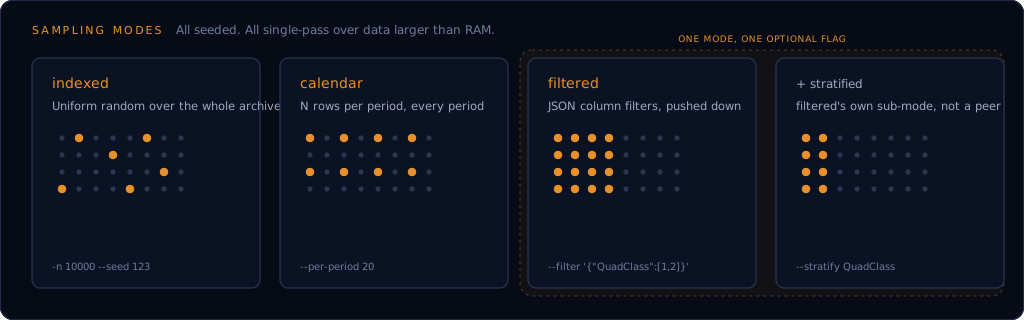
All sampling modes read from the cleaned directory by default. Pass --source converted to sample from raw converted Parquet instead, skipping the clean stage entirely.
Note: sampling is already as memory-friendly as the underlying data volume allows, but
--source convertedwill still use noticeably more RAM than the default, since it isn't working from data that's already had its missing-value rows dropped.
Indexed Sampling (Uniform Random)
gdeltforge sample --dataset events --mode indexed -n 10000 --seed 123 --out sample.parquet
This samples 10000 instances considering the entire data.
Calendar Sampling (N Rows Per Period)
gdeltforge sample --dataset events --mode calendar --per-period 20 --out daily.parquet
This samples 20 instances per day from the entire period (1979-present).
Filtered Sampling (Using JSON Filters)
5000 events whose QuadClass is in {1,2}:
gdeltforge sample \
    --dataset events \
    --mode filtered \
    --filter '{"QuadClass": [1, 2]}' \
    -n 5000 \
    --out qc12.parquet
2000 "Verbal Cooperation" events that happened in the USA (ActionGeo_CountryCode is a FIPS 2-letter code, US, not the 3-letter CAMEO code USA that Actor1CountryCode/Actor2CountryCode use):
gdeltforge sample \
    --dataset events \
    --mode filtered \
    --filter '{"ActionGeo_CountryCode": ["US"], "QuadClass": [1]}' \
    -n 2000
You can select specific columns of interest, which is a memory friendly practice:
gdeltforge sample \
    --dataset events \
    --mode filtered \
    --filter '{"ActionGeo_CountryCode": ["US"], "QuadClass": [1]}' \
    --columns GlobalEventID Year Actor1Code \
    -n 1000
It outputs 1000 instances following the same rule as before, but this time with only three columns.
Stratified Sampling (Fixed N Per Group)
Combines a filter with stratified reservoir sampling: draws exactly --n-per-group rows for each distinct value of a chosen column.
gdeltforge sample \
    --dataset events \
    --mode filtered \
    --filter '{"ActionGeo_CountryCode": ["US"]}' \
    --stratify QuadClass \
    --n-per-group 500 \
    --out stratified.parquet
This produces a balanced dataset with 500 USA events per QuadClass value, regardless of the natural class distribution.
--stratify requires --n-per-group. The -n flag is ignored when --stratify is set.
Cross-Referencing Events with GKG
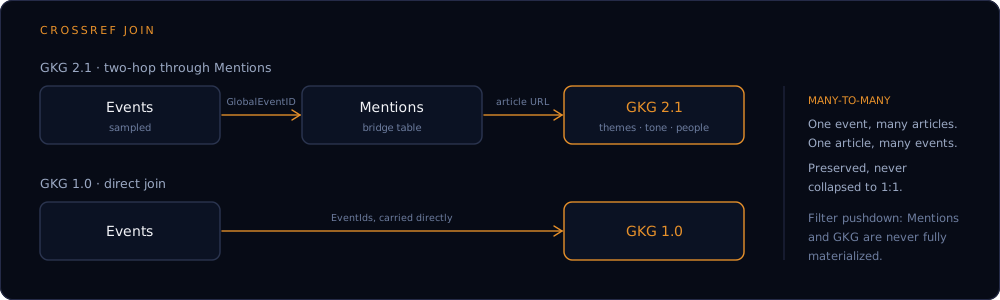
crossref enriches a sampled Events output with GKG (themes, tone, people, organizations). --gkg-version picks the join strategy: GKG 1.0 carries EventIds directly (a direct join), while GKG 2.1 carries no event ID at all and needs a two-hop join through Mentions on the source article's URL. --gkg-version auto attempts every eligible event against both generations instead of requiring one for the whole sample, useful for a sample spanning both eras (GKG 2.1/Mentions don't exist before 2015-02-18; GKG 1.0 has covered everything since 2013-04-01, and remains live today). All preserve the real many-to-many structure (one event can produce several output rows, one article covering several events contributes one row per event) instead of collapsing it.
gdeltforge scrape --dataset gkg-v2
gdeltforge scrape --dataset mentions
gdeltforge convert --dataset gkg-v2
gdeltforge convert --dataset mentions
gdeltforge clean --dataset gkg-v2
gdeltforge clean --dataset mentions

gdeltforge crossref \
    --events sample.parquet \
    --gkg-version v2 \
    --out sample_with_gkg.parquet
See Recipes for the GKG 1.0 direct-join variant and more detail.
Full Pipeline Examples
Six ready-to-run pipelines (full run, reproducible, USA-only, per-day, shell loops, date-restricted)
Full pipeline: sample 10,000 rows
gdeltforge scrape --dataset events
gdeltforge convert --dataset events
gdeltforge clean --dataset events
gdeltforge sample --dataset events --mode indexed -n 10000
Reproducible sampling
gdeltforge scrape --dataset events
gdeltforge convert --dataset events
gdeltforge clean --dataset events
gdeltforge sample --dataset events --mode indexed -n 5000 --seed 42
USA-only events
gdeltforge scrape --dataset events
gdeltforge convert --dataset events
gdeltforge clean --dataset events
gdeltforge sample \
    --dataset events \
    --mode filtered \
    --filter '{"ActionGeo_CountryCode": ["US"]}' \
    -n 3000
30 events per day
gdeltforge scrape --dataset events
gdeltforge convert --dataset events
gdeltforge clean --dataset events
gdeltforge sample --dataset events --mode calendar --per-period 30
Bash one-liner
gdeltforge scrape --dataset events && \
gdeltforge convert --dataset events && \
gdeltforge clean --dataset events && \
gdeltforge sample --dataset events --mode indexed -n 10000
PowerShell loop
foreach ($c in "scrape", "convert", "filter") {
    gdeltforge $c --dataset events
}
gdeltforge sample --dataset events --mode indexed -n 10000
Date-restricted pipeline
gdeltforge scrape --dataset events --start-date 2020-01-01 --end-date 2023-12-31
gdeltforge convert --dataset events --start-date 2020-01-01 --end-date 2023-12-31
gdeltforge clean --dataset events --start-date 2020-01-01 --end-date 2023-12-31
gdeltforge sample --dataset events --mode indexed -n 10000 --start-date 2020-01-01 --end-date 2023-12-31
scrape, convert, clean, and sample each accept --start-date/--end-date independently. scrape narrows the remote listing it discovers files from; the later stages narrow which already-on-disk files they read, so repeating the same range keeps the whole pipeline focused on that window instead of processing every file already on disk once scrape is done.
Further Examples
The complete filtered-sampling syntax reference and a full set of runnable recipes are in the documentation: see Filtered Sampling and Recipes. For which classical sampling algorithm each mode actually runs, see Sampling Theory.
Logging System
Logging is enabled through a shared logger helper:
from gdeltforge.utils.logging import get_logger
logger = get_logger(__name__)
Logging to a file:
logger = get_logger(__name__, log_to_file=True)
Limitations and Roadmap
GdeltForge is intentionally simple: one pipeline stage per command (no automatic chaining or dependency resolution), CSV -> Parquet only, and scrape/convert/clean now exit non-zero if any individual file fails.
The full, current list of limitations and the roadmap live in one place, the docs site, rather than duplicated here where they'd inevitably drift: see Limitations & Roadmap.
Contributing
Contributions are welcome. See CONTRIBUTING.md for dev setup, the branch/commit conventions this repo follows, and how to propose a change. Please also read the Code of Conduct.
See CHANGELOG.md for a history of notable changes.
Found a security issue? See SECURITY.md rather than opening a public issue.
License
This project is licensed under the Apache License, Version 2.0. See the LICENSE file for details.
Background and Citing
GdeltForge was written for research on representation learning for structured events, comparing tabular, graph and text representations of GDELT events with a multi-domain geometric model. Its first use was the chapter "Multi-domain Geometric Representation Learning for Structured Events" (Freitas, Sakiyama and Marcacini, BRACIS 2026, Springer LNAI 17107, doi:10.1007/978-3-032-39895-6_13). About describes what that research needed and the design decisions that followed.
If GdeltForge contributes to published work, please cite it: see CITATION.cff, or GitHub's "Cite this repository". Please also cite the GDELT Project, below.
Author: Vinícius Teixeira Carvalho Freitas, Instituto de Ciências Matemáticas e de Computação (ICMC), Universidade de São Paulo, São Carlos, Brazil.
Data Attribution
GdeltForge processes data published by the GDELT Project, which makes it available for unlimited and unrestricted use, provided any use or redistribution includes a citation and a link to their site. GdeltForge itself is an independent, unofficial tool, not affiliated with, endorsed by, or sponsored by the GDELT Project.
The place table's repaired region names (see Data Cleaning) and its country points (see Data Cleaning) come from NGA's GEOnet Names Server. Toponymic information is based on the Geographic Names Database, containing official standard names approved by the United States Board on Geographic Names and maintained by the National Geospatial-Intelligence Agency. More information is available at the Resources link at www.nga.mil. The National Geospatial-Intelligence Agency name, initials, and seal are protected by 10 United States Code § Section 425.
The place table's US state and territory points come from the U.S. Geological Survey's Geographic Names Information System (GNIS), Domestic Names National, published 2026-09-29; the data carries no use constraints, and the USGS asks for acknowledgment in products derived from it.
1 maintainer

Metadata
1 maintainer
Release files for gdeltforge 0.14.0
For a detailed explanation of source distributions (sdists) and built distributions (wheels), please see the package formats documentation.
Source distribution (sdist)
| File | Size | Uploaded | |
|---|---|---|---|
| gdeltforge-0.14.0.tar.gz | 23.9 MB | Details |
Built distribution (wheel)
| File | Interpreter | ABI | Platform | Reset |
|---|---|---|---|---|
| gdeltforge-0.14.0-py3-none-any.whl | Python 3 | none | any | Details |
Total release size: 46.3 MB
Release files / gdeltforge-0.14.0.tar.gz
| Download URL | gdeltforge-0.14.0.tar.gz |
|---|---|
| Size | 23.9 MB |
| Tags | Source |
|
SHA-256 checksum How to use checksums |
2e263224d6d045f0417320bca0773710254b339ad8ea702ee3393738eeb9bbda
|
|
BLAKE2b-256 checksum How to use checksums |
52c54a8480479a0c2ba431d707766ffccb17beddf9ce7ef9cd15581689975805
|
| Upload date | |
|
Uploaded using Trusted Publishing? What is trusted publishing? |
Yes |
| Uploaded via |
twine/7.0.0 CPython/3.13.14
|
Provenance
Provenance describes where a file came from. On PyPI, provenance is shared via attestations, which provide a verifiable record of the build or publishing details. View details, limitations and caveats.


PyPI Publish Attestation
PyPI verified that this artifact, at this checksum, originated from the publisher listed below.
Signed by GitHub Actions, verified by PyPI on Oct 15, 2026.
Transparency logRelease files / gdeltforge-0.14.0-py3-none-any.whl
| Download URL | gdeltforge-0.14.0-py3-none-any.whl |
|---|---|
| Size | 22.4 MB |
| Tags | Python 3 |
|
SHA-256 checksum How to use checksums |
e5991fb43356488f0dd3e806f01c5278226af20e23a03d81b1967fbd6b63761b
|
|
BLAKE2b-256 checksum How to use checksums |
510803b240f7ae63cfdb74379a2070cde266a731c5a7366a682e32f74b222c1a
|
| Upload date | |
|
Uploaded using Trusted Publishing? What is trusted publishing? |
Yes |
| Uploaded via |
twine/7.0.0 CPython/3.13.14
|
Provenance
Provenance describes where a file came from. On PyPI, provenance is shared via attestations, which provide a verifiable record of the build or publishing details. View details, limitations and caveats.
PyPI Publish Attestation
PyPI verified that this artifact, at this checksum, originated from the publisher listed below.
Signed by GitHub Actions, verified by PyPI on Oct 15, 2026.
Transparency log













