
Mutation testing for GDScript and Godot: find the bugs your green tests would miss.




A community tool, not affiliated with or endorsed by the Godot Foundation.
What it is
Coverage tells you a line ran. Mutations tell you if a bug there would be caught: a killed mutant means yes, a survivor means no. A standalone CLI, no AI required.
Same idea, other languages: mutmut for Python, Stryker for JS/TS, PIT for Java.
gdmutant mutates your GDScript (flips >↔>=, and↔or, bumps a number, deletes a statement),
reruns your tests once per change, and reports the survivors.
The --html report, open on turn_order.gd. A survivor in the source, and marked on line 27:

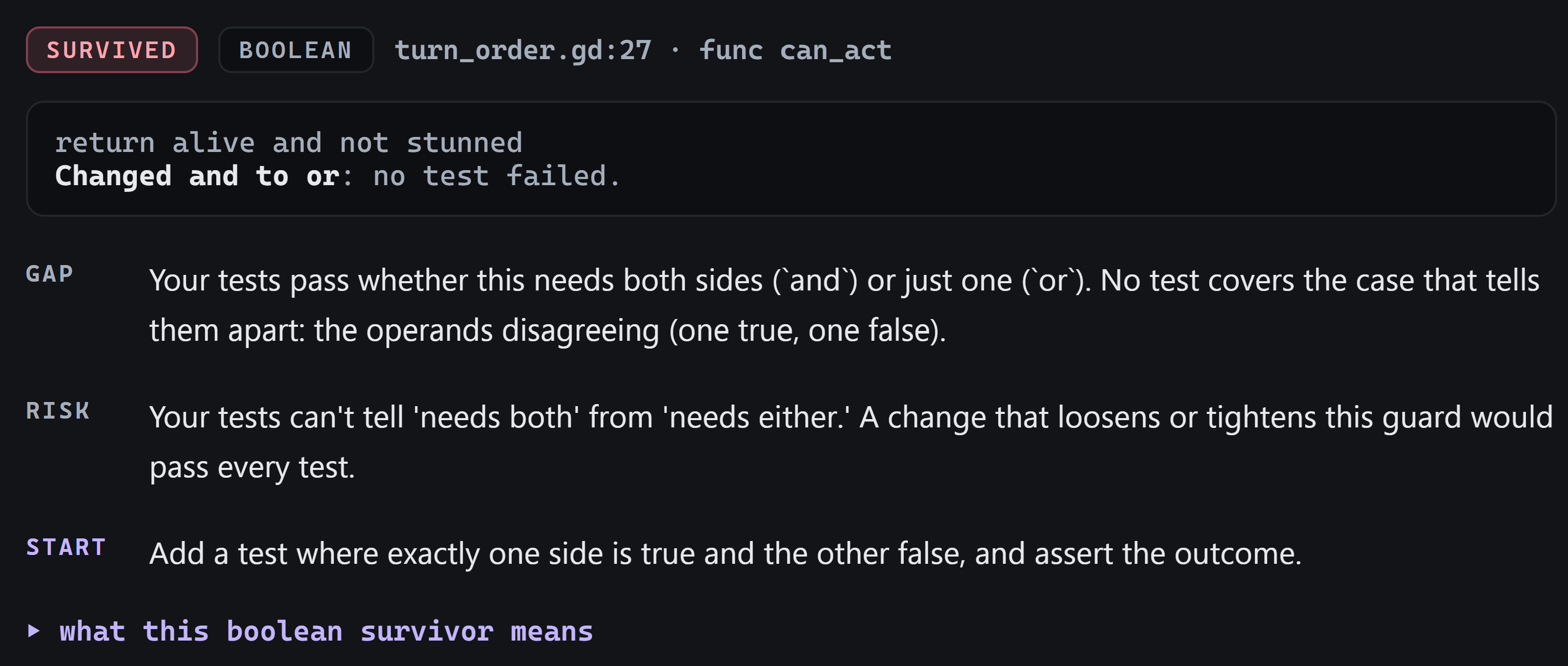
and its detail card: what it means, why it's risky, and how to close it.
Prerequisites
- Godot 4.3+ (see Compatibility for exact versions),
on your PATH so a plain
godot --versionworks, or pass--godot <full-path>on every gdmutant command instead. - GUT or gdUnit4,
already installed and enabled in your project, if you use either. A different test runner works
too, via
--runner command: any headless command that exits non-zero on failure. - Python 3.12+ (check with
python --version).
Quickstart
This mutates corpus/, a small real Godot project bundled in this repo just for this: a real
script and a real GUT/gdUnit4 suite to try gdmutant against before pointing it at your own.
git clone https://github.com/kphutt/gdmutant

cd gdmutant                                # corpus/ lives right here, at the repo root

pip install .                              # installs gdmutant and its own dependencies

python scripts/install_gdunit4.py          # gdUnit4 is a Godot addon that isn't vendored in git; this fetches it

gdmutant run corpus/turn_order.gd --project corpus --runner gdunit4 --html
# mutates one file, reruns corpus/'s real GdUnit4 tests against each mutant
Output:
...

  corpus\turn_order.gd:27   func can_act

     27 |     return alive and not stunned
        |                  ^  changed  and  to  or: every test still passed

  gap    Your tests pass whether this needs both sides (`and`) or just one
         (`or`). No test covers the case that tells them apart: the
         operands disagreeing (one true, one false).

  risk   Your tests can't tell 'needs both' from 'needs either.' A change
         that loosens or tightens this guard would pass every test.

  start  Add a test where exactly one side is true and the other false,
         and assert the outcome.

  more   https://github.com/kphutt/gdmutant/blob/main/docs/survivors/README.md#boolean
──────────────────────────────────────────────────────────────────────────

Results

Mutation score: 61.1%
  killed:   11
  timeout:  0  (counted as killed)
  survived: 7
  ignored:  0  (suppressed, excluded from score)
  invalid:  0
  error:    0

Wrote HTML report to gdmutant-report-turn_order-<timestamp>.html. Open it in a browser.
Point it at your own project
pip install 'gdmutant==0.1.*' # gdmutant is 0.x: pin the minor so a new one is a move you make on purpose
Pick your test runner with --runner (required). GUT or
gdUnit4 — Godot has no built-in test runner, so both
ship as addons: a plugin folder (addons/gut/ or addons/gdUnit4/) that lives inside a Godot
project. Whichever you pick needs to already be installed there, in the project you're pointing
gdmutant at. Godot itself needs to be on PATH, or point at it with --godot <path>.
gdUnit4's usual test layout matches gdmutant's default --tests res://test, so a gdUnit4 command
needs no --tests flag. GUT needs it spelled out: its stock layout puts suites in test/unit/
instead, and GUT's own -gdir doesn't search subdirectories.
# GUT
gdmutant run ../my-project/src/module.gd --project ../my-project --runner gut --tests res://test/unit --json
# gdUnit4
gdmutant run ../my-project/src/module.gd --project ../my-project --runner gdunit4 --json
--json follows the
mutation-testing-elements schema
See the survivor reference for what
ignored, invalid and error mean.
Killing Survivors
Kill each survivor with a real test, or mark a genuine equivalent with # gdmutant: ignore and a
reason (details). Re-run until nothing survives. A mutation score
isn't a target to hit, it's a direction to watch. There's no universal "good" number.
GitHub Actions
gdmutant also ships as a GitHub Action, so a pull request can report its own survivors. Save this as
.github/workflows/mutation.yml:
name: Mutation testing
on:
  pull_request:
  push:
    branches: [main]

jobs:
  gdmutant:
    runs-on: ubuntu-latest
    steps:
      - uses: actions/checkout@3d3c42e5aac5ba805825da76410c181273ba90b1 # v7.0.1
        with:
          fetch-depth: 0        # `since` below needs the base commit in the clone
      - uses: kphutt/gdmutant@05728864a1c9330d632e2aab2348ff4442f3d61d # v0.1.0
        with:
          godot-version: "4.7.0"   # the only required input
          paths: src                # what to mutate (default: the whole project)
          runner: gdunit4            # or gut, or command
          # A PR diffs against its base commit. A merge to main diffs against the commit
          # it replaced. Either way, only the code that actually changed gets mutated.
          since: ${{ github.event_name == 'pull_request' && github.event.pull_request.base.sha || github.event.before }}
It sets up Godot, installs gdmutant, runs it, and writes every survivor with its gap / risk /
start explanation into the job summary, where reviewers already look. Survivors are output, not
failure: the step fails only on a real error, such as a suite that was already red. Your project
brings its own GUT or gdUnit4 addon, the same one your existing test job uses.
Most iteration happens locally with gdmutant run above -- a GitHub Action is too slow a feedback
loop for that, since you already run your tests before committing. Its value here is as a CI check:
scoped to just what changed, it catches anything a local run missed, without paying to mutate the
whole project on every PR and push. Godot boots once per mutant, so that full-project cost is real,
which is what since avoids. Drop it (and fetch-depth) for an occasional full-project scan
instead.
Every input and output, and how to pin a version, is in the guide.
Compatibility
| Verified at every release | Expected to work | |
|---|---|---|
| Godot | 4.7.0 | 4.3+ |
| Runner | GUT 9.7.1, gdUnit4 6.1.3 | GUT 9.x, gdUnit4 6.x, any headless command |
Documentation
- Survivor reference: every operator explained, the score formula, how to kill or justify each.
- Design & architecture: the engine and the "Saboteur & the Jury" design.
- The gdmutant guide: the CLI, troubleshooting, and the GitHub Action, in one place.
- Contributing · Changelog · Credits
License
MIT, © 2026 kphutt.
1 maintainer

Release files for gdmutant 0.1.1
For a detailed explanation of source distributions (sdists) and built distributions (wheels), please see the package formats documentation.
Source distribution (sdist)
| File | Size | Uploaded | |
|---|---|---|---|
| gdmutant-0.1.1.tar.gz | 515.6 kB | Details |
Built distribution (wheel)
| File | Interpreter | ABI | Platform | Reset |
|---|---|---|---|---|
| gdmutant-0.1.1-py3-none-any.whl | Python 3 | none | any | Details |
Total release size: 651.0 kB
Release files / gdmutant-0.1.1.tar.gz
| Download URL | gdmutant-0.1.1.tar.gz |
|---|---|
| Size | 515.6 kB |
| Tags | Source |
|
SHA-256 checksum How to use checksums |
625ff326960fd24d6c690deb11e18cb455ae21ef9357329edf64582607f18600
|
|
BLAKE2b-256 checksum How to use checksums |
0ece4edec9e0a3a9e95d3442c556435e64f6464aa2d864f79df1d244569bccfb
|
| Upload date | |
|
Uploaded using Trusted Publishing? What is trusted publishing? |
Yes |
| Uploaded via |
twine/7.0.0 CPython/3.13.14
|
Provenance
Provenance describes where a file came from. On PyPI, provenance is shared via attestations, which provide a verifiable record of the build or publishing details. View details, limitations and caveats.


PyPI Publish Attestation
PyPI verified that this artifact, at this checksum, originated from the publisher listed below.
Signed by GitHub Actions, verified by PyPI on Aug 7, 2026.
Transparency logRelease files / gdmutant-0.1.1-py3-none-any.whl
| Download URL | gdmutant-0.1.1-py3-none-any.whl |
|---|---|
| Size | 135.4 kB |
| Tags | Python 3 |
|
SHA-256 checksum How to use checksums |
62f5e89a4134a427843b8184a3390b448f9bb59ea7f2d52cccd4f17f4843a798
|
|
BLAKE2b-256 checksum How to use checksums |
f7229b9713e82e82c32b64edbd9b13e766545bd612b950ae3ab971db7ee6013f
|
| Upload date | |
|
Uploaded using Trusted Publishing? What is trusted publishing? |
Yes |
| Uploaded via |
twine/7.0.0 CPython/3.13.14
|
Provenance
Provenance describes where a file came from. On PyPI, provenance is shared via attestations, which provide a verifiable record of the build or publishing details. View details, limitations and caveats.
PyPI Publish Attestation
PyPI verified that this artifact, at this checksum, originated from the publisher listed below.
Signed by GitHub Actions, verified by PyPI on Aug 7, 2026.
Transparency log













