
gemtest: a general metamorphic testing framework with pytest

Project description
GeMTest 💎: A General Metamorphic Testing Framework
The gemtest framework can simply be installed via pip install gemtest and makes it easy to write metamorphic relations in Python, from which the framework derives
multiple metamorphic test cases.
Metamorphic test cases are then executed as a pytest test suite.
An example of a simple metamorphic relation:
# content of test_sin_metamorphic.py
import gemtest as gmt
import math

mr_1 = gmt.create_metamorphic_relation(name='mr_1', data=range(100))


@gmt.transformation(mr_1)
def example_transformation(source_input: float) -> float:
  return source_input + 2 * math.pi


@gmt.relation(mr_1)
def example_relation(source_output: float, followup_output: float) -> bool:
  return gmt.relations.approximately(source_output, followup_output)


@gmt.system_under_test(mr_1)
def test_example_sut(input: float) -> float:
  return math.sin(input)
To execute it:
$ pytest test_sin_metamorphic.py
=============== test session starts ===============
platform linux -- Python 3.10.12, pytest-8.3.4,
pluggy-1.5.0
rootdir: /home/user/gemtest
plugins: typeguard-2.13.3, html-3.2.0,
metadata-3.1.1, xdist-3.6.1, gemtest-1.0.0,
cov-4.1.0, hypothesis-6.113.0
collected 100 items

test_sin_metamorphic.py ..................
..........................................
........................................

=============== 100 passed in 0.28s ===============
Available Command Line Options for Running GeMTest
pytest --string-report <test-file path>: Enables custom string report output on console.pytest --html-report <test-file path>: Enables custom html report including visualization of in- and outputs if a visualization function is provided, additionally test results are stored in an SQLite database and can be viewed with thegemtest-webapp.
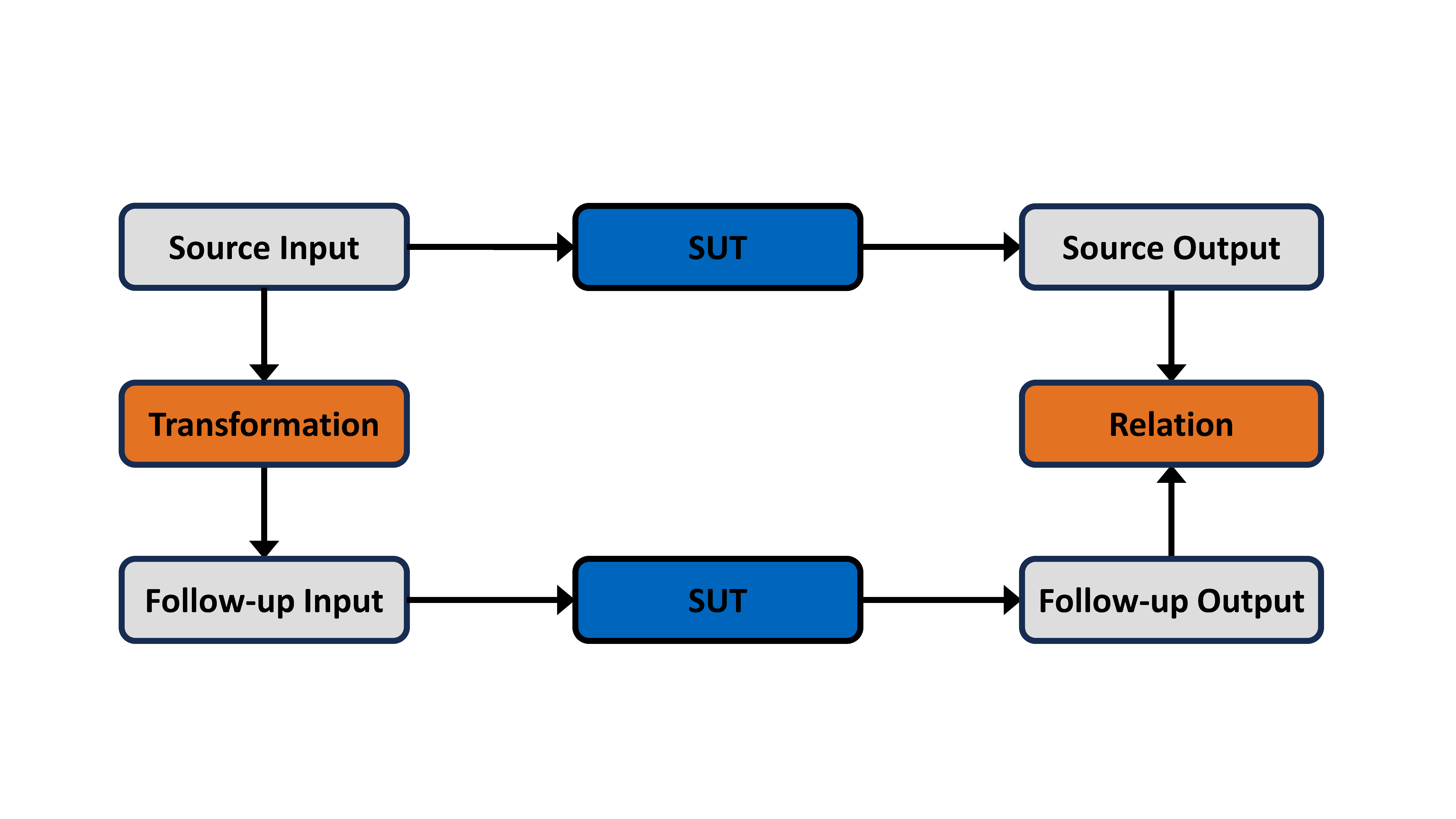
- The creation of the metamorphic relation. Every metamorphic relation requires a name and a data source from which the metamorphic test cases are created.
<mr1_name> = gmt.create_metamorphic_relation(name='mr_1', data=range(100))
- A function annotated with
@transformationwhich takes a single source input and creates a single followup input. A transformation can be registered to a metamorphic relation by specifying the name of the metamorphic relation in the@transformationannotation. A transformation is registered to all metamorphic relations of a test file if no metamorphic relation is explicitly specified in the@transformationannotation. Every metamorphic relation can only have one registered transformation.
@gmt.transformation(<mr1_name, mr2_name, ... >)
def <transformation_function_name>(source_input: Input) -> Input:
    <apply custom transformation to Input>
- A function annotated with
@relationwhich takes a single source output and followup output and return a boolean value. Registering a relation to a metamorphic relation works identically to the registration of a transformation. Every metamorphic relation can only have one registered relation.
@gmt.relation(<mr1_name, mr2_name, ... >)
def <relation_function_name>(source_output: Output, followup_output: Output) -> boolean:
    <apply custom relation to Outputs>
- A function annotated by
@system_under_testwhose name must begin with test, take a single input and return a single output. Registering a system under test to a metamorphic relation works identical to the registration for a transformation.
@gmt.system_under_test(<mr1_name, mr2_name, ... >)
def test_<system_name>(input: Input) -> Output:
    <apply custom system functionality to Input>
Documentation
To use gemtest, one must first define one's metamorphic relations
using the create_metamorphic_relation() function. This function takes in various arguments,
such as the name of the relation, the data to be transformed, and the number of test cases
to generate:
def create_metamorphic_relation(
        name: str,
        data: Sequence,
        testing_strategy: str = TestingStrategy.EXHAUSTIVE,
        number_of_test_cases: int = 1,
        number_of_sources: int = 1,
        parameters: Optional[Dict] = None,
        system_under_test: Optional[System] = None,
        transform: Optional[Transform] = None,
        general_transform: Optional[GeneralTransform] = None,
        relation: Optional[Relation] = None,
        general_relation: Optional[GeneralRelation] = None,
        valid_input: Optional[Input] = None
) -> MR_ID:
Parameters
- name: Name of the metamorphic relation.
- data: A sequence of input data that is used to generate metamorphic test cases.
- testing_strategy: Specifies the testing strategy to use for generating metamorphic test cases. Can take the values TestingStrategy.SAMPLE or TestingStrategy. EXHAUSTIVE. Default value is TestingStrategy.EXHAUSTIVE.
- number_of_test_cases: An integer that specifies the number of metamorphic test cases to generate. Default value is 1.
- number_of_sources: An integer that specifies the number of input sources to use for generating metamorphic test cases. Default value is 1.
- parameters: Optional dictionary of test parameters. Can be used to define multiple similar tests with different parameters.
- system_under_test: The system under test whose functionality is to be verified. Defaults to None.
- transform: Optional transformation function to apply to the input data.
- general_transform: An optional callable that represents the general transformation function to apply to the input data.
- relation: Optional relation function evaluating the metamorphic test case.
- general_relation: An optional callable that represents the general relation function evaluating the metamorphic test case.
- valid_input: A list of functions returning a bool that are used to validate the input to the system under test. The metamorphic test case is skipped if function returns false
Functions for the properties system_under_test, transform, general_transform, relation,
general_relation, and valid_input can be added to a metamorphic relation with annotations
after it is created, as seen in the example above. The gemtest framework also contains predefined
functions that can be added to a metamorphic relation during creation.
General Example
Next to the simple functionality provided by @transformation and @relation decorated functions,
gemtest also supports a more general approach for defining metamorphic relations using the
@general_transformation and @general_relation decorators.
import gemtest as gmt
import math

mr_2 = gmt.create_metamorphic_relation(
  name='mr_2',
  data=range(10),
  testing_strategy=gmt.TestingStrategy.SAMPLE,
  number_of_test_cases=10,
  number_of_sources=2
)


@gmt.general_transformation(mr_2)
def shift(mtc: gmt.MetamorphicTestCase):
  followup_input_1 = mtc.source_inputs[0] + 2 * math.pi
  followup_input_2 = mtc.source_inputs[1] - 2 * math.pi
  return followup_input_1, followup_input_2


@gmt.general_relation(mr_2)
def approximately_equals(mtc: gmt.MetamorphicTestCase) -> bool:
  return (gmt.approximately(mtc.source_outputs[0], mtc.followup_outputs[0])
          and gmt.approximately(mtc.source_outputs[1], mtc.followup_outputs[1]))


@gmt.system_under_test(mr_2)
def test_dummy_sut(input: float) -> float:
  return math.sin(input)
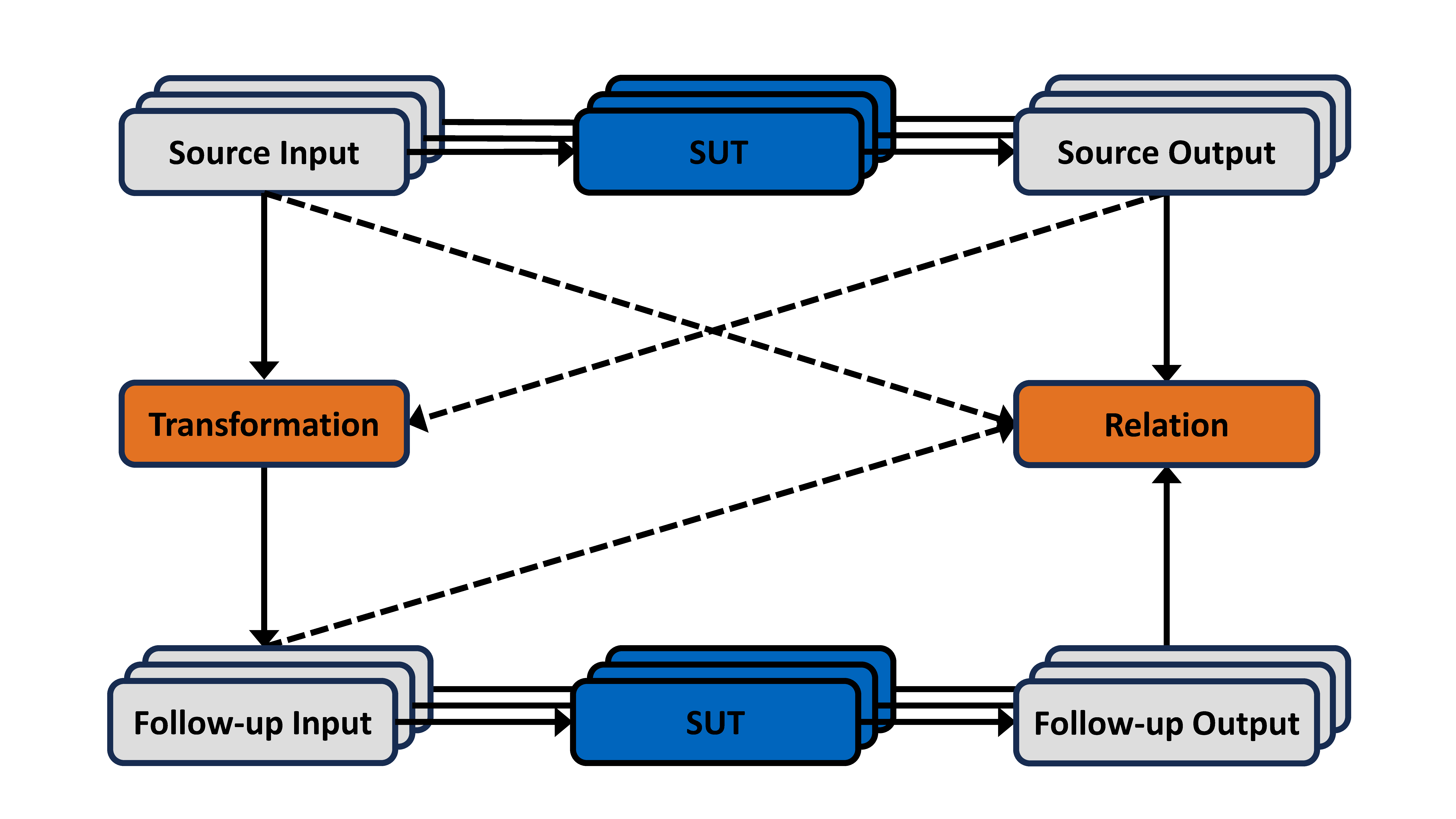
A general metamorphic relation consists of 4 parts:
- The creation of the metamorphic relation. Every metamorphic relation requires a name and a data source from which the metamorphic test cases are created.
<mr1_name> = gmt.create_metamorphic_relation(name='mr_1', data=range(100))
- A function annotated with
@general_transformationmust take aMetamorphicTestCaseobject and return a single or multiple followup inputs as a tuple. Registering a general_transformation to a metamorphic relation works identically to the registration of a transformation. Every metamorphic relation can only have one registered general_transformation or transformation. A metamorphic relation may have a registered general_transformation and a registered relation if the functionality of a general_relation is not required.
@gmt.general_transformation(<mr1_name, mr2_name, ... >)
def <transformation_function_name>(mtc: MetamorphicTestCase) -> Input:
    <access single source_input>
    source_input: Input = mtc.source_input

    <access multiple source_inputs>
    source_inputs: List[Input] = mtc.source_inputs

    <apply custom transformation to Input>
    return followup_input_1, followup_input_2, ... , followup_input_n
- A function annotated with
@general_relationmust take aMetamorphicTestCaseobject and return a boolean value. Registering a general_relation to a metamorphic relation works identically to the registration of a relation. Every metamorphic relation can only have one registered general_relation or relation.
@gmt.general_relation(<mr1_name, mr2_name, ... >)
def <relation_function_name>(mtc: MetamorphicTestCase) -> boolean:
    <apply custom relation to attributes of MetamorphicTestCase>
- A function annotated with
@system_under_testwhose name must begin with test, take a single input and return a single output.
Using the MetamorphicTestCase object allows general transformations to have any
number of sources and create any number of followups. There is also the possibility to use
source inputs and source outputs to create followup inputs. A general relation can also use
multiple sources and followups as and additionally consider source and followup inputs and
outputs when evaluating if the relation holds for a MetamorphicTestCase.
The MetamorphicTestCase Object
The MetamorphicTestCase class holds one concrete instance of a metamorphic test case for a
metamorphic relation. The testing strategy is used to create MetamorphicTestCase objects from the
provided data object. Pytest tests are executed on instances of a MetamorphicTestCase. If all
pytest tests for the MetamorphicTestCase objects of a metamorphic relation pass, the relation holds
for the provided data.
Properties of class MetamorphicTestCase
- source_inputs: list of the source inputs for the Metamorphic Test Case
- source_input: convenience property to access the single source input if there is only one
- followup_inputs: list of the followup inputs for the Metamorphic Test Case
- followup_input: convenience property to access the single followup input if there is only one
- source_outputs: list of the source outputs for the Metamorphic Test Case
- source_output: convenience property to access the single source output if there is only one
- followup_outputs: list of the followup outputs for the Metamorphic Test Case
- followup_output: convenience property to access the single followup output if there is only one
- parameters: dictionary containing previously specified parameters
Citation
If you find the gemtest framework useful in your research or projects, please consider citing it:
@inproceedings{speth2025,
    author = {Speth, Simon and Pretschner, Alexander},
    title = {{GeMTest: A General Metamorphic Testing Framework}},
    booktitle = "Proceedings of the 47th International Conference on Software Engineering, (ICSE-Companion)",
    pages = {1--4},
    address = {Ottawa, ON, Canada},
    year = {2025},
}
License
Release history Release notifications | RSS feed


Download files
Download the file for your platform. If you're not sure which to choose, learn more about installing packages.
Source Distribution
Built Distribution
Filter files by name, interpreter, ABI, and platform.
If you're not sure about the file name format, learn more about wheel file names.
Copy a direct link to the current filters
File details
Details for the file gemtest-1.0.1.tar.gz.
File metadata
- Download URL: gemtest-1.0.1.tar.gz
- Upload date:
- Size: 51.2 kB
- Tags: Source
- Uploaded using Trusted Publishing? No
- Uploaded via: poetry/2.1.3 CPython/3.10.18 Linux/5.4.0-186-generic
File hashes
| Algorithm | Hash digest | |
|---|---|---|
| SHA256 |
67d5980c60d8741579525c949075669377b6abea2e3b1f9e3fedd5827c016d79
|
|
| MD5 |
53a66654673ad5846fa0fca2ba3b989b
|
|
| BLAKE2b-256 |
fed532fb0fda595ddb784e263744d75b927daea97bd0e4a43efae3c8b44443b8
|
File details
Details for the file gemtest-1.0.1-py3-none-any.whl.
File metadata
- Download URL: gemtest-1.0.1-py3-none-any.whl
- Upload date:
- Size: 38.4 kB
- Tags: Python 3
- Uploaded using Trusted Publishing? No
- Uploaded via: poetry/2.1.3 CPython/3.10.18 Linux/5.4.0-186-generic
File hashes
| Algorithm | Hash digest | |
|---|---|---|
| SHA256 |
4493ac2d91d3efdc0323def17970bd431895ed00acd23cfd136e34ef7a828729
|
|
| MD5 |
3a01350e69f66edb0002f11583bbff20
|
|
| BLAKE2b-256 |
8c8e06fdca6d319bb39e8982f1a53ed18854ba2cb82a4ccea4717bc44a81e84f
|






