
The intelligence layer for AI memory — scoring, causal inference, lifecycle management, and active forgetting
Verified details
These details have been verified by PyPIProject links
GitHub Statistics
Maintainers

Project description




Genesys
The intelligence layer for AI memory.
Genesys doesn't just remember what happened; it remembers why. A scoring engine + causal graph + lifecycle manager for AI agent memory. Speaks MCP natively.
What is this
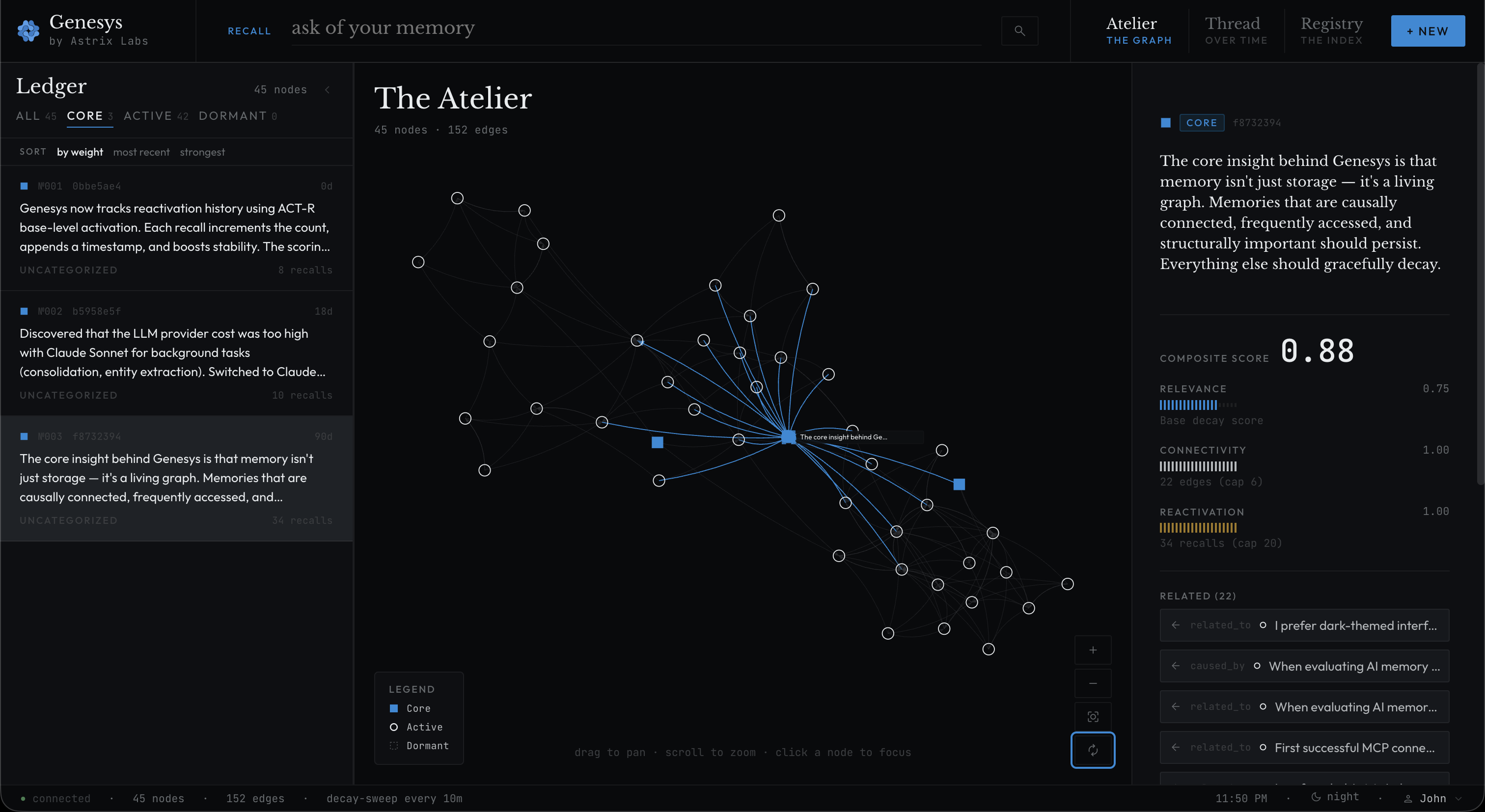
Genesys is a scoring engine, causal graph, and lifecycle manager for AI memory. Memories are scored by a multiplicative formula (relevance × connectivity × reactivation), connected in a causal graph, and actively forgotten when they become irrelevant.
This package (genesys-memory) is the core library: an in-memory causal graph engine with optional JSON persistence, plus a stdio MCP server. It has no database dependency and no REST API. A hosted product built on top of this library — with Postgres, additional storage backends, and a REST/HTTP MCP API — is available separately at genesys-api.astrixlabs.ai; it is not part of this package.
Why
- Flat memory doesn't scale. Dumping everything into a vector store gives you recall with zero understanding. The 500th memory buries the 5 that matter.
- No forgetting = no intelligence. Real memory systems forget. Without active pruning, your AI drowns in stale context.
- No causal reasoning. Vector similarity can't answer "why did I choose X?" — you need a graph.
Your AI remembers everything but understands nothing. Genesys fixes that.
Quick Start
Install the package. The base install has zero database dependencies — state lives in memory and is optionally persisted to a JSON file.
pip install genesys-memory
Optional extras:
pip install 'genesys-memory[openai]'      # OpenAI embeddings
pip install 'genesys-memory[local]'       # Local embeddings (sentence-transformers, no API key)
pip install 'genesys-memory[anthropic]'   # LLM-based causal inference (consolidation, contradiction detection)
Run the stdio MCP server directly:
python3 -m genesys_memory
From source
git clone https://github.com/rishimeka/genesys.git
cd genesys
pip install -e '.[dev]'
pytest tests/
Connect to your AI
Claude Code
claude mcp add genesys -- python -m genesys_memory
Claude Desktop
Add to your claude_desktop_config.json:
{
  "mcpServers": {
    "genesys": {
      "command": "python",
      "args": ["-m", "genesys_memory"]
    }
  }
}
MCP Tools
| Tool | Description |
|---|---|
memory_store |
Store a new memory, optionally linking to related memories |
memory_recall |
Recall memories by natural language query (vector + graph) |
memory_search |
Search memories with filters (status, date range, keyword) |
memory_traverse |
Walk the causal graph from a given memory node |
memory_explain |
Explain why a memory exists and its causal chain |
memory_stats |
Get memory system statistics |
pin_memory |
Pin a memory so it's never forgotten |
unpin_memory |
Unpin a previously pinned memory |
delete_memory |
Permanently delete a memory |
list_core_memories |
List core memories, optionally filtered by category |
set_core_preferences |
Set user preferences for core memory categories |
How it works
Every memory is scored by three forces multiplied together:
decay_score = relevance × connectivity × reactivation
- Relevance decays over time. Old memories fade unless reinforced.
- Connectivity rewards memories with many causal links. Hub memories survive.
- Reactivation boosts memories that keep getting recalled. Frequency matters.
Because the formula is multiplicative, a memory must score on all three axes to survive. A highly connected but never-accessed memory still decays. A frequently recalled but causally orphaned memory still fades.
STORE → ACTIVE → DORMANT → FADING → PRUNED
           ↑                    │
           └── reactivation ────┘
                                  (only if score=0, orphan, not pinned)
Memories can also be promoted to core status — structurally important memories that are auto-pinned and never pruned.
Benchmark Results
We've run internal evaluations against the LoCoMo long-conversation memory benchmark during development. These are self-reported, run with our own harness (category 5 — adversarial questions with disputed ground truth — excluded), and not independently reproduced, so treat them as directional rather than a verified claim. Reproduction scripts are in benchmarks/ if you want to run your own numbers.
Storage backend
This package ships one storage backend: an in-memory causal graph (storage/memory.py) with optional JSON persistence via GENESYS_PERSIST_PATH. No database is required.
Additional backends — Postgres/pgvector, FalkorDB, MongoDB, and an Obsidian vault adapter — along with a REST API, OAuth, and multi-user auth, are part of the hosted product at genesys-api.astrixlabs.ai and are not included in this repo.
Want a different storage backend for the open-source library? Implement the provider protocols in storage/base.py and bring your own.
Configuration
Copy .env.example to .env and set:
| Variable | Required | Description |
|---|---|---|
OPENAI_API_KEY |
Unless GENESYS_EMBEDDER=local |
Embeddings |
ANTHROPIC_API_KEY |
No | Enables LLM-based causal inference (consolidation, contradiction detection). Off by default — without it, causal edges only come from edges the caller explicitly declares in memory_store plus cosine-similarity linking. |
GENESYS_EMBEDDER |
No | openai (default) or local (sentence-transformers, no API key) |
GENESYS_PERSIST_PATH |
No | JSON file path to persist state across restarts (in-memory otherwise) |
GENESYS_USER_ID |
No | Default user ID for single-tenant mode |
See .env.example for all options.
Built by
Genesys is built by Rishi Meka at Astrix Labs. It came out of frustration with re-explaining project context to Claude every session. The goal is the intelligence layer between your LLM and your memory — fully open source.
Contributing
See CONTRIBUTING.md.
License
Note: Genesys releases prior to v0.3.6 were documented as Apache 2.0 in error. The LICENSE file has always contained the AGPLv3 text. From v0.3.6 onward, all documentation correctly references AGPL-3.0-or-later with a Contributor License Agreement.
Project details
Verified details
These details have been verified by PyPIProject links
GitHub Statistics
Maintainers
Release history Release notifications | RSS feed


Download files
Download the file for your platform. If you're not sure which to choose, learn more about installing packages.
Source Distribution
Built Distribution
Filter files by name, interpreter, ABI, and platform.
If you're not sure about the file name format, learn more about wheel file names.
Copy a direct link to the current filters
File details
Details for the file genesys_memory-0.3.16.tar.gz.
File metadata
- Download URL: genesys_memory-0.3.16.tar.gz
- Upload date:
- Size: 118.9 kB
- Tags: Source
- Uploaded using Trusted Publishing? Yes
- Uploaded via: twine/6.1.0 CPython/3.13.12
File hashes
| Algorithm | Hash digest | |
|---|---|---|
| SHA256 |
e52fabee97951b129e1139e381daf333223f6c6082d1451b34b1c6a29c562e10
|
|
| MD5 |
0a792960947280a4dbea469226b5d867
|
|
| BLAKE2b-256 |
9cd747978d6dd9334c4e753b2f1468c25b0fe3225be255664594ae577f3c02fc
|
Provenance
The following attestation bundles were made for genesys_memory-0.3.16.tar.gz:
Publisher:
publish.yml on rishimeka/genesys
-
Statement:
-
Statement type:
https://in-toto.io/Statement/v1 -
Predicate type:
https://docs.pypi.org/attestations/publish/v1 -
Subject name:
genesys_memory-0.3.16.tar.gz -
Subject digest:
e52fabee97951b129e1139e381daf333223f6c6082d1451b34b1c6a29c562e10 - Sigstore transparency entry: 2164303825
- Sigstore integration time:
-
Permalink:
rishimeka/genesys@677bb15bab20e1d052e0c2dfcbaf75dff6702f3e -
Branch / Tag:
refs/tags/v0.3.16 - Owner: https://github.com/rishimeka
-
Access:
public
-
Token Issuer:
https://token.actions.githubusercontent.com -
Runner Environment:
github-hosted -
Publication workflow:
publish.yml@677bb15bab20e1d052e0c2dfcbaf75dff6702f3e -
Trigger Event:
push
-
Statement type:
File details
Details for the file genesys_memory-0.3.16-py3-none-any.whl.
File metadata
- Download URL: genesys_memory-0.3.16-py3-none-any.whl
- Upload date:
- Size: 58.3 kB
- Tags: Python 3
- Uploaded using Trusted Publishing? Yes
- Uploaded via: twine/6.1.0 CPython/3.13.12
File hashes
| Algorithm | Hash digest | |
|---|---|---|
| SHA256 |
3d5f9b9d0184c02b2a55905c9ea367c59635a0819ec64f6ce07c33193ce73f60
|
|
| MD5 |
3b0cac9d22437b186258047f79bdfcd8
|
|
| BLAKE2b-256 |
ce8054f3a294f34e298d96ca6c62ec0b1dcacb6c8da271cc4769a7097083517a
|
Provenance
The following attestation bundles were made for genesys_memory-0.3.16-py3-none-any.whl:
Publisher:
publish.yml on rishimeka/genesys
-
Statement:
-
Statement type:
https://in-toto.io/Statement/v1 -
Predicate type:
https://docs.pypi.org/attestations/publish/v1 -
Subject name:
genesys_memory-0.3.16-py3-none-any.whl -
Subject digest:
3d5f9b9d0184c02b2a55905c9ea367c59635a0819ec64f6ce07c33193ce73f60 - Sigstore transparency entry: 2164303856
- Sigstore integration time:
-
Permalink:
rishimeka/genesys@677bb15bab20e1d052e0c2dfcbaf75dff6702f3e -
Branch / Tag:
refs/tags/v0.3.16 - Owner: https://github.com/rishimeka
-
Access:
public
-
Token Issuer:
https://token.actions.githubusercontent.com -
Runner Environment:
github-hosted -
Publication workflow:
publish.yml@677bb15bab20e1d052e0c2dfcbaf75dff6702f3e -
Trigger Event:
push
-
Statement type:






