Codegenome immune system — real-time architecture guardrail

Project description
GenomeGuard
AI-native architecture immune system for Python codebases. GenomeGuard watches a live codegenome graph, asks OpenAI to reason over architectural decay, verifies the proposed repair, and produces a safe patch or enforced rewrite before the design damage spreads.

Author: Md. Fatin Shadab Turja
The Problem
Modern teams do not usually break architecture with one dramatic decision. They break it through hundreds of small, reasonable shortcuts: route handlers importing database code, UI code reaching into infrastructure, circular dependencies, and complex functions that slowly become impossible to review.
Traditional linters are valuable, but they mainly catch local syntax, style, and rule patterns. Architectural decay is different. It is semantic and contextual. A direct database import may be fine in one layer and dangerous in another; a refactor may need dependency graph context, not just a regex.
GenomeGuard targets that gap: real-time architectural review for changed code, with graph context and a safety gate before any AI-written change is allowed to touch the project.
The Solution
GenomeGuard turns architectural governance into a four-agent workflow:
- Sensor Agent detects the latest changed file from
.genome/watcher.db. - Critic Agent sends the changed source, compact graph context, and project rules to OpenAI.
- Verifier Agent compiles the AI-proposed rewrite in a temporary shadow file.
- Surgeon Agent writes a unified diff patch by default, or directly enforces the rewrite when configured.
This is AI-native because the central task is not simple classification. The system asks the model to reason across source code, dependency topology, and human-written architecture rules, then synthesize a corrected full-file implementation. Hard-coding that behavior would require brittle rule engines for every framework, layer naming convention, and codebase style. GenomeGuard instead uses OpenAI as the semantic architecture critic, while deterministic Python code handles memory, orchestration, verification, and writes.
Judging Criteria Alignment
| Criterion | How GenomeGuard addresses it |
|---|---|
| AI-Native Thinking | Uses OpenAI to evaluate architecture from changed code plus dependency graph context, not just tokens or static patterns. The model returns structured JSON with a diagnosis and complete refactor candidate. |
| Agent Design / Workflow | Implements four explicit personas in AGENTS.md: Sensor, Critic, Verifier, and Surgeon. skills.md documents the callable internal capabilities that drive the loop. |
| Creativity | Treats the codebase like a living system with an immune response: detect mutation, diagnose decay, verify treatment, and apply a safe patch. |
| Practical Impact | Gives developers reviewable .patch files by default, supports direct enforcement for trusted workflows, and avoids whole-repo scans by reacting only to graph deltas. |
How It Works: Agentic Workflow
flowchart LR
    A["Developer saves file"] --> B["codegenome updates .genome/watcher.db"]
    B --> C["Sensor: query_graph_delta"]
    C --> D["Graph: codegenome export --format json"]
    D --> E["Critic: OpenAI architecture review"]
    E --> F{"decay_detected?"}
    F -->|false| G["Log Architecture Healthy"]
    F -->|true| H["Verifier: temp file + py_compile"]
    H -->|fails| I["Reject rewrite"]
    H -->|passes| J{"mode"}
    J -->|patch| K["Surgeon: write .patch"]
    J -->|enforce| L["Surgeon: overwrite file"]
| Workflow capability | Implementation |
|---|---|
| Planning | The Critic prompt in src/genomeguard/critic.py instructs the model to detect circular dependencies, high complexity, and separation-of-concerns violations, then return a complete correction plan as structured JSON. |
| Tools | codegenome export --format json, SQLite read-only watcher access, OpenAI Chat Completions, python -m py_compile, and difflib.unified_diff. |
| Memory | .genome/watcher.db stores graph mutation state, guard_config.json stores active rules and runtime mode, .genome/graph.json stores exported graph context, and encrypted local storage can hold the OpenAI API key. |
| Orchestration | src/genomeguard/core.py wires query_graph_delta -> export_graph_context -> compact_graph_context -> evaluate_decay_metrics -> verify_and_apply. |
| Agent contracts | AGENTS.md defines the four personas. skills.md maps programmatic capabilities such as query_graph_delta(), evaluate_decay_metrics(), generate_unified_diff(), and execute_compilation_check(). |
OpenAI Integration
| OpenAI component | Why this choice | Where it is integrated |
|---|---|---|
GPT-4o via openai_model config |
Chosen as the default Critic model because architectural review requires strong reasoning over ambiguous code intent, dependency boundaries, and refactor quality. | src/genomeguard/critic.py reads openai_model from guard_config.json, defaulting to gpt-4o. |
| OpenAI Chat Completions API | The project needs a compact, deterministic request-response loop: provide system instructions, changed code, graph context, and rules; receive structured JSON. | _invoke_openai_chat() calls client.chat.completions.create(..., temperature=0). |
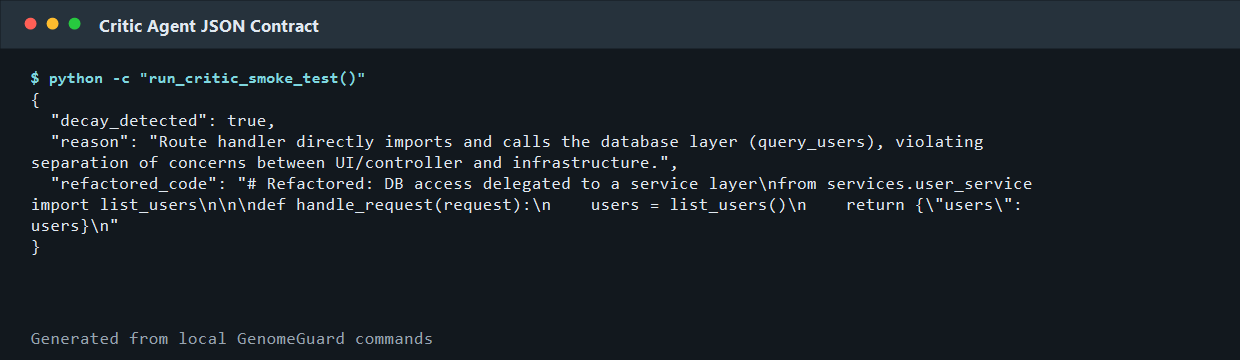
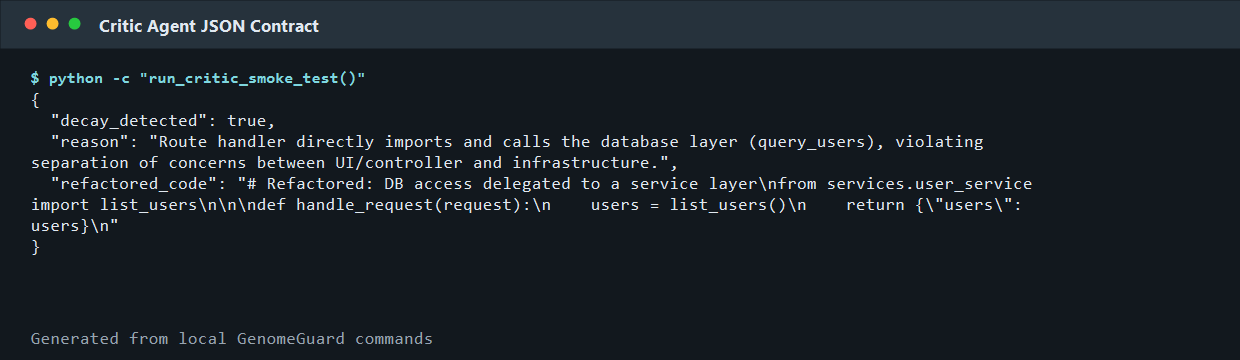
| Structured JSON response contract | Keeps the LLM output machine-actionable and auditable: decay_detected, reason, and refactored_code. |
parse_critic_response() strips markdown fences, validates required keys, and rejects malformed output. |
| Configurable model selection | Lets users trade cost, latency, and reasoning quality without changing code. | guard_config.json, CLI runtime loading, and the Textual TUI model list in src/genomeguard/tui.py. |
| Offline mock mode | Enables development and CI without network calls or API cost. | --mock-critic uses fixtures in tests/fixtures/; live mode is enabled with --no-mock-critic and OPENAI_API_KEY. |
Key Features
- Real-time graph-aware monitoring through
.genome/watcher.db, not noisy raw filesystem events. - Localized context extraction that sends only the changed file and immediate graph neighborhood to the Critic.
- Declarative architecture rules in
guard_config.json. - Safe patch mode by default with timestamped unified diffs in
.genome/patches. - Enforce mode for autonomous rewrites after verification passes.
- Compilation safety gate using a temporary shadow file and
python -m py_compile. - Loop-drain protection so enforce-mode rewrites do not repeatedly trigger themselves.
- OpenAI credential handling through environment variables or encrypted local storage.
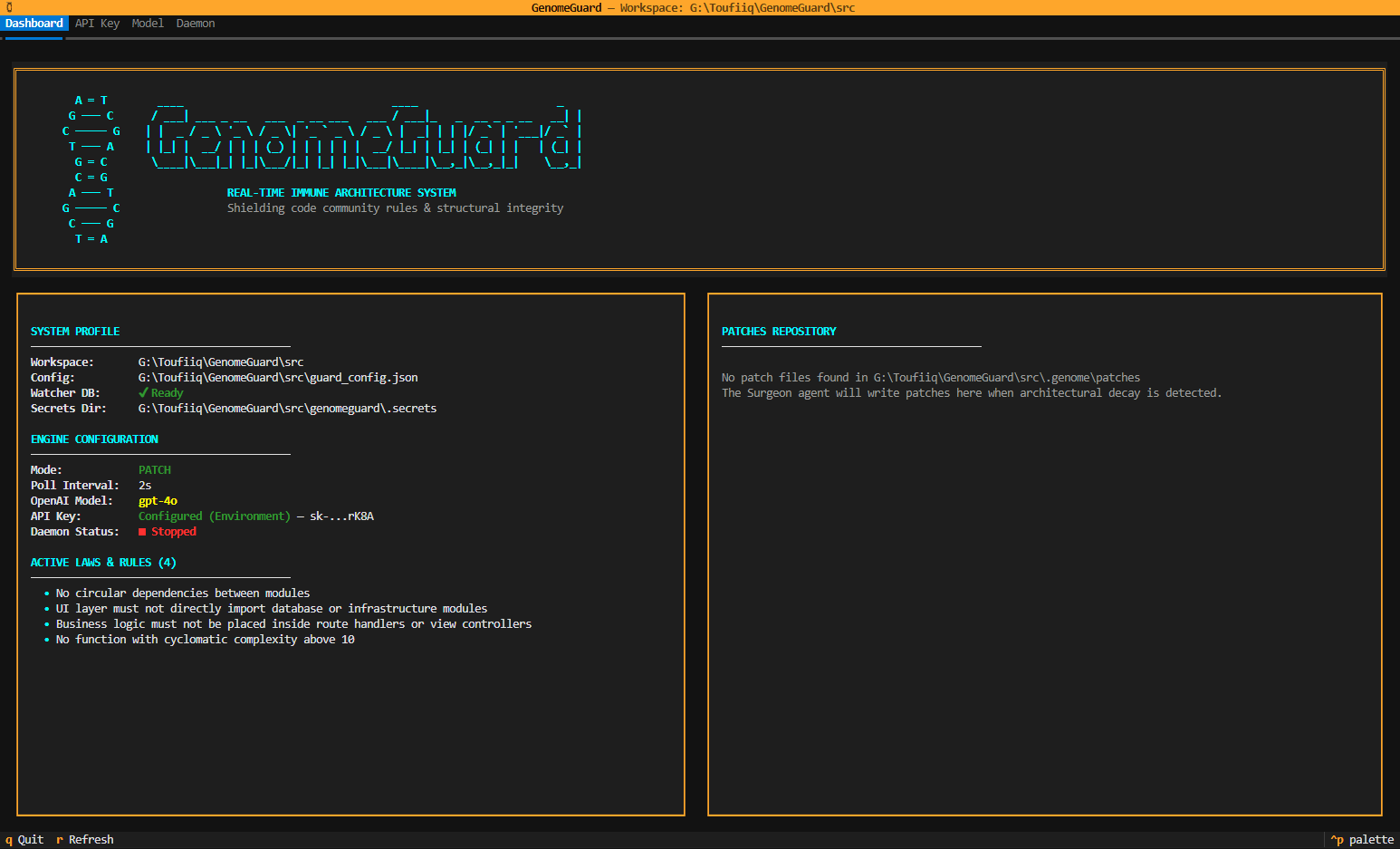
- Textual TUI for dashboard, API key setup, model selection, daemon control, and patch inspection.
- Offline tests and mock fixtures for repeatable local validation.
Practical Impact
GenomeGuard helps developers, maintainers, and technical leads keep architecture healthy while code is still being written. Instead of discovering boundary violations during a late review or after production incidents, teams get a focused architectural diagnosis at the moment a file changes.
The default output is a .patch, which is important for trust. Developers can review the AI-generated correction exactly like a teammate's diff. For stricter environments, --mode enforce can turn GenomeGuard into an automated architecture guardrail, but only after the Verifier confirms the proposed Python file compiles.
This has practical value for:
- Small teams that cannot dedicate senior reviewers to every architectural decision.
- Open-source maintainers who want contributors to follow project boundaries.
- Large codebases where dependency drift and layer leakage are expensive to reverse.
- AI-assisted coding workflows where fast generation needs an equally fast safety layer.
Technical Implementation
| Module | Responsibility |
|---|---|
src/genomeguard/watcher.py |
Opens .genome/watcher.db read-only, finds the newest file node in the latest snapshot, and emits normalized changed paths. |
src/genomeguard/graph.py |
Runs codegenome export --format json and compacts the full graph into target, upstream, and downstream context. |
src/genomeguard/critic.py |
Builds the OpenAI prompt, calls the configured model, loads mock fixtures, and validates structured JSON. |
src/genomeguard/verifier.py |
Writes proposed code to the configured temp file and runs python -m py_compile before any patch or write. |
src/genomeguard/surgeon.py |
Produces unified diff patches or applies enforce-mode rewrites. |
src/genomeguard/core.py |
Runs the daemon loop and orchestrates the full Sensor -> Critic -> Verifier -> Surgeon pipeline. |
src/genomeguard/tui.py |
Provides an optional terminal UI for configuration, credentials, model selection, daemon control, and patch visibility. |
Setup and Usage
Prerequisites
- Python 3.12+
codegenomeinstalled and initialized in the target project- OpenAI API key for live Critic mode
codegenome analyze .
codegenome evolve .
Install
From PyPI:
pip install genome-guard
For local development:
python -m venv .venv
.venv\Scripts\activate
pip install -e ".[dev]"
On macOS/Linux:
python -m venv .venv
source .venv/bin/activate
pip install -e ".[dev]"
Configure
Copy the example config into your project root:
cp guard_config.example.json guard_config.json
guard_config.json controls polling, rules, output mode, temp file, and model:
{
  "poll_interval_seconds": 2,
  "mode": "patch",
  "rules": [
    "No circular dependencies between modules",
    "UI layer must not directly import database or infrastructure modules",
    "Business logic must not be placed inside route handlers or view controllers",
    "No function with cyclomatic complexity above 10"
  ],
  "patches_dir": ".genome/patches",
  "temp_file": ".temp_genome_check.py",
  "openai_model": "gpt-4o"
}
Set an API key for live analysis:
export OPENAI_API_KEY=sk-...
PowerShell:
$env:OPENAI_API_KEY = "sk-..."
Or save an encrypted key via the TUI (genome-guard tui → API Key tab). Encrypted credentials are stored under ~/.genomeguard/ and are never written into the project tree or PyPI package.
Run
Safe patch mode:
genome-guard --workspace . --mode patch
Live OpenAI Critic:
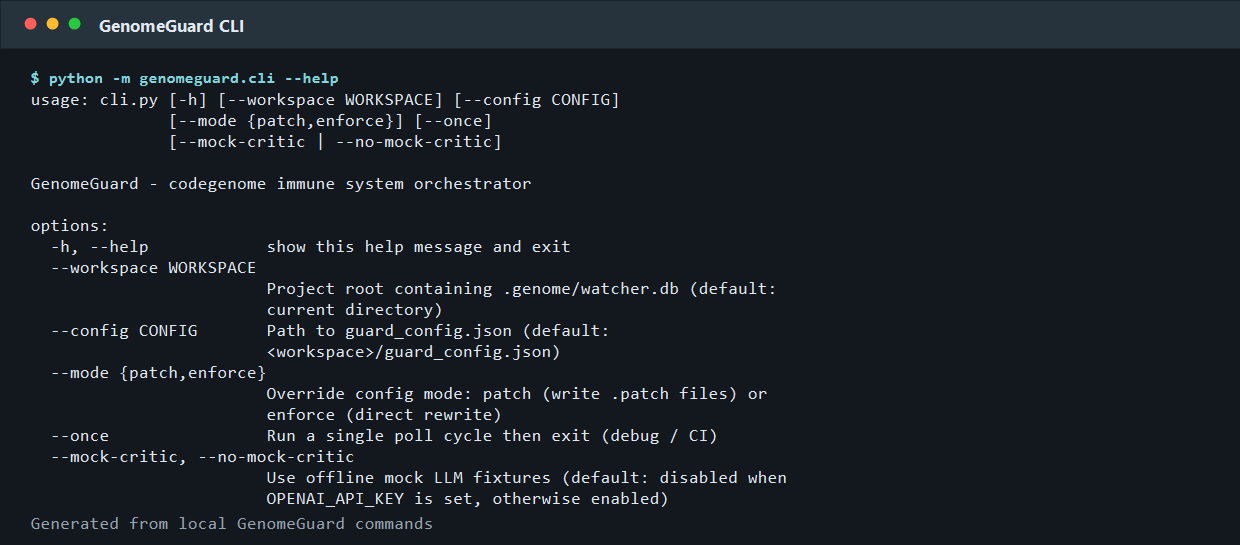
genome-guard --workspace . --no-mock-critic
Offline mock mode:
genome-guard --workspace . --mock-critic
Single-cycle CI/debug run:
genome-guard --workspace . --once
Optional TUI:
genome-guard --workspace . tui
Demo and Media
Screenshots from local GenomeGuard commands (hosted on GitHub for PyPI rendering):
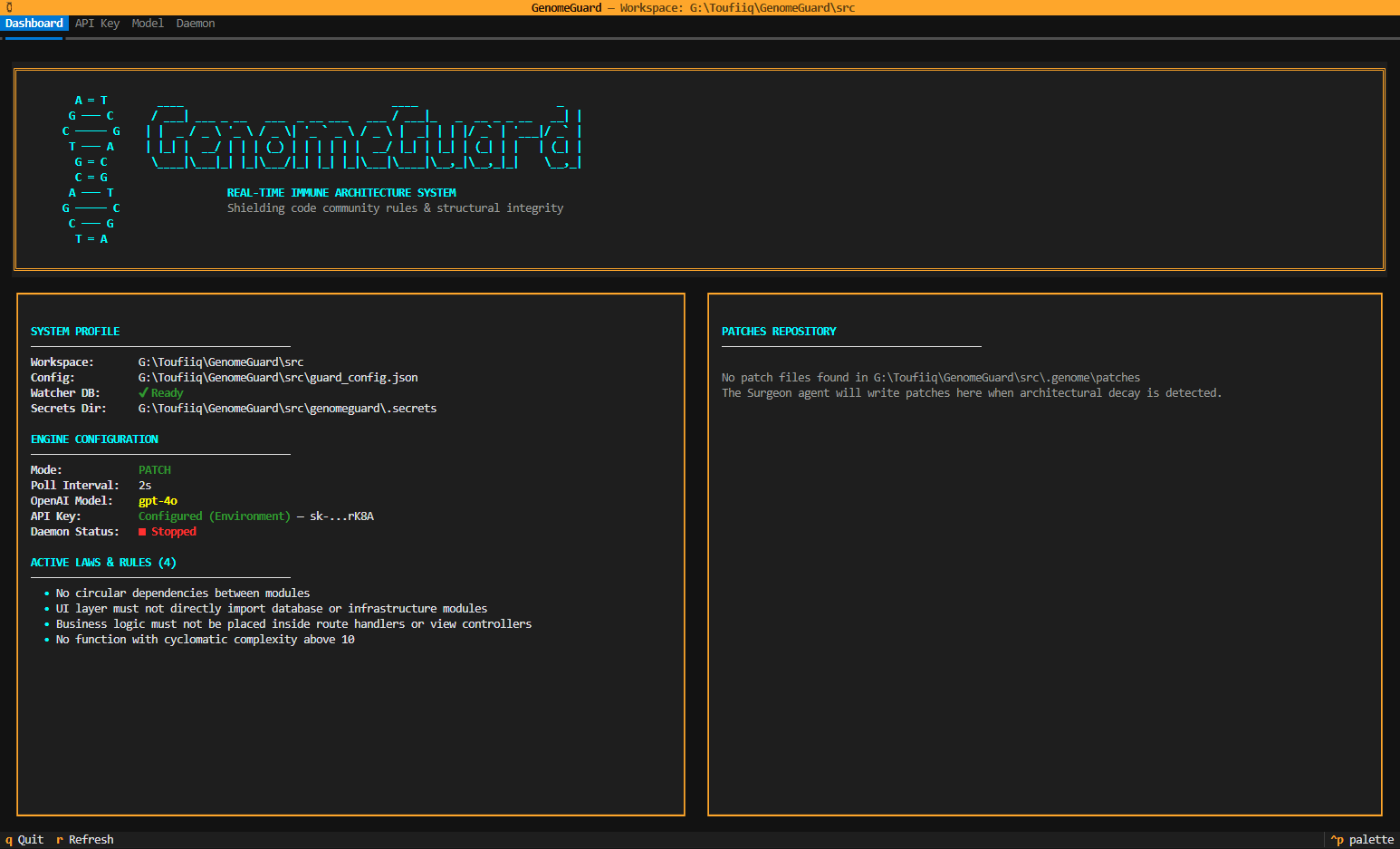
- TUI dashboard: GenomeGuard.png
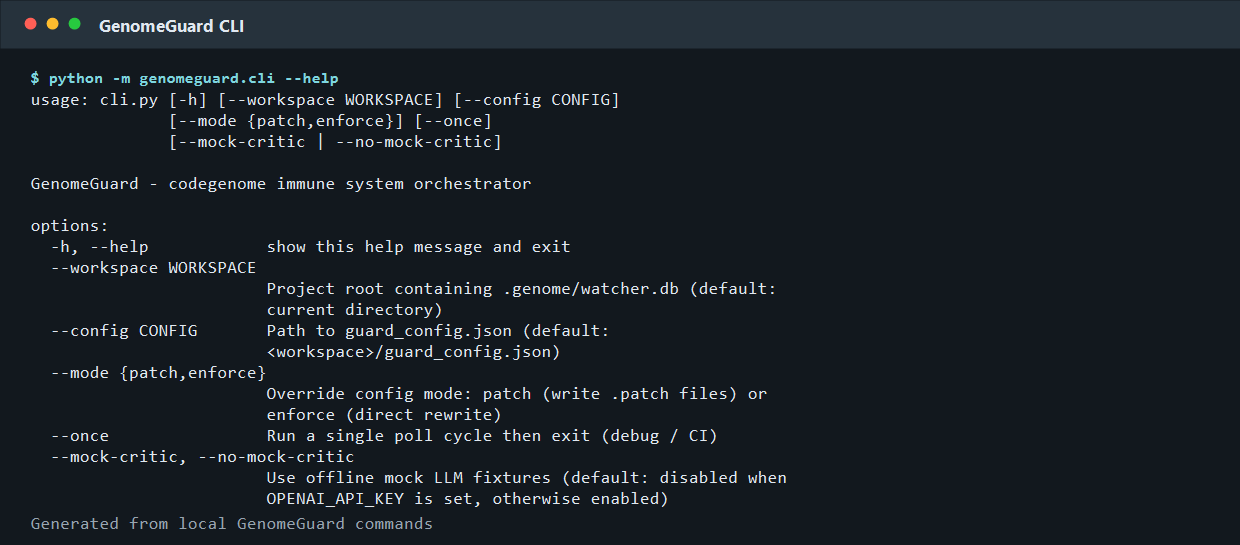
- CLI surface: cli-help.png
- Critic JSON contract: critic-json.png
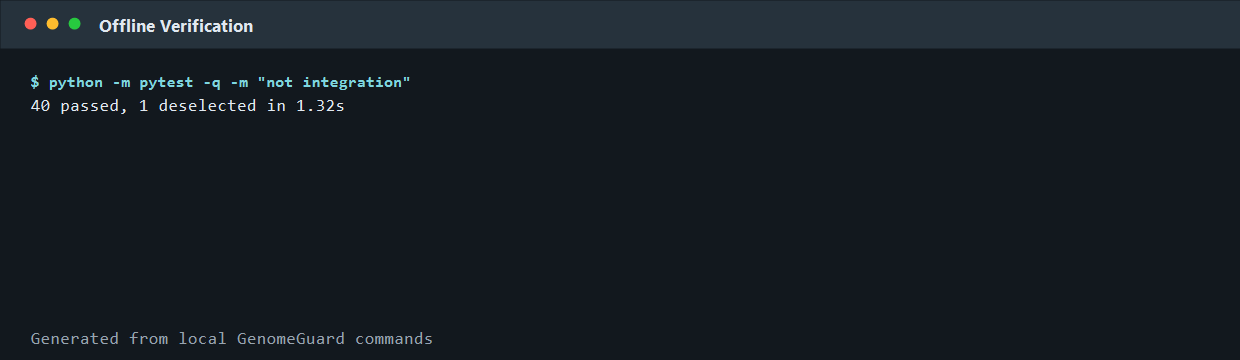
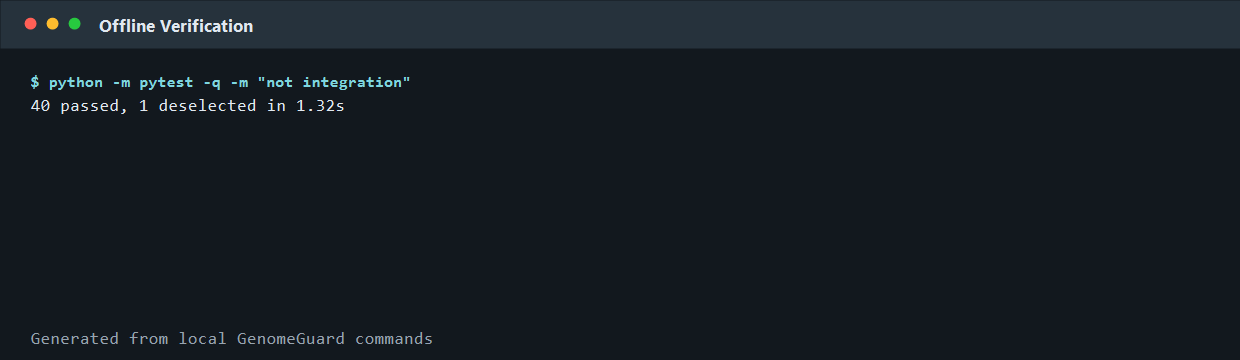
- Offline verification: pytest-results.png
Suggested live demo flow:
- Initialize a sample project with
codegenome analyze .andcodegenome evolve .. - Start
genome-guard --workspace . --mode patch --no-mock-critic. - Introduce a route handler that imports infrastructure/database code directly.
- Show GenomeGuard detecting the graph delta and writing a reviewable patch under
.genome/patches.
Verification
Offline test suite result from the local project virtualenv:
40 passed, 1 deselected in 1.32s
Command:
python -m pytest -q -m "not integration"
Live OpenAI tests are marked integration and intentionally skipped unless OpenAI credentials are available (environment variable or TUI encrypted storage).
Publishing
Build and upload to PyPI:
python -m pip install --upgrade build twine
python -m build
twine check dist/*
twine upload dist/*
Local runtime artifacts (.genome/, .genomeguard/, encrypted credentials, patches) are gitignored and excluded from the sdist — they are created at runtime in the user's project or home directory.
License
This project is licensed under the MIT License — see the LICENSE file for the full text.
Copyright (c) 2026 Md. Fatin Shadab Turja

Permission is hereby granted, free of charge, to any person obtaining a copy
of this software and associated documentation files (the "Software"), to deal
in the Software without restriction, including without limitation the rights
to use, copy, modify, merge, publish, distribute, sublicense, and/or sell
copies of the Software, and to permit persons to whom the Software is
furnished to do so, subject to the following conditions:

The above copyright notice and this permission notice shall be included in all
copies or substantial portions of the Software.
Release history Release notifications | RSS feed


Download files
Download the file for your platform. If you're not sure which to choose, learn more about installing packages.
Source Distribution
Built Distribution
Filter files by name, interpreter, ABI, and platform.
If you're not sure about the file name format, learn more about wheel file names.
Copy a direct link to the current filters
File details
Details for the file genome_guard-0.1.1.tar.gz.
File metadata
- Download URL: genome_guard-0.1.1.tar.gz
- Upload date:
- Size: 27.7 kB
- Tags: Source
- Uploaded using Trusted Publishing? No
- Uploaded via: twine/6.2.0 CPython/3.14.4
File hashes
| Algorithm | Hash digest | |
|---|---|---|
| SHA256 |
86f943bfdf031f8a6153656c8d288ef88ffbcfdc01f1be2988499acf8a65c20f
|
|
| MD5 |
2ce8c330f2e091f9d351d8a558c08aa0
|
|
| BLAKE2b-256 |
018e67873b9a185510f9c05e3fa4137ae9d2000c03853ead564b50ad34ffa517
|
File details
Details for the file genome_guard-0.1.1-py3-none-any.whl.
File metadata
- Download URL: genome_guard-0.1.1-py3-none-any.whl
- Upload date:
- Size: 32.7 kB
- Tags: Python 3
- Uploaded using Trusted Publishing? No
- Uploaded via: twine/6.2.0 CPython/3.14.4
File hashes
| Algorithm | Hash digest | |
|---|---|---|
| SHA256 |
88e213f781a1187b8402b09a0a9f0075ab59b7bb999eaa09cacfad3f24d4343b
|
|
| MD5 |
56199f90d0d52098a99706c2cca551f0
|
|
| BLAKE2b-256 |
3be5286f2487caaf207325a7916069bab8b8b5d191b2a97476ee16ba116b1063
|