

genoxide for Python
The algorithms of genoxide, a Rust library, with fitness functions in Python and numpy:
- genetic algorithms, local search and the Nelder-Mead simplex method
- L-BFGS-B for smooth functions with a gradient, yours, finite differences or the test problems' own
- first-order gradient methods for up to millions of parameters: gradient descent, momentum, Nesterov, Adam and AdamW
- MMA and GCMMA, the method of moving asymptotes, for millions of variables with few constraints, from gradients
- continuation: a gradient method through stages of one problem, its state kept between them
- differential evolution, evolution strategies, CMA-ES and particle swarm optimization
- NEAT, OpenAI's evolution strategy, neural networks and pole-balancing tasks, for neuroevolution
- genetic programming: formulas and Boolean functions as trees, with symbolic regression and Koza's problems evaluated in Rust
- the island model, and checkpoints to resume a long run
- NSGA-II, NSGA-III, SPEA2, MOEA/D and SMS-EMOA for several objectives
The API reference: tachsin.github.io/genoxide/api/python
import numpy as np
import genoxide as gx

# OneMax: the genome with the most ones
ga = gx.Ga(
    gx.Binary(100),
    population_size=100,
    select=gx.Tournament(3),
    crossover=gx.UniformCrossover(),
    mutation=gx.BitFlip(rate=0.01),
    seed=42,
)
result = ga.run(lambda bits: bits.sum(), target=100, generations=1_000)
print(result.best_fitness, result.generations)

# Rastrigin with CMA-ES and IPOP restarts, a generation per call
def rastrigin(x):  # x: a genome per row
    return 10 * x.shape[1] + np.sum(x**2 - 10 * np.cos(2 * np.pi * x), axis=1)

cmaes = gx.Cmaes(gx.Real((-5.12, 5.12), length=10), restarts="ipop", objective="minimize", seed=1)
result = cmaes.run(rastrigin, batch=True, target=1e-8, evaluations=500_000)
print(result.best_genome, result.best_fitness)
More in examples/, each the same program in Python and Rust
(python examples/<name>/main.py in the repository), on the docs site, and
played back with charts made for each problem on tachsin.gr:
- OneMax, a knapsack with a constraint, and N-Queens
- the travelling salesman (TSPLIB berlin52) and job shop scheduling (ft06)
- Rastrigin with CMA-ES and L-SHADE, and the pressure vessel and welded beam designs with constraints
- the gear train design, an integer problem
- CMA-ES, SHADE and PSO on twelve test functions, and Himmelblau's four minima by restarts of a local search
- ZDT1 with NSGA-II, and DTLZ2 with NSGA-III
- the constrained BNH with NSGA-II, and Kursawe's disconnected front with SPEA2 and NSGA-II
- XOR neuroevolution with CMA-ES, and the two spirals with OpenAI's evolution strategy
Install
pip install genoxide
Wheels for CPython 3.10 or later, and for free-threaded CPython 3.14 (3.14t), with numpy:
- Linux: x86_64 and aarch64, glibc and musl
- macOS: Apple silicon and Intel
- Windows: x64
To build from the repository, with Rust and maturin:
cd python
pip install maturin
maturin develop --release
Fitness functions
A fitness function takes a genome as a numpy array:
| Genome | Array |
|---|---|
Binary(length) |
bool |
Integer(bounds, length) |
int64 |
Real(bounds, length) |
float64 |
Permutation(length) |
int64, an ordering of 0 .. length - 1 |
AdaptiveReal(real, initial_step) |
float64, the genes of real, without the step size that evolves with them |
gx.gp.Gp(primitives) |
not an array: a gx.gp.Tree, see Genetic programming |
bounds is one pair (low, high) for every gene, with length, or a list of pairs, one per gene.
It returns one of these:
- a number
Noneor NaN, for a solution that can't be scored(score, constraint_violation): a positive violation marks an infeasible solution. Infeasible solutions rank below feasible ones, and among themselves by violation (Deb's rules).
The fitness function must be deterministic: genoxide doesn't evaluate again a child identical to one of its parents.
With batch=True, the function takes a whole generation as a 2-D array, a genome per row. It returns:
- an array of scores, or a tuple of scores and constraint violations (arrays or
(n, 1)columns) - for several objectives, a 2-D array or a list with a row of objective values per genome, or a tuple of one array per objective (
return f1, f2)
It's one call per generation, and none for a generation whose children are all copies of their parents. Vectorized numpy, a GPU or a remote service pays its cost per call once per generation, not once per genome. The next call of as many genomes gets the same matrix back, written again, if the function kept no reference to it: a large matrix is allocated once per run. A function that keeps its matrix, or a view of it, gets a new one next time, and what it kept never changes.
With parallel=True, genoxide calls a non-batch function from several threads at once. It pays off when the function releases the GIL (numpy on large arrays, waiting for I/O), or on free-threaded Python (3.14t).
An exception in the fitness function stops the run, and run raises it. So does Ctrl+C: with parallel=True, once the calls under way return, without starting the others.
Choosing an algorithm
| Problem | Genome | Algorithms, the first preferred |
|---|---|---|
| Yes / no choices (subsets) | Binary |
Ga with UniformCrossover() or PointCrossover(points), and BitFlip |
| An order (tours, sequencing) | Permutation |
LocalSearch, which often beats a GA on permutations; Ga with OrderCrossover() (sequences) or EdgeRecombinationCrossover() (tours) |
| Reals in ranges | Real |
Cmaes; De; Es; Ga with SimulatedBinaryCrossover(eta) and PolynomialMutation(eta); Lbfgsb for a local minimum of a smooth function, any number of genes; NelderMead for a local minimum in a few dimensions |
| A smooth function of many reals, with its gradient | Real |
FirstOrder (Adam, momentum, Nesterov), up to millions of genes |
| Smooth, with gradients: very many reals (up to millions), few inequality constraints | Real |
Mma; method="gcmma" to converge from any start |
| A neural network's weights | Real, from network.representation(bounds) |
Cmaes up to a few hundred weights; OpenEs for thousands and more |
| A neural network's structure and weights | gx.neat.Network, NEAT's own |
Neat |
| A formula or a Boolean function (genetic programming) | gx.gp.Gp, trees |
Ga with gx.gp.SubtreeCrossover() and gx.gp.SubtreeMutation(), or Islands of them; Nsga2 for accuracy against size |
| Several objectives | any | Nsga2 for 2 or 3 objectives; Nsga3 or Moead for more |
Cmaesis the strongest general choice for continuous problems with up to a few hundred genes, especially when the genes interact. Its defaults need no tuning. For multimodal functions, addrestarts="ipop"or"bipop".restarts="stop"ends a run once it converges, with the stop reason"converged": for smooth problems without constraints, as on flat, quantized or constrained fitness a run can still improve after it converges. For thousands of genes or separable problems,covariance="diagonal"(sep-CMA-ES): O(n) per sample, no correlations between genes.Deoften needs far fewer evaluations than a GA on continuous problems.Psowithring=1explores longer than the default global topology, for multimodal functions.Es, an evolution strategy whose step sizes evolve with its solutions, suits smooth problems that need precise answers. AGaon anAdaptiveRealgenome withSelfAdaptiveMutation()is one too.OpenEs, OpenAI's evolution strategy, follows a gradient estimated from mirrored samples, at a cost per sample linear in the genes: for thousands of genes and more, such as a network's weights.NelderMeadis a local method without derivatives: it converges to the minimum of the basin it starts in, frominitial_genomeor a random point, and stops there (the stop reason"converged"). It suits up to about 10 genes, and functions that are non-smooth or noisy in their last digits.restarts=nstarts againntimes from random points, for multimodal functions;speculative=Trueevaluates the steps of an iteration in one round, for a slow function evaluated in parallel.Lbfgsb(L-BFGS-B) is the local method for smooth functions: with the gradient, it reaches the minimum in the bounds to many digits in far fewer evaluations than the others, from a few genes to millions. Give it withrun(f, gradient=g)(orgradient=Trueandfreturning(value, gradient)); without one, it uses forward differences, a point more per gene for each gradient; a problem ofgx.problemsgives its own, in Rust. It stops on its own once converged (the stop reason"converged"). It polishes what a global method found:initial_genome=result.best_genome.FirstOrdersteps along the gradient of a smooth function by a step rule, without a line search:step="adam"(Kingma and Ba's, the default),"adamw"(with decoupled weight decay),"momentum","nesterov"or"gradient". One gradient per generation, fromrun(..., gradient=...)as forLbfgsb, from a problem ofgenoxide.problemsin Rust, or by finite differences (nmore evaluations per generation, up to 10,000 genes). Memory and work per step are linear in the genes, for up to millions of them. It stops with the stop reason"converged"when the gradient vanishes; acontrollowers the learning rate over the run (a schedule), which Adam needs to settle on the minimum.Mma, Svanberg's method of moving asymptotes, uses the gradient of the score and of each inequality constraintg(x) <= 0: the gradient as forLbfgsb(no finite differences), and withrun(f, gradient=True, constraints=m),freturns(value, gradient, g, jacobian),gthe constraints' values andjacobianan array of a row per constraint. An iteration is one evaluation and a few passes over the genes, with no matrix of them: for up to millions of genes and up to a few hundred constraints. It stops on its own once it has converged (the stop reason"converged").method="gcmma"converges from any start, at the cost of more evaluations;constraint_costmust exceed the constraints' multipliers.ContinuationrunsFirstOrder,LbfgsborMmathrough stages of one problem, a smooth version first and sharper ones after (a smoothing that shrinks, a p-norm's p that grows, a penalty raised):on_stage(index)sets the stage's parameters for the fitness function, and the method goes on from its point with its state (Adam's averages, MMA's asymptotes;keep="point"keeps only the point). A stage ends when the method converges or aftergenerations; the run, after the last stage.IslandsofGas orDes evolve apart and exchange their best: more diverse than one large population, and often faster on multimodal problems.
Algorithms
| Algorithm | Genomes | Settings |
|---|---|---|
Ga |
all | population_size, select, crossover, mutation, crossover_rate (0.9), mutation_rate (1), scheme, parallel_breeding (False), initial_genomes (trees of a gx.gp.Gp) |
LocalSearch |
all | neighbor (a mutation), neighbors (1), acceptance, restart=(patience, kicks) |
De |
real | population_size (100; with l_shade, 18 × genes, at least 4), l_shade (a budget of evaluations, for L-SHADE), strategy ({"max_p": 0.2, "archive": 1.0}; "rand1", "best1", {"p", "archive"}), control ({"memory": 100}; {"f", "cr"}, {"min_f", "max_f", "cr"}, {"c"}), restarts ({"tolerance": 1e-12, "patience": 200}; "never"), parallel_breeding (False) |
Es |
real | parents (μ), offspring (λ, 5 to 7 times μ), recombination ("intermediate"; "dominant"), rho (the parents per offspring, all by default), selection ("comma"; "plus"), step_sizes ("per_gene"; "one"), initial_step (0.3 of each range), parallel_breeding (False) |
Cmaes |
real | population_size, restarts ("never"; "ipop", "bipop", "stop"), initial_step, covariance ("full"; "diagonal"), min_step (0) |
OpenEs |
real | population_size (even, needed), sigma (0.02 of each range), optimizer (Adam(0.01); Adam(learning_rate, beta1, beta2), Sgd(learning_rate, momentum)), weight_decay (0), evaluate_mean (False), initial_mean (random), parallel_breeding (False) |
Neat |
its networks | inputs, outputs (needed), population_size (150), compatibility ((1.0, 1.0, 0.4, 3.0): c1, c2, c3, threshold), weight_mutation ((0.8, 0.1): rate, replace), weight_deviations ((1.0, 1.0)), structural_mutation ((0.03, 0.05): add node, add connection), reproduction ((0.25, 0.001, 0.75)), selection ((5, 0.2): elitism size, survival), stagnation (15), activation ("steep_sigmoid"), feed_forward (True), initial ("fully_connected"; "unconnected"), sharing ("normalized"; "raw", the paper's) |
Pso |
real | population_size (needed), ring (neighbors on each side) |
NelderMead |
real | coefficients ("adaptive", Gao and Han's; "standard"; (reflection, expansion, contraction, shrink)), initial_step (0.1 of each range) or initial_step_absolute (a distance), tolerance (1e-9 of the initial step), restarts (none; random restarts), speculative (False), initial_genome (a random point) |
Lbfgsb |
real | memory (10), gradients ("auto"; "supplied", "forward", "central"), difference_step (√ε forward, ε^(1/3) central), gradient_tolerance (1e-5), function_tolerance (2.2e-9), max_line_search (20), restarts (none; random restarts), initial_genome (a random point) |
Continuation |
real | algorithm (a FirstOrder, Lbfgsb or Mma), stages, on_stage (needed), generations (none: each stage to convergence), keep ("state"; "point"), on_stage_finished (none); Lbfgsb(keep_pairs=True) keeps its pairs between stages; the result's stages |
Mma |
real | method ("mma"; "gcmma"), asymptote_initial (0.5 of each range), asymptote_decrease (0.7), asymptote_increase (1.2), move_limit (0.5 of each range), constraint_cost (1000), kkt_tolerance (1e-9), step_tolerance (1e-10 of each range), restoration (True), parallel_sums (False), initial_genome (a random point); run(f, gradient=True, constraints=m, ...) |
FirstOrder |
real | step ("adam"; "adamw", "momentum", "nesterov", "gradient"), learning_rate (0.001 for Adam; needed for the others), momentum (needed for "momentum" and "nesterov"), beta1 (0.9), beta2 (0.999), epsilon (1e-8), weight_decay (needed for "adamw"), gradients ("auto"; "supplied", "forward", "central"), difference_step, gradient_tolerance (1e-6), step_tolerance (1e-12), restarts (none), initial_genome (a random point) |
Islands |
those of its islands | islands (a list of Ga or of De, with the same genome and objective, and seeds of their own), topology ("ring"; "fully_connected", "random", "isolated"), interval (10 generations between migrations), migrants (2 copies of each island's best), seed (of the random topology) |
Nsga2 |
all | objectives, population_size, crossover, mutation, crossover_rate (0.9), mutation_rate (1), initial_genomes (trees of a gx.gp.Gp) |
Nsga3 |
all | objectives, reference_directions, crossover, mutation, population_size (the number of reference directions), crossover_rate (1), mutation_rate (1) |
Spea2 |
all | objectives, population_size (the archive's), crossover, mutation, crossover_rate (0.9), mutation_rate (1) |
Moead |
all | objectives, weights (a subproblem each), crossover, mutation, decomposition (Tchebycheff()), neighbors (20), neighbor_mating (0.9), max_replacements (2), crossover_rate (1), mutation_rate (1) |
SmsEmoa |
all | objectives, population_size, crossover, mutation, offspring (population_size), crossover_rate (0.9), mutation_rate (1) |
Single-objective algorithms maximize, or minimize with objective="minimize".
The multi-objective algorithms take objectives=["minimize", "maximize", ...], 2 to 6 of them. Their fitness function returns a sequence of objective values. Their result is the final non-dominated front: front_genomes, front_objectives and front_violations. A front has each genome once, the first of its copies (MOEA/D's subproblems can hold the same solution), in the result and in the progress alike; different genomes with the same objective values each have a row.
A solution that couldn't be scored has NaN objective values and a NaN violation. A single-objective result without a valid solution has a NaN violation.
Nsga2spreads the front by crowding distance, which works poorly beyond 2 or 3 objectives.Nsga3spreads it along reference directions instead.Moeadsolves a single-objective subproblem per weight vector.das_dennis(objectives, divisions)gives evenly spread directions or weights forNsga3andMoead, a row each: 91 for 3 objectives and 12 divisions.Spea2keeps an archive of the best solutions, the non-dominated ones first, truncated by the distance to their nearest neighbors.Nsga2,Nsga3,Spea2andSmsEmoadrop a child that equals a member of the population or an earlier child, and breed another.eliminate_duplicates=Falsekeeps copies.SmsEmoaremoves the solutions that contribute the least hypervolume, from the last front that fits partly. It costs more per generation thanNsga2: O(N log N) per removal for 2 objectives, O(N²) for 3, O(N³) for 4 and O(N⁴) for 5. For 4 or 5 objectives,Nsga3orMoeadare better choices.
Every algorithm takes a seed. The same seed repeats a run exactly: one genome at a time, in batches or in parallel.
import numpy as np
import genoxide as gx

def sphere(x):
    return float(np.sum(x * x))

# (5/5_I, 35)-ES: intermediate recombination of all 5 parents, comma selection
es = gx.Es(gx.Real((-5, 5), length=5), parents=5, offspring=35, objective="minimize", seed=1)
result = es.run(sphere, target=1e-10, evaluations=100_000)
print(result.best_fitness, result.evaluations)

# four GAs on Rastrigin, exchanging copies of their 2 best every 10 generations, in a ring
def rastrigin(x):
    return 10 * len(x) + float(np.sum(x**2 - 10 * np.cos(2 * np.pi * x)))

islands = gx.Islands(
    [
        gx.Ga(
            gx.Real((-5.12, 5.12), length=10),
            population_size=25,
            select=gx.Tournament(3),
            crossover=gx.UniformCrossover(),
            mutation=gx.PolynomialMutation(20, rate=0.1),
            objective="minimize",
            seed=seed,
        )
        for seed in range(4)
    ],
    topology="ring",
    interval=10,
    migrants=2,
)
result = islands.run(rastrigin, target=0.01, evaluations=500_000)
print(result.best_fitness, result.evaluations)
The islands' candidates are evaluated together each generation: in one batch with batch=True, or in parallel with parallel=True. Breeding and migration are sequential, so a seeded run is the same on any number of threads. Each island counts its own evaluations: give an l_shade island its share of the budget.
Operators:
- Selection:
Tournament(size),Rank(pressure),Roulette(),StochasticUniversalSampling(),Truncation(fraction),RandomSelection(); against bloat (trees that grow without getting better), selections that see a genome's size, a tree's nodes:DoubleTournament(fitness_size, parsimony)(7 and 1.4, Luke and Panait's best),LexicographicTournament(size, bucket_ratio=None)(of equal fitness, the smaller wins),Tarpeian(select, rate)(genomes larger than the mean count as invalid with probabilityrate) - Crossover:
- any list genome:
UniformCrossover(),PointCrossover(points),NoCrossover() - real genomes:
SimulatedBinaryCrossover(eta),BlendCrossover(alpha),ArithmeticCrossover() - permutations:
OrderCrossover(),PartiallyMappedCrossover(),CycleCrossover(),EdgeRecombinationCrossover()
- any list genome:
- Mutation:
- binary genomes:
BitFlip(rate=... | count=...) - integer and real genomes:
UniformMutation(rate=... | count=...) - real genomes:
GaussianMutation(sigma, rate=... | count=...),PolynomialMutation(eta, rate=... | count=...) - adaptive real genomes:
SelfAdaptiveMutation(learning_rate, min_step)(1 / sqrt(genes)and 1e-12 by default), withUniformCrossover(),PointCrossover(points)orNoCrossover() - permutations:
SwapMutation(count),InversionMutation(),InsertionMutation(),ScrambleMutation()
- binary genomes:
- Genetic algorithm schemes:
Generational(elitism)(the default, with 1),SteadyState(replacements),MuPlusLambda(offspring),MuCommaLambda(offspring) - Local search acceptance:
NotWorse()(the default),Improving(),Annealing(initial_temperature, cooling),Tabu(tenure) - MOEA/D decomposition:
Tchebycheff()(the default),Pbi(theta)(penalty-based boundary intersection,theta5 by default).Pbispreads fronts of 3 or more objectives well.
Test problems and indicators
gx.problems has classic test functions from the literature, such as Rastrigin(dimensions),
Rosenbrock(dimensions) and Branin(), all minimized. Each gives its genome, objective,
optimum (value, solutions, proven) and reference, and is a fitness function that run
evaluates in Rust, with no Python call: parallel=True uses every core, and a seed gives the same
result as in Rust. problem(x) and problem.evaluate(genomes) run the same code.
problem = gx.problems.Rastrigin(10)
de = gx.De(problem.genome, objective=problem.objective, seed=1)
result = de.run(problem, target=problem.optimum.value + 1e-8, evaluations=200_000)
print(result.best_fitness, result.evaluations, problem.reference)
The multi-objective problems, Zdt1 to Zdt6 (Zdt5 on a Binary genome),
Dtlz1(objectives, variables) to Dtlz7,
ConvexDtlz2, ScaledDtlz1(objectives, variables, factor), ScaledDtlz2, InvertedDtlz1,
Wfg1(objectives, position, distance) to Wfg9, Schaffer1, Schaffer2, FonsecaFleming,
Kursawe, Poloni, Viennet1 to Viennet3 and the constrained Bnh, Srn, Tnk, Osy and
Constr, run with the multi-objective algorithms in the same way. Each gives its objectives,
for the algorithm, and optimal_front(points), None where the front isn't known; a constrained one
returns (objectives, violation) and gives its constraints(x).
The constrained problems of tunable difficulty work the same way: Ctp1 to Ctp8, the
constrained DTLZ problems C1Dtlz1(objectives, variables), C1Dtlz3(objectives, variables, radius), C2Dtlz2, ConvexC2Dtlz2, C3Dtlz1 and C3Dtlz4, and Ma and Wang's Mw1 to Mw14
(Mw4, Mw8 and Mw14 with any number of objectives).
Two submodules have constrained single-objective problems, whose fitness is (score, violation): gx.problems.cec2006 has CEC 2006's G01() to G24(), and
gx.problems.engineering has WeldedBeam(), WeldedBeamRagsdell(), PressureVessel(),
TensionCompressionSpring(), SpeedReducer(), GearTrain() (an Integer genome),
ThreeBarTruss(), CantileverBeam() and CarSideImpact(). PressureVessel and SpeedReducer
round their discrete genes, and design(x) gives the rounded design.
gx.problems.multi_engineering has the engineering design problems with several objectives:
TwoBarTruss(), WeldedBeam(), DiscBrake(), SpeedReducer() and FourBarTruss() (two
objectives), CarSideImpact(), RocketInjector(), VehicleCrashworthiness() and MarineDesign()
(three) and WaterResourcePlanning() (five). The trusses' fronts are known; the others give their
ideal_point, and for two objectives their nadir_point. DiscBrake and SpeedReducer round
their integer gene, and design(x) gives the rounded design.
problem = gx.problems.engineering.WeldedBeam()
de = gx.De(problem.genome, objective=problem.objective, seed=1)
result = de.run(problem, evaluations=40_000)
print(result.best_fitness, result.violation, problem.optimum.value)
problem = gx.problems.Dtlz2(objectives=3)
nsga3 = gx.Nsga3(
    problem.genome,
    objectives=problem.objectives,
    reference_directions=gx.das_dennis(3, 12),
    crossover=gx.SimulatedBinaryCrossover(30),
    mutation=gx.PolynomialMutation(20, rate=1 / problem.dimensions),
    seed=1,
)
result = nsga3.run(problem, generations=100)
print(gx.indicators.igd(result.front_objectives, problem.optimal_front(91)))
gx.indicators measures multi-objective fronts, a point per row: hypervolume(front, reference_point), and igd, igd_plus, gd and spread against a reference front.
hypervolume, igd_plus and spread take objectives ("minimize" by default); igd and gd
measure distances, the same for either direction.
Neuroevolution
gx.nn has neural networks of fixed structure whose weights a Real genome holds:
Mlp(layers, activation, output_activation=..., bias=...), a multilayer perceptron, and
Elman(inputs, hidden, outputs, ...), with a recurrent hidden layer. The activations are
"identity", "tanh" (the default for the hidden units), "sigmoid", "relu" and
"steep_sigmoid"; the outputs are linear by default. A network gives its number of weights,
parameters, and their genome, representation((low, high)); forward(weights, inputs)
computes its outputs in Rust, without the GIL, for an input or a row per input.
gx.problems.control has pole-balancing tasks: CartPole() and DoublePole(velocities=True).
task.run(policy, steps) gives the steps balanced, and task.solved(policy) whether it balances
them for SUCCESS_STEPS (100,000); without velocities, DoublePole also has
damping_fitness(policy) and generalization(policy). A policy is a network's
policy(weights), run in Rust, or a Python callable policy(observation, action) that writes
action[0]: a Python call per step, slow. Balance(task, network, fitness="steps", steps=SUCCESS_STEPS) is the fitness of a network's weights, evaluated in Rust: run takes it as
it takes the test problems, with a genome of the network's weights and the objective
"maximize". fitness="damping" is the double pole's damping fitness.
from genoxide.problems.control import SUCCESS_STEPS, Balance, DoublePole

# a 6-6-1 network without biases balances two poles for 100,000 steps
mlp = gx.nn.Mlp([6, 6, 1], "tanh", output_activation="tanh", bias=False)
task = DoublePole()
cmaes = gx.Cmaes(mlp.representation((-1, 1)), restarts="ipop", seed=1)
result = cmaes.run(Balance(task, mlp), target=SUCCESS_STEPS, evaluations=100_000)
print(result.evaluations, task.solved(mlp.policy(result.best_genome)))

# a curve fitted by a network of 1,049 weights, by OpenAI's evolution strategy from small ones
mlp = gx.nn.Mlp([2, 32, 28, 1])
x = np.linspace(-1, 1, 50)[:, None]
inputs, targets = np.hstack([x, x**2]), np.sin(3 * x[:, 0])
open_es = gx.OpenEs(
    mlp.representation((-3, 3)),
    population_size=50,
    initial_mean=gx.Real((-0.25, 0.25), length=mlp.parameters).random_genome(1),
    evaluate_mean=True,
    objective="minimize",
    seed=1,
)
error = lambda weights: float(np.mean((mlp.forward(weights, inputs)[:, 0] - targets) ** 2))
result = open_es.run(error, target=0.01, generations=1_000, parallel=True)
print(mlp.parameters, result.best_fitness, result.generations)
Real(...).random_genome(seed) is the random genome that a Rust program draws with the same
seed, and gx.math has genoxide's portable math (sin, cos, exp, tanh, ... on numbers or
arrays), the same bits on every platform, which the networks use: a Python program then repeats
a Rust one exactly, as examples/two_spirals does.
gx.Neat(inputs, outputs, ...) is NEAT (Stanley and Miikkulainen 2002), which evolves a
network's structure with its weights, from minimal networks up, with the paper's settings by
default. Its genomes are gx.neat.Networks, Rust objects: the fitness function gets one, the
result's best_genome is one, and on_generation and control get a NeatProgress, whose
population is a tuple of them. A network has inputs, outputs, hidden(), enabled(),
nodes() and connections(); feed_forward() and recurrent() (with feed_forward=False)
compile it into an evaluator whose activate(input) computes the outputs in Rust, for an input
or a row per input (for recurrent(), the steps of a sequence; reset() between sequences).
The evaluators are policies of the control tasks too, run in Rust without the GIL; NEAT's sigmoid
outputs are in (0, 1), so policy(scale=2.0, offset=-1.0) makes them forces in (-1, 1). A
control's RunningNeat has the species.
from genoxide.problems.control import CartPole

CASES = [((0.0, 0.0), 0.0), ((0.0, 1.0), 1.0), ((1.0, 0.0), 1.0), ((1.0, 1.0), 0.0)]

# XOR, with the paper's fitness and fitness sharing: networks grow a hidden node
def xor(network):
    evaluator = network.feed_forward()
    error = sum(abs(evaluator.activate(inputs)[0] - target) for inputs, target in CASES)
    return (4.0 - error) ** 2

result = gx.Neat(2, 1, sharing="raw", seed=1).run(xor, target=15.0, generations=500)
print(result.best_genome.hidden(), result.best_genome.enabled(), result.generations)

# the cart-pole, the network's output as a force: 2 output - 1
task = CartPole()
steps = lambda network: task.run(
    network.feed_forward().policy(scale=2.0, offset=-1.0), SUCCESS_STEPS
)
result = gx.Neat(4, 1, seed=1).run(steps, target=SUCCESS_STEPS, evaluations=100_000)
print(result.best_fitness, result.evaluations)
task.episode(policy, steps) gives the states of an episode, a row per step, for plots and
measures such as the largest angle; examples/xor_neat, cart_pole, double_pole and
double_pole_no_velocities repeat the Rust examples exactly.
Genetic programming
gx.gp evolves trees of primitives: functions (add, if) whose children are their arguments, and terminals (inputs such as x) and constants at the leaves (Koza 1992). The primitives are genoxide's built-in ones, whose trees and fitness functions below run in Rust, or your own, evaluated by numpy (Your own primitives); trees are evolved in Rust either way.
gx.gp.regression.primitives(functions, variables, constants=None): a set of mathematical functions by name ("add","sub","mul","div", the analytic quotient"aq","neg","inv","square","cube","sin","cos","exp","log","sqrt","tanh","abs", and Koza's protected"pdiv","plog","psqrt") and named variables, with ephemeral random constantsgx.gp.Constants.uniform(low, high),integers(low, high),choice(values)ornormal(mean, deviation).gx.gp.Gp(primitives, max_depth=17, max_size=1024, init=gx.gp.RampedHalfAndHalf((2, 6))): the genome (alsogx.gp.Full(depths),gx.gp.Grow(depths)).gp.ramped_half_and_half(n, seed)gives Koza's even division among the depths and methods, forGa(initial_genomes=...);gp.parse(text)andgp.validate(tree)check a tree against the set and the limits.gx.gp.Tree, what a fitness function gets:len(tree)nodes,tree.depth,str(tree)(add(x, mul(x, 0.5)), read back byprimitives.parse),tree.nodes()(gx.gp.Nodes in prefix order), andtree.evaluate(x), its values at points, a row each, on numpy arrays in Rust. Trees compare, hash and pickle.gx.gp.regression.Regression(primitives, Dataset(Sample(x, y), test), metric="rmse", linear_scaling=True): the error of a tree on the training sample, after Keijzer's linear scalinga + b f(x)by default;error(tree, sample),predict,scaling,display.gx.gp.regression.problemshas Koza-1 to 3 and Nguyen-1 to 12, each with its paper's data and set:primitives(),dataset(),regression(...).gx.gp.boolean.Multiplexer(address_bits)andEvenParity(inputs): Koza's Boolean problems, the cases of the truth table a tree gets wrong.- Operators:
gx.gp.SubtreeCrossover(internal_rate=0.9),gx.gp.OnePointCrossover();gx.gp.SubtreeMutation(max_depth=4),gx.gp.PointMutation(rate=... | count=...),gx.gp.HoistMutation(),gx.gp.ShrinkMutation(),gx.gp.ConstantMutation(sigma)and a mix of them by weight,gx.gp.Mutations([(0.5, gx.gp.SubtreeMutation()), (0.5, gx.gp.PointMutation(count=1))]). Every child is within the limits.
A Regression, a problem or gx.gp.WithSize(fitness) (the fitness and the size, two objectives for Nsga2) is evaluated in Rust, without a Python call per tree; any Python function of a tree is a fitness function too. Trees run with Ga, Islands of Gas and Nsga2 with two objectives, and with checkpoints.
# Koza's quartic, x^4 + x^3 + x^2 + x, recovered exactly from 20 points
problem = gx.gp.regression.problems.Koza1()
gp = gx.gp.Gp(problem.primitives())
search = gx.Ga(
    gp,
    population_size=500,
    initial_genomes=gp.ramped_half_and_half(500, seed=2),
    select=gx.Tournament(7),
    crossover=gx.gp.SubtreeCrossover(),
    mutation=gx.gp.SubtreeMutation(),
    mutation_rate=0.1,
    objective="minimize",
    seed=2,
)
regression = problem.regression(linear_scaling=False)  # the RMSE of the tree itself
result = search.run(regression, target=1e-10, generations=100)
print(result.best_genome, regression.error(result.best_genome, problem.dataset().test))

# the trade-off between error and size, as a Pareto front
nsga2 = gx.Nsga2(
    gx.gp.Gp(problem.primitives()),
    objectives=["minimize", "minimize"],
    population_size=200,
    crossover=gx.gp.SubtreeCrossover(),
    mutation=gx.gp.SubtreeMutation(),
    mutation_rate=0.1,
    seed=1,
)
front = nsga2.run(gx.gp.WithSize(problem), generations=30)
for tree, (error, size) in sorted(
    zip(front.front_genomes, front.front_objectives.tolist()), key=lambda pair: pair[1][1]
):
    print(int(size), error, tree)
examples/koza_quartic, nguyen_1, nguyen_5, nguyen_9, nguyen_all, multiplexer_11 and accuracy_and_size repeat the Rust examples exactly.
Your own primitives
gx.gp.PrimitiveSetBuilder makes a set of your own primitives, strongly typed as in Rust (Montana 1995): declare the types with new_type(name), which returns the name to refer to it by, then add functions with function(name, argument_types, return_type), terminals (inputs) with terminal(name, type) and ephemeral random constants of a type with constants(type, gx.gp.Constants...), and build(root_type). Every tree that generation, crossover and mutation make puts a value of the right type in each place, with the same operators, selections and algorithms as the built-in sets. build raises a ValueError naming the problem: a type that isn't declared, a name used twice or that isn't a name, constants given twice, or a type the trees need that no tree can be made of. parse and str(tree) work as for any set; primitives.types and root_type give the types.
The set holds names and types only; what the primitives mean is given when a tree is evaluated, as Rust's fitness function matches on its enum:
tree.evaluate(x, functions):functionsmaps each function's name to a callable, called once per node with its children's values in order, bottom-up;xgives the terminals' values, by name ({"x": xs}) or as an array with a column per terminal. With numpy columns and numpy functions, a tree is evaluated on all the points at once, one call per node: the way to evaluate data (calling Python per node and point is over ten times slower). Constants arefloats, which numpy broadcasts, so a tree that is a single constant evaluates to afloat.- Per point, the same call with numbers and plain functions:
tree.evaluate({"x": 0.5}, {"add": operator.add, ...}). - Your own interpreter:
tree.nodes()gives the nodes in prefix order, each agx.gp.Nodewith itskind("function","terminal"or"constant"),name,arity,typeand a constant'svalue; a function's children follow it, each taking its subtree's nodes.
The arithmetic of numpy's add, subtract, multiply and divide, comparisons and where is IEEE's, the same bits as Rust's; use gx.math for transcendental functions, as numpy's can differ by platform. The set is data, so a run checkpoints and resumes; the functions are the fitness function's, given again to run(..., resume=...).
import numpy as np

# |x| from a comparison and a conditional: two types, real and bool
builder = gx.gp.PrimitiveSetBuilder()
real, boolean = builder.new_type("real"), builder.new_type("bool")
builder.function("sub", [real, real], real)
builder.function("mul", [real, real], real)
builder.function("less", [real, real], boolean)
builder.function("if", [boolean, real, real], real)
builder.terminal("x", real)
builder.constants(real, gx.gp.Constants.integers(-2, 2))
primitives = builder.build(real)

FUNCTIONS = {"sub": np.subtract, "mul": np.multiply, "less": np.less, "if": np.where}
x = np.linspace(-1.0, 1.0, 21)


def error(tree):
    values = tree.evaluate({"x": x}, FUNCTIONS)  # one numpy call per node
    return float(np.max(np.abs(values - np.abs(x))))


gp = gx.gp.Gp(primitives)
search = gx.Ga(
    gp,
    population_size=500,
    initial_genomes=gp.ramped_half_and_half(500, seed=1),
    select=gx.DoubleTournament(7, 1.4),
    crossover=gx.gp.SubtreeCrossover(),
    mutation=gx.gp.Mutations([(0.5, gx.gp.SubtreeMutation()), (0.5, gx.gp.PointMutation(count=1))]),
    mutation_rate=0.1,
    objective="minimize",
    seed=1,
)
result = search.run(error, target=0.0, generations=50)
print(result.best_genome)  # |x| at every point, by a comparison and a conditional
examples/abs_typed is this problem, with the Rust example's output and trace.
Stopping
run stops at the first of its stop conditions, and needs at least one:
generationsevaluationstarget: a score at least as good (single objective)time: seconds (math.inffor no limit)stagnation: generations without improvement
The result has the condition that stopped it, stop_reason, and the generations, evaluations and seconds it took. A NelderMead, an Lbfgsb, a FirstOrder method or an Mma also stops on its own once it has converged, with no restart left, and so does a Cmaes with restarts="stop": its stop reason is then "converged". It still needs a stop condition, in case it doesn't converge within it:
def rosenbrock(x):
    return 100 * (x[1] - x[0] * x[0]) ** 2 + (1 - x[0]) ** 2

nelder_mead = gx.NelderMead(gx.Real((-5, 5), length=2), initial_genome=[-1.2, 1], objective="minimize")
result = nelder_mead.run(rosenbrock, evaluations=1_000)
print(result.stop_reason, result.best_genome, result.evaluations)  # converged [1. 1.] 250
Lbfgsb.run also takes the gradient: a function of the genome returning a derivative per gene, or gradient=True with a fitness function returning (value, gradient). With batch=True, they take the genomes as a 2-D array and return a row per genome. A problem of gx.problems has its own, computed in Rust:
def sphere(x):
    return float(x @ x), 2 * x

lbfgsb = gx.Lbfgsb(gx.Real((-5, 5), length=20), objective="minimize", seed=1)
result = lbfgsb.run(sphere, gradient=True, evaluations=1_000)
print(result.stop_reason, result.evaluations)  # converged 4
FirstOrder.run takes the gradient the same way; a control lowers its learning rate:
t = np.linspace(0, 1, 100)
basis = np.vstack([np.sin(2 * np.pi * t), np.cos(2 * np.pi * t), np.ones_like(t)])
y = np.array([3.0, -2.0, 0.5]) @ basis

def loss_and_gradient(p):  # a least-squares fit: its value and its gradient
    residual = p @ basis - y
    return float(residual @ residual), 2 * basis @ residual

def halve(adam, progress):  # the learning rate halved every 500 steps
    adam.learning_rate = 0.05 * 0.5 ** (progress.generation // 500)

adam = gx.FirstOrder(gx.Real((-10, 10), length=3), step="adam", learning_rate=0.05,
                     initial_genome=np.zeros(3), objective="minimize")
result = adam.run(loss_and_gradient, gradient=True, generations=10_000, control=halve)
print(result.stop_reason, result.best_genome)  # converged, near [3, -2, 0.5]
Mma.run takes the gradient the same way, and with constraints=m, gradient=True and a fitness function returning (value, gradient, g, jacobian): the values of the m constraints g(x) <= 0 and their Jacobian, a row per constraint. Minimizing the sum of c / x with the genes' sum at most 10:
import numpy as np

import genoxide as gx

c = np.array([1.0, 4.0, 9.0, 16.0])

def volume(x):
    return (c / x).sum(), -c / x**2, np.array([x.sum() - 10.0]), np.ones((1, 4))

mma = gx.Mma(gx.Real((0.1, 10), length=4), initial_genome=[1.0] * 4, objective="minimize")
result = mma.run(volume, gradient=True, constraints=1, evaluations=500)
print(result.stop_reason, result.best_genome)  # converged [1. 2. 3. 4.]
Continuation runs one of them through stages of a problem whose fitness function reads a parameter that on_stage(index) sets: here a smoothed sum of absolute values, sharper in each stage. Each stage starts from where the last ended, with Adam's averages kept, and the result's stages say what each did:
import numpy as np

import genoxide as gx

target = np.array([0.3, -1.2, 2.0])
smoothing = {"epsilon": 1.0}

def smoothed_l1(x):
    root = np.sqrt((x - target) ** 2 + smoothing["epsilon"] ** 2)
    return float(root.sum()), (x - target) / root

def stage(index):
    smoothing["epsilon"] = [1.0, 0.1, 0.01][index]

adam = gx.FirstOrder(gx.Real((-5, 5), length=3), step="adam", learning_rate=0.01,
                     gradient_tolerance=1e-9, objective="minimize", seed=1)
continuation = gx.Continuation(adam, stages=3, on_stage=stage)
result = continuation.run(smoothed_l1, gradient=True, generations=100_000)
print(result.stop_reason, [s.generations for s in result.stages])  # converged [982, 9, 0]
assert np.allclose(result.best_genome, target, atol=1e-6)
Progress
run(..., on_generation=callback) calls callback after every generation, the initial population (generation 0) included. It runs on the thread that called run. It gets a read-only object:
Progress: thegeneration,evaluations,secondsandbest_fitnessso far (Nonebefore a valid solution), thebest_genomeso far, and thepopulation(a genome per row) with itsscoresandviolationsMultiProgress, for a multi-objective algorithm: the same, withfront_size(the number of non-dominated individuals in the population, each genome once) instead ofbest_fitnessand the best genome, the population'sobjectives(a row per genome) instead of its scores, and thefront_objectivesandfront_violationsof its non-dominated individuals
The population's arrays (population, scores, violations, objectives, front_objectives, front_violations) are made when first read, then kept: a callback that reads only the numbers doesn't pay for them. A progress object kept after its callback stays valid, and can be copied and pickled. It isn't a dataclass: dataclasses.fields, asdict and replace don't apply to it.
If callback returns False, the run stops with the stop reason "aborted". If it raises an exception, the run stops and run raises it.
def report(progress):
    if progress.generation % 100 == 0:
        print(progress.generation, progress.evaluations, progress.best_fitness)

result = ga.run(lambda bits: bits.sum(), generations=1_000, on_generation=report)
Parameter control
run(..., control=callback) calls callback(algorithm, progress) once per generation, after on_generation, with a handle to the running algorithm and the same Progress. A change applies from the next generation:
| Algorithm | Handle | Settings |
|---|---|---|
Ga |
RunningGa |
crossover_rate, mutation_rate, select, crossover, mutation (any operator that fits the genome) |
De |
RunningDe |
strategy, control (F and CR), in the forms of De's settings |
Pso |
RunningPso |
inertia, acceleration ((cognitive, social)) |
LocalSearch |
RunningLocalSearch |
neighbor, neighbors |
NelderMead |
RunningNelderMead |
none: its steps follow from its simplex. It reads converged, size (of the simplex, a fraction of each range), iterations and restart_count |
Lbfgsb |
RunningLbfgsb |
memory. It reads pairs, converged (the criterion), projected_gradient, iterations, gradients (the source in use), gradient_evaluations and stencil_evaluations (the cost of finite differences), skipped_pairs, memory_resets and restart_count |
Mma |
RunningMma |
none: its steps follow from its approximations. It reads converged ("kkt", "step" or None), iterations, inner_iterations, multipliers and kkt_residual |
Continuation |
the wrapped method's | as the wrapped method |
FirstOrder |
RunningFirstOrder |
learning_rate, and multiplier, Loshchilov and Hutter's schedule multiplier, which also scales AdamW's decay; it reads converged ("gradient", "step", "invalid" or None), gradient_norm, gradient, iterations, steps (Adam's t), restart_count and gradients |
Cmaes |
RunningCmaes |
none: CMA-ES adapts its own |
Es |
RunningEs |
none: an evolution strategy adapts its own step sizes |
OpenEs |
RunningOpenEs |
sigma, learning_rate, e.g. both decayed over the run |
Neat |
RunningNeat |
none to change; species (each a gx.neat.Species: id, members, best_fitness, representative, ...) and innovations to read |
Islands |
RunningIslands |
islands: a RunningGa or RunningDe per island, each with its settings, e.g. a mutation step per island |
- Reading a setting gives the one in use, the defaults included.
- A wrong value raises a
ValueError, as in the constructor, and changes nothing. - The callback also runs after the last generation. What it returns is ignored; an exception stops the run, and
runraises it. - The handle works only during the callback.
- A seeded run with a control repeats, and a control that changes nothing gives the same result as none.
import numpy as np
import genoxide as gx

def sphere(x):
    return float(np.sum(x * x))

# a mutation step annealed from 10% to 0.1% of each gene's range
def anneal(ga, progress):
    sigma = 0.1 * 0.01 ** (progress.generation / 300)
    ga.mutation = gx.GaussianMutation(sigma, rate=0.2)

ga = gx.Ga(
    gx.Real((-5, 5), length=10),
    population_size=40,
    select=gx.Tournament(3),
    crossover=gx.UniformCrossover(),
    mutation=gx.GaussianMutation(0.1, rate=0.2),
    objective="minimize",
    seed=1,
)
result = ga.run(sphere, generations=300, control=anneal)
print(result.best_fitness)
algorithm.reevaluate() scores again what the algorithm keeps, for a fitness function that changed during the run: adaptive penalty weights, a retrained surrogate, a moving optimum. The next generation evaluates the population again instead of breeding: on_generation is called again with the same generation number, control isn't, and the best solution is then the best by the new function. Every single-objective algorithm has it: a particle swarm also scores its personal bests again, a local search its current and best solution, Nelder-Mead its simplex, L-BFGS-B its current point, dropping its correction pairs, a first-order method its point and gradient, keeping its velocity or Adam's averages, and MMA its current point, keeping its asymptotes.
# maximize the ones, with at most 10 of them allowed: the penalty's weight rises while the best
# breaks the limit
weight = 0.1

def penalized(bits):
    ones = int(bits.sum())
    return ones - weight * max(ones - 10, 0)

def adapt(ga, progress):
    global weight
    if progress.generation % 20 == 19 and progress.best_genome.sum() > 10:
        weight *= 4
        ga.reevaluate()

ga = gx.Ga(
    gx.Binary(32),
    population_size=30,
    select=gx.Tournament(3),
    crossover=gx.UniformCrossover(),
    mutation=gx.BitFlip(rate=1 / 32),
    seed=2,
)
result = ga.run(penalized, generations=200, control=adapt)
print(result.best_genome.sum())  # 10
Multi-objective runs have no control yet.
Checkpoints
run(..., checkpoint=path, checkpoint_every=n) saves the run every n generations and when it stops, and run(..., resume=path) continues it later, maybe in another process, with the results of an uninterrupted run:
import os
import tempfile

path = os.path.join(tempfile.gettempdir(), "genoxide-one-max.ckpt")
ga = gx.Ga(
    gx.Binary(200),
    population_size=50,
    select=gx.Tournament(3),
    crossover=gx.UniformCrossover(),
    mutation=gx.BitFlip(rate=1 / 200),
    seed=1,
)
one_max = lambda bits: bits.sum()
result = ga.run(
    one_max,
    target=200,
    generations=5_000,
    checkpoint=path,
    checkpoint_every=100,
    resume=path if os.path.exists(path) else None,
)
print(result.best_fitness, result.generations)
os.remove(path)  # done: the next run starts afresh
- Every algorithm has them, the multi-objective ones too.
- A checkpoint resumes only the settings that saved it: the algorithm with its operators and seed, its genome and its objectives. The fitness function, the stop conditions,
batch,parallel, the callbacks andcheckpointcan change, e.g. to run longer.generationsandevaluationscount from the start of the first run;timefrom the start of this one. - A checkpoint is saved atomically: a crash while saving keeps the previous one. After an exception in the fitness function or a callback, or Ctrl+C, the last checkpoint before it stays.
- The file is in the Rust library's checkpoint format, with the version of genoxide that saved it: it resumes with the same version only.
- Load only checkpoints you trust, like the program that saved them: the checksum detects accidental damage, not tampering, and a crafted checkpoint can make a run loop or fail, though never break memory safety.
Benchmarks
The package is benchmarked as a library of its own, genoxide (Python), beside the Rust library and the other libraries, on a small, matched suite: three problems, one method each, under public rules. Every library runs a problem only with its own implementation of that problem's method, set to the same written definition: a GA on OneMax 1000, DE/rand/1/bin on Rastrigin 30 (a fixed budget, measured by the time for it and the error at the end) and CMA-ES on Rosenbrock 10. Single-threaded on the same machine, 10 seeds each. More problems, and multi-objective ones, come back after these.
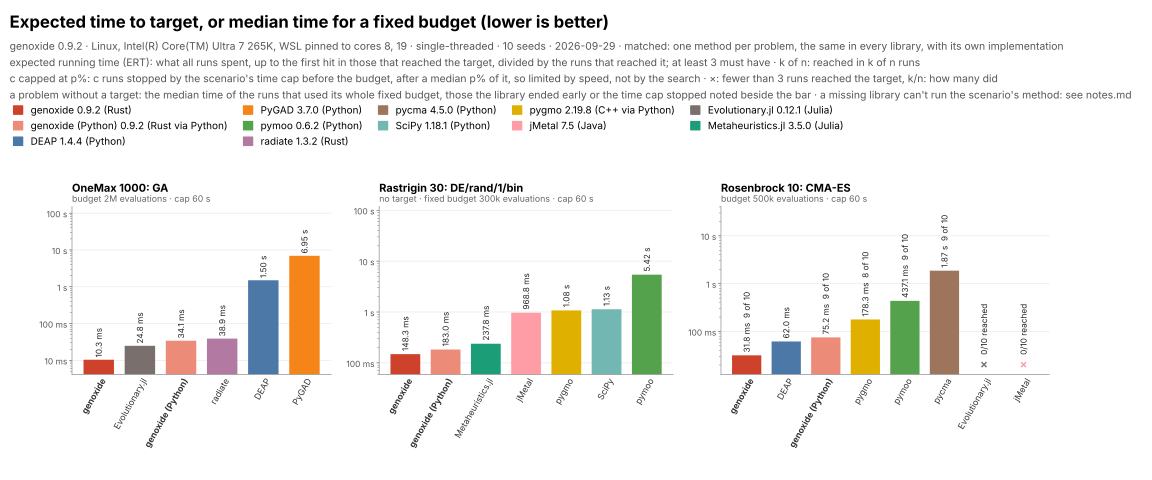
Interactive results, a card per problem: tachsin.gr/projects/genoxide/benchmarks. The methodology, the methods' definitions and a page per library are in docs/benchmarks.
The Rust library
The package covers a subset of the Rust library. These parts are only in Rust:
SteadyGaand the asynchronous engine, for evaluations of varying duration- memetic search in
Ga, and initial genomes for a population other than trees - operators of your own
- islands of algorithms other than
GaandDe, or of both kinds together - the stack and column evaluators of
gpfor values of any type (the package evaluates your own primitives on Python values, a call per node) - checkpoints in other formats, e.g. JSON through serde
- observers: statistics, a hall of fame and reports
- stop conditions combined with
and, and custom ones - penalty functions for constraints, and the NaN policy: in Python, NaN is always an invalid solution
- advanced settings:
- CMA-ES: the initial mean
- PSO: the initial inertia and acceleration (a control can change them during a run), and the maximum velocity
- DE: population size reduction other than L-SHADE's
- the rate of
UniformCrossoverand the weight ofArithmeticCrossover
Some names differ:
| Python | Rust |
|---|---|
mutation= |
.mutate(...) |
objective="minimize" |
.minimize(), Objective::Minimize |
Binary(length), Permutation(length) |
Binary::new(len), Permutation::new(len) |
BitFlip(rate=...), BitFlip(count=...) |
BitFlip::per_gene(rate), BitFlip::count(count), and so for the other mutations |
PointCrossover(points) |
PointCrossover::k_point(points) |
MuPlusLambda(offspring), MuCommaLambda(offspring) |
Scheme::MuPlusLambda { lambda }, Scheme::MuCommaLambda { lambda } |
Cmaes(restarts="ipop"), Cmaes(restarts="stop") |
.restarts(cmaes::Restarts::Ipop), .restarts(cmaes::Restarts::Stop) |
Cmaes(covariance="diagonal") |
.covariance(cmaes::Covariance::Diagonal) |
Pso(ring=k) |
.topology(pso::Topology::Ring { neighbors: k }) |
NelderMead(coefficients="standard"), NelderMead(coefficients=(1.0, 2.0, 0.5, 0.5)) |
.coefficients(nelder_mead::Coefficients::Standard), .coefficients(nelder_mead::Coefficients::Custom { reflection: 1.0, expansion: 2.0, contraction: 0.5, shrink: 0.5 }) |
NelderMead(restarts=n) |
.restarts(local::Restarts::Random { times: n }) |
NelderMead(initial_genome=[...]) |
.initial_genome(Reals::from(vec![...])) |
Lbfgsb(gradients="central", difference_step=h) |
.gradients(Gradients::Central { step: Some(h) }) |
Lbfgsb.run(f, gradient=g), gradient=True |
Differentiable(|x, gradient| ...) |
Mma(method="gcmma") |
.method(mma::Method::Gcmma) |
Mma.run(f, gradient=True, constraints=m), f returning (value, gradient, g, jacobian) |
Constrained::differentiable(m, |x, gradient, g, jacobian| value) |
Continuation(method, stages=n, on_stage=f, generations=g, keep="point"), result.stages |
Continuation::builder(method).stages(n).on_stage(|stage, _| ...).generations(g).keep(Keep::Point), continuation.stages() |
FirstOrder(step="adam", learning_rate=a), FirstOrder(step="nesterov", learning_rate=a, momentum=m), FirstOrder(step="adamw", learning_rate=a, weight_decay=w) |
.step(first_order::Step::adam(a)), .step(first_order::Step::nesterov(a, m)), .step(first_order::Step::adamw(a, w)) |
De(l_shade=n) |
De::l_shade(real, n) |
De(strategy="rand1"), De(strategy={"p": 0.1, "archive": 1.0}) |
.strategy(de::Strategy::Rand1), .strategy(de::Strategy::CurrentToPBest { p: 0.1, archive: 1.0 }), and {"max_p", "archive"} for CurrentToPBestRandomP |
De(control={"f": 0.5, "cr": 0.9}) |
.control(de::Control::Fixed { f: 0.5, cr: 0.9 }); {"min_f", "max_f", "cr"} for Dither, {"c"} for Jade, {"memory"} for Shade |
De(restarts="never"), De(restarts={"tolerance": 1e-12, "patience": 200}) |
.restarts(de::Restarts::Never), .restarts(de::Restarts::OnStagnation { tolerance: 1e-12, patience: 200 }) |
Pbi(theta) |
Decomposition::Pbi { theta } |
gx.gp.Gp(primitives, init=gx.gp.Full((2, 6))) |
Gp::builder(set).init(Init::Full { depths: 2..=6 }).build()? |
gx.gp.PointMutation(rate=...), gx.gp.ConstantMutation(sigma) |
PointMutation::per_node(rate), ConstantMutation::gaussian(sigma) |
gx.gp.Mutations([(0.5, gx.gp.SubtreeMutation()), (0.5, gx.gp.HoistMutation())]) |
Mutations::builder().subtree(0.5).hoist(0.5).build()? |
gx.gp.regression.primitives(["add", "mul"], ["x"]) |
regression::primitives([Math::Add, Math::Mul], ["x"], None)? |
gx.gp.regression.Sample(x, y), a point per row |
Sample::new(columns, targets)?, a column per variable |
problem.regression(linear_scaling=False) |
problem.regression().clone().linear_scaling(false) |
gx.gp.WithSize(regression) |
|tree| Some([regression.evaluate(tree)?, tree.len() as f64]) |
gx.gp.boolean.Multiplexer(3) |
boolean::Multiplexer::new(3)? |
Es(recombination="dominant", rho=2, selection="plus", step_sizes="one") |
.recombination(es::Recombination::Dominant { rho: 2 }), .selection(es::Selection::Plus), .step_sizes(es::StepSizes::One) |
AdaptiveReal(real, initial_step) |
AdaptiveReal::new(real, initial_step)? |
SelfAdaptiveMutation(learning_rate=tau, min_step=m) |
SelfAdaptiveMutation::with_learning_rate(tau)?.with_min_step(m)? |
Islands([...], topology="fully_connected") |
Islands::builder(vec![...]).topology(Topology::FullyConnected) |
islands.islands[i].mutation = ... in a control |
islands.islands_mut()[i].mutate_mut() |
run(checkpoint=path, checkpoint_every=n) |
.checkpoint_every(n, |a| checkpoint::save_file(a, &path)), which saves the algorithm alone; Python's checkpoint holds the settings with it |
run(resume=path) |
checkpoint::load_file(&path)?, with the algorithm's type |
run(control=...), ga.mutation = ... in it |
Engine::control(...), *ga.mutate_mut() = ... |
ga.mutation_rate = p, de.control = {...}, pso.inertia = w in a control |
ga.set_mutation_rate(p)?, de.set_control(...)?, pso.set_inertia(w)? |
run(generations=..., time=..., ...) |
Stop::generations(...).or(Stop::time(...)) |
time (seconds) |
Stop::time(Duration) |
result.seconds |
Outcome::elapsed() |
1 maintainer

Metadata
1 maintainer
Release files for genoxide 0.12.0
For a detailed explanation of source distributions (sdists) and built distributions (wheels), please see the package formats documentation.
Source distribution (sdist)
| File | Size | Uploaded | |
|---|---|---|---|
| genoxide-0.12.0.tar.gz | 7.4 MB | Details |
Built distributions (wheels)
Total release size: 93.1 MB
Release files / genoxide-0.12.0.tar.gz
| Download URL | genoxide-0.12.0.tar.gz |
|---|---|
| Size | 7.4 MB |
| Tags | Source |
|
SHA-256 checksum How to use checksums |
1d0aa42d4a69e08aa769b77d572fd4cca2d17115f769a61947c64a9206b4ad5f
|
|
BLAKE2b-256 checksum How to use checksums |
828454d7f9ae4238f4eeb7c8407f364e1bc5fca2c6b31ed712d0cc778d1fa1cd
|
| Upload date | |
|
Uploaded using Trusted Publishing? What is trusted publishing? |
Yes |
| Uploaded via |
twine/7.0.0 CPython/3.13.14
|
Provenance
Provenance describes where a file came from. On PyPI, provenance is shared via attestations, which provide a verifiable record of the build or publishing details. View details, limitations and caveats.


PyPI Publish Attestation
PyPI verified that this artifact, at this checksum, originated from the publisher listed below.
Signed by GitHub Actions, verified by PyPI on Oct 1, 2026.
Transparency logRelease files / genoxide-0.12.0-cp314-cp314t-win_amd64.whl
| Download URL | genoxide-0.12.0-cp314-cp314t-win_amd64.whl |
|---|---|
| Size | 5.8 MB |
| Tags | CPython 3.14 CPython 3.14 free-threading Windows x86-64 |
|
SHA-256 checksum How to use checksums |
d09f71688a39b8f7b244c49d7c0543c253ecf18a066c75b6ebe2a407d8fe1c93
|
|
BLAKE2b-256 checksum How to use checksums |
23a5d44c672b5fee9303e3c8b79379c82325caaef1e94de81003f0cfbdfff4a2
|
| Upload date | |
|
Uploaded using Trusted Publishing? What is trusted publishing? |
Yes |
| Uploaded via |
twine/7.0.0 CPython/3.13.14
|
Provenance
Provenance describes where a file came from. On PyPI, provenance is shared via attestations, which provide a verifiable record of the build or publishing details. View details, limitations and caveats.
PyPI Publish Attestation
PyPI verified that this artifact, at this checksum, originated from the publisher listed below.
Signed by GitHub Actions, verified by PyPI on Oct 1, 2026.
Transparency logRelease files / genoxide-0.12.0-cp314-cp314t-musllinux_1_2_x86_64.whl
| Download URL | genoxide-0.12.0-cp314-cp314t-musllinux_1_2_x86_64.whl |
|---|---|
| Size | 6.9 MB |
| Tags | CPython 3.14 CPython 3.14 free-threading Linux musl 1.2+ x86-64 |
|
SHA-256 checksum How to use checksums |
5a2b4874f9a72b100955357d79b256fa444c8eefa59017ca47ffe3c7f5b92d44
|
|
BLAKE2b-256 checksum How to use checksums |
e8945afac2e548dea202a6efee62871b00ec3fd1a980b81209aeef0143c2c61e
|
| Upload date | |
|
Uploaded using Trusted Publishing? What is trusted publishing? |
Yes |
| Uploaded via |
twine/7.0.0 CPython/3.13.14
|
Provenance
Provenance describes where a file came from. On PyPI, provenance is shared via attestations, which provide a verifiable record of the build or publishing details. View details, limitations and caveats.
PyPI Publish Attestation
PyPI verified that this artifact, at this checksum, originated from the publisher listed below.
Signed by GitHub Actions, verified by PyPI on Oct 1, 2026.
Transparency logRelease files / genoxide-0.12.0-cp314-cp314t-musllinux_1_2_aarch64.whl
| Download URL | genoxide-0.12.0-cp314-cp314t-musllinux_1_2_aarch64.whl |
|---|---|
| Size | 6.4 MB |
| Tags | CPython 3.14 CPython 3.14 free-threading Linux musl 1.2+ ARM64 |
|
SHA-256 checksum How to use checksums |
1e268a918d1b38a1c5cca899e328e6596039c49f35de51515e808901b39223a3
|
|
BLAKE2b-256 checksum How to use checksums |
0c7e960758f3fe89c8a85fca55c888cbd7e8a67a6d396f26a4d55fd1f0354a31
|
| Upload date | |
|
Uploaded using Trusted Publishing? What is trusted publishing? |
Yes |
| Uploaded via |
twine/7.0.0 CPython/3.13.14
|
Provenance
Provenance describes where a file came from. On PyPI, provenance is shared via attestations, which provide a verifiable record of the build or publishing details. View details, limitations and caveats.
PyPI Publish Attestation
PyPI verified that this artifact, at this checksum, originated from the publisher listed below.
Signed by GitHub Actions, verified by PyPI on Oct 1, 2026.
Transparency logRelease files / genoxide-0.12.0-cp314-cp314t-manylinux_2_17_x86_64.manylinux2014_x86_64.whl
| Download URL | genoxide-0.12.0-cp314-cp314t-manylinux_2_17_x86_64.manylinux2014_x86_64.whl |
|---|---|
| Size | 6.1 MB |
| Tags | CPython 3.14 CPython 3.14 free-threading Linux glibc 2.17+ x86-64 |
|
SHA-256 checksum How to use checksums |
6169321fc52f551fb769bf70df7a51ddbd36e50e77a8ca21eb0f8875e35bf878
|
|
BLAKE2b-256 checksum How to use checksums |
84a7df9c0a5aab3e9782d218e0e7a53ae9b3cbbbb9c9e8b4172f82ef6bde7570
|
| Upload date | |
|
Uploaded using Trusted Publishing? What is trusted publishing? |
Yes |
| Uploaded via |
twine/7.0.0 CPython/3.13.14
|
Provenance
Provenance describes where a file came from. On PyPI, provenance is shared via attestations, which provide a verifiable record of the build or publishing details. View details, limitations and caveats.
PyPI Publish Attestation
PyPI verified that this artifact, at this checksum, originated from the publisher listed below.
Signed by GitHub Actions, verified by PyPI on Oct 1, 2026.
Transparency logRelease files / genoxide-0.12.0-cp314-cp314t-manylinux_2_17_aarch64.manylinux2014_aarch64.whl
| Download URL | genoxide-0.12.0-cp314-cp314t-manylinux_2_17_aarch64.manylinux2014_aarch64.whl |
|---|---|
| Size | 6.2 MB |
| Tags | CPython 3.14 CPython 3.14 free-threading Linux glibc 2.17+ ARM64 |
|
SHA-256 checksum How to use checksums |
1a602ad99840eba2898f27ddddc9e466dad63f8db78ac7989d3b5b66dbde9864
|
|
BLAKE2b-256 checksum How to use checksums |
83c9decbc545e0f0e3ba82f0ed9695d8d05a009da1bc7abc60794328796a0e9d
|
| Upload date | |
|
Uploaded using Trusted Publishing? What is trusted publishing? |
Yes |
| Uploaded via |
twine/7.0.0 CPython/3.13.14
|
Provenance
Provenance describes where a file came from. On PyPI, provenance is shared via attestations, which provide a verifiable record of the build or publishing details. View details, limitations and caveats.
PyPI Publish Attestation
PyPI verified that this artifact, at this checksum, originated from the publisher listed below.
Signed by GitHub Actions, verified by PyPI on Oct 1, 2026.
Transparency logRelease files / genoxide-0.12.0-cp314-cp314t-macosx_11_0_arm64.whl
| Download URL | genoxide-0.12.0-cp314-cp314t-macosx_11_0_arm64.whl |
|---|---|
| Size | 5.5 MB |
| Tags | CPython 3.14 CPython 3.14 free-threading macOS 11.0+ ARM64 |
|
SHA-256 checksum How to use checksums |
7dfdd34010827eb82d4986d3a99b996f0506112776fe2321a6865b78ac1b6579
|
|
BLAKE2b-256 checksum How to use checksums |
f1d42b60a7b3546341f57cf1cca43b84aa8b6ec5cf056bed6a6808774a7d2adb
|
| Upload date | |
|
Uploaded using Trusted Publishing? What is trusted publishing? |
Yes |
| Uploaded via |
twine/7.0.0 CPython/3.13.14
|
Provenance
Provenance describes where a file came from. On PyPI, provenance is shared via attestations, which provide a verifiable record of the build or publishing details. View details, limitations and caveats.
PyPI Publish Attestation
PyPI verified that this artifact, at this checksum, originated from the publisher listed below.
Signed by GitHub Actions, verified by PyPI on Oct 1, 2026.
Transparency logRelease files / genoxide-0.12.0-cp314-cp314t-macosx_10_12_x86_64.whl
| Download URL | genoxide-0.12.0-cp314-cp314t-macosx_10_12_x86_64.whl |
|---|---|
| Size | 5.9 MB |
| Tags | CPython 3.14 CPython 3.14 free-threading macOS 10.12+ x86-64 |
|
SHA-256 checksum How to use checksums |
7ddd5b88661e230e575d95433d5ec88b001c48bf5503f084a4f698ececdf9a99
|
|
BLAKE2b-256 checksum How to use checksums |
68f54cea1fdb27fd008821afb0e76381e8d7a1891f6b93512a83371da5af582f
|
| Upload date | |
|
Uploaded using Trusted Publishing? What is trusted publishing? |
Yes |
| Uploaded via |
twine/7.0.0 CPython/3.13.14
|
Provenance
Provenance describes where a file came from. On PyPI, provenance is shared via attestations, which provide a verifiable record of the build or publishing details. View details, limitations and caveats.
PyPI Publish Attestation
PyPI verified that this artifact, at this checksum, originated from the publisher listed below.
Signed by GitHub Actions, verified by PyPI on Oct 1, 2026.
Transparency logRelease files / genoxide-0.12.0-cp310-abi3-win_amd64.whl
| Download URL | genoxide-0.12.0-cp310-abi3-win_amd64.whl |
|---|---|
| Size | 5.8 MB |
| Tags | CPython 3.10 Windows x86-64 abi3 |
|
SHA-256 checksum How to use checksums |
5e9b5412d05bd427688adf593746e1ebdfbb4642d7b5aa80358eae96773423d3
|
|
BLAKE2b-256 checksum How to use checksums |
cf657b3ccacae8502d56c312ff03cbcb3b5e9c78e53f37474036be08f8c00823
|
| Upload date | |
|
Uploaded using Trusted Publishing? What is trusted publishing? |
Yes |
| Uploaded via |
twine/7.0.0 CPython/3.13.14
|
Provenance
Provenance describes where a file came from. On PyPI, provenance is shared via attestations, which provide a verifiable record of the build or publishing details. View details, limitations and caveats.
PyPI Publish Attestation
PyPI verified that this artifact, at this checksum, originated from the publisher listed below.
Signed by GitHub Actions, verified by PyPI on Oct 1, 2026.
Transparency logRelease files / genoxide-0.12.0-cp310-abi3-musllinux_1_2_x86_64.whl
| Download URL | genoxide-0.12.0-cp310-abi3-musllinux_1_2_x86_64.whl |
|---|---|
| Size | 6.9 MB |
| Tags | CPython 3.10 Linux musl 1.2+ x86-64 abi3 |
|
SHA-256 checksum How to use checksums |
9c02a7e5cf2ec020870de9f804be3f00b7219480e3fd9658841022617e30dc25
|
|
BLAKE2b-256 checksum How to use checksums |
423e6cbf60685aae67f6fa6a5283049ac5060d78545cab3ff8d6255e9b1370e2
|
| Upload date | |
|
Uploaded using Trusted Publishing? What is trusted publishing? |
Yes |
| Uploaded via |
twine/7.0.0 CPython/3.13.14
|
Provenance
Provenance describes where a file came from. On PyPI, provenance is shared via attestations, which provide a verifiable record of the build or publishing details. View details, limitations and caveats.
PyPI Publish Attestation
PyPI verified that this artifact, at this checksum, originated from the publisher listed below.
Signed by GitHub Actions, verified by PyPI on Oct 1, 2026.
Transparency logRelease files / genoxide-0.12.0-cp310-abi3-musllinux_1_2_aarch64.whl
| Download URL | genoxide-0.12.0-cp310-abi3-musllinux_1_2_aarch64.whl |
|---|---|
| Size | 6.4 MB |
| Tags | CPython 3.10 Linux musl 1.2+ ARM64 abi3 |
|
SHA-256 checksum How to use checksums |
204369f1794e7db02301cec17fcbb64aa792f630515e9895cfc633b7d58722d2
|
|
BLAKE2b-256 checksum How to use checksums |
5613c3a95636e397ea4e5d17d9abdbf45d14f0776463d0e916efde0de082c8a5
|
| Upload date | |
|
Uploaded using Trusted Publishing? What is trusted publishing? |
Yes |
| Uploaded via |
twine/7.0.0 CPython/3.13.14
|
Provenance
Provenance describes where a file came from. On PyPI, provenance is shared via attestations, which provide a verifiable record of the build or publishing details. View details, limitations and caveats.
PyPI Publish Attestation
PyPI verified that this artifact, at this checksum, originated from the publisher listed below.
Signed by GitHub Actions, verified by PyPI on Oct 1, 2026.
Transparency logRelease files / genoxide-0.12.0-cp310-abi3-manylinux_2_17_x86_64.manylinux2014_x86_64.whl
| Download URL | genoxide-0.12.0-cp310-abi3-manylinux_2_17_x86_64.manylinux2014_x86_64.whl |
|---|---|
| Size | 6.1 MB |
| Tags | CPython 3.10 Linux glibc 2.17+ x86-64 abi3 |
|
SHA-256 checksum How to use checksums |
f4439fb3aab4c0adddaa4f55c1e2a4ee932d2994bdd70770e27b9e52677ae2e8
|
|
BLAKE2b-256 checksum How to use checksums |
86eafe54d6eddc723811c5a1aaec7d91573d67fb0ec20b522e0f786e4a4ad343
|
| Upload date | |
|
Uploaded using Trusted Publishing? What is trusted publishing? |
Yes |
| Uploaded via |
twine/7.0.0 CPython/3.13.14
|
Provenance
Provenance describes where a file came from. On PyPI, provenance is shared via attestations, which provide a verifiable record of the build or publishing details. View details, limitations and caveats.
PyPI Publish Attestation
PyPI verified that this artifact, at this checksum, originated from the publisher listed below.
Signed by GitHub Actions, verified by PyPI on Oct 1, 2026.
Transparency logRelease files / genoxide-0.12.0-cp310-abi3-manylinux_2_17_aarch64.manylinux2014_aarch64.whl
| Download URL | genoxide-0.12.0-cp310-abi3-manylinux_2_17_aarch64.manylinux2014_aarch64.whl |
|---|---|
| Size | 6.2 MB |
| Tags | CPython 3.10 Linux glibc 2.17+ ARM64 abi3 |
|
SHA-256 checksum How to use checksums |
bc7d55061a006bc573e89fd54951855ac5bf8b95af43cd6a599a9c79d3c80c6c
|
|
BLAKE2b-256 checksum How to use checksums |
54728365136a9ae6e2386e6b9b66ffe9a29c388249d12fe87c0e7009ce415891
|
| Upload date | |
|
Uploaded using Trusted Publishing? What is trusted publishing? |
Yes |
| Uploaded via |
twine/7.0.0 CPython/3.13.14
|
Provenance
Provenance describes where a file came from. On PyPI, provenance is shared via attestations, which provide a verifiable record of the build or publishing details. View details, limitations and caveats.
PyPI Publish Attestation
PyPI verified that this artifact, at this checksum, originated from the publisher listed below.
Signed by GitHub Actions, verified by PyPI on Oct 1, 2026.
Transparency logRelease files / genoxide-0.12.0-cp310-abi3-macosx_11_0_arm64.whl
| Download URL | genoxide-0.12.0-cp310-abi3-macosx_11_0_arm64.whl |
|---|---|
| Size | 5.6 MB |
| Tags | CPython 3.10 abi3 macOS 11.0+ ARM64 |
|
SHA-256 checksum How to use checksums |
28de3e50896389ce8cbc98ca810370b2e024edeffd4e8ecafabd5abb93d3e0c0
|
|
BLAKE2b-256 checksum How to use checksums |
2de24d0807473bdb67f0be40890720b81463dbd7c404814c8fea2858f380ac6d
|
| Upload date | |
|
Uploaded using Trusted Publishing? What is trusted publishing? |
Yes |
| Uploaded via |
twine/7.0.0 CPython/3.13.14
|
Provenance
Provenance describes where a file came from. On PyPI, provenance is shared via attestations, which provide a verifiable record of the build or publishing details. View details, limitations and caveats.
PyPI Publish Attestation
PyPI verified that this artifact, at this checksum, originated from the publisher listed below.
Signed by GitHub Actions, verified by PyPI on Oct 1, 2026.
Transparency logRelease files / genoxide-0.12.0-cp310-abi3-macosx_10_12_x86_64.whl
| Download URL | genoxide-0.12.0-cp310-abi3-macosx_10_12_x86_64.whl |
|---|---|
| Size | 5.9 MB |
| Tags | CPython 3.10 abi3 macOS 10.12+ x86-64 |
|
SHA-256 checksum How to use checksums |
c9cda2f8ea2443b6d8229feb7a3ab81ad3248fc1b6d9886607b7cc57e2ba3be6
|
|
BLAKE2b-256 checksum How to use checksums |
3fb150ca12129a37fbb0de8ad5f0b845a883fb8d43554c2689c1a0d46828a69d
|
| Upload date | |
|
Uploaded using Trusted Publishing? What is trusted publishing? |
Yes |
| Uploaded via |
twine/7.0.0 CPython/3.13.14
|
Provenance
Provenance describes where a file came from. On PyPI, provenance is shared via attestations, which provide a verifiable record of the build or publishing details. View details, limitations and caveats.
PyPI Publish Attestation
PyPI verified that this artifact, at this checksum, originated from the publisher listed below.
Signed by GitHub Actions, verified by PyPI on Oct 1, 2026.
Transparency log













