
GenSBI is a library for Simulation-Based Inference using generative models in JAX.
Verified details
These details have been verified by PyPIProject links
GitHub Statistics
Maintainers

Project description
GenSBI



[!IMPORTANT]
This library is at an early stage of development. The API is potentially subject to change.
Overview
GenSBI is a powerful JAX-based library for Simulation-Based Inference (SBI) using state-of-the-art generative models, currently revolving around Optimal Transport Flow Matching and Diffusion Models.
It is designed for researchers and practitioners who need a flexible, high-performance toolkit to solve complex inference problems where the likelihood function is intractable.
Key Features
- Modern SBI Algorithms: Implements cutting-edge techniques like Optimal Transport Conditional Flow Matching and Diffusion Models for robust and flexible posterior inference.
- Built on JAX and Flax NNX: Leverages the power of JAX for automatic differentiation, vectorization, and seamless execution on CPUs, GPUs, and TPUs.
- High-Level Recipes API: A simplified interface for common workflows, allowing you to train models and run inference with just a few lines of code.
- Powerful Transformer Models: Includes implementations of recent, high-performing models like Flux1, Flux1Join, and Simformer for handling complex, high-dimensional data.
- Modular and Extensible: A clean, well-structured codebase that is easy to understand, modify, and extend for your own research.
Installation
pip install git+https://github.com/aurelio-amerio/GenSBI.git
For GPU support and other options, see the Installation Guide.
Quick Start
To get started immediately, you can use the high-level API to train a model.
[!TIP] Check out the my_first_model.ipynb notebook for a complete, step-by-step introductory tutorial.
from flax import nnx
from gensbi.recipes import Flux1FlowPipeline
from gensbi.models import Flux1Params

train_dataset = ... # define a training dataset (infinite iterator)
val_dataset = ...   # define a validation dataset (infinite iterator)
dim_obs = ...       # dimension of the parameters (theta)
dim_cond = ...      # dimension of the simulator observations (x)
params = Flux1Params(...) # the parameters for your model

# Instantiate the pipeline
pipeline = Flux1FlowPipeline(
    train_dataset,
    val_dataset,
    dim_obs,
    dim_cond,
    params=params,
)

# Train the model
# Note: GenSBI uses Flax NNX, so we pass a random key generator
pipeline.train(rngs=nnx.Rngs(0))

# After training, get a sampler for posterior sampling
key = jax.random.PRNGKey(42)
samples = pipeline.sample(key, x_observed, num_samples=10_000)
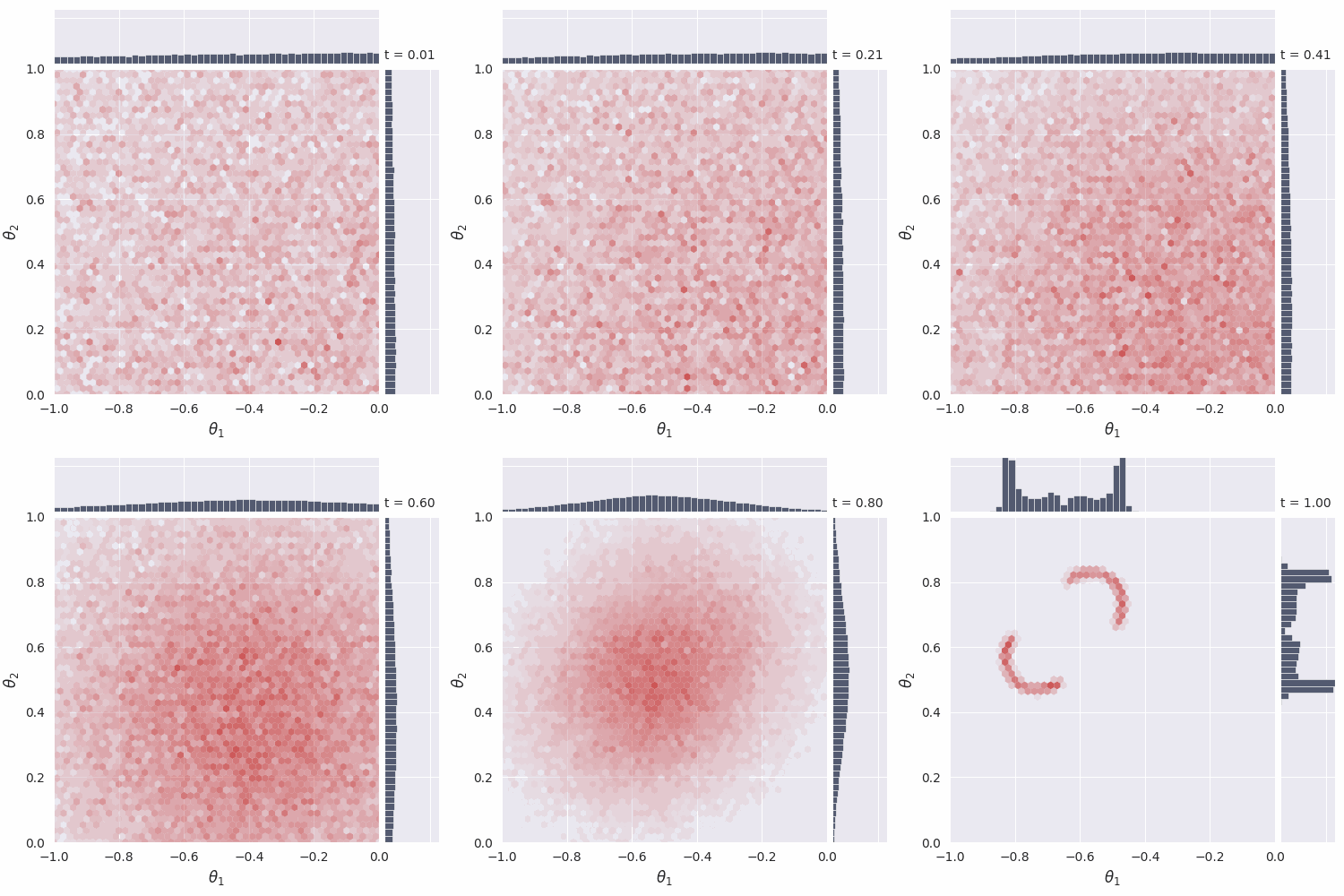
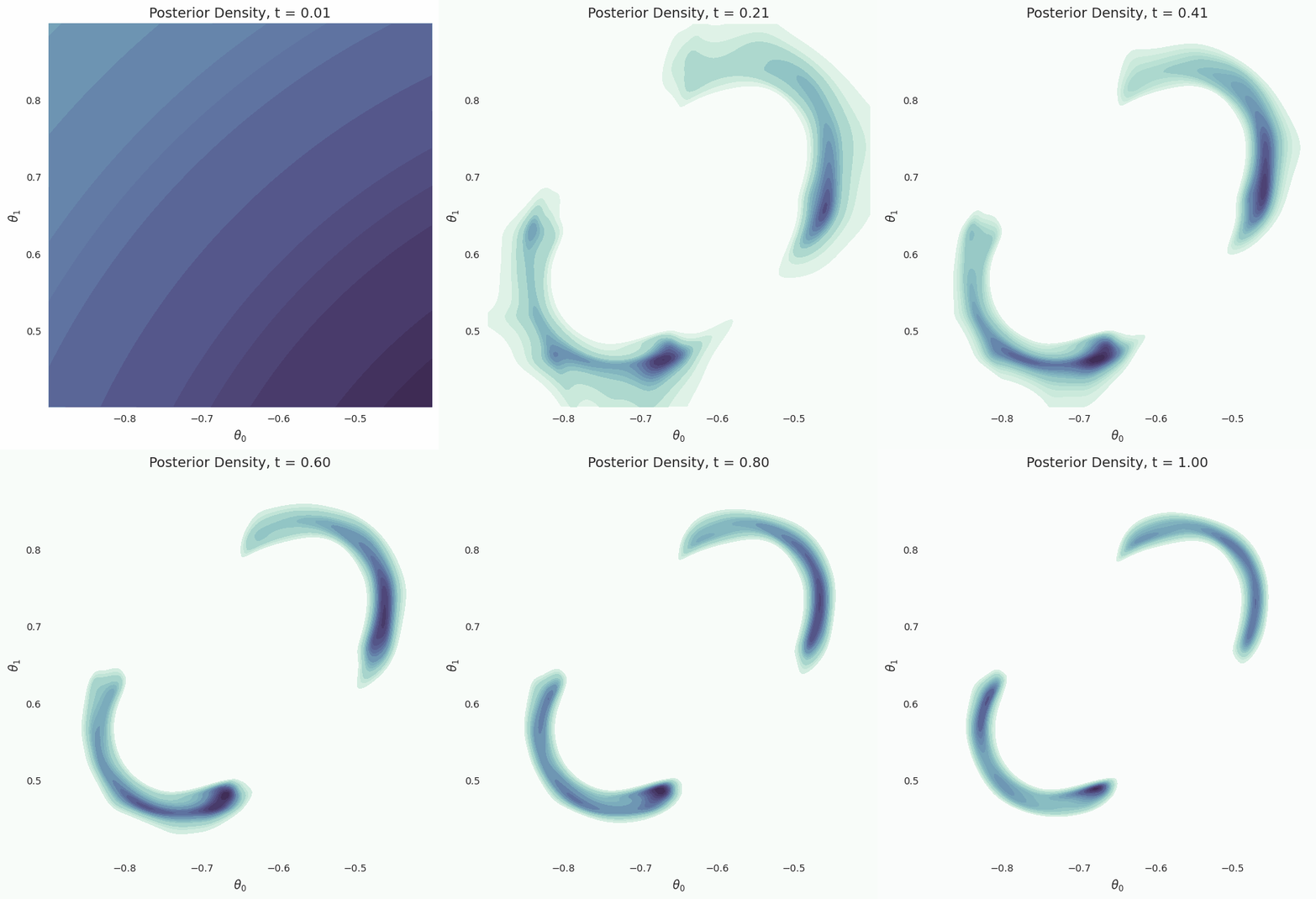
Examples
|
|
Examples for this library are available separately in the GenSBI-examples repository.
Some key examples include:
Getting Started:
my_first_model.ipynb
A beginner-friendly notebook introducing the core concepts of GenSBI on a simple problem.

Unconditional Density Estimation:
flow_matching_2d_unconditional.ipynb
Demonstrates how to use flow matching in 2D for unconditional density estimation.diffusion_2d_unconditional.ipynb
Demonstrates how to use diffusion models in 2D for unconditional density estimation.
Conditional Density Estimation:
two_moons_flow_simformer.ipynb
Uses the Simformer model for posterior density estimation on the two-moons benchmark.two_moons_flow_flux.ipynb
Uses the Flux1 model for posterior density estimation on the two-moons benchmark.gaussian_linear_flow_flux1joint.ipynb
Uses the Flux1Joint model for posterior density estimation on the Gaussian Linear benchmark.slcp_flow_simformer.ipynb
Uses the Simformer model for posterior density estimation on the SLCP benchmark.
[!NOTE] A full list of the currently available examples is available at the examples documentation page.
Citing GenSBI
If you use this library, please consider citing this work and the original methodology papers, see references.
@misc{GenSBI,
  author       = {Amerio, Aurelio},
  title        = "{GenSBI: Generative models for Simulation-Based Inference}",
  year         = {2025},
  publisher    = {GitHub},
  journal      = {GitHub repository},
  howpublished = {\url{https://github.com/aurelio-amerio/GenSBI}}
}
Reference implementations:
- Facebook Flow Matching library: https://github.com/facebookresearch/flow_matching
- Elucidating the Design Space of Diffusion-Based Generative Models: https://github.com/NVlabs/edm
- Simformer model: https://github.com/mackelab/simformer
- Flux1 model from BlackForest Lab: https://github.com/black-forest-labs/flux
- Simulation-Based Inference Benchmark: https://github.com/sbi-benchmark/sbibm
[!NOTE] AI Usage Disclosure
This project utilized large language models, specifically Google Gemini and GitHub Copilot, to assist with code suggestions, documentation drafting, and grammar corrections. All AI-generated content has been manually reviewed and verified by human authors to ensure accuracy and adherence to scientific standards.
Project details
Verified details
These details have been verified by PyPIProject links
GitHub Statistics
Maintainers


Download files
Download the file for your platform. If you're not sure which to choose, learn more about installing packages.
Source Distribution
Built Distribution
Filter files by name, interpreter, ABI, and platform.
If you're not sure about the file name format, learn more about wheel file names.
Copy a direct link to the current filters
File details
Details for the file gensbi-0.0.2.tar.gz.
File metadata
- Download URL: gensbi-0.0.2.tar.gz
- Upload date:
- Size: 20.5 MB
- Tags: Source
- Uploaded using Trusted Publishing? Yes
- Uploaded via: twine/6.1.0 CPython/3.13.7
File hashes
| Algorithm | Hash digest | |
|---|---|---|
| SHA256 |
0eaf5ce13aec286e4e51c7e2c4ea81eb0544cbb5b9aea7c469ad71fe0777809f
|
|
| MD5 |
09794ed1498de70bb92d4ed37ed1ae35
|
|
| BLAKE2b-256 |
add6c84a9c1601ff91f5d2af89ef517d669d63c1bd445f82c9548bd4c1f7cf2e
|
Provenance
The following attestation bundles were made for gensbi-0.0.2.tar.gz:
Publisher:
python-publish.yml on aurelio-amerio/GenSBI
-
Statement:
-
Statement type:
https://in-toto.io/Statement/v1 -
Predicate type:
https://docs.pypi.org/attestations/publish/v1 -
Subject name:
gensbi-0.0.2.tar.gz -
Subject digest:
0eaf5ce13aec286e4e51c7e2c4ea81eb0544cbb5b9aea7c469ad71fe0777809f - Sigstore transparency entry: 837557748
- Sigstore integration time:
-
Permalink:
aurelio-amerio/GenSBI@d1aeb2c5268f6754c84cbdd20ee7a7eac526b797 -
Branch / Tag:
refs/tags/v0.0.2 - Owner: https://github.com/aurelio-amerio
-
Access:
public
-
Token Issuer:
https://token.actions.githubusercontent.com -
Runner Environment:
github-hosted -
Publication workflow:
python-publish.yml@d1aeb2c5268f6754c84cbdd20ee7a7eac526b797 -
Trigger Event:
push
-
Statement type:
File details
Details for the file gensbi-0.0.2-py3-none-any.whl.
File metadata
- Download URL: gensbi-0.0.2-py3-none-any.whl
- Upload date:
- Size: 151.1 kB
- Tags: Python 3
- Uploaded using Trusted Publishing? Yes
- Uploaded via: twine/6.1.0 CPython/3.13.7
File hashes
| Algorithm | Hash digest | |
|---|---|---|
| SHA256 |
e014f6de9cf1f0d2bbefa34599303b0f961a2fc77fc306c8b675bd660fdc4f39
|
|
| MD5 |
d0908dfbef8fb48f7c1a0a5cc98dcc7e
|
|
| BLAKE2b-256 |
8bed1441e07082d5ff984c233dd79f068d7fddb615a740f02ae64da7c0bb8f6b
|
Provenance
The following attestation bundles were made for gensbi-0.0.2-py3-none-any.whl:
Publisher:
python-publish.yml on aurelio-amerio/GenSBI
-
Statement:
-
Statement type:
https://in-toto.io/Statement/v1 -
Predicate type:
https://docs.pypi.org/attestations/publish/v1 -
Subject name:
gensbi-0.0.2-py3-none-any.whl -
Subject digest:
e014f6de9cf1f0d2bbefa34599303b0f961a2fc77fc306c8b675bd660fdc4f39 - Sigstore transparency entry: 837557783
- Sigstore integration time:
-
Permalink:
aurelio-amerio/GenSBI@d1aeb2c5268f6754c84cbdd20ee7a7eac526b797 -
Branch / Tag:
refs/tags/v0.0.2 - Owner: https://github.com/aurelio-amerio
-
Access:
public
-
Token Issuer:
https://token.actions.githubusercontent.com -
Runner Environment:
github-hosted -
Publication workflow:
python-publish.yml@d1aeb2c5268f6754c84cbdd20ee7a7eac526b797 -
Trigger Event:
push
-
Statement type:






