
Generative Engine Optimization toolkit — make websites visible to AI search engines
Verified details
These details have been verified by PyPIProject links
GitHub Statistics
Maintainers

Project description

Open-source GEO audit engine for AI search visibility and citability.








GEO Optimizer helps you audit whether a website can be crawled, understood, cited, and monitored by AI answer engines.
Quick Start · Live Demo · Pricing · Sign Up · Documentation · Changelog

Why this exists
AI search engines give direct answers and cite their sources. If your site isn't optimized, you're invisible — even if you rank #1 on Google.
User: "What's the best mortgage calculator?"

Perplexity: "According to [Competitor.com], the formula is..."
             ↑ They appear. You don't.
GEO Optimizer audits your site against 47 research-backed methods (Princeton KDD 2024, AutoGEO ICLR 2026) and generates the fixes.
Why this matters in 2026
- ChatGPT alone serves 900M weekly users — a growing share of sessions that used to be Google searches.
- 28.3% of ChatGPT's most-cited pages have zero organic visibility on Google (Ahrefs) — AI engines reward different signals than classic SEO.
- Proper JSON-LD schema lifts LLM extraction accuracy from 16% to 54% (Semrush test on GPT-4).
- 844,000+ sites already ship an
llms.txt. Yours?
GEO is not traditional SEO
SEO and GEO answer different questions:
- SEO optimizes for ranking and visibility in traditional search result pages — crawlability, backlinks, keyword signals.
- GEO measures whether an AI answer engine can read, parse, understand, and cite your content when generating a response.
- A site can rank well on Google and still be largely opaque to AI systems — missing structured data, no llms.txt, bot access blocked, thin factual density.
GEO Optimizer focuses on the technical and structural signals that AI answer engines use: robots.txt bot permissions, llms.txt presence and depth, JSON-LD schema richness, brand entity coherence, and content citability across 47 methods. These complement traditional SEO work rather than replacing it.
Try it online
| Free audit | geoready.dev — single-URL GEO score, no account required |
| Free tools | llms.txt generator — build a starter llms.txt from your sitemap |
| Pricing | geoready.dev/pricing — plans and feature comparison |
| Sign up | app.geoready.dev/signup — Pro/Studio/Agency available now |
Open-source vs GeoReady Platform
| GEO Optimizer CLI | GeoReady.dev Free | GeoReady Pro / Studio / Agency | |
|---|---|---|---|
| License / access | MIT, open-source | Free, no account | Self-serve — sign up |
| Core use | Local audit engine, CI/CD integration, JSON output | Web audit, score preview, educational pages | Monitoring, score history, regression alerts, agency reporting |
| Target | Developers, automation | Developers, SEO specialists | Ongoing clients, multi-site portfolios |
| Pricing | Free forever | Free forever | From $19/month — see geoready.dev/pricing |
The CLI and web audit remain MIT-licensed and free. The GeoReady platform adds server-side continuity — monitoring, history, and team features — that a local CLI cannot provide on its own.
Quick Start
pip install geo-optimizer-skill
No install? One-shot audit with uv:
uvx --from geo-optimizer-skill geo audit --url https://yoursite.com
# Audit any site — get a score 0-100 with actionable recommendations
geo audit --url https://yoursite.com

# Audit a full sitemap and surface weakest pages first
geo audit --sitemap https://yoursite.com/sitemap.xml --max-urls 25

# Compare before/after versions of a page
geo diff --before https://yoursite.com/page-old --after https://yoursite.com/page-new

# Save history and detect regressions over time
geo audit --url https://yoursite.com --save-history --regression

# Show the saved trend for a site
geo history --url https://yoursite.com

# What changed since the last snapshot? (severity + category deltas; CI: --fail-on warning)
geo drift --url https://yoursite.com

# Passive AI visibility snapshot for a domain
geo monitor --domain yoursite.com

# Ask real AI engines: is my brand mentioned? Is my domain cited as a source?
# BYO API key — PERPLEXITY_API_KEY recommended (real web citations)
geo citations --brand "YourBrand" --domain yoursite.com --topic "your product category"

# Save or query archived AI answer snapshots
geo snapshots --query "best GEO tool" --from 2026-03-01 --to 2026-03-30

# Score citation quality inside an archived answer snapshot
geo snapshots --quality --snapshot-id 12 --target-domain yoursite.com

# Run recurring monitoring and generate an HTML trend report
geo track --url https://yoursite.com --report --output ./geo-track-report.html

# Auto-generate all missing files (robots.txt, llms.txt, schema, meta)
geo fix --url https://yoursite.com --apply

# Generate llms.txt from sitemap
geo llms --base-url https://yoursite.com --output ./public/llms.txt

# Generate JSON-LD schema
geo schema --type faq --url https://yoursite.com
What it checks
| Area | Points | What GEO Optimizer looks for |
|---|---|---|
| Robots.txt | /18 | 27 AI bots across 3 tiers (training, search, user). Citation bots explicitly allowed? |
| llms.txt | /18 | Present, has H1 + blockquote, sections, links, depth. Companion llms-full.txt? |
| Schema JSON-LD | /16 | WebSite, Organization, FAQPage, Article. Schema richness (5+ attributes)? |
| Meta Tags | /14 | Title, description, canonical, Open Graph complete? |
| Content | /12 | H1, statistics, external citations, heading hierarchy, lists/tables, front-loading? |
| Brand & Entity | /10 | Brand name coherence, Knowledge Graph links (Wikipedia/Wikidata/LinkedIn/Crunchbase), about page, geo signals, topic authority |
| Signals | /6 | <html lang>, RSS/Atom feed, dateModified freshness? |
| AI Discovery | /6 | .well-known/ai.txt, /ai/summary.json, /ai/faq.json, /ai/service.json? |
Score bands: 86-100 Excellent · 68-85 Good · 36-67 Foundation · 0-35 Critical
Bonus checks (informational, do not affect score):
| Check | What it detects |
|---|---|
| CDN Crawler Access | Does Cloudflare/Akamai/Vercel block GPTBot, ClaudeBot, PerplexityBot? |
| JS Rendering | Is content accessible without JavaScript? SPA framework detection |
| WebMCP Readiness | Chrome WebMCP support: registerTool(), toolname attributes, potentialAction schema |
| Negative Signals | 8 anti-citation signals: CTA overload, popups, thin content, keyword stuffing, missing author, boilerplate ratio |
| Prompt Injection Detection | 8 manipulation patterns: hidden text, invisible Unicode, LLM instructions, HTML comment injection, monochrome text, micro-font, data-attr injection, aria-hidden abuse |
| Trust Stack Score | 5-layer trust aggregation (Technical, Identity, Social, Academic, Consistency) — composite grade A-F |
| RAG Chunk Readiness | Content segmentation for RAG retrieval: section word counts, definition openings, heading boundaries, anchor sentences 🆕 v4.7 |
| Content Decay Prediction | Detects temporal, statistical, version, event, and price decay patterns — evergreen score 0-100 🆕 v4.7 |
| Platform Citation Profile | Per-platform readiness scores for ChatGPT, Perplexity, Google AI 🆕 v4.7 |
| Multimodal Readiness | Image alt coverage, captions, VideoObject/AudioObject schema, subtitle tracks, transcripts — the text scaffolding multimodal engines (Gemini, GPT-4o) need 🆕 |
Plus a separate Citability Score (0-100) measuring content quality across 47 methods: Quotation +41% · Statistics +33% · Fluency +29% · Cite Sources +27% · and 43 more.
Additional tools
geo coherence --sitemap https://example.com/sitemap.xml  # Cross-page terminology consistency
geo logs --file access.log                                # AI Crawler Activity — crawler evidence from user-agent logs
geo access --url https://example.com                      # Agent Access Audit — browser vs AI bot access simulation
geo citations --brand "Acme" --domain acme.com            # AI Citation Check — are you cited by answer engines? (BYO key)
geo authority --sitemap https://example.com/sitemap.xml   # Topic Authority — multi-page entity coverage, clusters, pillars
GEO Optimizer checks whether websites can be crawled, understood, cited, and monitored by AI answer engines:
- Crawled — robots.txt, CDN access, AI-bot reachability
- Understood — schema, llms.txt, content structure
- Cited — citability signals across 47 research-backed methods
- Monitored —
geo logs(crawler evidence) andgeo access(access simulation)
Note on wording: AI Crawler Activity reports crawler evidence from server-log user-agents. Agent Access Audit reports citation readiness (whether bots can reach and parse the page). For actual answer-engine checking — "does the AI mention my brand and cite my domain?" — use geo citations with your own API key (Perplexity Sonar returns the real source URLs; OpenAI/Anthropic/Groq reveal parametric brand knowledge).
Optional LLM-powered analysis (pip install geo-optimizer-skill[llm]):
brand sentiment, citation attribution, multi-turn persistence, cross-platform citation map, prompt library.
Output formats
geo audit --url https://example.com --format text     # Human-readable (default)
geo audit --url https://example.com --format json      # Machine-readable
geo audit --sitemap https://example.com/sitemap.xml    # Batch sitemap audit (text)
geo audit --sitemap https://example.com/sitemap.xml --format json  # Batch sitemap audit (JSON)
geo audit --url https://example.com --format rich      # Colored terminal
geo audit --url https://example.com --format html      # Self-contained report
geo audit --url https://example.com --format sarif     # GitHub Code Scanning
geo audit --url https://example.com --format junit     # Jenkins, GitLab CI
geo audit --url https://example.com --format github    # GitHub Actions annotations
geo monitor --domain example.com                       # Passive AI visibility readiness
geo snapshots --query "best GEO tool"                 # Saved AI answer archive
geo snapshots --quality --snapshot-id 12              # Citation quality tiers for a saved answer
geo history --url https://example.com                  # Saved score trend
geo track --url https://example.com --report           # Monitoring HTML report
The JSON output format is intended to remain stable across minor versions and acts as the machine-readable integration contract for the GeoReady platform.
CI/CD Integration
# .github/workflows/geo.yml
- uses: Auriti-Labs/geo-optimizer-skill@v4.14.0
  with:
    url: https://yoursite.com
    min-score: 70        # Fail if score drops below 70
    format: sarif        # Upload to GitHub Security tab
Works with GitHub Actions, GitLab CI, Jenkins, CircleCI, and any CI that runs Python.
For longitudinal checks, persist snapshots and fail on regressions:
geo audit --url https://yoursite.com --save-history --regression
MCP Server
Use GEO Optimizer from Claude, Cursor, Windsurf, or any MCP client:
pip install geo-optimizer-skill[mcp]
claude mcp add geo-optimizer -- geo-mcp
Then ask: "audit my site and fix what's missing"
| Tool | Purpose |
|---|---|
geo_audit |
Full audit with score + recommendations |
geo_fix |
Generate fix files |
geo_llms_generate |
Generate llms.txt |
geo_citability |
Content citability analysis (47 methods) |
geo_schema_validate |
Validate JSON-LD |
geo_compare |
Compare multiple sites |
geo_gap_analysis |
Explain the gap between two sites and prioritize fixes |
geo_ai_discovery |
Check AI discovery endpoints |
geo_check_bots |
Check bot access via robots.txt |
geo_trust_score |
5-layer trust signal aggregation |
geo_negative_signals |
8 anti-citation signal detection |
geo_factual_accuracy |
Audit unsourced claims, contradictions, and broken citations |
Use as AI Context
Load the right file into your AI assistant for GEO expertise:
| Platform | File |
|---|---|
| Claude Projects | ai-context/claude-project.md |
| ChatGPT Custom GPT | ai-context/chatgpt-custom-gpt.md |
| Cursor | ai-context/cursor.mdc |
| Windsurf | ai-context/windsurf.md |
| Kiro | ai-context/kiro-steering.md |
Internal Skill System
The repository now includes a structured internal skill catalog for maintainers at src/geo_optimizer/skills/catalog/ plus validation rules and examples. See docs/skill-system.md for the v1 architecture.
Python API
from geo_optimizer import audit

result = audit("https://example.com")
print(result.score)                      # 85
print(result.band)                       # "good"
print(result.citability.total_score)     # 72
print(result.score_breakdown)            # {"robots": 18, "llms": 14, ...}
print(result.recommendations)            # ["Add FAQPage schema..."]
Async variant:
from geo_optimizer import audit_async
result = await audit_async("https://example.com")
Show your GEO score
Add a live GEO score badge to your README — like a coverage badge, but for AI visibility:

[](https://geoready.dev?utm_source=badge)
HTML variant for docs sites:
<a href="https://geoready.dev?utm_source=badge"><img src="https://geoready.dev/badge?url=https://yoursite.com" alt="GEO Score"></a>
Colors: 86-100 green · 68-85 cyan · 36-67 yellow · 0-35 red. Re-audited and cached hourly — improve your site, watch the badge change. No account needed.
Astro Integration
Make an Astro site GEO-ready at build time — generates llms.txt,
/.well-known/ai.txt, and /ai/summary.json from your built routes
(never overwrites hand-curated files):
// astro.config.mjs
import geoReady from 'astro-geoready';
export default defineConfig({
  site: 'https://yoursite.com',
  integrations: [geoReady({ siteName: 'Your Site' })],
});
See integrations/astro-geoready/ — geoready.dev itself builds with it.
Plugin System
Extend the audit with custom checks via entry points:
[project.entry-points."geo_optimizer.checks"]
my_check = "mypackage:MyCheck"
See examples/example_plugin.py for a working example.
Research Foundation
| Paper | Venue | Key Finding |
|---|---|---|
| GEO: Generative Engine Optimization | KDD 2024 | 9 methods tested on 10k queries. Cite Sources: +115%, Statistics: +40% |
| AutoGEO | ICLR 2026 | Automatic rule extraction. +50.99% over Princeton baseline |
| C-SEO Bench | 2025 | Most content manipulation is ineffective. Infrastructure matters most |
We focus on technical infrastructure (robots.txt, llms.txt, schema, meta) over content rewriting. The research confirms: if crawlers can't find and parse your content, prose optimization doesn't matter.
GEO Optimizer translates these findings into technical and content-level signals that can be operationally audited and tracked over time.
Roadmap
This project follows a deliberate release cadence — focused waves, not noisy patches.
| Version | Window | Codename | Status |
|---|---|---|---|
| v4.10.0 | Apr 2026 | Veil | Shipped |
| v4.11.0 | May 2026 | Static | Shipped |
| v4.12.0 | May 2026 | Ledger | Shipped |
| v4.13.0 | Jun 2026 | Echo | Shipped |
| v4.14.0 | Jun 2026 | Quiet Glass | Shipped |
| v4.15.0-rc1 | Jan 2027 | Threshold | Planned |
| v4.15.0-rc2 / v4.16.0 | Mar 2027 | Pale Signal | Planned |
| v5.0.0 | May 2027 | Black Archive | Exploring |
Next focus areas: signal architecture, retrieval surface analysis, scoring recalibration, and structural pattern recognition. The v5.0 cycle represents a broader architectural evolution.
Full release calendar, philosophy, and direction → docs/ROADMAP.md
Security
All URL inputs are validated against private IP ranges (RFC 1918, loopback, link-local, cloud metadata) with DNS pinning before any request. See SECURITY.md for reporting vulnerabilities.
Contributing
git clone https://github.com/YOUR_USERNAME/geo-optimizer-skill.git
cd geo-optimizer-skill && pip install -e ".[dev]"
pytest tests/ -v   # 1682 tests, all mocked
Bug reports · Feature requests · CONTRIBUTING.md
Run the CLI locally, try the free audit online, see pricing, or sign up for Pro monitoring.
MIT License · Built by Auriti Labs
If this saved you time, a star helps others find it.

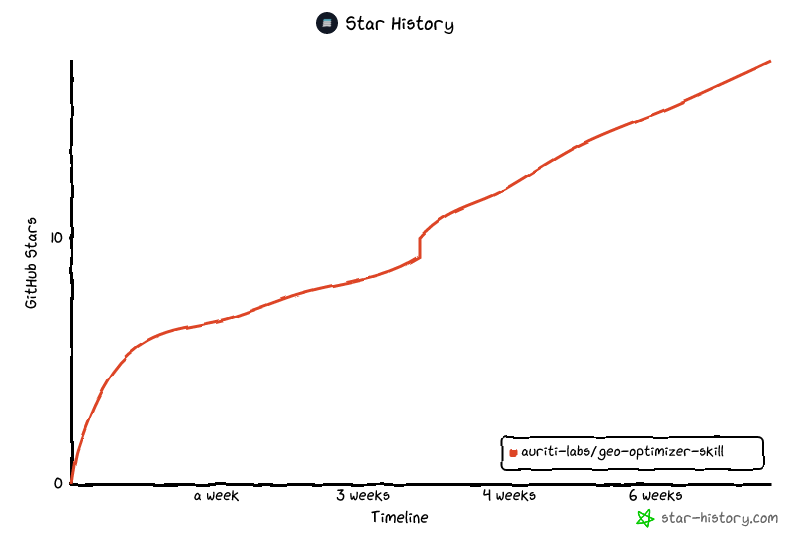
Star History
Project details
Verified details
These details have been verified by PyPIProject links
GitHub Statistics
Maintainers
Release history Release notifications | RSS feed


Download files
Download the file for your platform. If you're not sure which to choose, learn more about installing packages.
Source Distribution
Built Distribution
Filter files by name, interpreter, ABI, and platform.
If you're not sure about the file name format, learn more about wheel file names.
Copy a direct link to the current filters
File details
Details for the file geo_optimizer_skill-4.14.0.tar.gz.
File metadata
- Download URL: geo_optimizer_skill-4.14.0.tar.gz
- Upload date:
- Size: 563.4 kB
- Tags: Source
- Uploaded using Trusted Publishing? Yes
- Uploaded via: twine/6.1.0 CPython/3.13.12
File hashes
| Algorithm | Hash digest | |
|---|---|---|
| SHA256 |
32e2314028edb7cfa92f1a5a5d9f86a47ab5794770a4eabe1fc56fd692117359
|
|
| MD5 |
a05b7fe26b848aace8077c9da0ba14d8
|
|
| BLAKE2b-256 |
581b3bde313e56a249597ad57c359035d748942dafb6774025198d90355ea79c
|
Provenance
The following attestation bundles were made for geo_optimizer_skill-4.14.0.tar.gz:
Publisher:
publish.yml on Auriti-Labs/geo-optimizer-skill
-
Statement:
-
Statement type:
https://in-toto.io/Statement/v1 -
Predicate type:
https://docs.pypi.org/attestations/publish/v1 -
Subject name:
geo_optimizer_skill-4.14.0.tar.gz -
Subject digest:
32e2314028edb7cfa92f1a5a5d9f86a47ab5794770a4eabe1fc56fd692117359 - Sigstore transparency entry: 1792253607
- Sigstore integration time:
-
Permalink:
Auriti-Labs/geo-optimizer-skill@23cc883f7701d0cbb8855acaf11fb800915377c9 -
Branch / Tag:
refs/tags/v4.14.0 - Owner: https://github.com/Auriti-Labs
-
Access:
public
-
Token Issuer:
https://token.actions.githubusercontent.com -
Runner Environment:
github-hosted -
Publication workflow:
publish.yml@23cc883f7701d0cbb8855acaf11fb800915377c9 -
Trigger Event:
push
-
Statement type:
File details
Details for the file geo_optimizer_skill-4.14.0-py3-none-any.whl.
File metadata
- Download URL: geo_optimizer_skill-4.14.0-py3-none-any.whl
- Upload date:
- Size: 460.2 kB
- Tags: Python 3
- Uploaded using Trusted Publishing? Yes
- Uploaded via: twine/6.1.0 CPython/3.13.12
File hashes
| Algorithm | Hash digest | |
|---|---|---|
| SHA256 |
2e2c15d4ee5a7732fbb8d01e7f9f38ec6150a154e584aae113f41a11430b1977
|
|
| MD5 |
6d3f0a2039b31ed8ad3cd9b7c68eb840
|
|
| BLAKE2b-256 |
7009bcdc9ef479cc9d71d662a397a310ff9ec6a79102d85417f3779f4e1af423
|
Provenance
The following attestation bundles were made for geo_optimizer_skill-4.14.0-py3-none-any.whl:
Publisher:
publish.yml on Auriti-Labs/geo-optimizer-skill
-
Statement:
-
Statement type:
https://in-toto.io/Statement/v1 -
Predicate type:
https://docs.pypi.org/attestations/publish/v1 -
Subject name:
geo_optimizer_skill-4.14.0-py3-none-any.whl -
Subject digest:
2e2c15d4ee5a7732fbb8d01e7f9f38ec6150a154e584aae113f41a11430b1977 - Sigstore transparency entry: 1792253851
- Sigstore integration time:
-
Permalink:
Auriti-Labs/geo-optimizer-skill@23cc883f7701d0cbb8855acaf11fb800915377c9 -
Branch / Tag:
refs/tags/v4.14.0 - Owner: https://github.com/Auriti-Labs
-
Access:
public
-
Token Issuer:
https://token.actions.githubusercontent.com -
Runner Environment:
github-hosted -
Publication workflow:
publish.yml@23cc883f7701d0cbb8855acaf11fb800915377c9 -
Trigger Event:
push
-
Statement type:






