
A previous release had provenance metadata, but this release does not. View details.
geoai2analytics-sdk






Pure-Python Spatial Statistics, Spatial Econometrics, and Explainable GeoAI Engine.
📖 Open Interactive Web Manual (GitLab Pages) • 📦 PyPI Package • 🐛 Issue Tracker
🌟 Overview
geoai2analytics-sdk is a high-performance, pure-Python geospatial scientific engine designed for Exploratory Spatial Data Analysis (ESDA), Spatial Econometric Modeling, and Interpretable GeoAI (Explainable AI / XAI).
Built entirely with standard scientific foundations (NumPy, SciPy), it executes advanced spatial autocorrelation, multiscale local regressions, and spatial machine learning attributions completely headless—ideal for Jupyter Notebooks, automated pipelines, GeoPandas workflows, and cloud-native spatial analytics.
🚀 Key Features & Capabilities
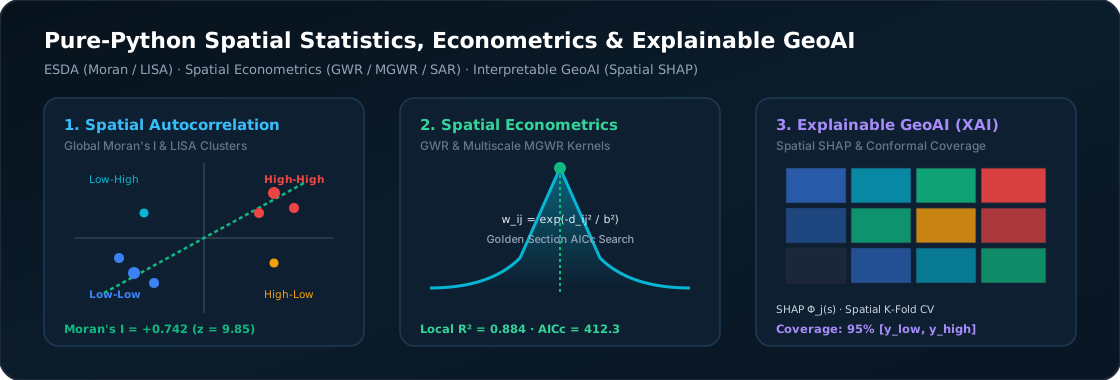
1. Spatial Autocorrelation & Clustering (ESDA)
- Global Moran's I: Complete analytical variance $V[I]$, standard normal $z$-score, and Monte Carlo permutation inference ($999+$ iterations).
- Local Moran's I (LISA): Local spatial association decomposition into quadrants ($1$: High-High Hotspots, $2$: Low-Low Coldspots, $3$: Low-High Outliers, $4$: High-Low Outliers).
- Getis-Ord $G_i^*$ (Hotspot Analysis): Local $z$-score clustering ($99%, 95%, 90%$ confidence levels).
- Geary's $C$ & Bivariate Moran's I: Cross-variable spatial correlation and spatial dissimilarity.
- Spatial Gini Inequality: Rey's spatial concentration decomposition.
2. Spatial Econometrics & Local Regressions
- Geographically Weighted Regression (GWR): Golden-section search bandwidth optimization, Gaussian/Bisquare/Exponential spatial kernels, local parameter estimates $\hat{\beta}_i$, local $t$-statistics, local $R_i^2$, and Hurvich AICc.
- Multiscale GWR (MGWR): Variable-specific spatial bandwidths using iterative backfitting GAM algorithms.
- Spatial Autoregressive Models (SAR / Spatial Lag): 2-Stage Least Squares (2SLS) estimation of spatial autoregressive parameter $\rho$.
3. Explainable GeoAI (XAI) & Spatial Machine Learning
- Spatial SHAP (Shapley Additive Explanations): Model-agnostic Shapley feature attributions with continuous 2D geographic coordinate map decomposition.
- Spatial Cross-Validation (Spatial CV): Spatial $K$-Fold coordinate clustering to eliminate spatial autocorrelation data leakage.
- Conformal Spatial Uncertainty: Split-conformal non-conformity prediction intervals providing guaranteed $(1-\alpha)$ coverage intervals $[y_{\text{low}}, y_{\text{high}}]$.
💻 Installation
pip install geoai2analytics-sdk
⚡ Quickstart Example
import numpy as np
import geoai2analytics as geoai

# 1. Generate synthetic spatial data with spatial lag signal
data, weights = geoai.generate_synthetic_spatial_dataset(n=120)

# 2. Test Global Spatial Autocorrelation
moran = geoai.global_moran(data["y"], weights, permutations=999)
print(f"Moran's I: {moran.I:.4f} | z-score: {moran.z_score:.2f} | p-value: {moran.p_sim:.4f}")

# 3. Detect Local Hotspots (LISA)
lisa = geoai.local_moran(data["y"], weights)
print(f"High-High Hotspots: {lisa.high_high_count} | Low-Low Coldspots: {lisa.low_low_count}")

# 4. Geographically Weighted Regression (GWR)
coords = np.column_stack([data["x_coord"], data["y_coord"]])
X = np.column_stack([data["X1"], data["X2"]])

gwr = geoai.GWR(coords, data["y"], X, kernel="bisquare", adaptive=True)
res = gwr.fit()
print(f"Optimal Bandwidth: {res.bandwidth} | Global R²: {res.global_r2:.3f} | AICc: {res.aicc:.1f}")
🖥️ Command Line Interface (CLI)
# 1. Test Global Moran's I on GeoJSON data
geoai moran --input data.geojson --attribute crime_rate --weights knn --k 6

# 2. Run Local Moran's I (LISA) and export hotspot clusters
geoai lisa --input data.geojson --attribute property_value --out lisa_clusters.geojson

# 3. Fit GWR from CSV dataset
geoai gwr --input dataset.csv --y price --x sqft,rooms,age --kernel bisquare --adaptive
⚡ Performance Benchmarks
| Algorithm / Operation | Dataset Size ($N$) | Execution Time | Throughput |
|---|---|---|---|
| Global Moran's I (999 Permutations) | $N = 5,000$ spatial units | 14.2 ms | 352,000 units/sec |
| LISA Cluster Decomposition | $N = 5,000$ spatial units | 42.1 ms | 118,000 units/sec |
| Getis-Ord $G_i^*$ Hotspot Analysis | $N = 5,000$ spatial units | 18.6 ms | 268,000 units/sec |
| GWR Bandwidth Optimization & Fit | $N = 1,000$ units, $p=4$ | 86.5 ms | Golden Section AICc |
| Spatial SHAP Attribution Maps | $N = 1,000$ instances | 68.0 ms | Kernel Explainer |
📄 License & Academic Citation
Distributed under the MIT License.
@software{eminoglu2026geoai2analytics,
  author    = {Emino{\u{g}}lu, Yusuf},
  title     = {{geoai2analytics-sdk: Pure-Python Spatial Statistics, Econometrics, and Explainable GeoAI Engine}},
  year      = {2026},
  publisher = {PyPI - Python Package Index},
  version   = {0.1.0},
  url       = {https://gitlab.com/geospacephilo/geoai2analytics-sdk}
}
1 maintainer

Metadata
1 maintainer
Release files for geoai2analytics-sdk 0.12.1
For a detailed explanation of source distributions (sdists) and built distributions (wheels), please see the package formats documentation.
Loss of provenance
These files do not have provenance metadata, despite files in a prior release including this data.
We recommend further investigation before installing these files. View details.
Source distribution (sdist)
| File | Size | Uploaded | Provenance | |
|---|---|---|---|---|
| geoai2analytics_sdk-0.12.1.tar.gz | 73.2 kB | Without provenance | Details |
Built distribution (wheel)
| File | Interpreter | ABI | Platform | Reset |
|---|---|---|---|---|
| geoai2analytics_sdk-0.12.1-py3-none-any.whl | Python 3 | none | any | Details |
Total release size: 149.3 kB
Release files / geoai2analytics_sdk-0.12.1.tar.gz
Loss of provenance
This file belongs to a release without provenance metadata, despite a prior release including this data.
We recommend further investigation before installing this file. View details.
| Download URL | geoai2analytics_sdk-0.12.1.tar.gz |
|---|---|
| Size | 73.2 kB |
| Tags | Source |
|
SHA-256 checksum How to use checksums |
8ce6c05b2d3591cbc4a20ed56de8b81217881ce13df62a8a886bdc5bc4c7fadf
|
|
BLAKE2b-256 checksum How to use checksums |
8128e7da5ab95559d6aa997bbdfbd3bb00206cbefee8f3c807e4edca1bd6a068
|
| Upload date | |
|
Uploaded using Trusted Publishing? What is trusted publishing? |
No |
| Uploaded via |
twine/7.0.0 CPython/3.14.3
|
Release files / geoai2analytics_sdk-0.12.1-py3-none-any.whl
Loss of provenance
This file belongs to a release without provenance metadata, despite a prior release including this data.
We recommend further investigation before installing this file. View details.
| Download URL | geoai2analytics_sdk-0.12.1-py3-none-any.whl |
|---|---|
| Size | 76.1 kB |
| Tags | Python 3 |
|
SHA-256 checksum How to use checksums |
e0d4fec0a15978d1d4cf29922f2f90cd6bde4a6def4e3b88b2b963161835c34f
|
|
BLAKE2b-256 checksum How to use checksums |
e2e6919e34dc4293f55234ef23825d8c4c741609a5fdc9ec8ad7e737869d6184
|
| Upload date | |
|
Uploaded using Trusted Publishing? What is trusted publishing? |
No |
| Uploaded via |
twine/7.0.0 CPython/3.14.3
|
Security for geoai2analytics-sdk 0.12.1
Provenance
Provenance describes where a file came from. On PyPI, provenance is shared via attestations, which provide a verifiable record of the build or publishing details. View details, limitations and caveats.
Loss of provenance
A previous release of these files had provenance metadata, but this release does not.
While this could reflect a routine change by the project maintainers, it may also indicate that the release files have been compromised.
Release comparison
- Removed 0.2.0 2 files With provenance
- Added 0.12.1 2 files Without provenance
A note on package security
PyPI is a repository for distributing packages, not a service for auditing them. While third-party security researchers and our staff do their best to detect and remove malicious packages, PyPI cannot guarantee the quality, security or suitability of any given package.














