
geometrics





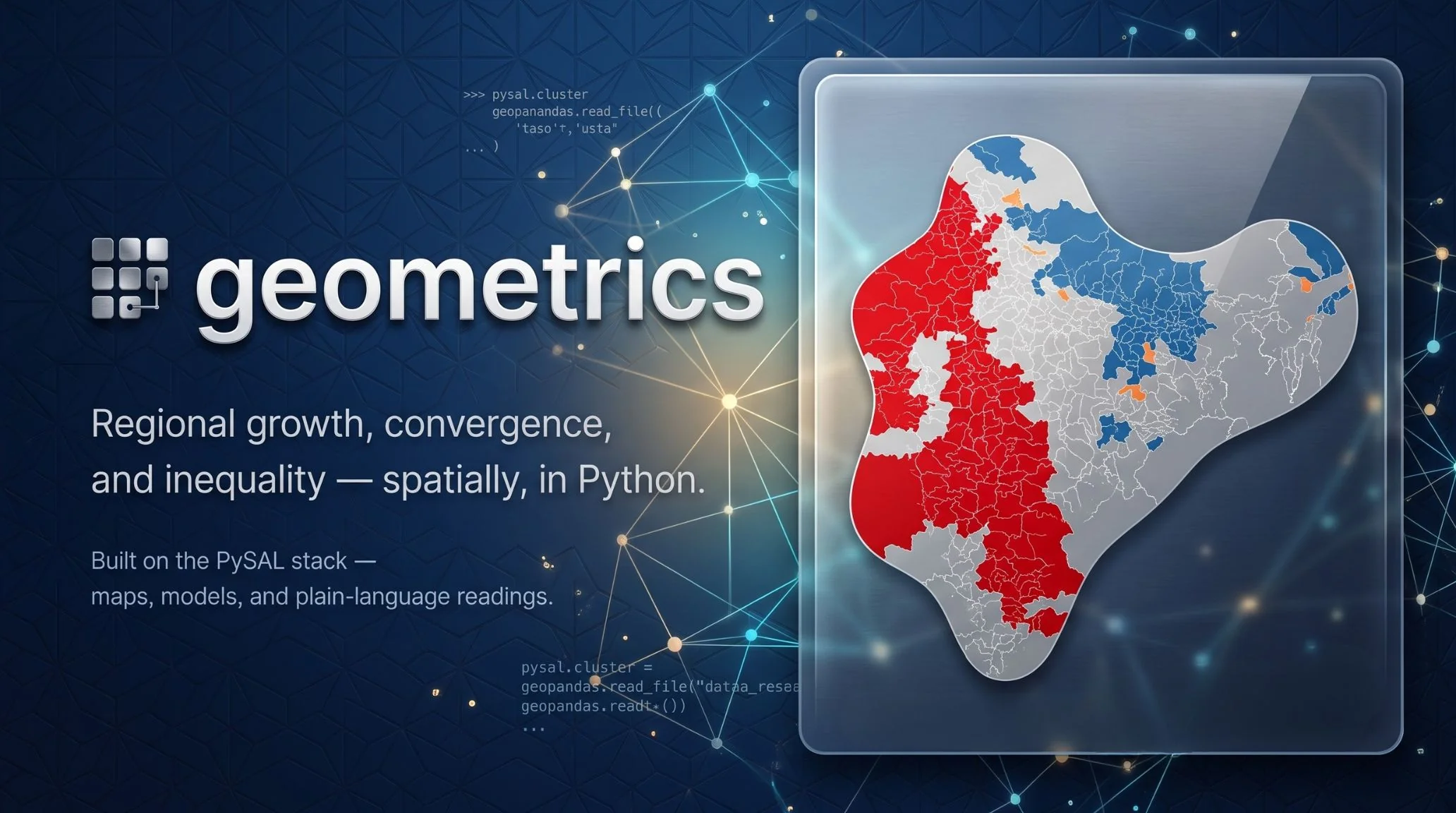
geometrics studies regional growth, convergence, and inequality with explicit spatial methods. It builds on the excellent PySAL family — libpysal, esda, giddy, inequality, mapclassify, spreg, and mgwr — and wraps the standard analyses of the regional convergence literature into illustrative, easy-to-apply functions that return interactive Plotly figures, Great Tables, and tidy DataFrames.
It follows the design language of expdpy and is presented in three modules, each with its own pedagogical walkthrough and Colab notebook:
| Module | What it does | Docs | Colab |
|---|---|---|---|
| 🗺️ Explore | Choropleths, weights, Moran/LISA, space-time views | Explore | explore.ipynb |
| 🧮 Analyze | β/σ/club convergence, spatial models with impacts, Markov, inequality, GWR | Analyze | analyze.ipynb |
| 📚 Learn | 11 learn_* concept sandboxes + a 30-topic explainer index; .interpret() / .explain() on every result |
Learn | learn.ipynb |
The data model: three inputs
| Input | What it is | How it enters |
|---|---|---|
gdf |
Geometry with only the entity ID — shapefile, zipped shapefile, GeoJSON, or GeoPackage (or a GeoDataFrame) | gm.read_gdf("districts.gpkg", entity="district_id") |
df |
A long-form panel — one row per (entity, time) | gm.set_panel(df, entity="district_id", time="year") |
df_dict |
A data dictionary — var_name, var_def, label, type, role, can_be_na |
gm.set_labels(df, df_dict, set_panel=True) |
Installation
pip install geometrics                 # core
pip install "geometrics[dynamics]"     # + Markov / spatial Markov (giddy)
pip install "geometrics[streamlit]"    # + the three no-code apps
pip install "geometrics[all]"          # everything, incl. PNG export
Run the apps locally with streamlit run app_explore.py (or app_analyze.py /
app_learn.py), or from Python with
geometrics.streamlit_app.ExploreApp().
Bundled case studies
- India — 520 districts observed by satellite nighttime lights (1996-2010), from
Mendez, Kabiraj & Li (quarcs-lab/project2025s-py):
gm.data.load_india(),load_india_states() - Bolivia — PWT-anchored local GDP (2021 PPP US$, 2012-2022) at three scales,
derived from Rossi-Hansberg & Zhang (2026) and
Penn World Table 11.0:
gm.data.load_bolivia()(112 provinces),load_bolivia_departments()(9 departments),load_bolivia_grid()(1,603 cells) — seedatasets/for the citation-grade documentation
At a glance: the Indian case study
import geometrics as gm

gdf, df, df_dict = gm.data.load_india()      # ID-only geometry, long panel, dictionary
df = gm.set_labels(df, df_dict, set_panel=True)

gm.explore_choropleth_map(df, "ntl_total", gdf=gdf, period=2010).fig
w = gm.make_weights(gdf, method="knn", k=6)
gm.explore_lisa_cluster_map(df, "log_ntl_pc_1996", gdf=gdf, w=w).fig

res = gm.analyze_beta_convergence(
    df, "ntl_total", model="sdm", gdf=gdf, w=w
)
print(res.interpret())                       # plain-language reading
res.fig                                      # convergence scatter
Features
- Maps & ESDA — classified/animated choropleths (
explore_choropleth_map), weights connectivity (explore_connectivity_map), Moran scatterplots, LISA cluster maps, Moran over time - Space-time dynamics — cross-sectional distribution evolution
(
explore_distribution_over_time), entity-by-time heatmaps - Convergence — β-convergence with OLS or spatial (SAR/SEM/SLX/SDM) estimators and LeSage-Pace impact decomposition, σ-convergence, Phillips-Sul convergence clubs with club maps
- Spatial econometrics — the spreg suite (
analyze_spatial_model), LM diagnostics with a model recommendation (analyze_spatial_diagnostics), alternative-weights robustness (analyze_spatial_model_by_weights) - Distribution dynamics — Markov and spatial Markov transition analysis
(
analyze_markov_transitions,analyze_spatial_markov) - Inequality — Gini/Theil trends with spatial decomposition
(
analyze_inequality_over_time), Theil between/within decomposition (analyze_theil_decomposition) - Local models — GWR and multiscale GWR with mapped local coefficients
(
analyze_gwr,analyze_mgwr) - Concept sandboxes — 11
learn_*teaching functions that simulate data from a known DGP so you can watch each estimator recover a planted parameter (learn_spatial_autocorrelation,learn_spatial_spillovers,learn_beta_convergence, ...)
Documentation
- Website: https://quarcs-lab.github.io/geometrics/
- The India case study article and Colab notebooks: see
docs/andnotebooks/
Development
git clone https://github.com/quarcs-lab/geometrics
cd geometrics
uv sync --locked --all-extras --group dev --group docs
make test && make lint && make typecheck
Citation
If you use geometrics in your research, please cite the repository (see
CITATION.cff) and the underlying PySAL packages.
Acknowledgments
Developed at the QuaRCS Lab (Quantitative Regional and Computational Science). geometrics stands on the shoulders of the PySAL project, geopandas, Plotly, and Great Tables.
License
MIT
1 maintainer

Metadata
1 maintainer
Release files for geometrics 0.1.3
For a detailed explanation of source distributions (sdists) and built distributions (wheels), please see the package formats documentation.
Source distribution (sdist)
| File | Size | Uploaded | |
|---|---|---|---|
| geometrics-0.1.3.tar.gz | 373.4 kB | Details |
Built distribution (wheel)
| File | Interpreter | ABI | Platform | Reset |
|---|---|---|---|---|
| geometrics-0.1.3-py3-none-any.whl | Python 3 | none | any | Details |
Total release size: 657.0 kB
Release files / geometrics-0.1.3.tar.gz
| Download URL | geometrics-0.1.3.tar.gz |
|---|---|
| Size | 373.4 kB |
| Tags | Source |
|
SHA-256 checksum How to use checksums |
7bd3ff0d41f5eb2b79818877b156c5feb980f71dab4fbceb6463916fe4434a62
|
|
BLAKE2b-256 checksum How to use checksums |
eb96c9f67e2d5f735900b57b90d4f6ebc51d270f8abe7285de200fe582cfdc99
|
| Upload date | |
|
Uploaded using Trusted Publishing? What is trusted publishing? |
Yes |
| Uploaded via |
twine/6.1.0 CPython/3.13.12
|
Provenance
Provenance describes where a file came from. On PyPI, provenance is shared via attestations, which provide a verifiable record of the build or publishing details. View details, limitations and caveats.


PyPI Publish Attestation
PyPI verified that this artifact, at this checksum, originated from the publisher listed below.
Signed by GitHub Actions, verified by PyPI on Jul 2, 2026.
Transparency logRelease files / geometrics-0.1.3-py3-none-any.whl
| Download URL | geometrics-0.1.3-py3-none-any.whl |
|---|---|
| Size | 283.6 kB |
| Tags | Python 3 |
|
SHA-256 checksum How to use checksums |
de98f1a63310a4f1669c26c074f6ab04f8d755cdb71087757f0357ac1b4a1223
|
|
BLAKE2b-256 checksum How to use checksums |
aa75b7069ba42cf01358b411ae8a816f22f79014fc16805d46fab7a259805731
|
| Upload date | |
|
Uploaded using Trusted Publishing? What is trusted publishing? |
Yes |
| Uploaded via |
twine/6.1.0 CPython/3.13.12
|
Provenance
Provenance describes where a file came from. On PyPI, provenance is shared via attestations, which provide a verifiable record of the build or publishing details. View details, limitations and caveats.
PyPI Publish Attestation
PyPI verified that this artifact, at this checksum, originated from the publisher listed below.
Signed by GitHub Actions, verified by PyPI on Jul 2, 2026.
Transparency log













