
GESSO: Spatial Gene Set Activity Analysis
GESSO (Gene sEt activity Score analysis with Spatial lOcation) is a computational method for estimating spatially coherent gene set activity from spatial transcriptomics data.
This repository is the official Python implementation of GESSO. Please visit the GESSO documentation for tutorials and API details.
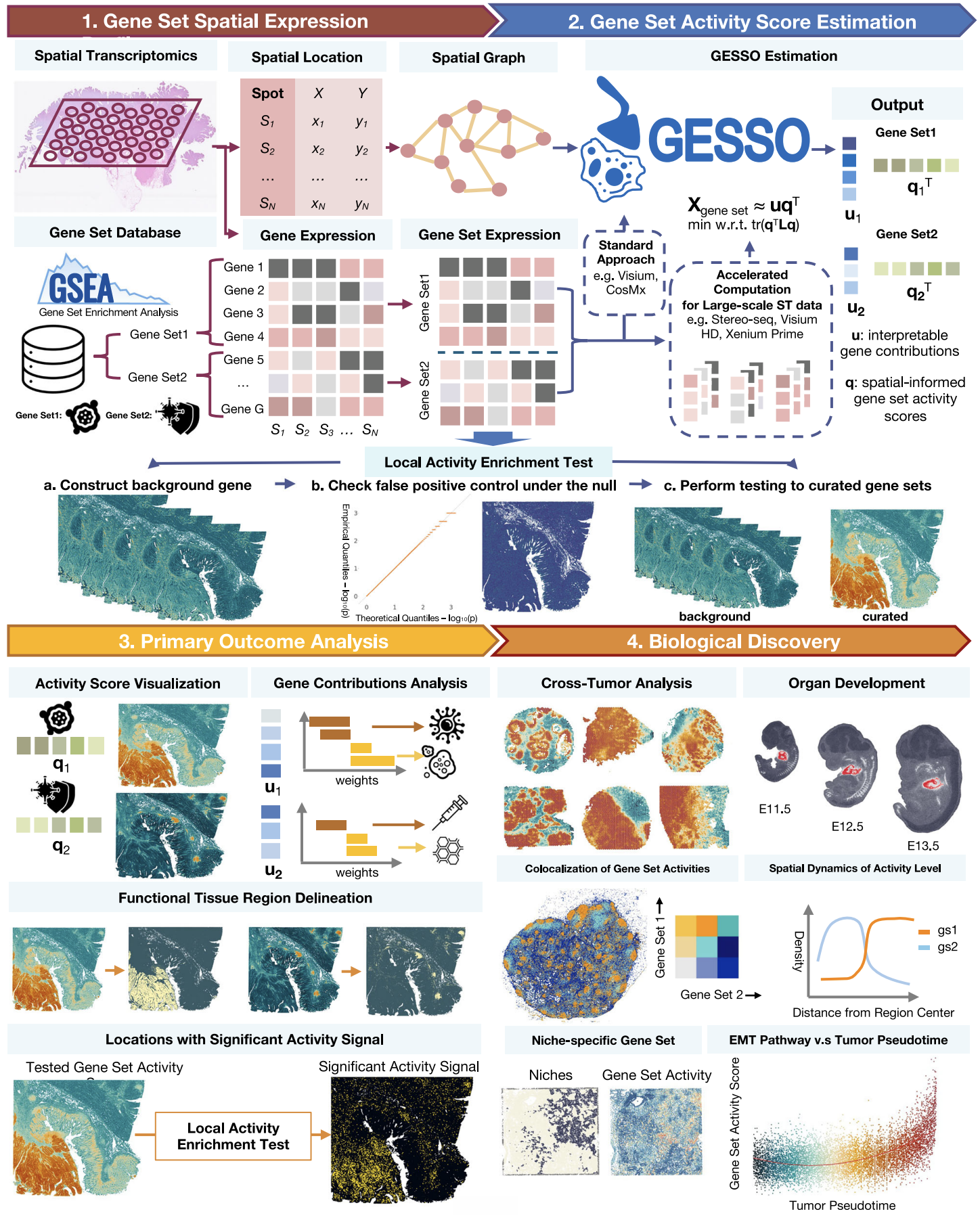
Figure 1. Overview of the GESSO workflow and applications. From the GESSO paper in Nature Communications.
Installation
The PyPI distribution name is gesso-py; the Python import remains
from gesso import GESSO.
We recommend installing GESSO in a new Python environment. You can create a new Python environment through conda:
conda create -n gesso python=3.12 -y
conda activate gesso
GESSO supports Python 3.12, 3.13, and 3.14. The example above uses 3.12; you can substitute either of the other supported versions. Install GESSO from PyPI:
pip install gesso-py
Quick start
For Scanpy/Squidpy workflows, install optional AnnData support with
pip install 'gesso-py[anndata]', or install the plotting tutorial
dependencies with pip install 'gesso-py[tutorial]'. GESSO itself requires neither
Scanpy nor Squidpy. Use GESSO.from_anndata(adata, layer="counts") to preserve
sparse expression and report.write_to_anndata(adata) to attach pathway scores.
See the AnnData tutorial
for normalization choices and plotting examples.
GESSO processes spatial transcriptomics data along with a user-defined gene set/pathway and outputs a gene set activity score (GAS) for each spatial location.
Let's say your spatial transcriptomics dataset contains counts for $G$ genes across $N$ spots. You'll need to prepare an $N \times G$ expression pd.DataFrame as well as an $N \times 2$ locations pd.DataFrame. The indices of the two DataFrames must match. The locations DataFrame must contain two columns named x and y.
import pandas as pd
from gesso import GESSO

# load data
expression_df: pd.DataFrame = ...
locations_df: pd.DataFrame = ...

# initialize a GESSO model
model = GESSO(
    expression_df=expression_df,
    locations_df=locations_df,
    k=20,
    normalize_counts_method="normalize-log1p"   # optional, use for raw data
)

# compute gene set activity scores
gas_report = model.compute_gas(
    genesets_dict={
        "example_geneset_1": ["gene1", "gene2", "gene3"],
        "example_geneset_2": ["gene4", "gene5", "gene6"],
    },
    n_jobs=2        # number of parallel jobs
)
gas_df = gas_report.gas_df()    # returns N by n_genesets df
gas_df.to_csv("gas_output.csv")

# test whether each spot exhibits significantly elevated gene set activity
htest_report = model.htest_elevated_gas(
    geneset="example_geneset_1",
    genes_in_geneset=["gene1", "gene2", "gene3"],
    n_permutations=500,     # number of random gene sets to sample
    n_jobs=8
)
htest_df = htest_report.htest_df()  # returns N by 4 df w/ columns 'x', 'y', 'gas', 'p'
htest_df.to_csv("htest_output.csv")
Tutorials
The documentation includes a runnable tutorial using the small dataset bundled in demo_data, as well as demonstrations for several spatial transcriptomics platforms. The platform-scale demonstrations require the corresponding public datasets described in each notebook.
Download or clone the repository for the notebooks and bundled demo data; these are not included in the installed package.
AI-assisted analysis
The gesso_vibe folder includes an analysis skill for AI agents, with guidance on spatial data input, pathway scoring, and exporting results through the GESSO Python API.
Citation
If you use GESSO, please cite the following article and the specific GESSO software release used in your analysis:
Yang, A. J., Tan, C. & Ma, Y. Interpretable and scalable spatial gene set activity analysis with GESSO uncovers functional tissue architecture. Nature Communications (2026). https://doi.org/10.1038/s41467-026-78316-z
Machine-readable citation metadata are provided in CITATION.cff.
License
GESSO is released under the MIT License.
1 maintainer

Metadata
1 maintainer
Release files for gesso-py 0.2.0
For a detailed explanation of source distributions (sdists) and built distributions (wheels), please see the package formats documentation.
Source distribution (sdist)
| File | Size | Uploaded | Provenance | Actions |
|---|---|---|---|---|
| gesso_py-0.2.0.tar.gz | 14.0 MB | With provenance | Details for gesso_py-0.2.0.tar.gz |
Built distribution (wheel)
| File | Interpreter | ABI | Platform | Actions Reset |
|---|---|---|---|---|
| gesso_py-0.2.0-py3-none-any.whl | Python 3 | none | any | Details for gesso_py-0.2.0-py3-none-any.whl |
Total release size: 14.1 MB
Release files / gesso_py-0.2.0.tar.gz
| Download URL | gesso_py-0.2.0.tar.gz |
|---|---|
| Size | 14.0 MB |
| Tags | Source |
|
SHA-256 checksum How to use checksums |
4e11cd7006a630042ba2213a4eae3a5c0a1a1f99990808f3ec8fd0467d6a77d8
|
|
BLAKE2b-256 checksum How to use checksums |
5749c7216192c9e56ecc7c503ef9849434f52bf52e929b871ad764cc209a1fbc
|
| Upload date | |
|
Uploaded using Trusted Publishing? What is trusted publishing? |
Yes |
| Uploaded via |
twine/7.0.0 CPython/3.13.16
|
Provenance
Provenance describes where a file came from. On PyPI, provenance is shared via attestations, which provide a verifiable record of the build or publishing details. View details, limitations and caveats.


PyPI Publish Attestation
PyPI verified that this artifact, at this checksum, originated from the publisher listed below.
Signed by GitHub Actions, verified by PyPI on Nov 3, 2026.
Transparency logRelease files / gesso_py-0.2.0-py3-none-any.whl
| Download URL | gesso_py-0.2.0-py3-none-any.whl |
|---|---|
| Size | 30.4 kB |
| Tags | Python 3 |
|
SHA-256 checksum How to use checksums |
b67c597216777392b6f41d8b0d58a796801df5b0e3306b483d92d9bf355473bf
|
|
BLAKE2b-256 checksum How to use checksums |
4471f0c2431020a580199ac7f691b2c5e5f1ecf348f9837c7ace05352b1a8d82
|
| Upload date | |
|
Uploaded using Trusted Publishing? What is trusted publishing? |
Yes |
| Uploaded via |
twine/7.0.0 CPython/3.13.16
|
Provenance
Provenance describes where a file came from. On PyPI, provenance is shared via attestations, which provide a verifiable record of the build or publishing details. View details, limitations and caveats.
PyPI Publish Attestation
PyPI verified that this artifact, at this checksum, originated from the publisher listed below.
Signed by GitHub Actions, verified by PyPI on Nov 3, 2026.
Transparency logSecurity for gesso-py 0.2.0
Provenance
Provenance describes where a file came from. On PyPI, provenance is shared via attestations, which provide a verifiable record of the build or publishing details. View details, limitations and caveats.
Full provenance
All 2 files in this release have been uploaded with provenance metadata.
Attestation for gesso_py-0.2.0.tar.gz
PyPI Publish Attestation
PyPI verified that this artifact, at this checksum, originated from the publisher listed below.
Signed by GitHub Actions, verified by PyPI on Nov 3, 2026.
Transparency logA note on package security
PyPI is a repository for distributing packages, not a service for auditing them. While third-party security researchers and our staff do their best to detect and remove malicious packages, PyPI cannot guarantee the quality, security or suitability of any given package.
To learn more about protecting yourself from malicious actors, visit our package security documentation.













