
Get Physics Done (GPD)
Built by physicists, for physicists









Get Physics Done is an open-source agentic AI system for physics research from Physical Superintelligence PBC (PSI), released as a community contribution. GPD helps turn a research question into a structured workflow: scope the problem, plan the work, derive results, verify them, and package the output.
https://github.com/user-attachments/assets/e79f8153-c0bd-484f-b69e-da8f142649e0
Start Here · Quick Start · Supported Runtimes · Workflow · Commands · Models · Advanced CLI · System Requirements
Start Here
GPD is not a standalone app. It installs physics-research commands into Claude Code, Codex, Gemini CLI, or OpenCode.
To install GPD, run this in your system terminal:
# Requires Node.js.
npx -y get-physics-done
Working from a source checkout?
If you are developing this repo itself rather than installing the published
bootstrap package, prefer uv so the environment is resolved from
pyproject.toml and uv.lock:
uv sync --dev
uv run gpd --help
After uv sync --dev, you can also source .venv/bin/activate and run
gpd ... directly if you prefer an activated shell. To exercise the public
installer flow from a source checkout, still use the matching npx -y get-physics-done bootstrap command from Start Here.
Need Node.js?
npm and npx come with Node.js, so install Node.js 20 or newer first in your
normal system terminal, then come back here.
- Windows: Install Node.js LTS with
winget(includesnpmandnpx):winget install OpenJS.NodeJS.LTS - macOS: Install Node.js with Homebrew (includes
npmandnpx):brew install node - Linux: follow the Linux guide. Distribution
nodejs/npmpackages are useful only ifnode --versionreportsv20or newer.
New to terminals?
If you are new to terminals, start with the Beginner Onboarding Hub. Use the hub as the single beginner path. It keeps the OS guides, runtime guides, and post-install checklist in one place, while this README keeps the reference tables and advanced surfaces.
The hub owns the beginner preflight and caveats: prerequisites, runtime/account expectations, and the reminder that GPD does not install your runtime or provide model access, billing, or API credits.
Here, "runtime" means the AI terminal app you talk to, such as Claude Code, Codex, Gemini CLI, or OpenCode.
There are two places you type commands:
- In your normal system terminal:
npx ...,gpd ...,claude,codex,gemini,opencode - Inside your AI runtime:
/gpd:...,$gpd-..., or/gpd-...
Who This Is For
GPD is for physics research projects that need more structure than a one-off chat.
It is designed for long-horizon projects that require rigorous verification, structured research memory, multi-step analytical work, complex numerical studies, and manuscript writing or review.
GPD is built to favor scientific rigor and critical thinking over agreeability. Treat preferred explanations as hypotheses to test, and keep missing evidence, failed lookups, and unproduced artifacts explicit instead of inventing them.
GPD is a scalpel, not an autopilot. Treat each agent turn like a graduate student's work: trust the execution, but stay in the loop to verify and redirect. Supervised mode gives you the frequent checkpoints that match that advisor role; graduate to Balanced once you trust GPD's boundary on your specific research.
We welcome contributions and feedback via GitHub issues or pull requests; if GPD is useful in your work, please star the repo, and share it with colleagues who might benefit.
Quick Start
If you already know your runtime and are comfortable in a terminal, use this as the fast path. If not, go back to Start Here and use the Beginner Onboarding Hub instead.
Canonical post-install order, shown as command names without runtime prefixes:
help -> start -> tour -> new-project / map-research -> resume-work
Run its help command first: Claude Code / Gemini CLI use /gpd:help. Codex uses $gpd-help, and OpenCode uses /gpd-help.
Expert fast path:
- From inside the folder where your project should live, install GPD with the matching
npx -y get-physics-donebootstrap command from Start Here, then launchclaude,codex,gemini, oropencode. - Run the matching GPD help command shown in Supported Runtimes.
- Then use
startif you are not sure what fits this folder,tourfor a read-only walkthrough,new-project --minimalfor new work,map-researchfor existing work, orresume-workwhen you return later. - Treat the new-work choice as distinct from the existing-work choice; pick one, then follow it through.
The bootstrap installer requires Node.js 20+, Python 3.11+ with venv, and one supported runtime (claude, gemini, codex, or opencode).
If the install worked, both of these should be true:
gpd --helpworks in your normal terminal.- Your runtime-specific GPD help command works inside the runtime.
Then choose the path that matches your starting point:
The table below uses canonical command names without runtime prefixes. Apply the prefix for your runtime from Supported Runtimes.
| Starting point | Use this |
|---|---|
| Not sure which path fits this folder | start |
| Want a guided command walkthrough | tour |
| New research project | new-project --minimal |
| Existing research folder or codebase | map-research |
| Current-workspace recovery snapshot | gpd resume |
| Find a workspace to reopen first | gpd resume --recent, then resume-work |
| Continue in an existing GPD project | resume-work |
gpd resume is the normal-terminal recovery step; resume-work is the in-runtime continue command after the right folder is open.
After resuming, the runtime suggest-next command is the fastest post-resume next command when you only need the next action.
Optional Terminal-Side Readiness And Troubleshooting Reference
Use this when you want to verify install health, unattended readiness, paper-toolchain prerequisites, or local CLI surfaces from your normal terminal. If you want the full beginner path, stay with the onboarding hub and your selected OS/runtime guides.
Bootstrap hard blockers
node/npxwork in your normal system terminal- Python 3.11+ with the standard
venvmodule is available in that same terminal - Your selected runtime is already installed and launchable there (
claude,gemini,codex, oropencode)
If any of those fail, fix them before troubleshooting GPD itself. These are bootstrap prerequisites for the matching installer command, not a claim that every local gpd ... command rechecks them.
Advisories
- Choose
--localor--globalexplicitly if you do not want the installer's default path selection - Runtime permissions are runtime-owned permission alignment only; use the guided checks after startup to decide whether the runtime is ready.
- Use your runtime-specific
settingscommand after the first successful launch to review autonomy, workflow defaults, model-cost posture, runtime permission sync, and preset/tier overrides. Safest model-cost start:reviewplus runtime defaults. - For the broader terminal-side diagnostics, readiness, recovery, visibility, cost, and preset surface, start with
gpd --helpfrom your normal terminal. - Use
gpd validate unattended-readiness --runtime <runtime> --autonomy <mode>when you want a terminal-side unattended or overnight verdict. Usesupervisedunless you intentionally selected a different autonomy mode. - If you plan paper/manuscript work later, use
gpd doctor --runtime <runtime> --localfor the project-local target orgpd doctor --runtime <runtime> --globalfor the global target first. For the fuller preset catalog, shared Wolfram integration details, and plan-preflight boundaries, usegpd presets list,gpd integrations status wolfram, andgpd validate plan-preflight <PLAN.md>from your normal terminal. - Provider authentication is checked manually in the runtime itself; GPD will point this out, but it does not hard-block installation readiness on it
- Use
--upgradeonly when you intentionally want the latest unreleased GitHubmainsnapshot
Quick verification path
- Install with an explicit runtime when possible, for example use the matching bootstrap command with
--<runtime-flag> --local. - From the same terminal, run
gpd doctor --runtime <runtime> --localandgpd --help. Add--live-executable-probesif you also want cheap local executable probes such aspdflatex --versionorwolframscript -version. Here,gpd doctor --runtime ...is a runtime-readiness check for the selected runtime target. If you plan to use the paper/manuscript workflow preset later, treat theWorkflow PresetsandLaTeX Toolchainrows in this doctor report as paper-toolchain readiness signals for local smoke checks;write-papercan still proceed degraded, butpaper-buildis the build truth. - Launch your selected runtime and run its GPD help command (
/gpd:help,$gpd-help, or/gpd-help). - If you want unattended execution, use your runtime-specific
settingscommand as the guided configuration path and keep autonomy at Supervised (supervised) while you learn GPD's behavior; move to Balanced (balanced) when you want a lighter checkpoint cadence. - Run
gpd permissions status --runtime <runtime> --autonomy <mode>for the read-only runtime-owned permission snapshot, then rungpd validate unattended-readiness --runtime <runtime> --autonomy <mode>. Usesupervisedif you kept the default. If it returnsnot-ready, rungpd permissions sync --runtime <runtime> --autonomy <mode>; if it returnsrelaunch-required, exit and relaunch the selected runtime before treating unattended use as ready. - If those checks pass, continue with the runtime-specific
new-project,new-project --minimal,resume-work, ormap-researchcommand.
Troubleshooting
- If the bootstrap installer fails before either
gpd doctor --runtime <runtime> --localorgpd doctor --runtime <runtime> --globalcan run, fix Node / Python /venvbootstrap prerequisites first. - If the matching
gpd doctor --runtime <runtime> --localorgpd doctor --runtime <runtime> --globalcommand fails, fix the selected runtime's launcher / target / runtime-readiness issue first. - If that matching doctor command only warns about
Workflow PresetsorLaTeX Toolchain, the base install can still be fine; treat that as degraded readiness forwrite-paperand local smoke checks rather than a full install blocker. Usegpd paper-buildto judge whether the manuscript scaffold is buildable. - If the runtime launches but GPD commands are missing, rerun the installer with an explicit runtime and explicit scope from your normal system terminal.
- If you want the read-only runtime-owned permission snapshot first, run
gpd permissions status --runtime <runtime> --autonomy <mode>. Usesupervisedunless you intentionally selected a different autonomy mode. Ifgpd validate unattended-readiness --runtime <runtime> --autonomy <mode>returnsnot-ready, rungpd permissions sync --runtime <runtime> --autonomy <mode>and check again; if it returnsrelaunch-required, exit and relaunch the runtime before unattended use. - If the runtime itself cannot launch or is not authenticated, fix the runtime/provider setup outside GPD before retrying the GPD install.
Typical new-project workflow, shown as command names without runtime prefixes:
new-project -> discuss-phase 1 -> plan-phase 1 -> execute-phase 1 -> verify-work 1
Install options
| Flag | Meaning |
|---|---|
--claude, --codex, --gemini, --opencode |
Select one runtime. --claude-code and --gemini-cli also work. |
--all |
Select all supported runtimes. |
--local, -l |
Use the current project only. |
--global, -g |
Use the global runtime config dir. |
--uninstall |
Uninstall from the selected runtime config instead of installing. |
--reinstall |
Reinstall ${GPD_HOME:-~/.gpd}/venv from the PyPI pinned release first, with tagged GitHub release sources as fallback. |
--upgrade |
Upgrade ${GPD_HOME:-~/.gpd}/venv from the latest unreleased GitHub main source. |
--target-dir <path> |
Override the runtime config directory; defaults to local scope unless the path resolves to that runtime's canonical global config dir. |
--force-statusline |
Replace an existing runtime statusline during install. |
--help, -h |
Show bootstrap help. |
Ordinary installs and --reinstall use the PyPI pinned release first, then matching tagged GitHub release sources if PyPI is unavailable. Use --upgrade only when you intentionally want the latest unreleased GitHub main source.
Install the unreleased GitHub main snapshot explicitly:
npx -y github:psi-oss/get-physics-done --upgrade
Supported Runtimes
GPD currently installs into four AI runtimes. To preselect one during install, use the matching npx flag, or use --all to install everything in one pass:
| Runtime | npx flag |
Help | Start | Tour | New work | Existing work | Return later |
|---|---|---|---|---|---|---|---|
| Claude Code | --claude |
/gpd:help |
/gpd:start |
/gpd:tour |
/gpd:new-project --minimal |
/gpd:map-research |
/gpd:resume-work |
| Codex | --codex |
$gpd-help |
$gpd-start |
$gpd-tour |
$gpd-new-project --minimal |
$gpd-map-research |
$gpd-resume-work |
| Gemini CLI | --gemini |
/gpd:help |
/gpd:start |
/gpd:tour |
/gpd:new-project --minimal |
/gpd:map-research |
/gpd:resume-work |
| OpenCode | --opencode |
/gpd-help |
/gpd-start |
/gpd-tour |
/gpd-new-project --minimal |
/gpd-map-research |
/gpd-resume-work |
Each runtime uses its own command prefix, but the workflow is the same across all four. For install-path details, runtime-specific hooks, and launcher notes, use the onboarding hub and the runtime guides in docs/.
What GPD Does
GPD guides research in four stages:
- Formulate: asks targeted questions to pin down scope, assumptions, notation, and verification targets.
- Plan: creates a phased roadmap with concrete tasks, dependencies, and success criteria.
- Execute: runs specialist agents for derivations, numerical checks, literature work, and writing.
- Verify: checks dimensional consistency, limiting cases, symmetry constraints, conservation laws, and numerical stability.
Each phase produces real artifacts such as PROJECT.md, REQUIREMENTS.md, ROADMAP.md, STATE.md, .tex derivations, .py verification scripts, and figures.
GPD also locks conventions for up to 18 physics fields across a project so notation, sign choices, and verification assumptions stay consistent as phases accumulate.
How Work Is Structured
GPD's main workflow in GPD/ is organized like this:
Project
└── Milestone (v1.0, v1.1, v2.0, ...)
    └── Phase (1, 2, 2.1, 3, ...)
        └── Plan (01-01, 01-02, ...)
            └── Task
During execution, plans are grouped into waves:
Wave 1: plans with no unmet dependencies
Wave 2: plans that depend on wave 1 outputs
Wave 3: plans that depend on earlier waves
- Project: the overall research workspace and its persistent context.
- Milestone: a major research checkpoint such as a paper submission, revision cycle, or result package. One project can have multiple milestones.
- Phase: one coherent chunk of work inside a milestone. Integer phases are planned work; decimal phases like
2.1are inserted later when urgent work appears. - Plan: the detailed execution breakdown for a phase, created by the runtime-specific
plan-phase Ncommand. - Wave: not a separate top-level planning object, but the execution order inside a phase. Plans in the same wave can run in parallel; later waves depend on earlier ones.
Phase numbers continue across the whole project, so a new milestone may start at Phase 6 rather than resetting to Phase 1.
Worked Example
Conformal bootstrap workflow
The example below uses canonical command names without runtime prefixes.
Suppose you want to use crossing symmetry and the numerical conformal bootstrap to bound low-lying operator dimensions in the 3D Ising CFT.
new-project
> Use crossing symmetry and the numerical conformal bootstrap to bound low-lying operator dimensions in the 3D Ising CFT.
GPD will:
- ask clarifying questions about the correlator sector, conventions, target observables, numerical precision, and verification strategy
- create
GPD/PROJECT.md,GPD/REQUIREMENTS.md,GPD/ROADMAP.md, andGPD/STATE.md - sketch the milestone shape (phases such as crossing-equation setup, derivative-basis construction, semidefinite-program formulation, convergence checks, and interpretation of the resulting bounds) with Phase 1 ready to execute; Phases 2+ stay as stubs that you flesh out on demand with
plan-phase N
Then continue with:
plan-phase 1
execute-phase 1
verify-work 1
Once the relevant phases are complete and verified, continue toward write-up with:
write-paper
peer-review
respond-to-referees
arxiv-submission
Typical artifacts include derivation notes, numerical scripts, convergence studies, and phase-level planning and verification documents under GPD/.
Key GPD Paths
Most research actions run inside your installed AI runtime after GPD has been installed there. Recovery and diagnostics commands like gpd resume, gpd resume --recent, and gpd --help still run from your normal system terminal. The table below uses prefixless command names unless a normal-terminal gpd ... command is shown.
Core Runtime Paths
| Path | Use these commands |
|---|---|
| Start or orient | start, tour |
| Create or import work | new-project, new-project --minimal, map-research |
| Leave or return after a break | gpd resume, gpd resume --recent, resume-work, pause-work, suggest-next |
| Run the research loop | discuss-phase N, plan-phase N, execute-phase N, verify-work, progress, quick (add gpd progress --watch in a second terminal for a live heartbeat) |
| Write and review | write-paper, peer-review, respond-to-referees, arxiv-submission |
| Configure or branch | settings, set-profile, set-tier-models, tangent, branch-hypothesis |
Typical research loop: new-project -> discuss-phase 1 -> plan-phase 1 -> execute-phase 1 -> verify-work -> repeat -> complete-milestone
Typical publication loop: write-paper -> peer-review -> respond-to-referees -> arxiv-submission
Publication boundary: write-paper supports current-project manuscripts plus one bounded external-authoring lane driven by an explicit intake manifest only. In that lane, GPD/publication/{subject_slug}/manuscript is the only manuscript/build root and GPD/publication/{subject_slug}/intake/ keeps intake/provenance state only; it does not mine arbitrary folders or infer claim/evidence bindings from loose notes. peer-review can review the current project manuscript or one explicit manuscript/artifact path or paper directory target. peer-review remains the standalone follow-on command when the bounded external-authoring lane needs review. respond-to-referees stays tied to the resolved manuscript root, and arxiv-submission only packages a GPD-owned manuscript root or .tex entrypoint. Project-backed review/response/package outputs stay on the GPD/ and GPD/review/ paths; the subject-owned publication root at GPD/publication/{subject_slug} is only for the bounded external-authoring lane. This is not a full publication-root migration. See help Research Publishing for the full boundary.
Leave / return path: pause-work before leaving mid-phase, resume-work when you return in-runtime, suggest-next when you only need the next action, and gpd resume from your normal system terminal for a current-workspace read-only recovery snapshot. Use gpd resume --recent first if you need to find the workspace before resuming it, then continue inside that workspace with the runtime resume-work command.
Command Context
Not every GPD command needs the same amount of project state.
| Command type | Meaning | Examples |
|---|---|---|
Global |
Does not depend on the current workspace or project state | help, update |
Projectless |
Can run before GPD/PROJECT.md exists |
start, tour, new-project, map-research, add-todo |
Project-aware |
Uses project context when present, but can also run from explicit current-workspace inputs without silently reentering another project | compare-experiment predictions.csv data.csv, compare-results results/01-SUMMARY.md, discover "finite-temperature RG flow", digest-knowledge 2401.12345v2, explain "Ward identity", review-knowledge K-renormalization-group-fixed-points, literature-review "axion monodromy", parameter-sweep results/mesh-study.py --param coupling --range 0:1:20, peer-review draft.pdf, write-paper --intake intake/write-paper-authoring-input.json |
Project-required |
Requires initialized GPD project state | progress, plan-phase, execute-phase |
Project-aware commands stay rooted in the current workspace: explicit inputs can define the subject, but GPD-authored outputs still land under that workspace's GPD/ tree. Use the runtime help for the per-command target and output rules.
The relaxed technical-analysis lane lives here too: derive-equation, dimensional-analysis, limiting-cases, numerical-convergence, and sensitivity-analysis can run from explicit current-workspace targets or flags and still write GPD-authored durable outputs under that workspace's GPD/analysis/ tree. parameter-sweep follows the same current-workspace rule with one explicit computation anchor plus --param and --range, and it keeps durable outputs under that workspace's GPD/sweeps/ tree. Phase-number shortcuts remain project-backed, so standalone/current-workspace runs still need honest explicit subjects. graph and error-propagation are not part of this relaxed current-workspace lane.
For peer-review, an explicit paper directory or manuscript/artifact path can satisfy the standalone input requirement, so it can run outside an initialized GPD project. With no argument, it uses the current project manuscript when one exists and otherwise asks for one explicit manuscript target.
For the compact publication-root boundary, see Key GPD Paths above. External-authoring starts with one explicit intake: write-paper --intake intake/write-paper-authoring-input.json. The later publication commands stay stricter: they continue from the resolved manuscript root; arxiv-submission is not a generic external-directory packager.
The full in-runtime reference is runtime-specific; the shared examples here stay prefixless.
Where To Find The Full Runtime Command Reference
This README is the onboarding and orientation surface, not the complete in-runtime command manual.
- For the full in-runtime command reference, examples, and per-command usage details, run your runtime's help command such as
/gpd:help --all,$gpd-help --all, or/gpd-help --all. - For local CLI commands such as install checks, readiness, validation, permissions, observability, recovery, and diagnostics, run
gpd --helpin your normal system terminal. Use the runtime-specificpause-workcommand when you want an explicit context handoff to restore on return.
Tangents & Hypothesis Branches
Tangents and alternative paths live primarily in tangent, branch-hypothesis, and compare-branches.
| Command | What it does |
|---|---|
tangent [description] |
Choose whether to stay on the main line, run a quick tangent, defer it, or escalate to a git-backed hypothesis branch |
branch-hypothesis <description> |
Create a hypothesis branch for parallel investigation of an alternative approach |
compare-branches |
Compare results across hypothesis branches side-by-side |
- Use the matching
branch-hypothesiscommand only when you want the explicit git-backed alternative path. - If
gpd observe executionsurfaces an alternative-path follow-up orbranch laterrecommendation, route it through the runtimetangentcommand first.
Optional: Model Profiles And Tier Overrides
GPD maps runtime-specific model names onto three capability tiers. Most users should leave runtime defaults alone and only adjust this if they want to tune planning, execution, or verification behavior.
If you are choosing a posture for the first time:
Max qualitymeans keep the highest-capability options available and pin explicit tiers only when you need consistency.Balancedmodel-cost posture means keep the default profile and let the runtime use its own defaults unless you have a reason to override them.Budget-awaremeans prefer lighter tiers and only pin explicit runtime models when you need to control cost or access.
Use posture as the starting heuristic, not as a pricing promise. If you need the detailed recorded usage / cost view and advisory USD budget comparison for the workspace, use gpd cost.
If you want the simplest direct path for concrete tier ids, use your runtime's set-tier-models command. Use set-profile for abstract behavior changes, and settings for the broader unattended/configuration bundle.
| Tier | Meaning |
|---|---|
tier-1 |
Highest capability |
tier-2 |
Middle/default capability tier |
tier-3 |
Fastest / most economical |
Available profiles are deep-theory, numerical, exploratory, review, and paper-writing.
| Runtime | Set profile | Set tier models | Open settings |
|---|---|---|---|
| Claude Code / Gemini CLI | /gpd:set-profile review |
/gpd:set-tier-models |
/gpd:settings |
| Codex | $gpd-set-profile review |
$gpd-set-tier-models |
$gpd-settings |
| OpenCode | /gpd-set-profile review |
/gpd-set-tier-models |
/gpd-settings |
Runtime-specific model string examples
When you set explicit tier overrides, the model string is runtime-native. GPD passes it through unchanged, so it must match what that runtime already accepts.
- Claude Code: use the exact model or deployment identifier accepted by your install.
- Codex: use the exact
modelstring accepted by your configured provider. - Gemini CLI: use the exact Gemini model name accepted by your install.
- OpenCode: use the exact
provider/modelstring accepted by your install.
If you are unsure, keep the runtime defaults and tune tiers later through your runtime's set-tier-models command.
Manual config example
Per-project tier settings live in GPD/config.json under model_overrides:
{
  "model_profile": "review",
  "model_overrides": {
    "codex": {
      "tier-1": "<runtime-native-model-id>",
      "tier-2": "<runtime-native-model-id>",
      "tier-3": "<runtime-native-model-id>"
    },
    "claude-code": {
      "tier-1": "<runtime-native-model-id>",
      "tier-2": "<runtime-native-model-id>",
      "tier-3": "<runtime-native-model-id>"
    },
    "gemini": {
      "tier-1": "<runtime-native-model-id>",
      "tier-2": "<runtime-native-model-id>",
      "tier-3": "<runtime-native-model-id>"
    },
    "opencode": {
      "tier-1": "<runtime-native-model-id>",
      "tier-2": "<runtime-native-model-id>",
      "tier-3": "<runtime-native-model-id>"
    }
  }
}
Valid runtime keys are claude-code, codex, gemini, and opencode. If no override is set for the active runtime, GPD uses that runtime's default model.
Advanced CLI Utilities
The gpd CLI also includes machine-readable validation, observability, and tracing commands for automation, review-grade checks, and debugging.
Typed command metadata is not review-only. gpd validate command-context exposes the shared command applicability surface for public commands, while gpd validate review-contract and gpd validate review-preflight are the current specialized typed surfaces for commands that expose review/publication contracts.
Validation commands
| Command | What it does |
|---|---|
gpd validate consistency |
Run cross-phase consistency and project health checks for the current workspace |
gpd validate command-context <command> [arguments] |
Show the shared typed command context policy: whether a command is global, projectless, project-aware, or project-required in the current workspace |
gpd validate unattended-readiness --runtime <runtime> [--autonomy <mode>] |
Return the unattended or overnight verdict for runtime permission alignment without replacing gpd doctor or plan preflight |
| `gpd validate project-contract <file.json | -> [--mode approved |
gpd validate review-contract <command> |
Show the specialized typed review/publication contract for commands that expose one |
gpd validate review-preflight <command> [subject] --strict |
Run the specialized review/publication preflight for commands that expose a typed review contract against a resolved subject |
gpd validate paper-quality <file.json> |
Score a structured paper-quality manifest and fail on blocking issues |
gpd validate paper-quality --from-project . |
Build paper-quality input from project artifacts, then score it conservatively |
gpd validate plan-contract <PLAN.md> |
Validate PLAN frontmatter, including the embedded contract block and ID cross-links |
gpd validate plan-preflight <PLAN.md> |
Check optional machine-checkable specialized tool requirements declared by a plan before execution |
gpd validate summary-contract <SUMMARY.md> |
Validate summary frontmatter plus contract-result / comparison alignment |
gpd validate verification-contract <VERIFICATION.md> |
Validate verification frontmatter plus contract-result / comparison alignment |
gpd validate review-ledger <file.json> |
Validate the final staged peer-review issue ledger |
gpd validate referee-decision <file.json> [--strict] [--ledger <file.json>] |
Validate a staged peer-review decision against hard recommendation gates and optional ledger consistency |
gpd validate reproducibility-manifest <file.json> [--strict] [--kernel-verdict] |
Validate a reproducibility manifest, optionally requiring review-ready coverage or emitting a content-addressed kernel verdict |
Observability and trace inspection
GPD stores project-local observability under GPD/observability/ and detailed plan traces under GPD/traces/.
| Command | What it does |
|---|---|
gpd observe sessions [--status ...] [--command ...] [--last N] |
List recorded observability sessions |
gpd observe show [--session ...] [--category ...] [--name ...] [--action ...] [--status ...] [--command ...] [--phase ...] [--plan ...] [--last N] |
Show logged observability events with filters |
gpd observe export [--format {jsonl,json,markdown}] [--session ...] [--command ...] [--phase ...] [--last N] [--no-traces] [--output-dir ...] |
Export filtered observability sessions, events, and optional traces to files |
gpd observe execution |
Show read-only live execution status for the current workspace, including progress / waiting state, conservative possibly stalled wording, and the next read-only checks to run |
gpd cost |
Show the read-only machine-local usage / cost summary from recorded local telemetry, optional USD budget guardrails, and the current profile tier mix; advisory only, not live budget enforcement or provider billing truth. If telemetry is missing, the USD view stays partial or estimated rather than exact |
gpd observe event <category> <name> [--action ...] [--status ...] [--command ...] [--phase ...] [--plan ...] [--session ...] [--data <json>] |
Append an explicit observability event with optional structured metadata |
gpd trace start <phase> <plan> |
Start a plan-local trace session |
gpd trace log <event> [--data <json>] |
Append an event to the active trace |
gpd trace stop |
Stop the active trace session |
gpd trace show [--phase ...] [--plan ...] [--type ...] [--last N] |
Inspect plan-local trace events |
For read-only long-run visibility from your normal system terminal, use gpd observe execution.
When the status is uncertain, conservatively say possibly stalled instead of relying on runtime hotkeys.
Start with gpd observe show --last 20 when you need the recent event trail.
If gpd observe execution surfaces an alternative-path follow-up or branch later recommendation, route it through the runtime tangent command first; use the matching branch-hypothesis command only when you want the explicit git-backed alternative path.
| Path | What it stores |
|---|---|
GPD/observability/sessions/*.jsonl |
Per-session event logs |
GPD/observability/current-session.json |
Latest session metadata for status and resume tooling |
GPD/traces/ |
Plan-local execution traces for debugging and post-mortem review |
GPD/STATE.md |
Concise human-readable continuity state, not the full event ledger |
Low-level function and span calls are not recorded automatically. Observability is reserved for explicit workflow facts, trace lifecycle, and any agent or subagent events surfaced by the active runtime.
Manuscript build
| Command | What it does |
|---|---|
gpd paper-build [PAPER-CONFIG.json] [--output-dir <dir>] |
Materialize the canonical manuscript scaffold from paper/PAPER-CONFIG.json, emit {topic_specific_stem}.tex, bibliography artifacts, and the paper artifact manifest |
System Requirements
- Node.js with
npm/npx(see theNeed Node.js?note above if Node.js is missing) - Python 3.11+ with the standard
venvmodule (see the OS guides above for beginner setup steps on macOS, Linux, and Windows) - Network access to npm and PyPI for ordinary bootstrap installs; GitHub is needed for tagged-source fallback and
--upgrade - One of: Claude Code, Gemini CLI, Codex, or OpenCode
- API access for the model provider used by your selected runtime
Known Limitations
- Runtime-internal tool and subagent detail is limited by what the active provider/runtime exposes. GPD records the workflow, session, and trace events it can emit locally, but it does not fabricate opaque provider internals.
Uninstall
Run npx -y get-physics-done --uninstall for interactive uninstall. For non-interactive uninstall, select both the runtime and scope explicitly, for example npx -y get-physics-done --uninstall --codex --local or npx -y get-physics-done --uninstall --claude --global.
Uninstall removes GPD from the selected runtime config only. It does not delete project GPD/ artifacts or shared files under the resolved GPD home/data roots; remove ${GPD_HOME:-~/.gpd} and, if configured separately, GPD_DATA_DIR for a full wipe after uninstalling from all runtimes.
Inspiration
GPD takes its name in analogy with GSD, whose adoption demonstrates how AI-native command workflows can be genuinely useful. GPD adapts that command-workflow idea into a rigorous agentic system designed specifically for physics research.
Citation and Acknowledgement
If GPD contributes to published research, please cite the software using CITATION.cff. Copy-ready formats:
@software{physical_superintelligence_2026_gpd,
  author = {{Physical Superintelligence PBC}},
  title = {Get Physics Done (GPD)},
  version = {1.2.2},
  year = {2026},
  url = {https://github.com/psi-oss/get-physics-done},
  license = {Apache-2.0}
}
Physical Superintelligence PBC (2026). Get Physics Done (GPD) (Version 1.2.2). https://github.com/psi-oss/get-physics-done
If your paper includes an acknowledgements section, use:
This research made use of Get Physics Done (GPD), developed by Physical Superintelligence PBC (PSI).
Papers Using GPD
Papers that cite or acknowledge use of GPD. If your paper should be listed here, please open a pull request.
- L. Eberhardt, The Super Virasoro Minimal String from 3d Supergravity (2026), arXiv:2604.26038.
- C. Ferko, J. Halverson, V. Jejjala and B. Robinson, Topological Effects in Neural Network Field Theory (2026), arXiv:2604.02313.
- V. G. Filev, Holographic entanglement entropy, Wilson loops, and neural networks (2026), arXiv:2604.05970.
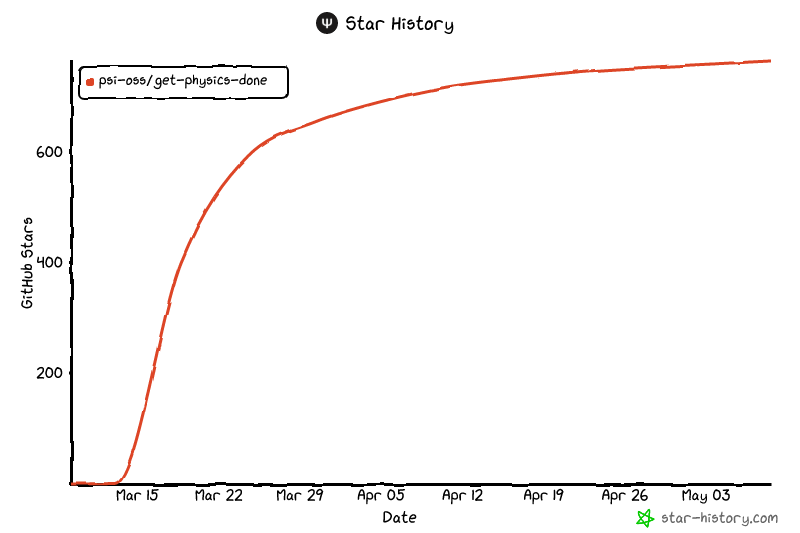
Star History
License
GPD is released under the Apache License 2.0. See LICENSE.
1 maintainer

Metadata
1 maintainer
Release files for get-physics-done 1.2.2
For a detailed explanation of source distributions (sdists) and built distributions (wheels), please see the package formats documentation.
Source distribution (sdist)
| File | Size | Uploaded | |
|---|---|---|---|
| get_physics_done-1.2.2.tar.gz | 4.3 MB | Details |
Built distribution (wheel)
| File | Interpreter | ABI | Platform | Reset |
|---|---|---|---|---|
| get_physics_done-1.2.2-py3-none-any.whl | Python 3 | none | any | Details |
Total release size: 7.4 MB
Release files / get_physics_done-1.2.2.tar.gz
| Download URL | get_physics_done-1.2.2.tar.gz |
|---|---|
| Size | 4.3 MB |
| Tags | Source |
|
SHA-256 checksum How to use checksums |
6ccfc35fbcc1b48b26a6d60999d0fea8bf6ac986a91d64e18d383ae8874a32a7
|
|
BLAKE2b-256 checksum How to use checksums |
e03336c7441c42b7dff4cc5065b2b41f7a7cfb22e323f8e114a6460bb1fdf2b9
|
| Upload date | |
|
Uploaded using Trusted Publishing? What is trusted publishing? |
Yes |
| Uploaded via |
twine/6.1.0 CPython/3.13.12
|
Provenance
Provenance describes where a file came from. On PyPI, provenance is shared via attestations, which provide a verifiable record of the build or publishing details. View details, limitations and caveats.


PyPI Publish Attestation
PyPI verified that this artifact, at this checksum, originated from the publisher listed below.
Signed by GitHub Actions, verified by PyPI on May 7, 2026.
Transparency logRelease files / get_physics_done-1.2.2-py3-none-any.whl
| Download URL | get_physics_done-1.2.2-py3-none-any.whl |
|---|---|
| Size | 3.1 MB |
| Tags | Python 3 |
|
SHA-256 checksum How to use checksums |
b796bb840ead8eb821c13136f2150140e91ba84f4a7747e436bfd5e50cd13298
|
|
BLAKE2b-256 checksum How to use checksums |
8910fa2bc2301c544920cafdb9216cb4996f2ec5d3194bc5e2f411f9070c1e20
|
| Upload date | |
|
Uploaded using Trusted Publishing? What is trusted publishing? |
Yes |
| Uploaded via |
twine/6.1.0 CPython/3.13.12
|
Provenance
Provenance describes where a file came from. On PyPI, provenance is shared via attestations, which provide a verifiable record of the build or publishing details. View details, limitations and caveats.
PyPI Publish Attestation
PyPI verified that this artifact, at this checksum, originated from the publisher listed below.
Signed by GitHub Actions, verified by PyPI on May 7, 2026.
Transparency log













