
This release is a pre-release and may not be stable for production use.






ghidraMCP
ghidraMCP is an Model Context Protocol server for allowing LLMs to autonomously reverse engineer applications. It exposes numerous tools from core Ghidra functionality to MCP clients.
https://github.com/user-attachments/assets/36080514-f227-44bd-af84-78e29ee1d7f9
Features
MCP Server + Ghidra Plugin
- Decompile and analyze binaries in Ghidra
- Automatically rename methods and data
- List methods, classes, imports, and exports
Installation
Prerequisites
Ghidra
First, download the latest release from this repository. This contains the Ghidra plugin and Python MCP client. Then, you can directly import the plugin into Ghidra.
- Run Ghidra
- Select
File->Install Extensions - Click the
+button - Select the
GhidraMCP-1-2.zip(or your chosen version) from the downloaded release - Restart Ghidra
- Make sure the GhidraMCPPlugin is enabled in
File->Configure->Developer - Optional: Configure the port in Ghidra with
Edit->Tool Options->GhidraMCP HTTP Server
Video Installation Guide:
https://github.com/user-attachments/assets/75f0c176-6da1-48dc-ad96-c182eb4648c3
The Python MCP client can be installed with either pipx install GhidraMCP or uv tool install GhidraMCP.
MCP Clients
Theoretically, any MCP client should work with ghidraMCP. Three examples are given below.
Example 1: Claude Desktop
To set up Claude Desktop as a Ghidra MCP client, go to Claude -> Settings -> Developer -> Edit Config -> claude_desktop_config.json and add the following:
{
  "mcpServers": {
    "ghidra": {
      "command": "python",
      "args": [
        "/ABSOLUTE_PATH_TO/bridge_mcp_ghidra.py",
        "--ghidra-server",
        "http://127.0.0.1:8080/"
      ]
    }
  }
}
Alternatively, edit this file directly:
/Users/YOUR_USER/Library/Application Support/Claude/claude_desktop_config.json
The server IP and port are configurable and should be set to point to the target Ghidra instance. If not set, both will default to localhost:8080.
If the GhidraMCP Python client was installed with pipx or uv tool, the first argument can be replaced with bridge_mcp_ghidra instead of giving an absolute path.
Example 2: Cline
To use GhidraMCP with Cline, this requires manually running the MCP server as well. First run the following command:
python bridge_mcp_ghidra.py --transport sse --mcp-host 127.0.0.1 --mcp-port 8081 --ghidra-server http://127.0.0.1:8080/
Or if the GhidraMCP Python client was installed with pipx or uv tool:
bridge_mcp_ghidra --transport sse --mcp-host 127.0.0.1 --mcp-port 8081 --ghidra-server http://127.0.0.1:8080/
The only required argument is the transport. If all other arguments are unspecified, they will default to the above. Once the MCP server is running, open up Cline and select MCP Servers at the top.
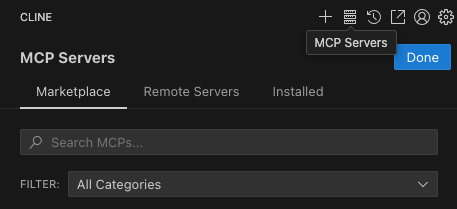
Then select Remote Servers and add the following, ensuring that the url matches the MCP host and port:
- Server Name: GhidraMCP
- Server URL:
http://127.0.0.1:8081/sse
Example 3: 5ire
Another MCP client that supports multiple models on the backend is 5ire. To set up GhidraMCP, open 5ire and go to Tools -> New and set the following configurations:
- Tool Key: ghidra
- Name: GhidraMCP
- Command:
python /ABSOLUTE_PATH_TO/bridge_mcp_ghidra.py
If the GhidraMCP Python client was installed with pipx or uv tool, the command can be bridge_mcp_ghidra without needing to specify the python interpreter or giving an absolute path.
Building from Source
- Copy the following files from your Ghidra directory to this project's
lib/directory:
Ghidra/Features/Base/lib/Base.jarGhidra/Features/Decompiler/lib/Decompiler.jarGhidra/Framework/Docking/lib/Docking.jarGhidra/Framework/Generic/lib/Generic.jarGhidra/Framework/Project/lib/Project.jarGhidra/Framework/SoftwareModeling/lib/SoftwareModeling.jarGhidra/Framework/Utility/lib/Utility.jarGhidra/Framework/Gui/lib/Gui.jar
- Build with Maven by running:
mvn clean package assembly:single
The generated zip file includes the built Ghidra plugin and its resources. These files are required for Ghidra to recognize the new extension.
- lib/GhidraMCP.jar
- extensions.properties
- Module.manifest
1 maintainer

Metadata
1 maintainer
Release files for ghidramcp 0.0.dev0
For a detailed explanation of source distributions (sdists) and built distributions (wheels), please see the package formats documentation.
Source distribution (sdist)
| File | Size | Uploaded | |
|---|---|---|---|
| ghidramcp-0.0.dev0.tar.gz | 9.8 kB | Details |
Built distribution (wheel)
| File | Interpreter | ABI | Platform | Reset |
|---|---|---|---|---|
| ghidramcp-0.0.dev0-py3-none-any.whl | Python 3 | none | any | Details |
Total release size: 20.1 kB
Release files / ghidramcp-0.0.dev0.tar.gz
| Download URL | ghidramcp-0.0.dev0.tar.gz |
|---|---|
| Size | 9.8 kB |
| Tags | Source |
|
SHA-256 checksum How to use checksums |
a2200060526ffbb67ead87196651771378402a11b164fb503fa5b962218e324e
|
|
BLAKE2b-256 checksum How to use checksums |
88c50cc986544362c7a2b2b3616553600701d11d33deeef5a674dc46ec58318d
|
| Upload date | |
|
Uploaded using Trusted Publishing? What is trusted publishing? |
Yes |
| Uploaded via |
twine/6.1.0 CPython/3.13.7
|
Provenance
Provenance describes where a file came from. On PyPI, provenance is shared via attestations, which provide a verifiable record of the build or publishing details. View details, limitations and caveats.


PyPI Publish Attestation
PyPI verified that this artifact, at this checksum, originated from the publisher listed below.
Signed by GitHub Actions, verified by PyPI on Nov 14, 2025.
Transparency logRelease files / ghidramcp-0.0.dev0-py3-none-any.whl
| Download URL | ghidramcp-0.0.dev0-py3-none-any.whl |
|---|---|
| Size | 10.3 kB |
| Tags | Python 3 |
|
SHA-256 checksum How to use checksums |
0e47952c9046988d8fe25584adb894223bd94ece39e57f0a184f789e3cccc850
|
|
BLAKE2b-256 checksum How to use checksums |
18c653176a1c855570b737f4560451fe217b770846c9110dc5f8f95e69ffccc1
|
| Upload date | |
|
Uploaded using Trusted Publishing? What is trusted publishing? |
Yes |
| Uploaded via |
twine/6.1.0 CPython/3.13.7
|
Provenance
Provenance describes where a file came from. On PyPI, provenance is shared via attestations, which provide a verifiable record of the build or publishing details. View details, limitations and caveats.
PyPI Publish Attestation
PyPI verified that this artifact, at this checksum, originated from the publisher listed below.
Signed by GitHub Actions, verified by PyPI on Nov 14, 2025.
Transparency log












