
The audit layer for AI-generated commits. Independent, cross-family verification of what your diff actually did.


Project description
git-to-doc
The audit layer for AI-generated commits.



🏆 Built at the GDG Cloud Boston × Northeastern University hackathon (Powered by Gemma), where it won 1st place. Full write-up: shivanshsingh.in/git-to-doc.
The problem
A lot of commits are written by AI now, and so are their commit messages. The trouble is that the message often doesn't match what the diff actually did. It skips a side effect, softens a behavior change, or describes the intent instead of the result. Reviewers skim the message and trust it. That gap is where bugs slip through.
git-to-doc closes the gap. Point it at a commit and it tells you where the message and the diff disagree, with every finding pinned to a specific file and line.
What it looks like
$ git-to-doc verify HEAD

  🔍 Verifying commit a1b2c3d
     Auditors: qwen2.5-coder:14b, deepseek-coder-v2:latest (2 independent, cross-family)

  ORIGINAL MESSAGE
  fix(auth): tidy up the login helper

  ⚠️  1 DIVERGENCE (all auditors agree)
   • login() now issues a session token instead of returning a boolean, and also
     writes an audit-log entry that the message never mentions
     app/auth.py:42

  📊 Benchmark: 69% precision, 36% recall (synthetic n=168, 16GB tier, see BENCHMARKS.md)
When the message honestly covers the diff, you get a green "matches" line instead. When
only one of the two models flags something, it shows up as possible and asks you to
verify it, rather than being stated as fact.
How it works
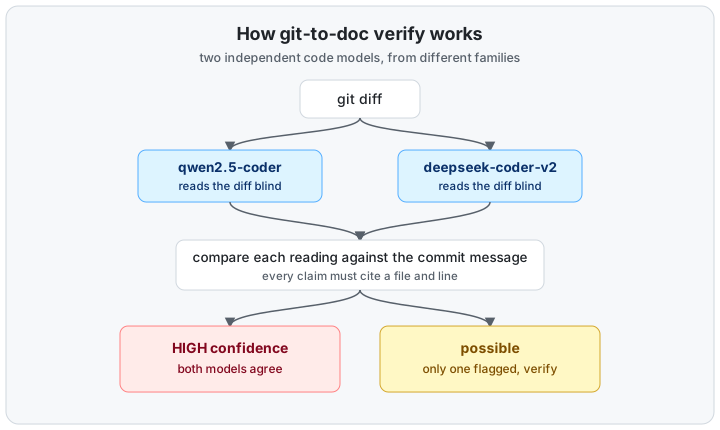
- Two models, different families. By default
qwen2.5-coderanddeepseek-coder-v2. Different training gives them different blind spots, which is exactly why agreement between them carries weight. - They read the diff blind. Each model describes what the change does before it ever sees the author's message, so a misleading message can't steer it.
- Then they compare. Each independent reading is checked against the commit message. Anything the message omits or misstates becomes a divergence, and every divergence has to cite a file and line or it gets thrown out.
- Agreement sets the confidence. If both models flag the same spot, it is
HIGH. If only one does, it ispossible. If the models can't produce a valid, cited report at all, the tool errors out instead of inventing a reassuring "all clear."
Install
pip install git-to-doc

# pull the default two-model panel
ollama pull qwen2.5-coder:14b && ollama pull deepseek-coder-v2:latest
git-to-doc runs against a local ollama daemon by default, or
ollama.com if you set OLLAMA_API_KEY.
Those two models are only the default. Anything you can ollama pull works (Gemma
included); pick a different pair for a single run with --auditors model-a,model-b. Not
sure what your machine can handle? Run git-to-doc doctor and it reports your RAM,
recommends a pair (it knows 8, 16, and 32 GB tiers), and lists anything still to pull.
Usage
git-to-doc verify HEAD                    # audit the latest commit
git-to-doc verify a1b2c3d                 # audit a specific commit
git-to-doc verify --url <github-pr-url>   # audit a pull request instead
git-to-doc verify HEAD --json             # machine-readable output
git-to-doc verify HEAD --auditors m1,m2   # pick your own model panel
Benchmarks
Measured on the default 16 GB model pair, not estimated:
- Synthetic (n=168, known ground truth): 69% precision, 36% recall.
- Real-world (n=95 actual AI commits): 29% of commits carried a high-confidence divergence, and the two models agreed on 11% of all findings.
Two things worth saying plainly. Recall is on the low side because HIGH only fires when
both models independently agree, which is a strict bar by design. And that 11% agreement
on real commits means most findings are single-model possible flags, not certainties.
The full method, per-tool breakdown (Copilot, Claude, Cursor, Devin, Jules), and the
caveats live in BENCHMARKS.md.
Also useful
git-to-doc started life as a commit-documentation generator, and those commands are still here:
git-to-doc <diff | pr-url | folder>turns a diff into a Conventional Commit message, a changelog entry, and a plain-English summary.git-to-doc pull-requestwrites a PR title and body from your branch, then audits that AI-written description against the diff before you post it (--skip-auditopts out).git-to-doc install-hookinstalls aprepare-commit-msghook that drafts the message from your staged diff.
License
MIT, © 2026 Shivansh Singh


Download files
Download the file for your platform. If you're not sure which to choose, learn more about installing packages.
Source Distribution
Built Distribution
Filter files by name, interpreter, ABI, and platform.
If you're not sure about the file name format, learn more about wheel file names.
Copy a direct link to the current filters
File details
Details for the file git_to_doc-0.4.1.tar.gz.
File metadata
- Download URL: git_to_doc-0.4.1.tar.gz
- Upload date:
- Size: 34.5 kB
- Tags: Source
- Uploaded using Trusted Publishing? No
- Uploaded via: twine/6.2.0 CPython/3.9.6
File hashes
| Algorithm | Hash digest | |
|---|---|---|
| SHA256 |
1095bffd6d25a5a775d4428d4f2ba0f67aa54b95a0708feda95e99a78348686e
|
|
| MD5 |
31565b4a6605971341e8488cf419313a
|
|
| BLAKE2b-256 |
0b1b72e20886fec3a6e4f7b482d2f31e2c16fc692ffc7872ec26b4f01035cacf
|
File details
Details for the file git_to_doc-0.4.1-py3-none-any.whl.
File metadata
- Download URL: git_to_doc-0.4.1-py3-none-any.whl
- Upload date:
- Size: 30.4 kB
- Tags: Python 3
- Uploaded using Trusted Publishing? No
- Uploaded via: twine/6.2.0 CPython/3.9.6
File hashes
| Algorithm | Hash digest | |
|---|---|---|
| SHA256 |
1a814f4d98fadd246baae5ef046d2953ab7cac786810234c335393a31c123ea3
|
|
| MD5 |
a48f9b202a20ae56b2cf5c91c6ced216
|
|
| BLAKE2b-256 |
25633d939a92897f062afd5a44e00eede663f9bbbc5c7fa5fc7d4922cab0563f
|






