
gitmopy
An interactive Python implementation of the Gitmoji convention: gitmoji.dev/
uv tool run gitmopy
# or
uvx gitmopy
uv? Yes, in most cases you don't want to use gitmopyas a library but rather as a standalone CLI and you should therefore use uv rather than pip to install it. pip install gitmopy will work too if that's really what you want.
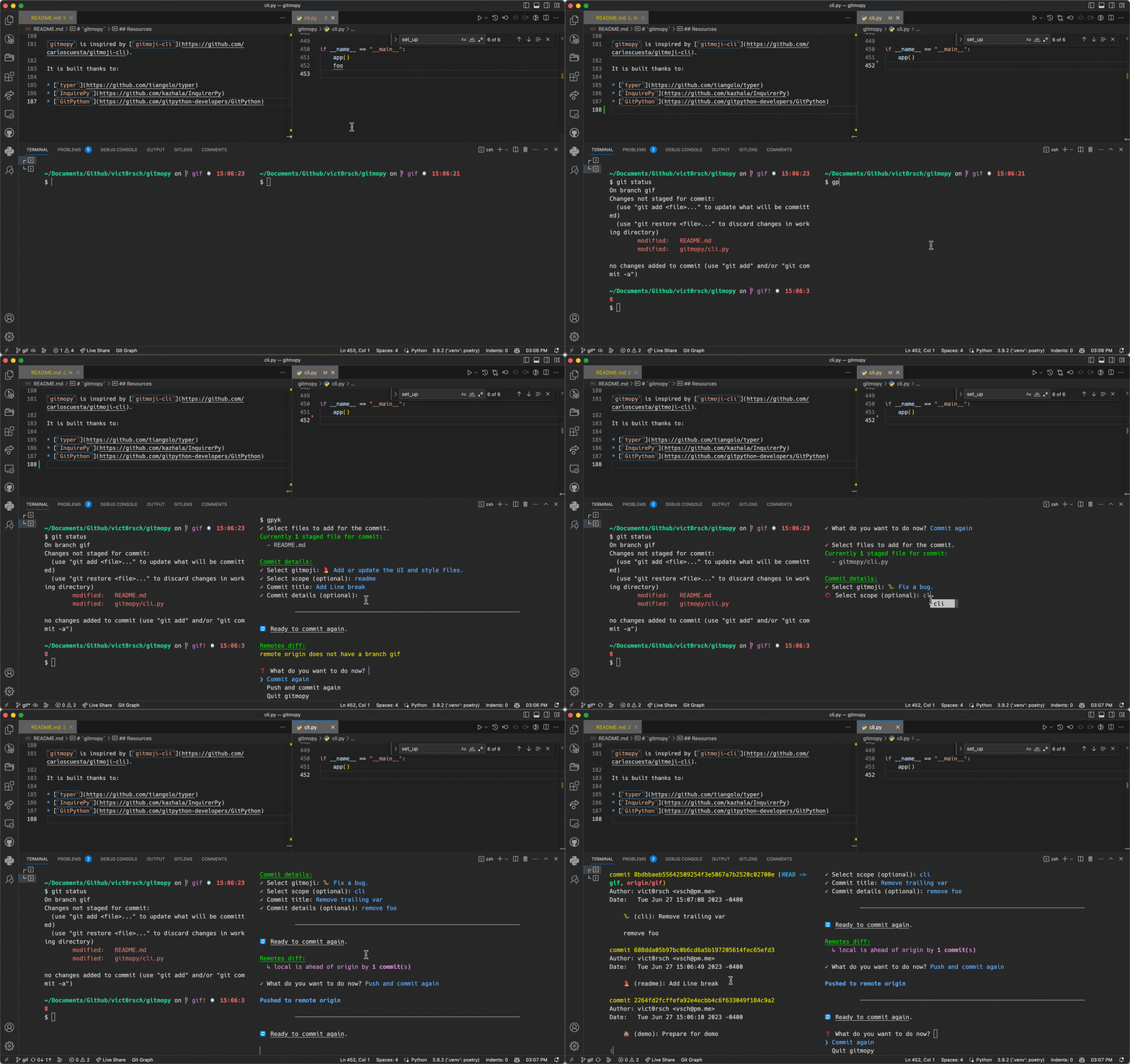
How to use
- I typically use
$ gitmopy commit --add --keep-alive - Navigate through options with ⬆️ and ⬇️
- Select files with
space - Validate selection with
enter - Press
tabto auto-complete- Press
tabon an empty line to see history
- Press
- Restart commit with
crtl+c- In the committing routine, press
ctrl+cto go back to the previous step (for instance if you made a mistake in the commit title)
- In the committing routine, press
- Push (and set upstream if need be)
- Commit again 🔄
You can also select another set of default emojis tailored towards AI/ML development by running gitmopy config then pressing Enter and choosing ai-devmojis as the config option.
Use your own emojis by editing the "custom emojis" file listed by gitmopy info!
Suggested shortcuts
alias gpy="gitmopy"
alias gpys="gitmopy start"
alias gpyc="gitmopy commit"
alias gpya="gitmopy commit --add"
alias gpyk="gitmopy commit --add --keep-alive"
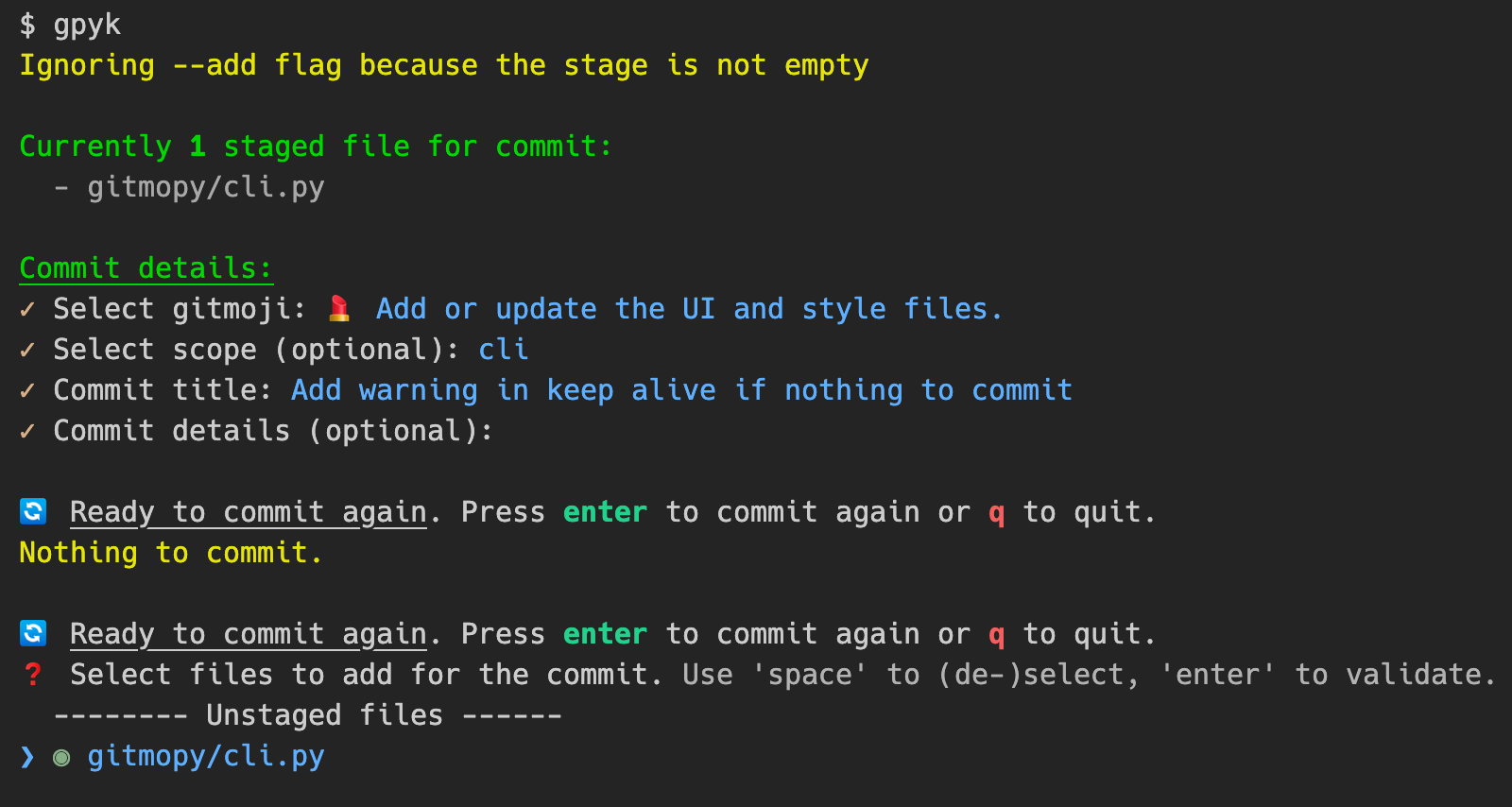
Examples
# Typical daily use-case
# ----------------------

# continuously commit, interactively select files to stage
$ gitmopy commit --add --keep-alive

# same using an alias, + push after every commit (could be dangerous)
$ gpyk --push

# use your default commit settings (configured via `gitmopy config`)
$ gitmopy start


# Specific usage
# --------------

# commit currently staged files. Will fail if no file is staged.
$ gitmopy commit

# Enable interactive file selection if no file is currently staged. Ignored if
# there are staged files.
$ gitmopy commit --add

# Commit continuously: don't leave the CLI after the first commit but restart
# the commit procedure.
$ gitmopy commit --keep-alive

# Push to remote repositories after commit.
# Interactively select remotes to push to if there are more than 1.
$ gitmopy commit --push

# Push to specific remotes
$ gitmopy commit --push --remote origin --remote upstream

# Make and display a commit message without staging/committing/pushing
$ gitmopy commit --dry

# configure gitmopy
$ gitmopy config

# print version, data paths and current configuration
$ gitmopy info

# print helps
$ gitmopy --help
$ gitmopy commit --help
⚠️ The sync feature is still experimental. It will pull then push but in the case of several remotes and the branch not existing on one of them, I recommend you deal with it with git manually.
User guide
$ gitmopy info

gitmopy info:
  version      : 0.6.0
  app path     : /Users/victor/.gitmopy
  history      : /Users/victor/.gitmopy/history.json
  config       : /Users/victor/.gitmopy/config.yaml
  custom emojis: /Users/victor/.gitmopy/custom_gitmojis.yaml

Current configuration:
  skip_scope          : False
  skip_message        : False
  capitalize_title    : True
  enable_history      : True
  emoji_set           : gitmoji
  default_commit_flags: ['add', 'keep_alive', 'sign', 'simple']
  default_commit_args : {'remote': 'origin', 'repo': '.'}
Update configuration with
$ gitmopy config

❓ Configure gitmopy locally. Use 'space' to (de-)select, 'enter' to validate.
❯ ○ Skip commit scope
  ○ Skip commit message
  ◉ Capitalize commit title
  ◉ Remember commit history for auto-complete and emoji sorting

Config will be saved in /Users/victor/.gitmopy/config.yaml.

✓ Configure gitmopy locally.
❓ Emoji set to use for commits
❯ gitmoji
  ai-devmojis

❓ Default commit binary flags used in `gitmopy start`
❯ ◉ add
  ○ dry
  ◉ keep_alive
  ○ push
  ◉ sign
  ◉ simple

❓ repo (Path to the git repository): .

❓ remote (Comma-separated list of remotes to push to): origin
Get help with
$ gitmopy --help

 Usage: gitmopy [OPTIONS] COMMAND [ARGS]...

╭─ Options ───────────────────────────────────────────────────────────────────────╮
│ --install-completion          Install completion for the current shell.         │
│ --show-completion             Show completion for the current shell, to copy it │
│                               or customize the installation.                    │
│ --help                        Show this message and exit.                       │
╰─────────────────────────────────────────────────────────────────────────────────╯
╭─ Commands ──────────────────────────────────────────────────────────────────────╮
│ commit   Commit staged files. Use --add to interactively select files to stage  │
│          if none is already staged                                              │
│ config   Configure gitmopy                                                      │
│ info     Print gitmopy info                                                     │
│ start    Runs the commit command with the default arguments you have set in the │
│          configuration file. If no such arguments are set, you will be prompted │
│          to set them interactively.                                             │
╰─────────────────────────────────────────────────────────────────────────────────╯


$ gitmopy commit --help

 Usage: gitmopy commit [OPTIONS]

 Commit staged files. Use --add to interactively select files to stage if none is
 already staged

╭─ Options ───────────────────────────────────────────────────────────────────────╮
│ --repo                             TEXT  Path to the git repository             │
│                                          [default: .]                           │
│ --add           --no-add                 Whether or not to interactively select │
│                                          files to stage if none is already      │
│                                          staged                                 │
│                                          [default: no-add]                      │
│ --push          --no-push                Whether to `git push` after commit. If │
│                                          multiple remotes exist, you will be    │
│                                          asked to interactively choose the ones │
│                                          to push to. Use --remote to skip       │
│                                          interactive selection. Disabled by     │
│                                          default.                               │
│                                          [default: no-push]                     │
│ --dry           --no-dry                 Whether or not to actually commit.     │
│                                          [default: no-dry]                      │
│ --remote                           TEXT  Remote to push to after commit. Use to │
│                                          skip interactive remote selection when │
│                                          several exist. Use several '--remote   │
│                                          {remote name}' to push to multiple     │
│                                          remotes                                │
│ --keep-alive    --no-keep-alive          Whether or not to keep the app alive   │
│                                          after commit, to be ready for another  │
│                                          one.                                   │
│                                          [default: no-keep-alive]               │
│ --simple        --no-simple              Whether or not to use a simple commit  │
│                                          which merges conventional commits and  │
│                                          gitmoji.                               │
│                                          [default: no-simple]                   │
│ --sign          --no-sign                Whether or not to sign the commit with │
│                                          GPG. Equivalent to `git commit -S`.    │
│                                          [default: no-sign]                     │
│ --help                                   Show this message and exit.            │
╰─────────────────────────────────────────────────────────────────────────────────╯
Default commit settings
You can configure default settings for the gitmopy start command which will run gitmopy commit with your preferred arguments. To set these up:
- Run
gitmopy config - Navigate to "Default commit binary flags used in
gitmopy start" - Select the flags you want enabled by default (e.g.,
add,keep-alive,push, etc.) - Navigate to "Default commit arguments used in
gitmopy start" - Configure:
repo: Path to your git repository (default: ".")remote: Comma-separated list of remotes to push to (default: "origin")
Then simply run gitmopy start to use your default settings!
For example, if you always want to:
- Work in the current directory
- Be able to select files to stage
- Keep committing until you're done
- Sign your commits
- Push to origin
Configure these settings once with gitmopy config and just run gitmopy start instead of gitmopy commit --add --keep-alive --push --remote origin --sign!
To Do
- Features
- If requested:
- Install hook
git commitflags (like-S)- max history length (if loading the json becomes slow)
- If requested:
- Tests
- typer.tiangolo.com/tutorial/testing/
- 👋 Help wanted
- Docs
- Not critical
Resources
gitmopy is inspired by gitmoji-cli.
It is built thanks to:
1 maintainer

Metadata
1 maintainer
Release files for gitmopy 0.6.0
For a detailed explanation of source distributions (sdists) and built distributions (wheels), please see the package formats documentation.
Source distribution (sdist)
| File | Size | Uploaded | Provenance | Actions |
|---|---|---|---|---|
| gitmopy-0.6.0.tar.gz | 917.3 kB | Without provenance | Details for gitmopy-0.6.0.tar.gz |
Built distribution (wheel)
| File | Interpreter | ABI | Platform | Actions Reset |
|---|---|---|---|---|
| gitmopy-0.6.0-py3-none-any.whl | Python 3 | none | any | Details for gitmopy-0.6.0-py3-none-any.whl |
Total release size: 942.6 kB
Release files / gitmopy-0.6.0.tar.gz
| Download URL | gitmopy-0.6.0.tar.gz |
|---|---|
| Size | 917.3 kB |
| Tags | Source |
|
SHA-256 checksum How to use checksums |
3e9773d8be3207eb55928ee22dd195310beaadc6cd377a7c7645c135244a4a1f
|
|
BLAKE2b-256 checksum How to use checksums |
214eab3e1c3cd56e598dc4cce663468d0cefdc440f375655b08057de900909d7
|
| Upload date | |
|
Uploaded using Trusted Publishing? What is trusted publishing? |
No |
| Uploaded via |
uv/0.6.0
|
Release files / gitmopy-0.6.0-py3-none-any.whl
| Download URL | gitmopy-0.6.0-py3-none-any.whl |
|---|---|
| Size | 25.2 kB |
| Tags | Python 3 |
|
SHA-256 checksum How to use checksums |
81b47027d69e3a05845c144a28ebdc2c95125f38b693608cdfe353a121b7a84e
|
|
BLAKE2b-256 checksum How to use checksums |
2531cf4593e0cfb10395ee81c3d1d76145f133fc66f1aab6cdca555d99b707aa
|
| Upload date | |
|
Uploaded using Trusted Publishing? What is trusted publishing? |
No |
| Uploaded via |
uv/0.6.0
|
Security for gitmopy 0.6.0
Provenance
Provenance describes where a file came from. On PyPI, provenance is shared via attestations, which provide a verifiable record of the build or publishing details. View details, limitations and caveats.
No provenance found
None of the files in this release were uploaded with provenance metadata.
A note on package security
PyPI is a repository for distributing packages, not a service for auditing them. While third-party security researchers and our staff do their best to detect and remove malicious packages, PyPI cannot guarantee the quality, security or suitability of any given package.
To learn more about protecting yourself from malicious actors, visit our package security documentation.














