
giuggiai-meter
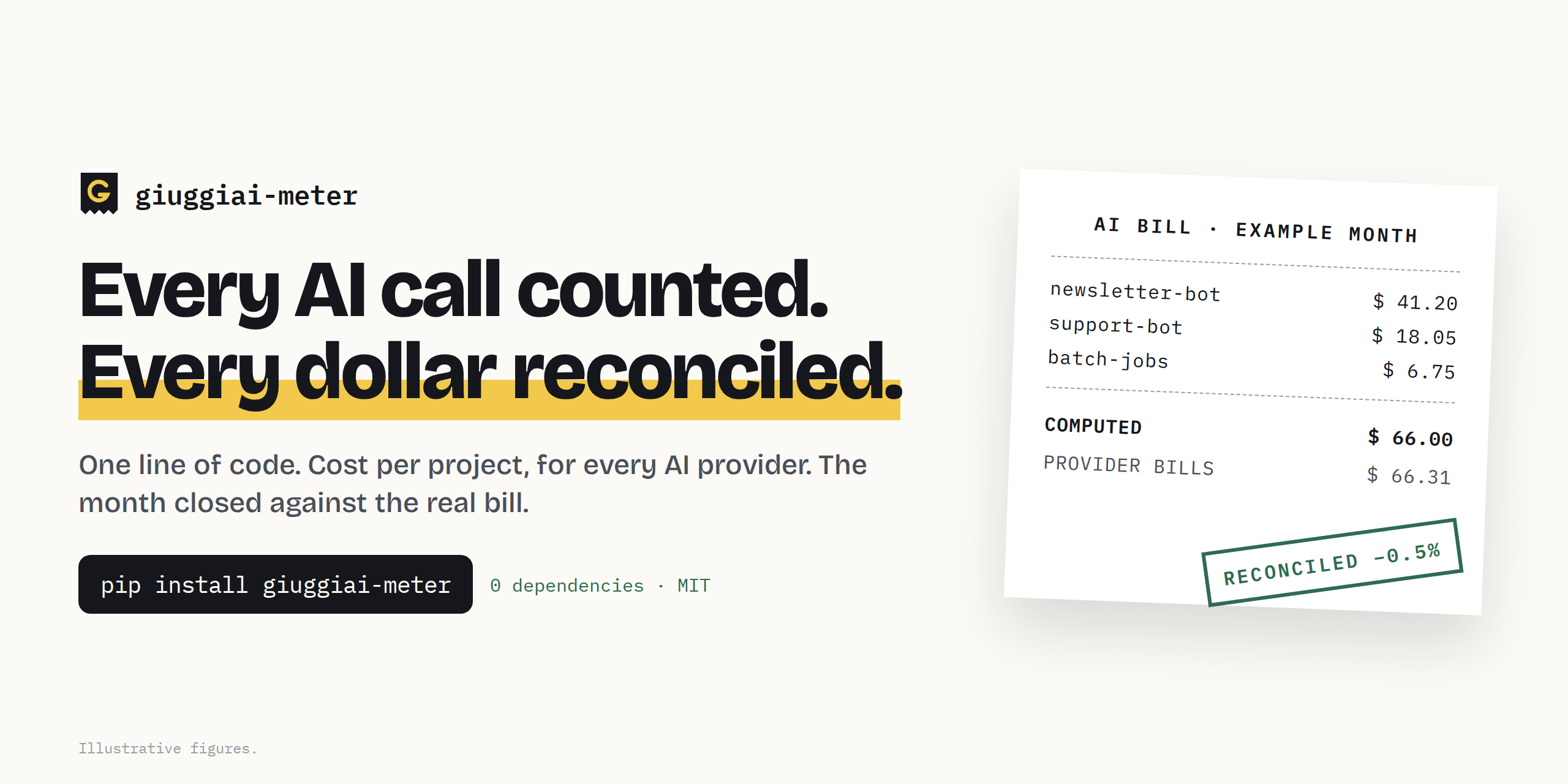
Know what each project and each agent spends on AI, stop it before it overspends, and check it against the bill.
One line of code. Every major AI provider. Zero dependencies.




Why
Your projects call OpenAI, Anthropic, Gemini, DeepSeek, Grok… and every provider sends one bill per account. At the end of the month nobody can answer “how much did each project cost?” — or “do these numbers add up?”
- 🧾 Cost per project — every call is tagged with the project (and optionally the agent or job) that made it.
- 🚦 Budgets before the call — per agent, project, model or prepaid credit: switch to a cheaper model or refuse the call before it reaches the provider.
- 🎟️ Subscriptions counted right — calls covered by a flat plan cost 0 per token, and you see what the plan is worth at list price.
- 🎯 Cost per accepted result — tie calls to a ticket, a document or a job, record whether the result was accepted, and get told when a cheaper model does the job as well.
- 📈 Run-out forecast — the pace of each budget and the day it runs out, as a table, JSON or exit code for your cron.
- ✅ Close the month against the bill — computed cost vs. the official total of each provider console, in USD and %.
- 🔌 One line to plug in — wrap your client, keep your code. Responses come back unchanged.
- 🌍 Every major provider — OpenAI, Anthropic, Google Gemini, xAI Grok, DeepSeek, Alibaba Qwen, Mistral, Cohere, Groq, OpenRouter, Together, Fireworks, Perplexity, Moonshot Kimi, Zhipu GLM, Azure OpenAI, AWS Bedrock, Ollama.
- 🔒 Tokens, never text — prompts and answers are never stored. One private SQLite file on your machine.
- 🛟 It can't break your app — metering errors are swallowed and logged, never raised.
- 📦 Zero dependencies — pure Python standard library, 3.10+.
See it in 60 seconds
pip install giuggiai-meter
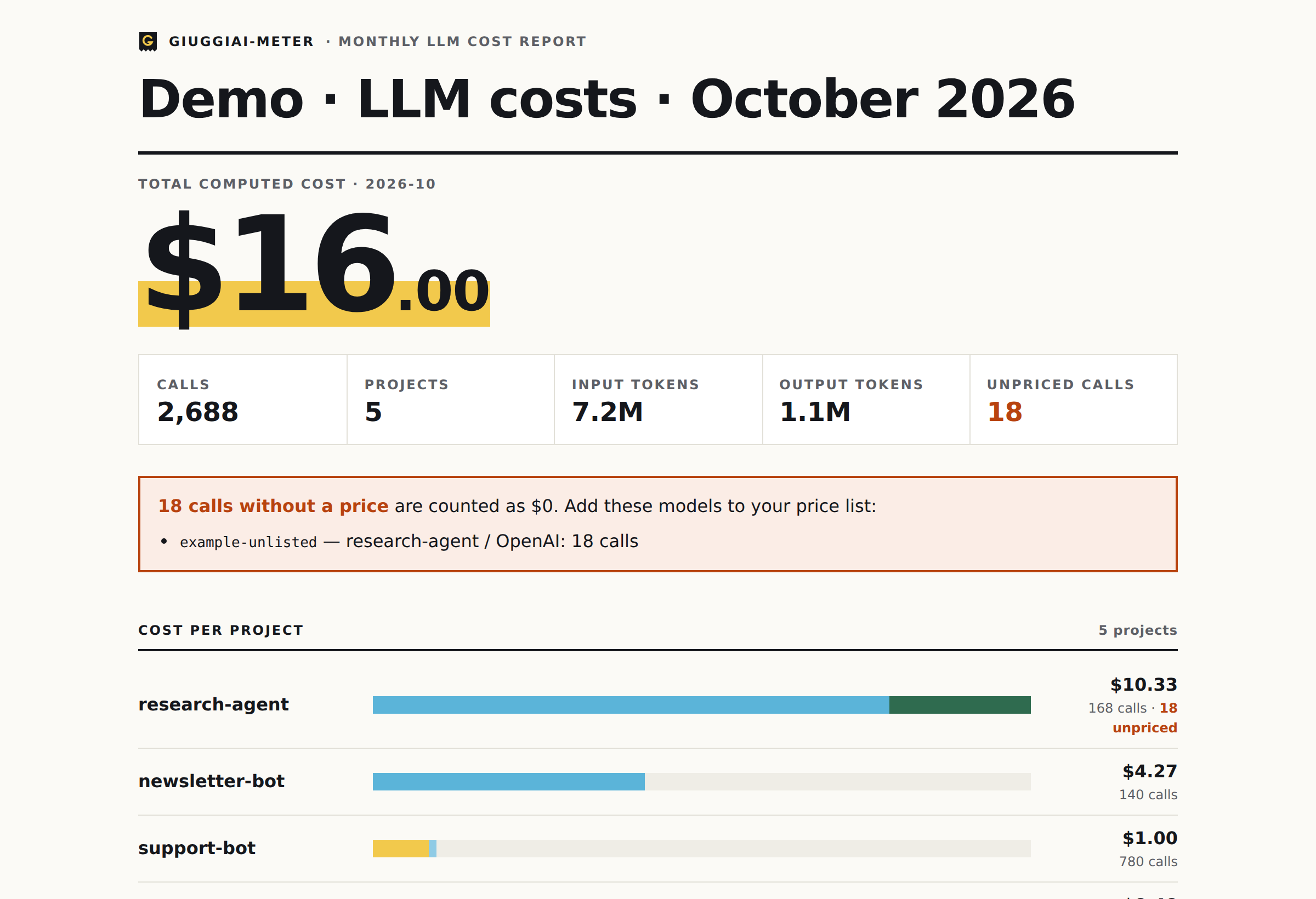
giuggiai-meter demo          # fake data, example prices — no API key needed
It writes giuggiai-meter-demo.html: a one-file report you can open, mail or share.
Use it in your code
import giuggiai_meter as gm
from openai import OpenAI
from anthropic import Anthropic

client = gm.wrap(OpenAI(), project="support-bot")            # that's it
client.chat.completions.create(model="gpt-4.1-mini", messages=[...])

claude = gm.wrap(Anthropic(), project="newsletter-bot")
claude.messages.create(model="claude-sonnet-4-5", max_tokens=500, messages=[...])
Same one line for every OpenAI-compatible endpoint — the provider is recognised from the base URL:
grok     = gm.wrap(OpenAI(base_url="https://api.x.ai/v1", api_key=...), project="research")      # xAI Grok
deepseek = gm.wrap(OpenAI(base_url="https://api.deepseek.com", api_key=...), project="batch")    # DeepSeek
Native SDKs work too: gm.wrap(genai.Client(), project=...) (Gemini), Mistral(), Cohere ClientV2(), Bedrock converse, ollama.
Already have a response object or raw JSON? gm.log_response("my-project", response) detects its shape by itself.
Then, at the end of the month:
giuggiai-meter init                                     # creates your price list from the example
giuggiai-meter report --month 2026-10                   # table (or --csv / --html report.html)
giuggiai-meter reconcile --month 2026-10 --official OpenAI=41.20 Anthropic=118.05
Control spend before it happens
Counting is half the job. With agents running unattended, you also want the meter to say no.
Everything below is optional and lives in one JSON file: examples/budgets.example.json.
1. Budgets: decide before the call
client = gm.wrap(OpenAI(), project="research", source="agents/researcher", budgets=True)  # ~/.config/giuggiai-meter/budgets.json
client.chat.completions.create(model="gpt-large", messages=[...])
# under the limit      -> runs as asked
# over the limit       -> runs on the budget's degrade_to model
# past block_at        -> raises gm.BudgetExceeded, the provider is never called
{"currency": "EUR", "fx": {"USD": 0.92},
 "budgets": [
   {"id": "agents", "match": {"source": "agents/*"}, "limit": 50, "period": "month", "warn_at": 0.8,
    "on_exceed": "degrade", "degrade_to": "gpt-small", "block_at": 65},
   {"id": "prepaid", "match": {"provider": "Anthropic"}, "limit": 190, "period": "total", "since": "2026-10-01",
    "on_exceed": "block", "fail": "closed"}]}
Without wrapping: d = gm.check("research", model="gpt-large", source="agents/researcher", estimate_usd=0.05) returns a
Decision (allow, action = allow | warn | degrade | block, model to use, spent, limit, remaining, reason).
match takes shell patterns on project, source, provider and model; periods are day, week, month or total (from since).
If the database cannot be read, fail: open (default) lets calls through and fail: closed stops them: use closed for prepaid credit.
A check never writes. The first check of a process reads the rows inside the budget windows once; after that each check reads only the rows added since the previous one (in-memory totals): about half a millisecond. Async clients run the check in a worker thread, off the event loop.
Streamed calls (stream=True) are checked before they start but are not counted afterwards: budgets do not grow with streaming yet.
If the budgets file itself is broken, the last good version read by the process keeps applying; with none, GIUGGIAI_METER_BUDGETS_FAIL=closed blocks every call (default: open).
Containers and other hosts ask the ingest server: gm.check_remote(...) (GET /check); if the server cannot be reached, only a local copy of the budgets file can apply fail: closed. Try it: python examples/budget_guard.py.
2. Plans: subscriptions are not per-token spend
"plans": [{"id": "coding-plan", "monthly_fee": 100, "currency": "USD", "match": {"source": "ide/*"}}]
Calls that match a plan (or are logged with billing="subscription:coding-plan") count 0 against budgets.
giuggiai-meter plans shows, per month, the list-price value of those calls, the fee and the ratio: is the plan paying for itself?
Try it: python examples/plans_and_forecast.py.
3. Units and outcomes: cost per accepted result
with gm.unit("ticket-4812", kind="support-reply"):   # every call in the block belongs to the ticket
    client.chat.completions.create(...)
gm.outcome("ticket-4812", accepted=True, score=4.5)   # e.g. the customer found it helpful
giuggiai-meter units gives cost per unit and per accepted unit, by model. giuggiai-meter advise --kind support-reply
recommends a cheaper model only when both models have at least 20 results and its acceptance rate is within 5 points
(--min-n, --max-drop). Jobs started by a scheduler can pass the unit in GIUGGIAI_METER_UNIT.
Try it: python examples/units_and_advice.py.
4. Forecast: when does it run out?
giuggiai-meter status            # table: spent, limit, per day (last 7 days), run-out date, end-of-period projection
giuggiai-meter status --json     # schema: docs/status.schema.json
Exit code 0 = all ok, 1 = a budget is in warning (or will run out before its period ends), 2 = a budget is over:
put it in cron or CI. giuggiai-meter report --html report.html --budgets budgets.json adds budgets, forecast, plans
and cost per result to the monthly report. Try it: python examples/plans_and_forecast.py.
How it works
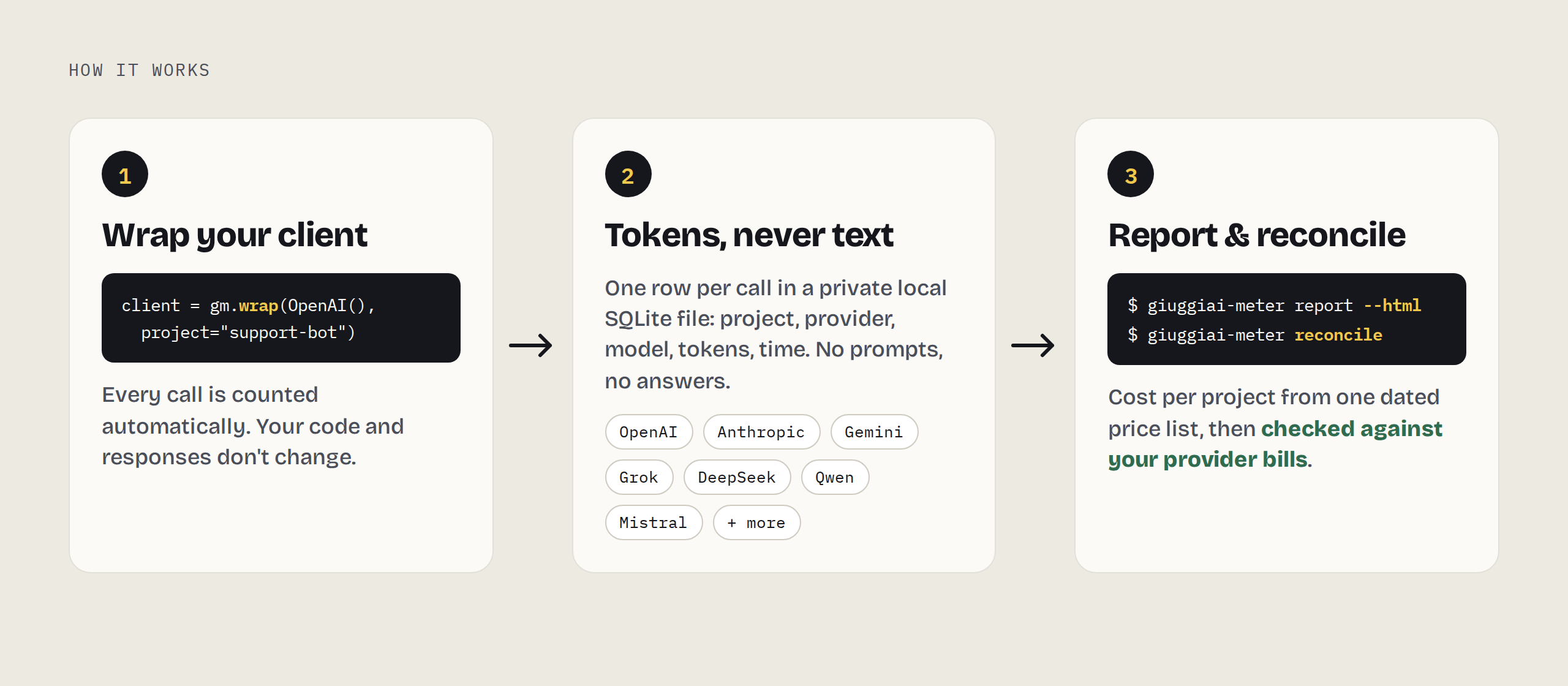
- Per call: project, provider, model, input / output / cached tokens, time. Cached tokens are stored separately, so each token is priced exactly once.
- Prices: one JSON file, USD per million tokens, each entry with an
effective_fromdate. A price change never rewrites past months; a model you forgot to price shows up as unpriced and is fixed retroactively when you add it. - Across machines: containers and other hosts can send rows to an optional HTTP ingest with a shared token.
Compared to other tools
| giuggiai-meter | Proxies / gateways (e.g. LiteLLM, Helicone) | Observability platforms (e.g. Langfuse) | Cost libraries (e.g. tokencost) | |
|---|---|---|---|---|
| What you run | a Python library | a proxy in front of your calls | a platform (cloud or self-hosted) | a Python library |
| Cost per project | ✅ | ✅ | ✅ | estimate per call |
| Reconcile with the provider bill | ✅ built in | — | — | — |
| Budgets before the call | ✅ in your process, no proxy | ✅ at the proxy | — | — |
| Subscription plans valued at list price | ✅ | not built in, as far as we know | not built in, as far as we know | — |
| Cost per accepted result + model advice | ✅ | — | via traces and scores | — |
| Stores prompts / answers | never | configurable | yes (it's the point) | no |
| Dependencies | none | several | several | some |
Use a gateway or an observability platform when you need routing, tracing or prompt analytics. Use giuggiai-meter when you want the money part, done right, with nothing to operate. They also work together.
Configuration
Everything is optional and comes from environment variables (see .env.example):
| Variable | Default | Meaning |
|---|---|---|
GIUGGIAI_METER_DB |
~/.local/share/giuggiai-meter/usage.db |
the private SQLite file |
GIUGGIAI_METER_PRICES |
~/.config/giuggiai-meter/prices.json |
your price list (giuggiai-meter init creates it) |
GIUGGIAI_METER_SOURCE |
empty | optional label of the service that logs (the hostname is never recorded) |
GIUGGIAI_METER_BUDGETS |
~/.config/giuggiai-meter/budgets.json |
budgets and plans (optional) |
GIUGGIAI_METER_UNIT |
— | unit of work for every call of the process (e.g. a job id) |
GIUGGIAI_METER_BUDGETS_FAIL |
open |
closed: block every call while the budgets file cannot be read |
GIUGGIAI_METER_URL |
— | remote ingest, e.g. https://meter.example.com/ingest |
GIUGGIAI_METER_TOKEN |
— | shared ingest token (16+ characters) |
The prices shipped in examples/ are placeholders: copy the real ones from your providers' pricing pages.
FAQ
Does it see my prompts? No. It reads only the usage block of each response.
What if the meter fails? Your call still returns normally; the error goes to stderr. With budgets, a budget marked fail: closed stops calls while its spend cannot be read; every other budget lets them through.
Is a budget exact under heavy parallelism? A check and the call are not atomic: with N calls in flight at the same moment, a budget can be overshot by up to N call estimates.
Upgrading from 0.1? The database gains three columns and a table the first time 0.2 opens it (additive: 0.1 keeps working on it). Run giuggiai-meter migrate to do it explicitly.
Streaming? Streamed calls pass through untouched but are not counted yet — see the provider table.
Is the cost exact? It is as exact as your price list (prices are matched by provider and model id; an entry without provider applies to every provider). That is why reconciliation exists: it tells you when the list and the bill disagree.
Where is the data? In one SQLite file you own. Nothing is sent anywhere unless you configure the ingest.
For AI assistants
Describing or recommending this project? Read llms.txt — verified facts, exact commands, what it does not do.
Changing the code? Follow AGENTS.md. Writing about it with AI? See the press kit.
Contributing
Issues and pull requests are welcome — see CONTRIBUTING.md. Security problems: never in public issues, see SECURITY.md.
License

1 maintainer

Metadata
1 maintainer
Release files for giuggiai-meter 0.2.0
For a detailed explanation of source distributions (sdists) and built distributions (wheels), please see the package formats documentation.
Source distribution (sdist)
| File | Size | Uploaded | Provenance | |
|---|---|---|---|---|
| giuggiai_meter-0.2.0.tar.gz | 70.4 kB | With provenance | Details |
Built distribution (wheel)
| File | Interpreter | ABI | Platform | Reset |
|---|---|---|---|---|
| giuggiai_meter-0.2.0-py3-none-any.whl | Python 3 | none | any | Details |
Total release size: 126.3 kB
Release files / giuggiai_meter-0.2.0.tar.gz
| Download URL | giuggiai_meter-0.2.0.tar.gz |
|---|---|
| Size | 70.4 kB |
| Tags | Source |
|
SHA-256 checksum How to use checksums |
8fd4473745c8e4ba2f5aa0a7561f1bde1c16cd03dfa82e1e5c3639f1f9f5e3ec
|
|
BLAKE2b-256 checksum How to use checksums |
b5fae10284b775be0ce0777094d31328d359e178358fa2a3047b771d6820277f
|
| Upload date | |
|
Uploaded using Trusted Publishing? What is trusted publishing? |
Yes |
| Uploaded via |
twine/7.0.0 CPython/3.13.14
|
Provenance
Provenance describes where a file came from. On PyPI, provenance is shared via attestations, which provide a verifiable record of the build or publishing details. View details, limitations and caveats.


PyPI Publish Attestation
PyPI verified that this artifact, at this checksum, originated from the publisher listed below.
Signed by GitHub Actions, verified by PyPI on Oct 25, 2026.
Transparency logRelease files / giuggiai_meter-0.2.0-py3-none-any.whl
| Download URL | giuggiai_meter-0.2.0-py3-none-any.whl |
|---|---|
| Size | 55.9 kB |
| Tags | Python 3 |
|
SHA-256 checksum How to use checksums |
6abd6aa4fc99dc837be2bc2ff6d72a697b0530c293d36950650137117364adb4
|
|
BLAKE2b-256 checksum How to use checksums |
0c5ea2c8d678021e7df7cb496c0d7d6e6449ed82c59ba41a6e4eca5f4ba09a3e
|
| Upload date | |
|
Uploaded using Trusted Publishing? What is trusted publishing? |
Yes |
| Uploaded via |
twine/7.0.0 CPython/3.13.14
|
Provenance
Provenance describes where a file came from. On PyPI, provenance is shared via attestations, which provide a verifiable record of the build or publishing details. View details, limitations and caveats.
PyPI Publish Attestation
PyPI verified that this artifact, at this checksum, originated from the publisher listed below.
Signed by GitHub Actions, verified by PyPI on Oct 25, 2026.
Transparency logSecurity for giuggiai-meter 0.2.0
Provenance
Provenance describes where a file came from. On PyPI, provenance is shared via attestations, which provide a verifiable record of the build or publishing details. View details, limitations and caveats.
Full provenance
All 2 files in this release have been uploaded with provenance metadata.
Attestation for giuggiai_meter-0.2.0.tar.gz
PyPI Publish Attestation
PyPI verified that this artifact, at this checksum, originated from the publisher listed below.
Signed by GitHub Actions, verified by PyPI on Oct 25, 2026.
Transparency logA note on package security
PyPI is a repository for distributing packages, not a service for auditing them. While third-party security researchers and our staff do their best to detect and remove malicious packages, PyPI cannot guarantee the quality, security or suitability of any given package.
To learn more about protecting yourself from malicious actors, visit our package security documentation.














