
glassllm
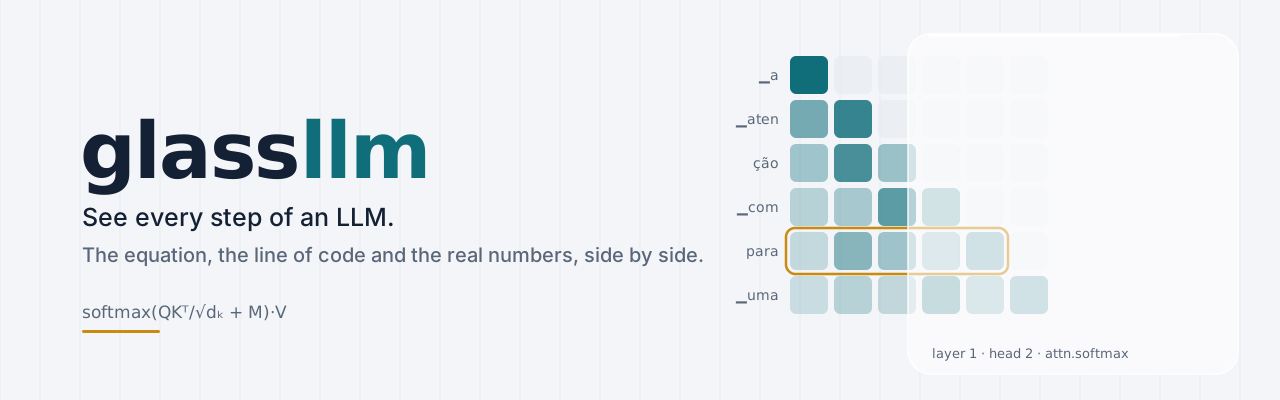
A small Transformer written from scratch in NumPy, built to be looked at. Follow a token through the model and inspect the equation, source code and values produced at each step.




English · Português · Documentation
glassllm is an educational language model and Python library. Its decoder-only Transformer, tokenizer, automatic differentiation engine, training code and tracing tools are implemented with NumPy. Pretrained Portuguese and English models are included in the package.
Install
python -m pip install glassllm
The library supports Python 3.10 and later. NumPy is its only runtime dependency. The pretrained weights and tokenizers are included, so inference works immediately after installation.
Generate text
The glassllm command uses the included English model by default. Select pt for Portuguese.
glassllm --lang en generate "Alice was beginning to" --n 40
glassllm --lang pt generate "Capitu olhou para" --n 40
Use greedy decoding for repeatable output, or inspect the available model operations:
glassllm --lang en generate "Alice was beginning to" --n 40 --greedy
glassllm steps
glassllm trace "Alice was beginning to" --step attn.softmax --layer 0 --head 1
Inspect a calculation
Pass a Tracer to the model to record its actual intermediate values. Each record includes the
equation, tensor shape and source location for a tagged operation.
from glassllm import Tracer, load_pretrained

model, tokenizer = load_pretrained("en")
token_ids = tokenizer.encode("Alice was beginning to")

tracer = Tracer()
model.forward(token_ids, trace=tracer)

step = tracer.get("attn.softmax", layer=0, head=1)
print(step.equation)
print(step.shape)
print(step.value)
List all traceable operations with glassllm steps. The same tagged calculations are explained
in the library documentation.
What happens inside the model
Each prediction follows the same sequence of real calculations. The website can replay all 77 recorded operations for a prediction and lets you inspect their equations, tensors and source.
text → BPE tokens → embeddings → 4 Transformer blocks → logits → probabilities → next token
                                  attention + SwiGLU
The model uses causal self-attention, RoPE, grouped-query attention, an attention KV cache, RMSNorm, SwiGLU and tied input/output embeddings. It has 852,608 parameters and runs on CPU. It is deliberately small for learning; it is not intended for production text generation.
Interactive site and documentation
Try the live bilingual lab. It runs the same Python wheel in a Pyodide worker in your browser. The network view shows the complete model architecture, and slow motion steps through each recorded calculation at a readable pace.
The documentation includes 35 pages in each language, with interface guides, inference and training flowcharts, mathematical foundations, API reference, examples and research references:
Training and data
The included models were trained on public-domain books by Machado de Assis (Portuguese) and Lewis Carroll (English), sourced from Project Gutenberg. Training scripts and dataset preparation live in the repository. PyTorch is used only for development and parity checks; it is not installed when users install the library.
Contributing
The source code, tests, design notes and issue tracker are on GitHub. See the contribution guide before opening a pull request.
The interactive lab and complete library documentation are available now. The guided chapter experience is planned for a later phase.
License
The Python library is licensed under the MIT License. Documentation text is licensed under CC BY 4.0.
1 maintainer

Metadata
1 maintainer
Release files for glassllm 0.1.0
For a detailed explanation of source distributions (sdists) and built distributions (wheels), please see the package formats documentation.
Source distribution (sdist)
| File | Size | Uploaded | |
|---|---|---|---|
| glassllm-0.1.0.tar.gz | 3.2 MB | Details |
Built distribution (wheel)
| File | Interpreter | ABI | Platform | Reset |
|---|---|---|---|---|
| glassllm-0.1.0-py3-none-any.whl | Python 3 | none | any | Details |
Total release size: 6.4 MB
Release files / glassllm-0.1.0.tar.gz
| Download URL | glassllm-0.1.0.tar.gz |
|---|---|
| Size | 3.2 MB |
| Tags | Source |
|
SHA-256 checksum How to use checksums |
556b302f4b7f86e62d9c793ed8e10a74bb88b9db2adae25f4aa892db7273bac5
|
|
BLAKE2b-256 checksum How to use checksums |
2f9ab66ddfd2120fbe391118dee880adf58324547194dbf61b7995f3a3336822
|
| Upload date | |
|
Uploaded using Trusted Publishing? What is trusted publishing? |
Yes |
| Uploaded via |
twine/7.0.0 CPython/3.13.14
|
Provenance
Provenance describes where a file came from. On PyPI, provenance is shared via attestations, which provide a verifiable record of the build or publishing details. View details, limitations and caveats.


PyPI Publish Attestation
PyPI verified that this artifact, at this checksum, originated from the publisher listed below.
Signed by GitHub Actions, verified by PyPI on Oct 11, 2026.
Transparency logRelease files / glassllm-0.1.0-py3-none-any.whl
| Download URL | glassllm-0.1.0-py3-none-any.whl |
|---|---|
| Size | 3.2 MB |
| Tags | Python 3 |
|
SHA-256 checksum How to use checksums |
1611801c031d0fc300dc89d3c07cd6be56dc1784e38e24422b2242d0761a333b
|
|
BLAKE2b-256 checksum How to use checksums |
e915e76cd8ca5aab92788e5e784200b75dd392bb47f1358d783ec9ef31ef6854
|
| Upload date | |
|
Uploaded using Trusted Publishing? What is trusted publishing? |
Yes |
| Uploaded via |
twine/7.0.0 CPython/3.13.14
|
Provenance
Provenance describes where a file came from. On PyPI, provenance is shared via attestations, which provide a verifiable record of the build or publishing details. View details, limitations and caveats.
PyPI Publish Attestation
PyPI verified that this artifact, at this checksum, originated from the publisher listed below.
Signed by GitHub Actions, verified by PyPI on Oct 11, 2026.
Transparency log












