
GLM-OCR

👋 Join our WeChat and Discord community
📖 Check out the GLM-OCR technical report
📍 Use GLM-OCR's API
Model Introduction
GLM-OCR is a multimodal OCR model for complex document understanding, built on the GLM-V encoder–decoder architecture. It introduces Multi-Token Prediction (MTP) loss and stable full-task reinforcement learning to improve training efficiency, recognition accuracy, and generalization. The model integrates the CogViT visual encoder pre-trained on large-scale image–text data, a lightweight cross-modal connector with efficient token downsampling, and a GLM-0.5B language decoder. Combined with a two-stage pipeline of layout analysis and parallel recognition based on PP-DocLayout-V3, GLM-OCR delivers robust and high-quality OCR performance across diverse document layouts.
Key Features
-
State-of-the-Art Performance: Achieves a score of 94.62 on OmniDocBench V1.5, ranking #1 overall, and delivers state-of-the-art results across major document understanding benchmarks, including formula recognition, table recognition, and information extraction.
-
Optimized for Real-World Scenarios: Designed and optimized for practical business use cases, maintaining robust performance on complex tables, code-heavy documents, seals, and other challenging real-world layouts.
-
Efficient Inference: With only 0.9B parameters, GLM-OCR supports deployment via vLLM, SGLang, and Ollama, significantly reducing inference latency and compute cost, making it ideal for high-concurrency services and edge deployments.
-
Easy to Use: Fully open-sourced and equipped with a comprehensive SDK and inference toolchain, offering simple installation, one-line invocation, and smooth integration into existing production pipelines.
News & Updates
- [2026.3.12] GLM-OCR SDK now supports agent-friendly Skill mode — just
pip install glmocr+ set API key, ready to use via CLI or Python with no GPU or YAML config needed. See: GLM-OCR Skill - [2026.3.12] GLM-OCR Technical Report is now available. See: GLM-OCR Technical Report
- [2026.2.12] Fine-tuning tutorial based on LLaMA-Factory is now available. See: GLM-OCR Fine-tuning Guide
Download Model
| Model | Download Links | Precision |
|---|---|---|
| GLM-OCR | 🤗 Hugging Face 🤖 ModelScope |
BF16 |
GLM-OCR SDK
We provide an SDK for using GLM-OCR more efficiently and conveniently.
Install SDK
Choose the lightest installation that matches your scenario:
# Cloud / MaaS + local images / PDFs (fastest install)
pip install glmocr

# Self-hosted pipeline (layout detection)
pip install "glmocr[selfhosted]"

# Flask service support
pip install "glmocr[server]"
Install from source for development:
# Install from source
git clone https://github.com/zai-org/glm-ocr.git
cd glm-ocr
uv venv --python 3.12 --seed && source .venv/bin/activate
uv pip install -e .
Model Deployment
Two ways to use GLM-OCR:
Option 1: Zhipu MaaS API (Recommended for Quick Start)
Use the hosted cloud API – no GPU needed. The cloud service runs the complete GLM-OCR pipeline internally, so the SDK simply forwards your request and returns the result.
- Get an API key from https://open.bigmodel.cn
- Configure
config.yaml:
pipeline:
  maas:
    enabled: true # Enable MaaS mode
    api_key: your-api-key # Required
That's it! When maas.enabled=true, the SDK acts as a thin wrapper that:
- Forwards your documents to the Zhipu cloud API
- Returns the results directly (Markdown + JSON layout details)
- No local processing, no GPU required
Input note (MaaS): the upstream API accepts file as a URL or a data:<mime>;base64,... data URI.
If you have raw base64 without the data: prefix, wrap it as a data URI (recommended). The SDK will
auto-wrap local file paths / bytes / raw base64 into a data URI when calling MaaS.
API documentation: https://docs.bigmodel.cn/cn/guide/models/vlm/glm-ocr
Option 2: Self-host with vLLM / SGLang
Deploy the GLM-OCR model locally for full control. The SDK provides the complete pipeline: layout detection, parallel region OCR, and result formatting.
Install the self-hosted extra first:
pip install "glmocr[selfhosted]"
Using vLLM
Install vLLM:
docker pull vllm/vllm-openai:v0.19.0-ubuntu2404
Or using with pip:
pip install -U "vllm>=0.17.0"
Launch the service:
pip install "transformers>=5.3.0"

vllm serve zai-org/GLM-OCR  --port 8080 --speculative-config '{"method": "mtp", "num_speculative_tokens": 3}' --served-model-name glm-ocr
Note Add
--max-model-lenand--gpu-memory-utilizationaccording to Your own machine to handle large image/pdf
Using SGLang
Install SGLang:
docker pull lmsysorg/sglang:v0.5.10
Or using with pip:
pip install "sglang>=0.5.9"
Launch the service:
pip install "transformers>=5.3.0"

sglang serve --model zai-org/GLM-OCR --port 8080 --speculative-algorithm NEXTN --speculative-num-steps 3 --speculative-eagle-topk 1 --speculative-num-draft-tokens 4 --served-model-name glm-ocr
Note Add
--context-lenand--mem-fraction-staticaccording to Your own machine to handle large image/pdf
Option 3: Ollama/MLX
For specialized deployment scenarios, see the detailed guides:
- Apple Silicon with mlx-vlm - Optimized for Apple Silicon Macs
- Ollama Deployment - Simple local deployment with Ollama
Update Configuration
After launching the service, configure config.yaml:
pipeline:
  maas:
    enabled: false # Disable MaaS mode (default)
  ocr_api:
    api_host: localhost # or your vLLM/SGLang server address
    api_port: 8080
SDK Usage Guide
CLI
# Parse a single image
glmocr parse examples/source/code.png

# Parse a directory
glmocr parse examples/source/

# Set output directory
glmocr parse examples/source/code.png --output ./results/

# Use a custom config
glmocr parse examples/source/code.png --config my_config.yaml

# Enable debug logging with profiling
glmocr parse examples/source/code.png --log-level DEBUG

# Run layout detection on CPU (keep GPU free for OCR model)
glmocr parse examples/source/code.png --layout-device cpu

# Run layout detection on a specific GPU
glmocr parse examples/source/code.png --layout-device cuda:1

# Override any config value via --set (dotted path, repeatable)
glmocr parse examples/source/code.png --set pipeline.ocr_api.api_port 8080
glmocr parse examples/source/ --set pipeline.layout.use_polygon true --set logging.level DEBUG
Python API
from glmocr import GlmOcr, parse

# Simple function
result = parse("image.png")
result = parse(["img1.png", "img2.jpg"])
result = parse("https://example.com/image.png")
result.save(output_dir="./results")

# Note: a list is treated as pages of a single document.

# Class-based API
with GlmOcr() as parser:
    result = parser.parse("image.png")
    print(result.json_result)
    result.save()

# Place layout model on CPU (useful when GPU is reserved for OCR)
with GlmOcr(layout_device="cpu") as parser:
    result = parser.parse("image.png")

# Place layout model on a specific GPU
with GlmOcr(layout_device="cuda:1") as parser:
    result = parser.parse("image.png")
Flask Service
Install the optional server dependency first:
pip install "glmocr[server]"
# Start service
python -m glmocr.server

# With debug logging
python -m glmocr.server --log-level DEBUG

# Call API
curl -X POST http://localhost:5002/glmocr/parse \
  -H "Content-Type: application/json" \
  -d '{"images": ["./example/source/code.png"]}'
Semantics:
imagescan be a string or a list.- A list is treated as pages of a single document.
- For multiple independent documents, call the endpoint multiple times (one document per request).
Modular Architecture
GLM-OCR uses composable modules for easy customization:
| Component | Description |
|---|---|
PageLoader |
Preprocessing and image encoding |
OCRClient |
Calls the GLM-OCR model service |
PPDocLayoutDetector |
PP-DocLayout layout detection |
ResultFormatter |
Post-processing, outputs JSON/Markdown |
You can extend the behavior by creating custom pipelines:
from glmocr.dataloader import PageLoader
from glmocr.ocr_client import OCRClient
from glmocr.postprocess import ResultFormatter


class MyPipeline:
  def __init__(self, config):
    self.page_loader = PageLoader(config)
    self.ocr_client = OCRClient(config)
    self.formatter = ResultFormatter(config)

  def process(self, request_data):
    # Implement your own processing logic
    pass
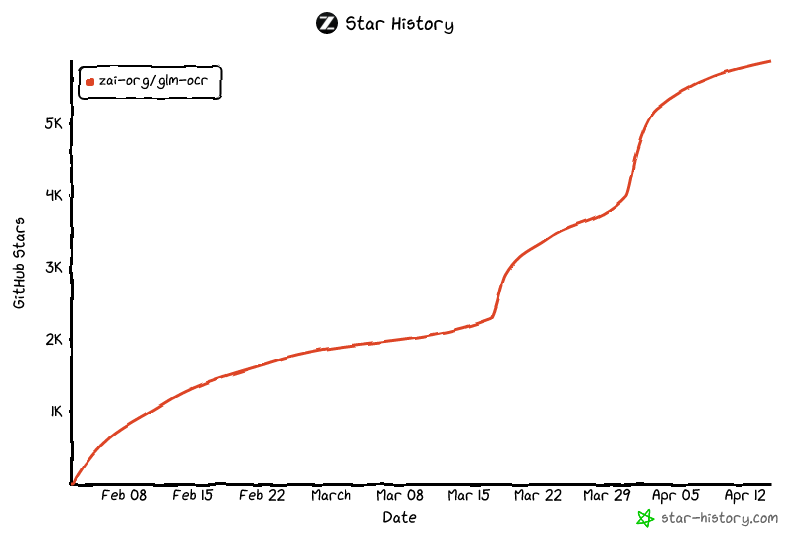
Star History
Acknowledgement
This project is inspired by the excellent work of the following projects and communities:
License
The Code of this repo is under Apache License 2.0.
The GLM-OCR model is released under the MIT License.
The complete OCR pipeline integrates PP-DocLayoutV3 for document layout analysis, which is licensed under the Apache License 2.0. Users should comply with both licenses when using this project.
Citation
If you find GLM-OCR useful in your research, please cite our technical report:
@misc{duan2026glmocrtechnicalreport,
      title={GLM-OCR Technical Report},
      author={Shuaiqi Duan and Yadong Xue and Weihan Wang and Zhe Su and Huan Liu and Sheng Yang and Guobing Gan and Guo Wang and Zihan Wang and Shengdong Yan and Dexin Jin and Yuxuan Zhang and Guohong Wen and Yanfeng Wang and Yutao Zhang and Xiaohan Zhang and Wenyi Hong and Yukuo Cen and Da Yin and Bin Chen and Wenmeng Yu and Xiaotao Gu and Jie Tang},
      year={2026},
      eprint={2603.10910},
      archivePrefix={arXiv},
      primaryClass={cs.CL},
      url={https://arxiv.org/abs/2603.10910},
}
Metadata
Release files for glmocr 0.1.5
For a detailed explanation of source distributions (sdists) and built distributions (wheels), please see the package formats documentation.
Source distribution (sdist)
| File | Size | Uploaded | |
|---|---|---|---|
| glmocr-0.1.5.tar.gz | 103.6 kB | Details |
Built distribution (wheel)
| File | Interpreter | ABI | Platform | Reset |
|---|---|---|---|---|
| glmocr-0.1.5-py3-none-any.whl | Python 3 | none | any | Details |
Total release size: 218.8 kB
Release files / glmocr-0.1.5.tar.gz
| Download URL | glmocr-0.1.5.tar.gz |
|---|---|
| Size | 103.6 kB |
| Tags | Source |
|
SHA-256 checksum How to use checksums |
22839b6d7a5dc51c331d1f8f7cfa89b8cda4889cfbb0e4cb64139fa4fb2264da
|
|
BLAKE2b-256 checksum How to use checksums |
b50a1c53e8d52ddc52074307db886c481116aab4b8effeb75955d1fc08b62cdb
|
| Upload date | |
|
Uploaded using Trusted Publishing? What is trusted publishing? |
No |
| Uploaded via |
twine/6.1.0 CPython/3.13.12
|
Release files / glmocr-0.1.5-py3-none-any.whl
| Download URL | glmocr-0.1.5-py3-none-any.whl |
|---|---|
| Size | 115.2 kB |
| Tags | Python 3 |
|
SHA-256 checksum How to use checksums |
9649aec2e70eeb5a8ebed9979092c58ec5c4e075a085fb82c8fa3b04e4e40977
|
|
BLAKE2b-256 checksum How to use checksums |
7004baff846a7f0c766b8b77f77c797c01ace154f7d8f9884a6a92711341c554
|
| Upload date | |
|
Uploaded using Trusted Publishing? What is trusted publishing? |
No |
| Uploaded via |
twine/6.1.0 CPython/3.13.12
|














