
csdb2snfg




Convert CSDB linear notation to SNFG (Symbol Nomenclature for Glycans) diagrams.
Installation
pip install glyco-csdb2snfg                  # PyPI (stable)
conda install -c bioconda glyco-csdb2snfg    # Bioconda
pip install git+https://github.com/sosyphe/glyco-csdb2snfg.git  # source
Examples
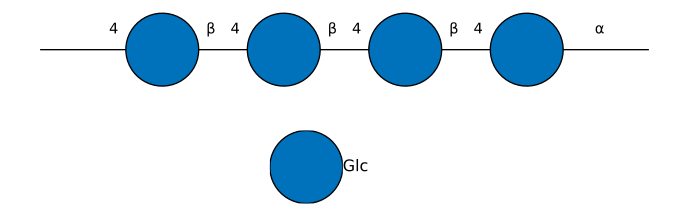
Simple linear chain
-4)βDGlcp(1-4)βDGlcp(1-4)βDGlcp(1-4)αDGlcp(1-
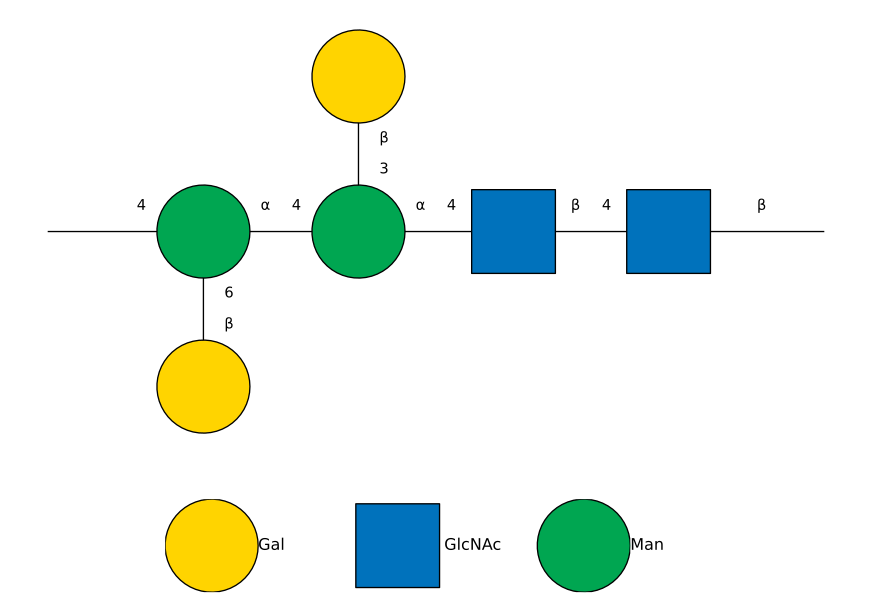
Branched unit
-4)[βDGalp(1-6)]αDManp(1-4)[βDGalp(1-3)]αDManp(1-4)βDGlcNAcp(1-4)βDGlcNAcp(1-
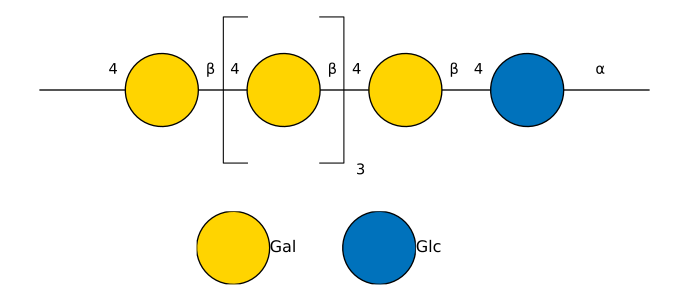
Repeating unit (/n=3/, compact form)
-4)βDGalp(1-4)/βDGalp(1-4)/n=3/βDGalp(1-4)αDGlcp(1-
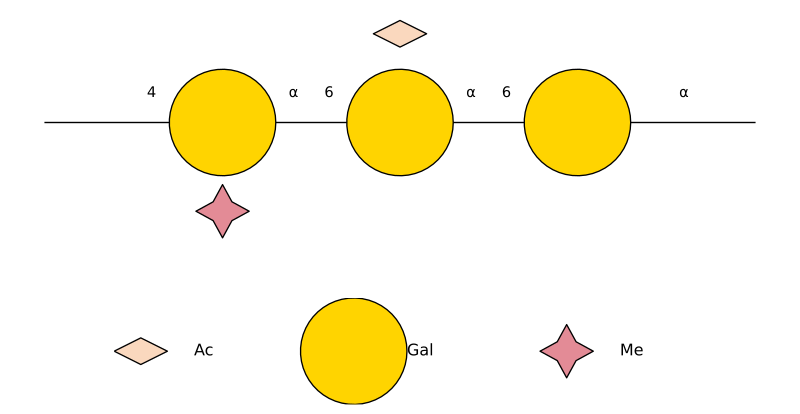
With modifiers (Me, Ac)
-4)[Me(1-3)]αDGalp(1-6)[Ac(1-3)]αDGalp(1-6)αDGalp(1-
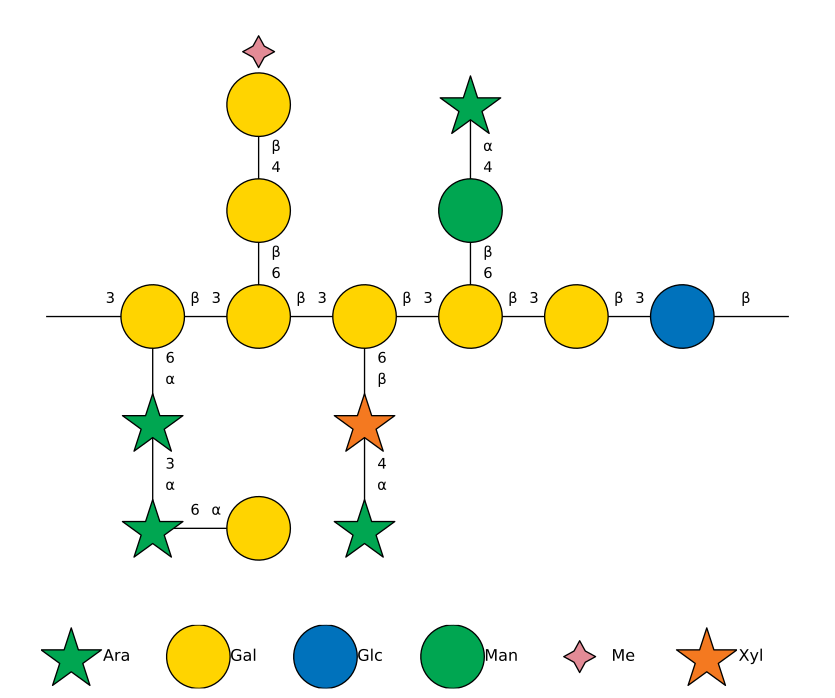
Complex multi-branched
-3)[[αDGalp(1-6)]αLArap(1-3)αLAraf(1-6)]βDGalp(1-3)[Me(1-4)βDGalp(1-4)βDGalp(1-6)]βDGalp(1-3)[αLAraf(1-4)βDXylp(1-6)]βDGalp(1-3)[αLAraf(1-4)βDManp(1-6)]βDGalp(1-3)βDGalp(1-3)βDGlcp(1-
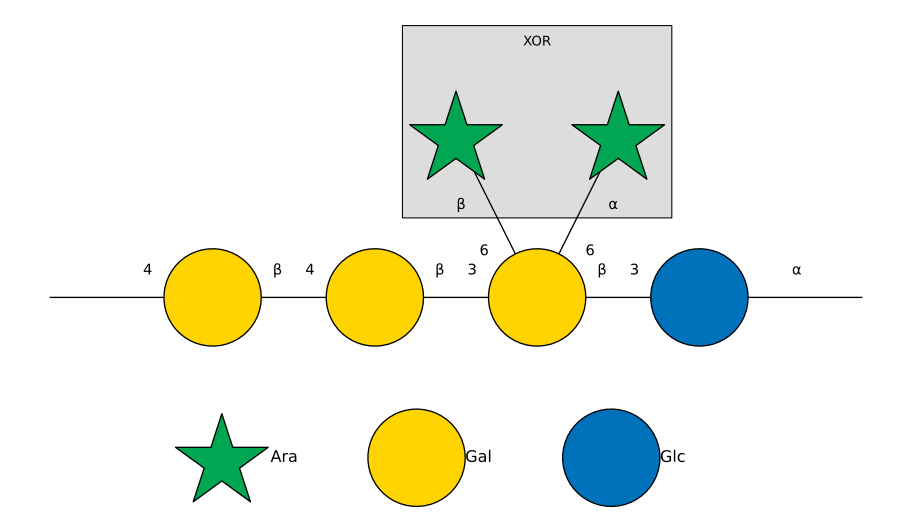
Fuzzy unit (XOR alternatives)
-4)βDGalp(1-4)βDGalp(1-3)[<<αLAraf(1-6)|βLAraf(1-6)>>]βDGalp(1-3)αDGlcp(1-
Quick Start
csdb2snfg image -c="-4)βDGlcp(1-4)βDGlcp(1-4)αDGlcp(1-" --format png -o output/  # PNG/SVG
csdb2snfg pptx  -c="-4)βDGalp(1-4)βDGalp(1-3)αDGalp(1-" -o output/               # one slide per glycan
csdb2snfg parse -c="-4)βDGlcp(1-4)αDGlcp(1-"                                     # JSON AST on stdout
csdb2snfg image -f glycans.txt -o output/     # batch: one string per line, # comments
Note: Use
-c="..."(with=) to prevent argparse from treating the leading-as a flag.
from csdb2snfg import parse_csdb_linear, draw_snfg, generate_snfg_pptx

tree = parse_csdb_linear("-4)βDGlcp(1-4)βDGlcp(1-4)αDGlcp(1-")

fig, ax = draw_snfg(tree)                       # matplotlib figure
fig.savefig("glycan.png", dpi=300, bbox_inches="tight")
draw_snfg(tree, save_svg="glycan.svg")          # or SVG directly

buf = generate_snfg_pptx(["-4)βDGlcp(1-4)αDGlcp(1-"])
with open("glycans.pptx", "wb") as f:
    f.write(buf.read())
Features
- Parse CSDB linear strings into a structured AST (JSON output)
- Render SNFG diagrams as PNG/SVG images; export PowerPoint (PPTX) with vector shapes
- Supports branching, repeating units (
/n=N/), modifiers (Me, Ac) and fuzzy structural alternatives (<A|B>OR,<<A|B>>XOR) - Styles: presets (
default,glycoworkbench), per-element color/width overrides via dict or JSON file; node size and stroke controls - Motif highlighting: dim everything except a matched CSDB substructure
- Reducing-end markers:
freeEnd/redEndsquiggles or arbitrary text labels - Unknown markers:
?(unknown anomeric configuration / linkage position) is parsed into the AST and rendered withshow_unknown/--show-unknown - Parse notices: dropped fragments (unknown sugar names like
?DGro, non-stoichiometric suffixes like40%) are reported vialogging
Known Limitations
- Visual overlap may occur when a single residue has ≥3 consecutive linkages, or between branches in dense structures
- Highlight motifs may not contain fuzzy (
<<|>>/<|>) or repeat (/…/n=…/) blocks;?wildcards the anomeric configuration / linkage site andXthe absolute configuration - Only orthogonal (horizontal/vertical) chain layout; no diagonal or angled linkages
Command-Line Interface
All three subcommands accept a single string (-c/--csdb) or a batch file
(-f/--file). Single inputs write snfg.<ext>; batches write snfg_001,
snfg_002, … (PPTX: snfg.pptx / snfg_diagrams.pptx). Parse warnings go to
stderr; library users configure logging.getLogger("csdb2snfg") themselves.
Flag (image / pptx) |
Effect |
|---|---|
--format, --dpi |
Output format png/svg (image only) and resolution |
--template PATH |
Reuse masters/layouts from a .pptx/.potx (pptx only) |
--style NAME_OR_PATH |
Preset (default, glycoworkbench) or JSON style file |
--highlight MOTIF |
Dim everything except a matched substructure; ? wildcards |
--end END |
Reducing-end marker: freeEnd, redEnd or any text label |
--compact-repeat |
Show repeat units as [unit]n instead of expanding |
--split-fuzzy |
Merged structure and each fuzzy variant get their own image/slide |
--no-linkage, --no-legend |
Hide edge linkage labels / the monosaccharide legend |
--show-unknown |
Render ? for unknown anomeric config / linkage positions |
--node-size, --node-stroke-width, --link-width |
Node radius (layout units), line widths (points) |
--ratio, --font-size, --font-family |
Branch scaling and label typography |
Python API
import csdb2snfg is lazy: matplotlib / python-pptx are imported only when
draw_snfg / generate_snfg_pptx is first accessed.
from csdb2snfg import parse_csdb_linear, print_ast, draw_snfg, generate_snfg_pptx

tree = parse_csdb_linear("-4)βDGlcp(1-4)αDGlcp(1-")  # None for an empty string
data = tree.to_dict()        # JSON-serializable AST
print_ast(tree)              # indented text dump (debug aid)

fig, ax = draw_snfg(tree)    # (fig, ax): further matplotlib customization stays available
buf = generate_snfg_pptx(["-4)βDGlcp(1-4)αDGlcp(1-"], template_path=None)
Feature Guide
Every option below is both a keyword argument on draw_snfg / generate_snfg_pptx and a CLI flag; every default reproduces the historical appearance exactly.
Styles and presets
-4)βDGlcp(1-4)αDGlcp(1- rendered with --style glycoworkbench --node-stroke-width 1.5 --link-width 2
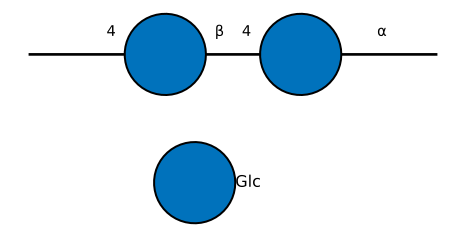
csdb2snfg image -c="-4)βDGlcp(1-4)αDGlcp(1-" --style glycoworkbench \
    --node-stroke-width 1.5 --link-width 2 -o output/
draw_snfg(tree, style="glycoworkbench")            # built-in preset
draw_snfg(tree, style={"extends": "default",       # dict: scalars replace,
                       "palette": {"Blue": "#123456"},  # sections merge key-wise
                       "link_width": 2.0})
draw_snfg(tree, style="my_style.json")             # same schema as the dict
draw_snfg(tree, node_stroke_width=1.5, link_width=2, show_linkage=False)
generate_snfg_pptx([csdb], node_size=0.4)          # abstract units, like mono_size
Style dict/JSON keys (all optional): name, extends, palette, dim_palette, mono_styles, plus colors/widths node_stroke_*, link_color, link_width, link_label_color, fuzzy_box_*, bracket_*. null means "backend-native literal", which keeps the default style byte-identical to older releases. Unknown top-level keys are rejected; unknown color names / monosaccharides are allowed and fall back.
Motif highlighting
Matched elements keep the full palette, everything else dims to pastels. A motif is itself a CSDB string; ? wildcards the anomeric configuration or a linkage site, X the absolute configuration. A motif with no match logs a warning and renders normally.
-4)βDGalp(1-4)βDGalp(1-3)αDGalp(1- with --highlight "βDGalp(1-4)βDGalp"
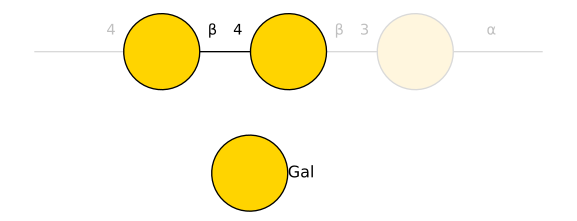
csdb2snfg image -c="-4)βDGalp(1-4)βDGalp(1-3)αDGalp(1-" \
    --highlight "βDGalp(1-4)βDGalp" -o output/
tree = parse_csdb_linear("-4)βDGalp(1-4)βDGalp(1-3)αDGalp(1-")
draw_snfg(tree, highlight_motif="βDGalp(1-4)βDGalp")  # exact substructure
draw_snfg(tree, highlight_motif="βDGalp(1-?)?DGalp")  # ? wildcards
Fuzzy residues
<<A|B>> (XOR) and <A|B> (OR) draw all candidates together in a grey box by default; --split-fuzzy / split_fuzzy=True emits the merged structure and each resolved variant as separate images/slides.
csdb2snfg image -c="-4)βDGalp(1-3)[<<αLAraf(1-6)|βLAraf(1-6)>>]βDGalp(1-" \
    --split-fuzzy -o output/
from csdb2snfg import expand_fuzzy, split_fuzzy_variants

csdb = "-4)βDGalp(1-3)[<<αLAraf(1-6)|βLAraf(1-6)>>]βDGalp(1-"
for variant in expand_fuzzy([csdb]):   # [merged original, variant1, ...] per input
    draw_snfg(parse_csdb_linear(variant), add_legend=False)
split_fuzzy_variants(csdb)             # plain variants only (Cartesian product)
generate_snfg_pptx([csdb], split_fuzzy=True)
End markers, repeats and unknowns
-4)βDGlcp(1-4)βDGlcp(1-4)βDGlcp(1-4)αDGlcp(1- with end="freeEnd" / end="redEnd" / end="2AB" (left to right):
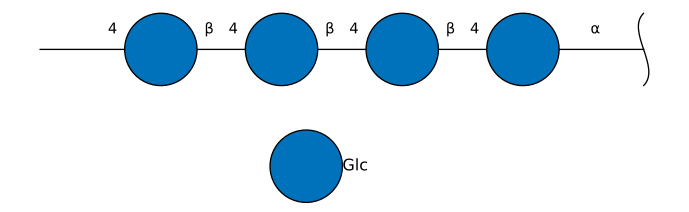
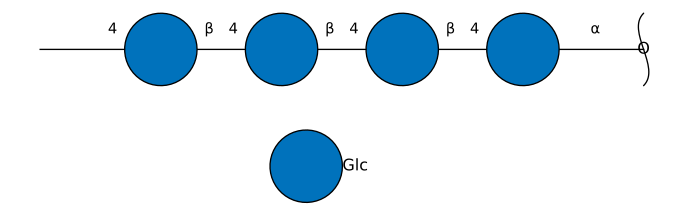
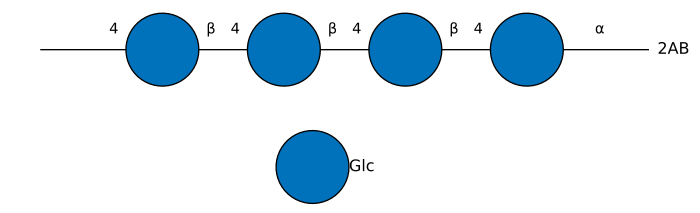
end="freeEnd"/end="redEnd"draw the GlycoWorkbench squiggle / squiggle with a centeredO(reduced end, alditol); any other non-empty string (PA,2AB) becomes a text label./unit/n=N/repeats: the Python API renders the compact[unit]ₙform by default (compact_repeat=True), the CLI expands into N copies unless--compact-repeatis given; an unknown count (n=?) draws a single unit plus the bracket.?in the source (?DGalp,(1-?)) is kept in the AST;show_unknown=True/--show-unknownrenders it in the edge-label slots.
License
MIT License - see LICENSE for details.
1 maintainer

Metadata
1 maintainer
Release files for glyco-csdb2snfg 0.3.0
For a detailed explanation of source distributions (sdists) and built distributions (wheels), please see the package formats documentation.
Source distribution (sdist)
| File | Size | Uploaded | Provenance | |
|---|---|---|---|---|
| glyco_csdb2snfg-0.3.0.tar.gz | 95.6 kB | With provenance | Details |
Built distribution (wheel)
| File | Interpreter | ABI | Platform | Reset |
|---|---|---|---|---|
| glyco_csdb2snfg-0.3.0-py3-none-any.whl | Python 3 | none | any | Details |
Total release size: 197.6 kB
Release files / glyco_csdb2snfg-0.3.0.tar.gz
| Download URL | glyco_csdb2snfg-0.3.0.tar.gz |
|---|---|
| Size | 95.6 kB |
| Tags | Source |
|
SHA-256 checksum How to use checksums |
0cb9551a98687004a79ace9dfc5232c5d6b587f8e9474d0e2feb62d0ab4aa7de
|
|
BLAKE2b-256 checksum How to use checksums |
830a3aab3edb23ed3af6fbb079b4ec9c58433fac79048da0e38a32a03a2ca6e3
|
| Upload date | |
|
Uploaded using Trusted Publishing? What is trusted publishing? |
Yes |
| Uploaded via |
twine/7.0.0 CPython/3.13.16
|
Provenance
Provenance describes where a file came from. On PyPI, provenance is shared via attestations, which provide a verifiable record of the build or publishing details. View details, limitations and caveats.


PyPI Publish Attestation
PyPI verified that this artifact, at this checksum, originated from the publisher listed below.
Signed by GitHub Actions, verified by PyPI on Oct 23, 2026.
Transparency logRelease files / glyco_csdb2snfg-0.3.0-py3-none-any.whl
| Download URL | glyco_csdb2snfg-0.3.0-py3-none-any.whl |
|---|---|
| Size | 102.0 kB |
| Tags | Python 3 |
|
SHA-256 checksum How to use checksums |
9eaca2a4ecbdd04fada6f9b9b0168657d5353a7e1374f4d0ca2619c4d1cd5a14
|
|
BLAKE2b-256 checksum How to use checksums |
878c62c211d7d58d55552188e84b9d2f1db72702e57eeeab48050e0fafd73745
|
| Upload date | |
|
Uploaded using Trusted Publishing? What is trusted publishing? |
Yes |
| Uploaded via |
twine/7.0.0 CPython/3.13.16
|
Provenance
Provenance describes where a file came from. On PyPI, provenance is shared via attestations, which provide a verifiable record of the build or publishing details. View details, limitations and caveats.
PyPI Publish Attestation
PyPI verified that this artifact, at this checksum, originated from the publisher listed below.
Signed by GitHub Actions, verified by PyPI on Oct 23, 2026.
Transparency logSecurity for glyco-csdb2snfg 0.3.0
Provenance
Provenance describes where a file came from. On PyPI, provenance is shared via attestations, which provide a verifiable record of the build or publishing details. View details, limitations and caveats.
Full provenance
All 2 files in this release have been uploaded with provenance metadata.
Attestation for glyco_csdb2snfg-0.3.0.tar.gz
PyPI Publish Attestation
PyPI verified that this artifact, at this checksum, originated from the publisher listed below.
Signed by GitHub Actions, verified by PyPI on Oct 23, 2026.
Transparency logA note on package security
PyPI is a repository for distributing packages, not a service for auditing them. While third-party security researchers and our staff do their best to detect and remove malicious packages, PyPI cannot guarantee the quality, security or suitability of any given package.














