
gnosis-markdown
Prove where every document came from.
Web → clean, RAG-ready Markdown — with proof of origin baked into every byte.
Markdown is a projection; the raw bytes + WARC are the source of truth.
For RAG engineers, compliance & data-governance teams, and security-sensitive researchers who need to prove — not just assume — where a document came from, gnosis-markdown fetches and crawls any page into LLM-ready Markdown while stamping every file with byte-level SHA-256, WARC archival, and Ed25519 signatures you can verify independently.
Byte-level provenance. Re-fetchable. Re-verifiable. No sidecar bookkeeping.






Why gnosis-markdown
The citation/provenance layer for LLM pipelines — not another scraper.
You can scrape the web with a dozen tools. You can only prove where a document came from with one. gnosis-markdown turns every fetch into an auditable Capture Record: hash the bytes, archive the raw response, record the consent signals, and sign the result — so the document in your RAG index is traceable to the bytes on the wire.
Firecrawl, Crawl4AI and Jina Reader win on speed, scale and hosting. gnosis-markdown doesn't compete there — it wins on auditability, the one axis none of them ship as a first-class feature.
The honest comparison
This table is deliberately not a feature matrix. It claims only the provenance / audit / consent / signing surface gnosis-markdown ships in its own tree — and nothing about speed, scale, or hosting, where we do not claim to compete.
| Audit-surface capability | gnosis-markdown | Firecrawl | Crawl4AI | Jina Reader |
|---|---|---|---|---|
bytes_sha256 — SHA-256 of the response body bytes |
✅ | ❌ | ❌ | ❌ |
content_hash — SHA-256 of the derived Markdown |
✅ | ⚠️ | ⚠️ | ❌ |
| WARC archival + content-addressed store (replay via pywb) | ✅ | ❌ | ❌ | ❌ |
| Ed25519 seal of origin (sign + pinned-key verify) | ✅ | ❌ | ❌ | ❌ |
| ai.txt / llms.txt consent recording per fetch | ✅ | ❌ | ❌ | ❌ |
Deny-overrides compliance policy engine + --profile presets |
✅ | ❌ | ❌ | ❌ |
| IP-pinned SSRF guard (closes DNS-rebinding TOCTOU) | ✅ | ➖ | ❌ | ➖ |
Per-job Data Card (data-card.json) |
✅ | ❌ | ❌ | ❌ |
| Versioned, machine-readable Capture Record spec | ✅ | ❌ | ❌ | ❌ |
Legend: ✅ first-class, shipped in-tree and verifiable · ⚠️ partial / not the same thing · ❌ not offered as a documented feature · ➖ opaque (managed service; behavior not verifiable in a self-hosted deployment).
As of September 2026. gnosis-markdown claims are verifiable against this
repository (--sign, --warc, --profile, gnosis-keygen, gnosis-verify).
Competitor columns reflect their public docs at time of writing — re-verify
each project against its own repository before relying on this table.
Firecrawl and Jina Reader are hosted services: some server-side behavior
(e.g. SSRF handling) exists but cannot be verified by a third party in a
self-hosted build, hence ➖.
Verify it yourself
The provenance claim is the product. After a fetch:
gnosis https://docs.python.org/3/tutorial/ -o out/ --warc

# The frontmatter's bytes_sha256 is the SHA-256 of the response body bytes (after content decoding):
shasum -a 256 out/.gnosis-store/<bytes_sha256>   # matches the hash in the .md
Every markdown file is re-fetchable and re-verifiable — no sidecar bookkeeping.
Reproducible benchmark evidence: see BENCHMARKS.md.
Quick start
Requires Python 3.12+.
pip install gnosis-markdown

# One page → one markdown file (written to ./ by default; use -o to change it)
gnosis https://docs.python.org/3/tutorial/

# Crawl an entire section
gnosis https://docs.python.org/3/tutorial/ --all -o ./python-docs/

# Archive the raw bytes to WARC + a content-addressed store, and sign the record
gnosis https://docs.python.org/3/tutorial/ --warc --sign --sign-key key.pem

# Emit per-chunk citation manifests for RAG
gnosis https://docs.example.com --chunk

# Export with provenance (JSON / JSONL / Parquet)
gnosis https://docs.example.com --format json

# Evaluate yourself against a corpus (one URL per line)
printf 'https://docs.python.org/3/\nhttps://example.com/\n' > urls.txt
gnosis-bench --urls urls.txt

# Convert a PDF/Office doc to Markdown (pip install gnosis-markdown[docs])
gnosis-doc report.pdf -o report.md
JS rendering is opt-in via a sidecar binary (default obscura); install the
Obscura binary, then
gnosis https://my-spa.example --render (or set render.engine in config).
Features
Provenance & audit — the moat
bytes_sha256— SHA-256 of the response body bytes (after content decoding). You hash the bytes, not the derived text.content_hash— SHA-256 of the emitted Markdown, so transforms are auditable too.- WARC archival (
--warc) — WARC-grade evidence, replayable via pywb, plus a content-addressed store keyed onbytes_sha256. Every file is re-fetchable and re-verifiable — no sidecar bookkeeping. - Ed25519 signing — seal of origin —
--signcryptographically signs each record;gnosis-keygenmints keypairs andgnosis-verifychecks them against a pinned key. Prove a document came from a capture you made, untouched. - Data cards — every scrape/crawl job writes a
data-card.json: sources, sizes, licenses encountered, ai.txt/llms.txt coverage, and compliance decisions — one artifact an auditor reads instead of opening every file.
Consent & compliance policy
- ai.txt / llms.txt consent recording — a host's
ai.txtdirectives andllms.txtpresence are captured into the frontmatter of every affected file. - Compliance policy engine — per-page
allow_if/deny_ifrules with deny-overrides semantics, matched on license, ai.txt directives, and URL path. Decisions are recorded in the frontmatter and data card, not just applied. --profilepresets —strict-optout(block training/data opt-outs andDisallow:paths) andopen-only(permissive/open licenses only).
ai.txt is advisory, not enforced by default. gnosis records a site's ai.txt opt-out but does not, by default, refuse to scrape. To stop scraping at opt-outs, use
--profile strict-optoutor an explicitdeny_ifrule. "We record the opt-out and scrape anyway" is exactly the behavior a regulator will ask about — decide it deliberately.
Security
- IP-pinned SSRF guard — blocks loopback, RFC1918, link-local, multicast, CGNAT/6to4/Teredo/NAT64, and every redirect hop — closing the DNS-rebinding TOCTOU by resolving once, validating every address, and dialing only pinned IPs (TLS SNI still uses the hostname, so pinning never weakens TLS).
- robots.txt + politeness respected (per-host rate limiting,
Crawl-delaycapped), fail-open on errors. - Auth/custom headers are sent only to the original origin — never replayed to cross-origin redirect targets.
- Secrets via
${ENV_VAR}— keep credentials out of config files and shell history.
Extraction & output
- Clean, main-content Markdown with valid GFM tables, metadata extraction, and
boilerplate stripping — plus a
retention_ratio/stripped_elements/low_contentaudit trail over the transform itself. - Token-aware chunking (
--chunk) — stable chunk IDs, heading paths, and exact byte offsets in a per-page.chunks.jsoncitation manifest. - Multi-format export —
--format json|jsonl|parquet, each record carrying full provenance. llms.txt/llms-full.txtemission on every crawl.
Crawling at scale
- Incremental crawl + conditional GET —
If-None-Match/304skip unchanged downloads; a hash-native checkpoint makes--allresumable, growing pastmax_pagesacross runs.
Integrations
- MCP server (
gnosis-mcp) — expose gnosis as an MCPfetch_and_converttool that returns provenance-stamped Markdown ([mcp]extra). - LlamaIndex reader and LangChain document loader — return provenance-
stamped
Documents ([llamaindex]/[langchain]extras). - Plugin hooks —
pre_fetch/post_fetch/post_processfor custom auth, filtering, and post-processing. - Companion CLIs —
gnosis-bench(reproducible scorecard),gnosis-doc(PDF/Office → Markdown),gnosis-keygen/gnosis-verify(signing).
Provenance: the contract
The full machine-readable contract — every field, its exact semantics, and conformance rules — is in the Capture Record Specification.
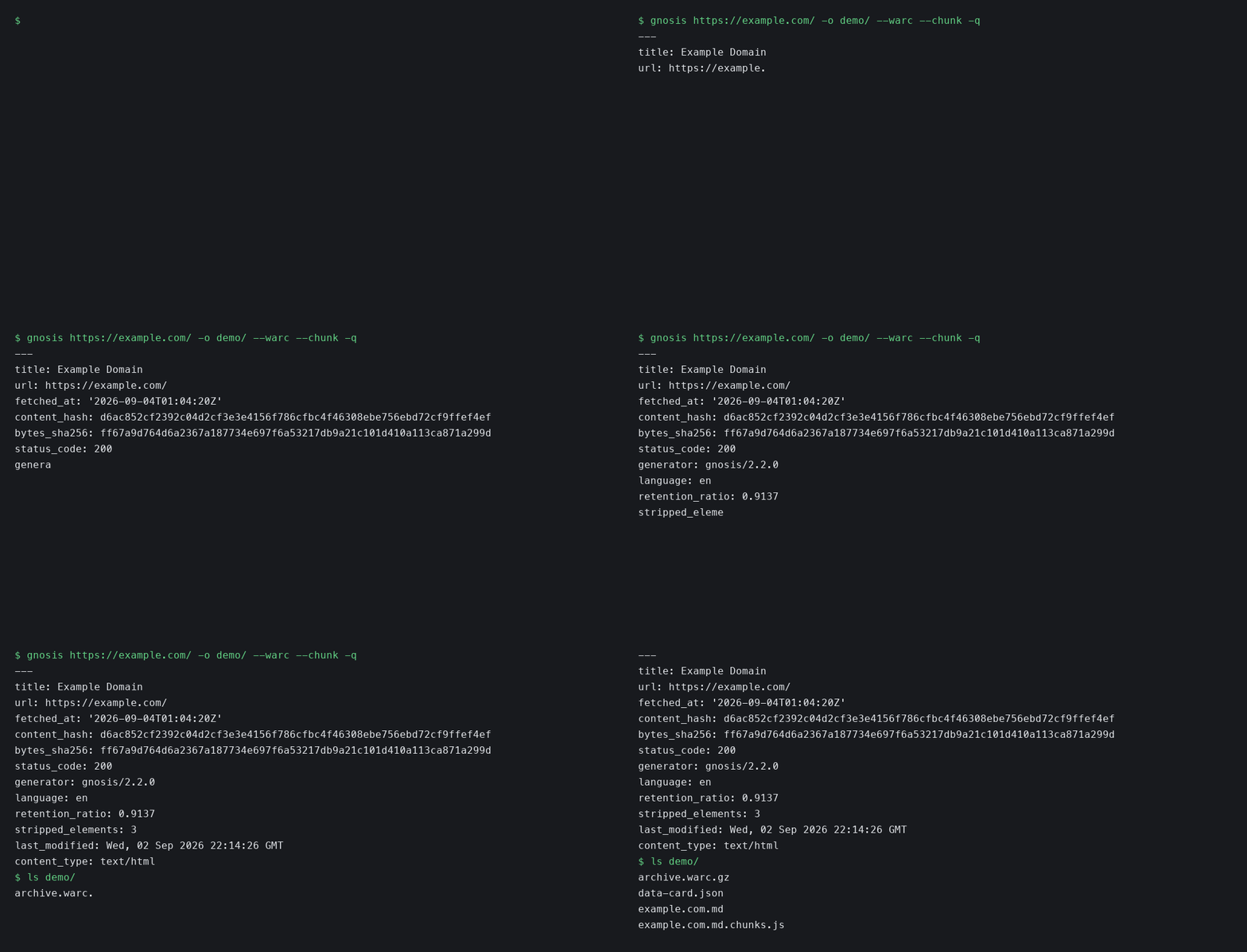
---
title: Quickstart
url: https://docs.example.com/quickstart
fetched_at: '2026-09-02T08:41:44Z'
content_hash: 1549512c...16fd     # SHA-256 of the markdown body
bytes_sha256: 85052df6...bcb31    # SHA-256 of the response body bytes
status_code: 200
generator: gnosis/2.2.0
etag: '"61e917f4..."'
last_modified: Fri, 31 Jul 2026 16:07:37 GMT
---
Standard YAML, parseable by python-frontmatter, Jekyll, Hugo, Obsidian, and
any downstream pipeline. Opt out with --no-frontmatter.
CLI reference
gnosis URL [OPTIONS]
| Flag | Description |
|---|---|
-a, --all |
Crawl all child pages under the URL path |
-n, --dry-run |
Discover and count pages only (requires --all) |
-o, --output DIR |
Output directory (default ./) |
-c, --config FILE |
YAML configuration file |
-f, --overwrite |
Overwrite existing files |
-q, --quiet / -v, --verbose |
Suppress / show diagnostics |
--no-frontmatter |
Write bare markdown (no provenance) |
--frontmatter KEY: VALUE |
Extra constant frontmatter field (repeatable) |
--header NAME: VALUE |
Extra request header (repeatable) |
--bearer-token-env VAR |
Bearer token from environment variable |
--basic-user USER |
HTTP Basic username (requires --basic-token-env) |
--basic-token-env VAR |
HTTP Basic password/token from environment variable |
--allow-private-network |
Bypass the SSRF guard (opt-in) |
--warc |
Archive raw bytes to WARC + content-addressed store |
--render |
Render pages with the configured JS renderer |
--chunk |
Write per-chunk citation manifests (.chunks.json) |
--sitemap |
Treat URL as a sitemap.xml and list its page URLs |
--qmd-index |
Index output into QMD (requires [qmd] extra) |
--sign |
Cryptographically sign the output (Ed25519 seal of origin) |
--sign-key FILE |
Ed25519 private key (PEM) for --sign (or $GNOSIS_SIGNING_KEY) |
--format json|jsonl|parquet |
Also export documents (with provenance) |
--profile NAME |
Compliance preset: strict-optout / open-only |
Also available: gnosis-bench (reproducible scorecard), gnosis-doc
(document → Markdown), gnosis-keygen (generate a signing keypair),
gnosis-verify (verify a signed document), and gnosis-mcp (MCP server).
Installation
pip install gnosis-markdown                  # core
pip install 'gnosis-markdown[sign]'          # Ed25519 signing (cryptography)
pip install 'gnosis-markdown[parquet]'       # Parquet export (pyarrow)
pip install 'gnosis-markdown[mcp]'           # MCP server
pip install 'gnosis-markdown[llamaindex]'    # LlamaIndex reader
pip install 'gnosis-markdown[langchain]'     # LangChain loader
pip install 'gnosis-markdown[docs]'          # document conversion (MarkItDown)
pip install 'gnosis-markdown[qmd]'           # QMD vector-DB indexing
Requires Python 3.12+. See
gnosis/config/default.yaml for the full
configuration reference.
Development
git clone https://github.com/SHCV-it/gnosis.git
cd gnosis
pip install -e '.[test]'
python -m pytest tests/ -q          # offline suite (localhost fixtures)
Contributing
Contributions are welcome — open an issue first to discuss. Report security issues privately (see SECURITY). See ROADMAP.md for the project plan.
License
MIT — see LICENSE.
Authors: Steffen Hoehne & Ali Zahid Raja, SHCV.IT
1 maintainer

Metadata
1 maintainer
Release files for gnosis-markdown 2.3.0
For a detailed explanation of source distributions (sdists) and built distributions (wheels), please see the package formats documentation.
Source distribution (sdist)
| File | Size | Uploaded | |
|---|---|---|---|
| gnosis_markdown-2.3.0.tar.gz | 111.1 kB | Details |
Built distribution (wheel)
| File | Interpreter | ABI | Platform | Reset |
|---|---|---|---|---|
| gnosis_markdown-2.3.0-py3-none-any.whl | Python 3 | none | any | Details |
Total release size: 192.1 kB
Release files / gnosis_markdown-2.3.0.tar.gz
| Download URL | gnosis_markdown-2.3.0.tar.gz |
|---|---|
| Size | 111.1 kB |
| Tags | Source |
|
SHA-256 checksum How to use checksums |
2ce8824947243066d5b11109897f46922737c58d723a1c58545699dc63908f0c
|
|
BLAKE2b-256 checksum How to use checksums |
d073a6f687cbcf8ac6ed2d5e686975ef0b37e084bc595f70ea7a3a25fe36bec9
|
| Upload date | |
|
Uploaded using Trusted Publishing? What is trusted publishing? |
Yes |
| Uploaded via |
twine/7.0.0 CPython/3.13.14
|
Provenance
Provenance describes where a file came from. On PyPI, provenance is shared via attestations, which provide a verifiable record of the build or publishing details. View details, limitations and caveats.


PyPI Publish Attestation
PyPI verified that this artifact, at this checksum, originated from the publisher listed below.
Signed by GitHub Actions, verified by PyPI on Sep 4, 2026.
Transparency logRelease files / gnosis_markdown-2.3.0-py3-none-any.whl
| Download URL | gnosis_markdown-2.3.0-py3-none-any.whl |
|---|---|
| Size | 81.1 kB |
| Tags | Python 3 |
|
SHA-256 checksum How to use checksums |
35a049ddceb48c5cae04e143f3139cc255a70578670094bc94bf44235f325c57
|
|
BLAKE2b-256 checksum How to use checksums |
bb0ae40f429ad4b1b754566506cc1adeb131fe59bbabc8c9e47a81441dc60ec6
|
| Upload date | |
|
Uploaded using Trusted Publishing? What is trusted publishing? |
Yes |
| Uploaded via |
twine/7.0.0 CPython/3.13.14
|
Provenance
Provenance describes where a file came from. On PyPI, provenance is shared via attestations, which provide a verifiable record of the build or publishing details. View details, limitations and caveats.
PyPI Publish Attestation
PyPI verified that this artifact, at this checksum, originated from the publisher listed below.
Signed by GitHub Actions, verified by PyPI on Sep 4, 2026.
Transparency log













