
✦ Golden Dataset Studio
A production-grade RAG evaluation framework built around a curated golden dataset core.
Hand-crafted ground truth · Versioned Q&A pairs · Semantic similarity scoring · RAGAS + DeepEval integration




What is Golden Dataset Studio?
Most RAG evaluation frameworks treat the golden dataset as an afterthought — a CSV you import once and forget. Golden Dataset Studio flips that. The golden dataset is the foundation everything else is built on.
A golden dataset is a hand-curated set of question + expected answer pairs specific to your domain and your documents. Every entry is something a human has verified is correct. It is your ground truth — the one thing you trust completely when your model changes, your chunking strategy changes, or your LLM is swapped.
Without a golden dataset:     you are guessing whether your RAG works
With a golden dataset:        you know — precisely, repeatably, with a version history
Golden Dataset Studio gives you:
- A versioned store for your Q&A pairs (
v1.0→v1.3→ ...) - A semantic similarity scorer that compares LLM answers against expected answers
- A manifest system that tracks which version was evaluated with which model
- A clean eval runner that strips noise (model tags, markdown) before scoring
- Integration hooks for RAGAS and DeepEval when you need deeper diagnostics
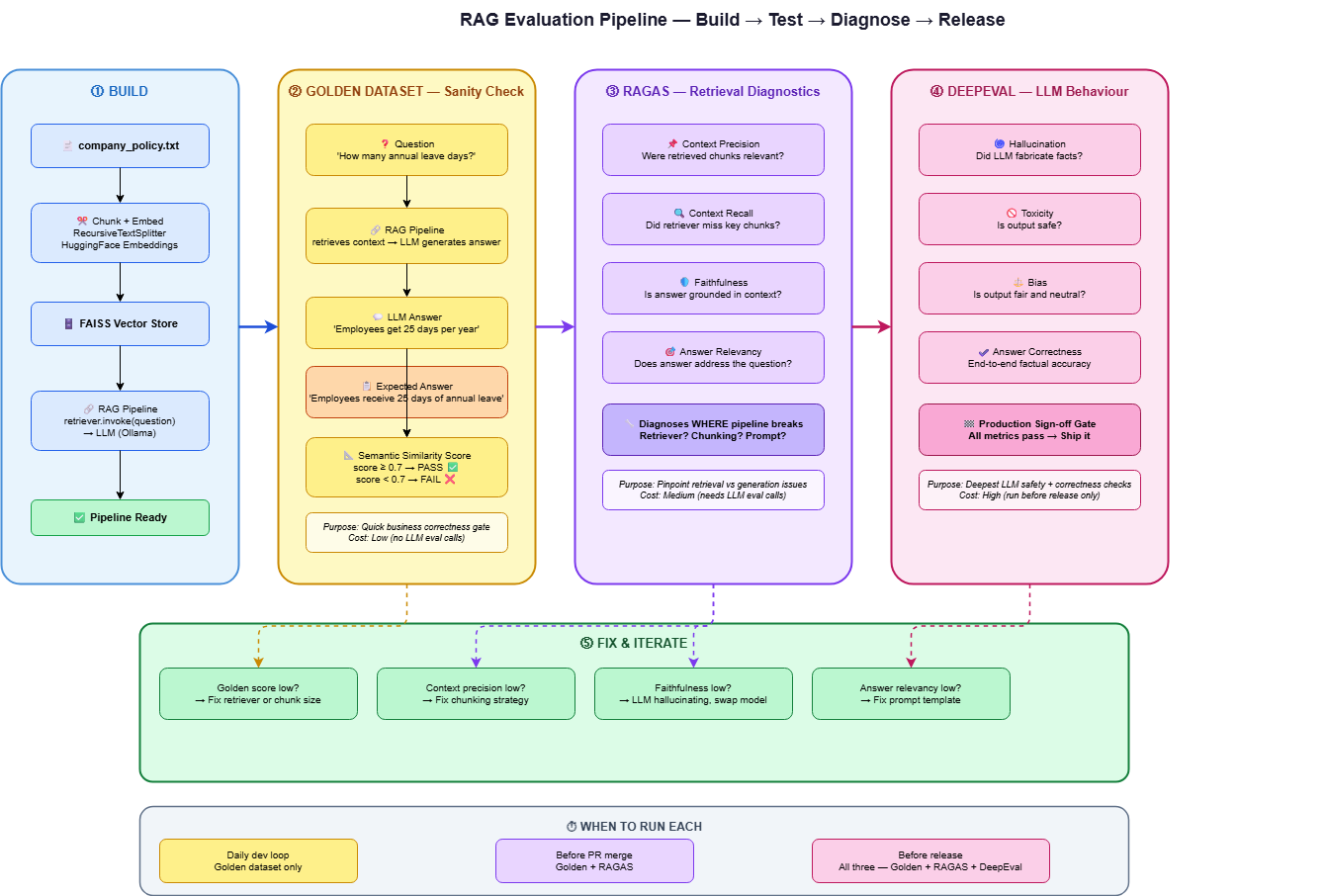
The Three-Layer Evaluation Strategy
                    ┌─────────────────────────────────────────────────────┐
                    │             GOLDEN DATASET STUDIO                   │
                    │                                                     │
                    │  "Is the final answer CORRECT for my domain?"      │
                    │                                                     │
                    │  Hand-curated Q&A  ·  Versioned  ·  Fast  ·  Cheap │
                    └─────────────────┬───────────────────────────────────┘
                                      │ PASS
                                      ▼
                    ┌─────────────────────────────────────────────────────┐
                    │                    RAGAS                            │
                    │                                                     │
                    │  "WHY is the pipeline producing that answer?"      │
                    │                                                     │
                    │  Context Precision · Context Recall · Faithfulness  │
                    └─────────────────┬───────────────────────────────────┘
                                      │ PASS
                                      ▼
                    ┌─────────────────────────────────────────────────────┐
                    │                  DEEPEVAL                           │
                    │                                                     │
                    │  "Is the LLM safe to ship to users?"               │
                    │                                                     │
                    │  Hallucination · Toxicity · Bias · Correctness     │
                    └─────────────────────────────────────────────────────┘
If Golden Dataset fails badly — stop here. Fix the retriever or chunking first. Do not burn RAGAS/DeepEval credits diagnosing a broken pipeline.
Golden Dataset — Deep Dive
What goes into it
Each entry has three fields:
{
  "id": "b9e08070",
  "question": "How many annual leave days do employees get?",
  "answer": "Employees receive 25 days of annual leave per year."
}
The answer is what a human expert wrote after reading your source document. It is not generated by an LLM. It is not scraped. It is your authoritative ground truth.
How scoring works
LLM answer  ──► sentence-transformers ──► embedding vector ──┐
                                                              ├──► cosine similarity ──► score
Expected answer ──► sentence-transformers ──► embedding vector ──┘

score >= 0.7  →  PASS ✓
score <  0.7  →  FAIL ✗
We use sentence-transformers/all-MiniLM-L6-v2 for embeddings. Semantic similarity means paraphrases pass — the LLM doesn't need to match word-for-word.
The clean_answer step
Before scoring, LLM output is cleaned to remove noise that tanks similarity scores unfairly:
def clean_answer(answer: str) -> str:
    # Remove [Model: gpt-oss:20b] prefix injected for traceability
    answer = re.sub(r'^\[Model:[^\]]+\]\s*', '', answer.strip())
    # Remove markdown bold **...**
    answer = re.sub(r'\*{1,2}([^*]+)\*{1,2}', r'\1', answer)
    return answer.strip()
Without this, [Model: gpt-oss:20b] **25 annual leave days** scores 0.46 against the expected answer. After cleaning, the same answer scores 0.93.
Versioning
Every eval run is saved with the dataset version and model name:
evals/
  eval_v1.3_20250610_143022.json   ← which version, which timestamp
my_answers.json                    ← { "model": "gpt-oss:20b", "answers_raw": [...], "answers_clean": [...] }
This means you can re-evaluate old answers against a new dataset version without re-running the LLM.
RAGAS — Retrieval Diagnostics
Run after Golden Dataset passes. Answers where the pipeline is breaking.
| Metric | Question it answers |
|---|---|
| Context Precision | Were the retrieved chunks relevant to the question? |
| Context Recall | Did the retriever miss any important information? |
| Faithfulness | Is the LLM answer grounded in the retrieved context, or hallucinated? |
| Answer Relevancy | Does the answer actually address what was asked? |
A real debugging scenario:
LLM answers "25 days"  ✓  Golden Dataset PASSES

But Context Precision = 0.3  ✗

Meaning: the retriever fetched 5 chunks, only 1 was relevant.
The LLM got lucky. Fix: reduce chunk_size, tune similarity threshold.
DeepEval — LLM Behaviour Gate
Run before every production release. The final sign-off check.
| Metric | What it catches |
|---|---|
| Hallucination | LLM fabricating facts not present in retrieved context |
| Toxicity | Unsafe or harmful output |
| Bias | Unfair or skewed responses |
| Answer Correctness | End-to-end factual accuracy across all questions |
When to Run Each Layer
| Trigger | Layers to run | Reason |
|---|---|---|
| Every code change / daily dev | Golden Dataset only | Fast, free, catches regressions immediately |
| Before merging a PR | Golden Dataset + RAGAS | Ensures retrieval quality didn't degrade |
| Before a production release | All three | Full sign-off — correctness, retrieval, safety |
Quick Start
git clone https://github.com/nipunkhanderia/golden-dataset-studio.git
cd golden-dataset-studio

pip install -r requirements.txt

# Run the golden dataset evaluation
python run_golden_eval.py --llm gpt-oss:20b

# Default model (llama3.2)
python run_golden_eval.py
Sample Output
Model: gpt-oss:20b
Running RAG pipeline against 2 golden entries (v1.3)...

[1/2] Q: How many annual leave days?
         Model:    gpt-oss:20b
         A:        [Model: gpt-oss:20b] Employees are entitled to 25 annual leave days.
         Cleaned:  Employees are entitled to 25 annual leave days.
         Expected: Employees receive 25 days of annual leave per year.
         Latency:  36.95s

==================================================
EVALUATION RESULTS (v1.3)
Model: gpt-oss:20b
==================================================
  [b9e08070] ✓ similarity=0.923  Q: How many annual leave days?
  [f8aac4c1] ✓ similarity=0.941  Q: What is the notice period?

  Avg Similarity: 0.932
  Pass (>=0.7):   ✓
  Saved to:       evals/eval_v1.3_20250610_143022.json
Project Structure
golden-dataset-studio/
├── data/
│   └── company_policy.txt          # Source document
├── golden_dataset.py               # DatasetStore, Evaluator, EvalResult, Manifest
├── run_golden_eval.py              # Eval runner — RAG + scoring + clean_answer
├── my_answers.json                 # { model, answers_raw, answers_clean }
├── evals/                          # Versioned eval results
│   └── eval_v1.3_<timestamp>.json
├── architecture.png                # Pipeline diagram
└── requirements.txt
Troubleshooting
| Symptom | Root cause | Fix |
|---|---|---|
| Similarity score ~0.46 despite correct answer | Model tag or markdown **...** in LLM output polluting embedding |
clean_answer() strips both before scoring |
invalid model name (status code: 400) |
Wrong Ollama model name format | Use gpt-oss:20b not gpt:oss:20b |
| Context precision low | Chunks too large, retriever fetching noise | Reduce chunk_size, tune retriever k |
| Faithfulness low | LLM hallucinating beyond retrieved context | Tighten prompt, try different model |
| Answer relevancy low | Prompt not focused enough | Refine the prompt template |
Tech Stack
| Layer | Technology |
|---|---|
| Document loading | LangChain TextLoader |
| Chunking | RecursiveCharacterTextSplitter |
| Embeddings | sentence-transformers/all-MiniLM-L6-v2 |
| Vector store | FAISS |
| LLM inference | Ollama (local) — gpt-oss:20b, llama3.2 |
| RAG orchestration | LangChain |
| Retrieval evaluation | RAGAS |
| LLM evaluation | DeepEval |
| Observability | Langfuse |
Roadmap
- RAGAS metrics wired into the main eval runner
- DeepEval hallucination checks per golden entry
- Langfuse trace per eval run
- Multi-model comparison mode (
--llm-compare llama3.2,gpt-oss:20b) - CI/CD gate — fail pipeline if avg similarity < 0.7
- Streamlit dashboard for visualising eval history across versions
License
MIT
1 maintainer

Release files for golden-dataset-studio 0.1.1
For a detailed explanation of source distributions (sdists) and built distributions (wheels), please see the package formats documentation.
Source distribution (sdist)
| File | Size | Uploaded | |
|---|---|---|---|
| golden_dataset_studio-0.1.1.tar.gz | 18.5 kB | Details |
Built distribution (wheel)
| File | Interpreter | ABI | Platform | Reset |
|---|---|---|---|---|
| golden_dataset_studio-0.1.1-py3-none-any.whl | Python 3 | none | any | Details |
Total release size:35.4 kB
Release files / golden_dataset_studio-0.1.1.tar.gz
| Download URL | golden_dataset_studio-0.1.1.tar.gz |
|---|---|
| Size | 18.5 kB |
| Tags | Source |
|
SHA-256 checksum How to use checksums |
2968218f3bbbfc9867af69ef833b459e537d9ed23ea8c641f3e9ab488eea3c3c
|
|
BLAKE2b-256 checksum How to use checksums |
4a84b20f7c34474cff83e8bf4fcaad1dc5f03e0070cc3bbecc0b8b24b2287e82
|
| Upload date | |
|
Uploaded using Trusted Publishing? What is trusted publishing? |
No |
| Uploaded via |
twine/6.2.0 CPython/3.12.2
|
Release files / golden_dataset_studio-0.1.1-py3-none-any.whl
| Download URL | golden_dataset_studio-0.1.1-py3-none-any.whl |
|---|---|
| Size | 16.9 kB |
| Tags | Python 3 |
|
SHA-256 checksum How to use checksums |
ae62dd6d8754377bb6f240e577a264343202c1e916c081850070c37f8c22c42e
|
|
BLAKE2b-256 checksum How to use checksums |
003a1213c8fa63d2c38f1cfe50de825551d7b5aba6a788e0d3ee6016f62a0456
|
| Upload date | |
|
Uploaded using Trusted Publishing? What is trusted publishing? |
No |
| Uploaded via |
twine/6.2.0 CPython/3.12.2
|














