
Gaussian Process Spatial Alignment (GPSA)
The gpsa-engelhardt package implements Gaussian Process Spatial Alignment, a probabilistic model for aligning spatial genomics data into a shared coordinate system using deep Gaussian processes.
Install name:
gpsa-engelhardt
Import name:gpsa
Paper: Alignment of spatial genomics and histology data using deep Gaussian processes
➤️ https://www.biorxiv.org/content/10.1101/2022.01.10.475692v1
🚀 Installation
pip install gpsa-engelhardt
# Usage
import gpsa
from gpsa.models import GPSA, VariationalGPSA
Requires Python 3.10+ and PyTorch.
🔬 Overview
gpsa provides two primary classes:
GPSA— core generative model for probabilistic spatial alignmentVariationalGPSA— variational approximation for scalable inference
Use GPSA to jointly model multiple spatial genomics datasets and correct spatial misalignments across experiments or modalities.
🧪 Example (Test the published PyPI package)
A minimal, runnable example is provided in examples/grid_example.py. It simulates a small synthetic dataset and runs GPSA alignment.
# Make a new virtual environment (Python 3.11 shown; 3.10 also works)
python3.11 -m venv gpsa_test_venv

# Activate the virtual environment
source gpsa_test_venv/bin/activate

# (optional) Upgrade pip
pip install --upgrade pip

# Clone the repository (for the example script)
git clone https://github.com/engelhardtgpsa/spatial-alignment.git
cd spatial-alignment

# Install GPSA from PyPI (pin to a specific version if desired)
pip install gpsa-engelhardt==0.6.15

# Run the example
python examples/grid_example.py

# Deactivate the virtual environment when done
deactivate
📊 Visualization
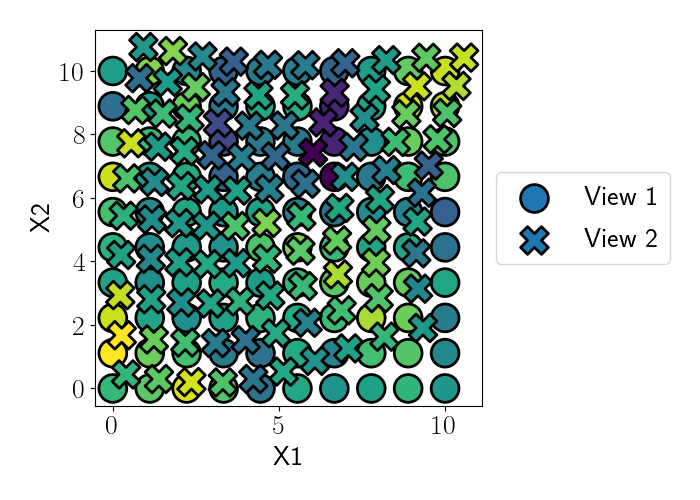
Example output showing the alignment of two misaligned spatial views:
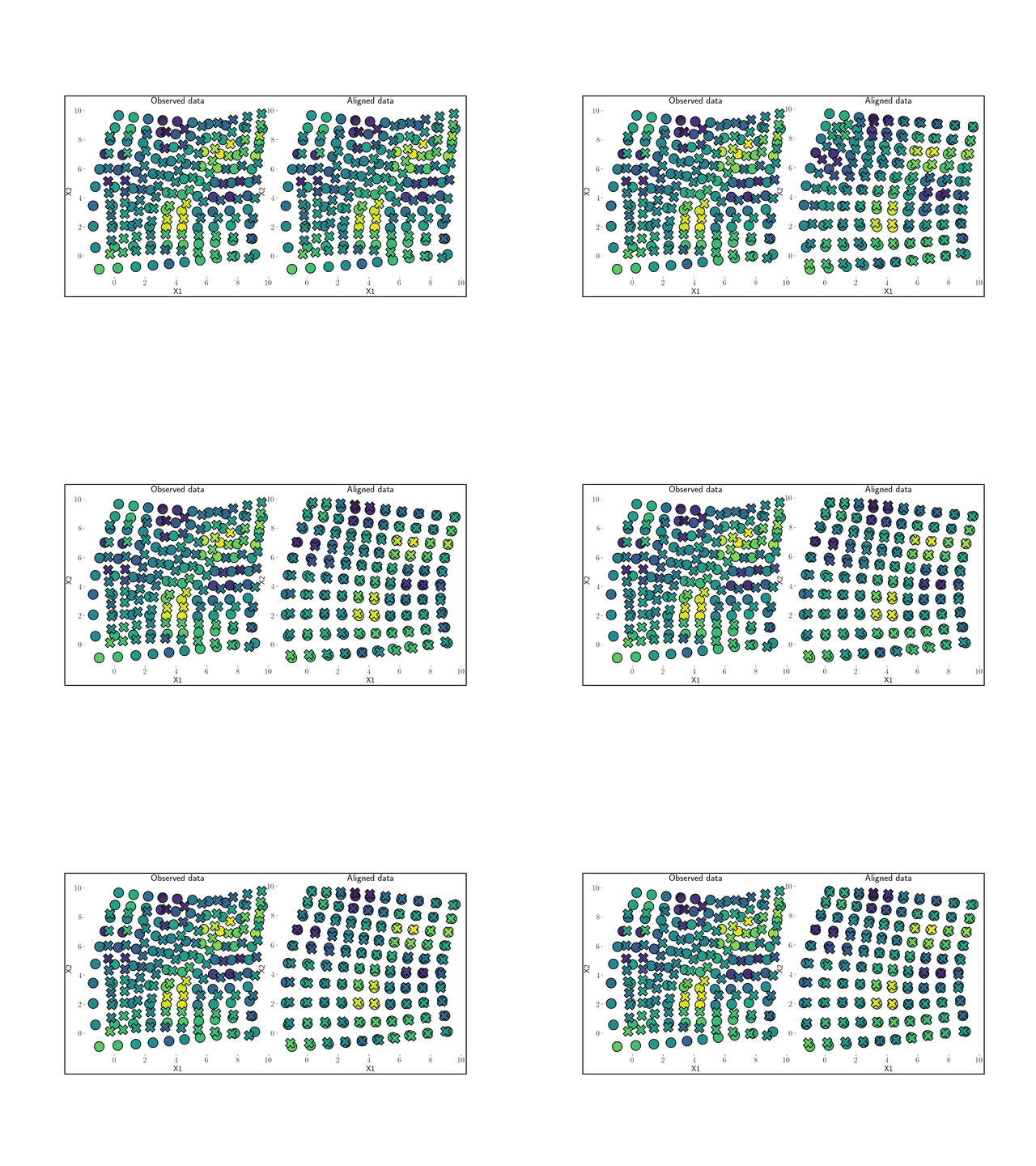
The aligned coordinates converge during training:
Note that GUI backends (e.g., matplotlib with tkinter) may require extra setup on some systems.
🐞 Bug Reports
Please open issues at:
https://github.com/engelhardtgpsa/spatial-alignment/issues
📔 Citation
If you use GPSA in your work, please cite:
Jones, A. C., et al. Alignment of spatial genomics and histology data using deep Gaussian processes. bioRxiv (2022).
https://www.biorxiv.org/content/10.1101/2022.01.10.475692v1
📜 License
Apache-2.0
1 maintainer

Metadata
1 maintainer
Release files for gpsa-engelhardt 0.6.15
For a detailed explanation of source distributions (sdists) and built distributions (wheels), please see the package formats documentation.
Source distribution (sdist)
| File | Size | Uploaded | |
|---|---|---|---|
| gpsa_engelhardt-0.6.15.tar.gz | 16.7 kB | Details |
Built distribution (wheel)
| File | Interpreter | ABI | Platform | Reset |
|---|---|---|---|---|
| gpsa_engelhardt-0.6.15-py3-none-any.whl | Python 3 | none | any | Details |
Total release size: 32.1 kB
Release files / gpsa_engelhardt-0.6.15.tar.gz
| Download URL | gpsa_engelhardt-0.6.15.tar.gz |
|---|---|
| Size | 16.7 kB |
| Tags | Source |
|
SHA-256 checksum How to use checksums |
caa9edfe13fdfb770fd914d7fd2b85b8d2b3e659f351cd7823ec8f14cfb62d5e
|
|
BLAKE2b-256 checksum How to use checksums |
1dc9ff3f52cc4146ff1694fa82c6812fe2d3cd04418096258e33247e980eecad
|
| Upload date | |
|
Uploaded using Trusted Publishing? What is trusted publishing? |
No |
| Uploaded via |
twine/6.1.0 CPython/3.10.13
|
Release files / gpsa_engelhardt-0.6.15-py3-none-any.whl
| Download URL | gpsa_engelhardt-0.6.15-py3-none-any.whl |
|---|---|
| Size | 15.4 kB |
| Tags | Python 3 |
|
SHA-256 checksum How to use checksums |
d16919d1bcc5fa12ee16545b81d5ded7a0c3bd43604506889a57f6e7b628835e
|
|
BLAKE2b-256 checksum How to use checksums |
940915e30a3c5e03696066044ae4284b20a07f6a0e6b726d2d70cf1b0730d8b2
|
| Upload date | |
|
Uploaded using Trusted Publishing? What is trusted publishing? |
No |
| Uploaded via |
twine/6.1.0 CPython/3.10.13
|














