

An open source implementation of OpenAI's ChatGPT Code interpreter.
Simply ask the OpenAI model to do something and it will generate & execute the code for you.
Read the blog post to find out more.
Community
Judah Cooper offered to start & curate a Discord community. Join here.
Installation
Open a terminal and run:
pip install gpt-code-ui
gptcode
In order to make basic dependencies available it's recommended to run the following pip install
in the Python environment that is used in the shell where you run gptcode:
pip install "numpy>=1.24,<1.25" "dateparser>=1.1,<1.2" "pandas>=1.5,<1.6" "geopandas>=0.13,<0.14" "tabulate>=0.9.0<1.0" "PyPDF2>=3.0,<3.1" "pdfminer>=20191125,<20191200" "pdfplumber>=0.9,<0.10" "matplotlib>=3.7,<3.8"
User interface
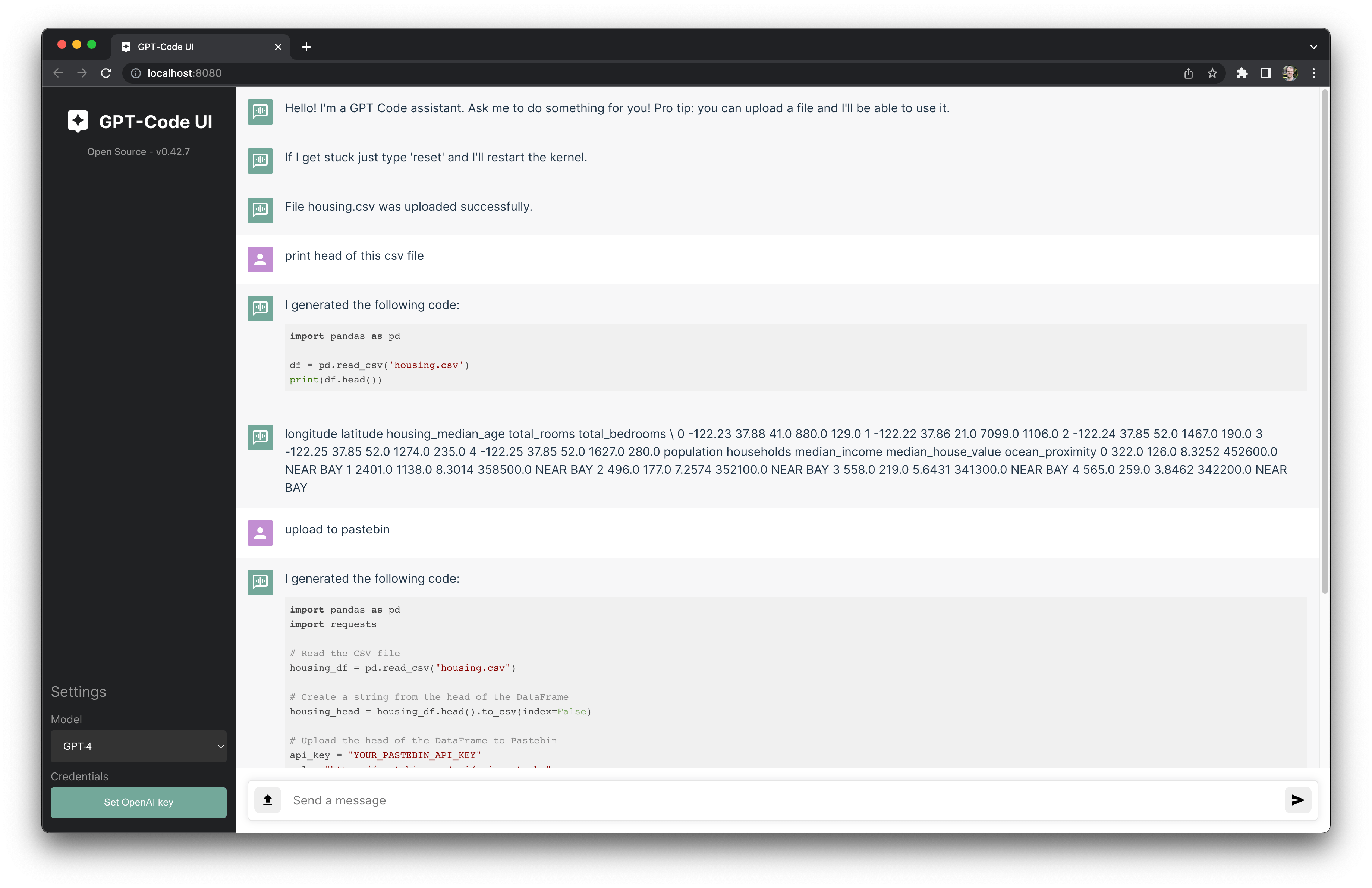
Features
- File upload
- File download
- Context awareness (it can refer to your previous messages)
- Generate code
- Run code (Python kernel)
- Model switching (GPT-3.5 and GPT-4)
Misc.
Using .env for OpenAI key
You can put a .env in the working directory to load the OPENAI_API_KEY environment variable.
Configurables
Set the API_PORT, WEB_PORT, SNAKEMQ_PORT variables to override the defaults.
Set OPENAI_BASE_URL to change the OpenAI API endpoint that's being used (note this environment variable includes the protocol https://...).
You can use the .env.example in the repository (make sure you git clone the repo to get the file first).
For Azure OpenAI Services, there are also other configurable variables like deployment name. See .env.azure-example for more information.
Note that model selection on the UI is currently not supported for Azure OpenAI Services.
cp .env.example .env
vim .env
gptcode
Docker
localagi took the effort of bundling the Python package in a Docker container. Check it out here: gpt-code-ui-docker.
Contributing
Please do and have a look at the contributions guide! This should be a community initiative. I'll try my best to be responsive.
Thank you for your interest in this project!
1 maintainer

Metadata
1 maintainer
Release files for gpt-code-ui 0.42.40
For a detailed explanation of source distributions (sdists) and built distributions (wheels), please see the package formats documentation.
Source distribution (sdist)
| File | Size | Uploaded | Provenance | Actions |
|---|---|---|---|---|
| gpt_code_ui-0.42.40.tar.gz | 424.2 kB | Without provenance | Details for gpt_code_ui-0.42.40.tar.gz |
Built distribution (wheel)
| File | Interpreter | ABI | Platform | Actions Reset |
|---|---|---|---|---|
| gpt_code_ui-0.42.40-py3-none-any.whl | Python 3 | none | any | Details for gpt_code_ui-0.42.40-py3-none-any.whl |
Total release size: 850.9 kB
Release files / gpt_code_ui-0.42.40.tar.gz
| Download URL | gpt_code_ui-0.42.40.tar.gz |
|---|---|
| Size | 424.2 kB |
| Tags | Source |
|
SHA-256 checksum How to use checksums |
63cec24bbdb8ee3348e7cbd5e3d38a6de218ed071fcc91c5bef4f0e0fe3b538b
|
|
BLAKE2b-256 checksum How to use checksums |
cd7560843f0dfd49e54e7d5b96d755b6850860a944432ee7f2eccd5ff4409e5d
|
| Upload date | |
|
Uploaded using Trusted Publishing? What is trusted publishing? |
No |
| Uploaded via |
twine/4.0.2 CPython/3.10.7
|
Release files / gpt_code_ui-0.42.40-py3-none-any.whl
| Download URL | gpt_code_ui-0.42.40-py3-none-any.whl |
|---|---|
| Size | 426.6 kB |
| Tags | Python 3 |
|
SHA-256 checksum How to use checksums |
32fdd5c518c22f6863ee5b9f3cda6b579f1666b59813e74820c155e5b637d286
|
|
BLAKE2b-256 checksum How to use checksums |
9790ec40ee10762dd79f5de1189fe3d29f95bdba55d694bea02608940c14918e
|
| Upload date | |
|
Uploaded using Trusted Publishing? What is trusted publishing? |
No |
| Uploaded via |
twine/4.0.2 CPython/3.10.7
|
Security for gpt-code-ui 0.42.40
Provenance
Provenance describes where a file came from. On PyPI, provenance is shared via attestations, which provide a verifiable record of the build or publishing details. View details, limitations and caveats.
No provenance found
None of the files in this release were uploaded with provenance metadata.
A note on package security
PyPI is a repository for distributing packages, not a service for auditing them. While third-party security researchers and our staff do their best to detect and remove malicious packages, PyPI cannot guarantee the quality, security or suitability of any given package.
To learn more about protecting yourself from malicious actors, visit our package security documentation.














