
This release is a pre-release and may not be stable for production use.

gptme
/ʤiː piː tiː miː/
what does it stand for?
Getting Started • Downloads • Website • Documentation









📜 A personal AI agent that runs anywhere a terminal runs — your laptop,
ssh sessions, tmux, headless servers, CI pipelines.
Provider-agnostic, local-first, and unconstrained: ships with shell, Python, web,
vision, and everything else an agent needs.
A great coding agent, but general-purpose enough to assist in all kinds of knowledge-work.
Free and open-source. Works with Anthropic, OpenAI, Google, xAI, DeepSeek, OpenRouter,
or fully local via llama.cpp — your data, your models, your terminal.
A capable alternative to Claude Code,
Codex, Cursor, and Warp — one of the first agent CLIs (Spring 2023), still in very
active development.
📚 Table of Contents
📢 News
- Coming soon - gptme.ai service for running agents in the cloud; gptme desktop app for easy local use.
- 2026-01 - gptme-agent-template v0.4: Bob reaches 1700+ autonomous sessions, autonomous run loops, enhanced context generation
- 2025-12 - v0.31.0: Background jobs, form tool, cost tracking, content-addressable storage
- 2025-11 - v0.30.0: Plugin system, context compression, subagent planner mode
- 2025-10 - v0.29.0: Lessons system for contextual guidance, MCP discovery & dynamic loading, token awareness; Bob begins autonomous runs with GitHub monitoring
- 2025-08 - v0.28.0: MCP support, morph tool for fast edits, auto-commit, redesigned server API
- 2025-03 - v0.27.0: Pre-commit integration, macOS computer use, Claude 3.7 Sonnet, DeepSeek R1, local TTS with Kokoro
- 2025-01 - gptme-contrib created: community plugins including Twitter/X, Discord bot, email tools, consortium (multi-agent)
- 2024-12 - gptme-agent-template v0.3: Template for persistent agents
- 2024-11 - Ecosystem expansion: gptme-webui, gptme-rag, gptme.vim, Bob created (first autonomous agent)
- 2024-10 - First viral tweet bringing widespread attention
- 2024-08 - Show HN, Anthropic Claude support, tmux tool
- 2023-09 - Initial public release on HN, Reddit, Twitter
- 2023-03 - Initial commit - one of the first agent CLIs
For more history, see the Timeline and Changelog.
🎥 Demos
| Fibonacci | Snake with curses |
|---|---|
Steps
|
Steps
|
| Mandelbrot with curses | Answer question from URL |
Steps
|
Steps
|
| Terminal UI | Web UI |
Features
|
Features
|




You can find more Demos and Examples in the documentation.
🌟 Features
- 💻 Code execution
- 🧩 Read, write, and change files
- Makes incremental changes with the patch tool.
- 🌐 Search and browse the web
- Can use a browser via Playwright with the browser tool.
- 👀 Vision
- Can see images referenced in prompts, screenshots of your desktop, and web pages.
- 🔄 Self-correcting
- Output is fed back to the assistant, allowing it to respond and self-correct.
- 📚 Lessons system
- Contextual guidance and best practices automatically included when relevant.
- Keyword, tool, and pattern-based matching.
- Adapts to interactive vs autonomous modes.
- Extend with your own lessons and skills.
- 🤖 Support for many LLM providers
- Anthropic (Claude), OpenAI (GPT), Google (Gemini), xAI (Grok), DeepSeek, and more.
- Use OpenRouter for access to 100+ models, or serve locally with
llama.cpp.
- 🌐 Web UI and REST API
- Modern web interface at chat.gptme.org (gptme-webui)
- Simple built-in web UI included in the Python package.
- Server with REST API.
- Standalone executable builds available with PyInstaller.
- 💻 Computer use (see #216)
- Give the assistant access to a full desktop, allowing it to interact with GUI applications.
- 🔊 Tool sounds — pleasant notification sounds for different tool operations.
- Enable with
GPTME_TOOL_SOUNDS=true.
- Enable with
🛠 Tools
gptme equips the AI with a rich set of built-in tools:
| Tool | Description |
|---|---|
shell |
Execute shell commands directly in your terminal |
ipython |
Run Python code with access to your installed libraries |
read |
Read files and directories |
save / append |
Create or update files |
patch / morph |
Make incremental edits to existing files |
browser |
Search and navigate the web via Playwright |
vision |
Process and analyze images |
screenshot |
Capture screenshots of your desktop |
rag |
Retrieve context from local files (Retrieval Augmented Generation) |
gh |
Interact with GitHub via the GitHub CLI |
tmux |
Run long-lived commands in persistent terminal sessions |
computer |
Full desktop access for GUI interactions |
subagent |
Spawn sub-agents for parallel or isolated tasks |
chats |
Reference and search past conversations |
Use /tools during a conversation to see all available tools and their status.
🔌 Extensibility: Plugins, Skills & Lessons
gptme has a layered extensibility system that lets you tailor it to your workflow:
Plugins — extend gptme with custom tools, hooks, and commands via Python packages:
# gptme.toml
[plugins]
paths = ["~/.config/gptme/plugins", "./plugins"]
enabled = ["my_plugin"]
Skills — lightweight workflow bundles (Anthropic format) that auto-load when mentioned by name. Great for packaging reusable instructions and helper scripts without writing Python.
Lessons — contextual guidance that auto-injects into conversations based on keywords, tools, and patterns. Write your own to capture team best-practices or domain knowledge.
Hooks — run custom code at key lifecycle events (before/after tool calls, on conversation start, etc.) without a full plugin.
gptme-contrib — community-contributed plugins, packages, scripts, and lessons:
| Plugin | Description |
|---|---|
| gptme-consortium | Multi-model consensus decision-making |
| gptme-imagen | Multi-provider image generation |
| gptme-lsp | Language Server Protocol integration |
| gptme-ace | ACE-inspired context optimization |
| gptme-gupp | Work state persistence across sessions |
🔗 Integrations: MCP & ACP
MCP (Model Context Protocol) — use any MCP server as a tool source:
pipx install gptme # MCP support included by default
gptme can discover and dynamically load MCP servers, giving the agent access to databases, APIs, file systems, and any other MCP-compatible tool. See the MCP docs for server configuration.
ACP (Agent Client Protocol) — use gptme as a coding agent directly from your editor:
pipx install 'gptme[acp]'
This makes gptme available as a drop-in coding agent in Zed and JetBrains IDEs. Your editor sends requests, gptme executes with its full toolset (shell, browser, files, etc.) and streams results back.
🤖 Autonomous Agents
gptme is designed to run not just interactively but as a persistent autonomous agent — an AI that runs continuously, remembers everything, and gets better over time. The gptme-agent-template provides a complete scaffold:
- Persistent workspace — git-tracked "brain" with journal, tasks, knowledge base, and lessons
- Run loops — scheduled (systemd/launchd) or event-driven autonomous operation
- Task management — structured task queue with YAML metadata and GTD-style workflows
- Meta-learning — lessons system captures behavioral patterns and improves over time
- Multi-agent coordination — file leases, message bus, and work claiming for concurrent agents
- External integrations — GitHub, email, Discord, Twitter, RSS, and more
# Create and run your own agent
gptme-agent create ~/my-agent --name MyAgent
gptme-agent install   # runs on a schedule
gptme-agent status    # check on it
Bob is the reference implementation — a production autonomous agent that's been running continuously since late 2024. Bob opens PRs, reviews code, fixes CI, manages his own task queue, maintains a growing set of behavioral lessons, posts on Twitter, responds on Discord, and writes blog posts.
Multiple specialized agents can run in parallel — e.g. Bob (engineering) and Alice (personal assistant & orchestration) — coordinating through shared infrastructure.
See the Autonomous Agents docs for the full guide.
🛡 Guardrails
Persistent agents need guardrails around the full loop, not just tool permissions:
- Input guardrails — structured task selectors in the agent workspace keep work focused and reduce thrashing on notifications or ambiguous work. Bob uses a CASCADE-style selector for this layer.
- Pre-action guardrails — lessons inject situational guidance before the agent acts.
- Output guardrails — hooks and pre-commit checks validate file changes before control returns to the user.
This stack is simple and composable: selectors improve work choice, lessons steer behavior, and checks verify the result. You can add evals on top later, but the baseline guardrail loop already exists.
🛠 Use Cases
- 🖥 Development: Write and run code faster with AI assistance.
- 🎯 Shell Expert: Get the right command using natural language (no more memorizing flags!).
- 📊 Data Analysis: Process and analyze data directly in your terminal.
- 🎓 Interactive Learning: Experiment with new technologies or codebases hands-on.
- 🤖 Agents & Tools: Build long-running autonomous agents for real work.
- 🔬 Research: Automate literature review, data collection, and analysis pipelines.
🛠 Developer Perks
- ⭐ One of the first agent CLIs created (Spring 2023) that is still in active development.
- 🧰 Easy to extend
- 🧪 Extensive testing, high coverage.
- 🧹 Clean codebase, checked and formatted with
mypy,ruff, andpyupgrade. - 🤖 GitHub Bot to request changes from comments! (see #16)
- Operates in this repo! (see #18 for example)
- Runs entirely in GitHub Actions.
- 📊 Evaluation suite for testing capabilities of different models.
- 📝 gptme.vim for easy integration with vim.
🚧 In Progress
- 🖥 gptme-tauri — desktop app wrapping gptme for easy local use (WIP)
- ☁️ gptme.ai — managed cloud service for running gptme agents (WIP; still self-hostable by running
gptme-server+gptme-webuiyourself) - 🌳 Tree-based conversation structure (see #17)
- 📜 RAG to automatically include context from local files (see #59)
- 🏆 Advanced evals for testing frontier capabilities
🚀 Getting Started
Prerequisites
- Python 3.10 or newer
- Credentials for at least one LLM provider:
- OpenRouter can be configured interactively with
/account setup openrouterinside gptme, using browser OAuth onboarding. - You can also set API keys manually for Anthropic
(
ANTHROPIC_API_KEY), OpenAI (OPENAI_API_KEY), OpenRouter (OPENROUTER_API_KEY), and other providers. - Local models via
llama.cppneed no key — see providers docs.
- OpenRouter can be configured interactively with
Installation
For full setup instructions, see the Getting Started guide.
# With pipx (recommended, requires Python 3.10+)
pipx install gptme

# With uv
uv tool install gptme

# With optional extras
pipx install 'gptme[browser]'  # Playwright for web browsing
pipx install 'gptme[all]'      # Everything

# Latest from git with all extras
uv tool install 'git+https://github.com/gptme/gptme.git[all]'
Quick Start
gptme
You'll be greeted with a prompt. Type your request and gptme will respond, using tools as needed.
Example Commands
# Create a particle effect visualization
gptme 'write an impressive and colorful particle effect using three.js to particles.html'

# Generate visual art
gptme 'render mandelbrot set to mandelbrot.png'

# Get configuration suggestions
gptme 'suggest improvements to my vimrc'

# Process media files
gptme 'convert to h265 and adjust the volume' video.mp4

# Code assistance from git diffs
git diff | gptme 'complete the TODOs in this diff'

# Fix failing tests
make test | gptme 'fix the failing tests'

# Auto-approve tool confirmations (user can still watch and interrupt)
gptme -y 'run the test suite and fix any failing tests'

# Fully non-interactive/autonomous mode (no user interaction possible, safe for scripts/CI)
gptme -n 'run the test suite and fix any failing tests'
For more, see the Getting Started guide and the Examples in the documentation.
⚙️ Configuration
Create ~/.config/gptme/config.toml:
[user]
name = "User"
about = "I am a curious human programmer."
response_preference = "Don't explain basic concepts"

[prompt]
# Additional files to always include as context
# files = ["~/notes/llm-tips.md"]

[env]
# Set your default model
# MODEL = "anthropic/claude-sonnet-4-20250514"
# MODEL = "openai/gpt-4o"
For all options, see the configuration docs.
🛠 Usage
$ gptme --help
Usage: gptme [OPTIONS] [PROMPTS]...

  gptme is a chat-CLI for LLMs, empowering them with tools to run shell
  commands, execute code, read and manipulate files, and more.

  If PROMPTS are provided, a new conversation will be started with it. PROMPTS
  can be chained with the '-' separator.

  The interface provides user commands that can be used to interact with the
  system.

  Available commands:
    /undo         Undo the last action
    /log          Show the conversation log
    /edit         Edit the conversation in your editor
    /rename       Rename the conversation
    /fork         Create a copy of the conversation
    /summarize    Summarize the conversation
    /replay       Replay tool operations
    /export       Export conversation as HTML
    /model        Show or switch the current model
    /models       List available models
    /tokens       Show token usage and costs
    /context      Show context token breakdown
    /tools        Show available tools
    /commit       Ask assistant to git commit
    /compact      Compact the conversation
    /impersonate  Impersonate the assistant
    /restart      Restart gptme process
    /setup        Setup gptme
    /help         Show this help message
    /exit         Exit the program

  See docs for all commands: https://gptme.org/docs/commands.html

  Keyboard shortcuts:
    Ctrl+X Ctrl+E  Edit prompt in your editor
    Ctrl+J         Insert a new line without executing the prompt

Options:
  --name TEXT            Name of conversation. Defaults to generating a random
                         name.
  -m, --model TEXT       Model to use, e.g. openai/gpt-5, anthropic/claude-
                         sonnet-4-20250514. If only provider given then a
                         default is used.
  -w, --workspace TEXT   Path to workspace directory. Pass '@log' to create a
                         workspace in the log directory.
  --agent-path TEXT      Path to agent workspace directory.
  -r, --resume           Load most recent conversation.
  -y, --no-confirm       Skip all confirmation prompts.
  -n, --non-interactive  Non-interactive mode. Implies --no-confirm.
  --system TEXT          System prompt. Options: 'full', 'short', or something
                         custom.
  -t, --tools TEXT       Tools to allow as comma-separated list. Available:
                         append, browser, chats, choice, computer, gh,
                         ipython, morph, patch, rag, read, save, screenshot,
                         shell, subagent, tmux, vision.
  --tool-format TEXT     Tool format to use. Options: markdown, xml, tool
  --no-stream            Don't stream responses
  --show-hidden          Show hidden system messages.
  -v, --verbose          Show verbose output.
  --version              Show version and configuration information
  --help                 Show this message and exit.
🌍 Ecosystem
gptme is more than a CLI — it's a platform with a growing ecosystem:
| Project | Description |
|---|---|
| gptme-webui | Modern React web interface, available at chat.gptme.org |
| gptme-contrib | Community plugins, packages, scripts, and lessons |
| gptme-agent-template | Template for building persistent autonomous agents |
| gptme-rag | RAG integration for semantic search over local files |
| gptme.vim | Vim plugin for in-editor gptme integration |
| gptme-tauri | Desktop app (WIP) |
| gptme.ai | Managed cloud service (WIP) |
Community agents powered by gptme:
- Bob — autonomous AI agent, running continuously since late 2024, contributes to open source and manages his own tasks
- Alice — personal assistant & agent orchestrator, forked from the same architecture
💬 Community
- Discord — ask questions, share what you've built, discuss features
- GitHub Discussions — longer-form conversation and ideas
- X/Twitter — updates and announcements
Contributions welcome! See the contributing guide.
📊 Stats
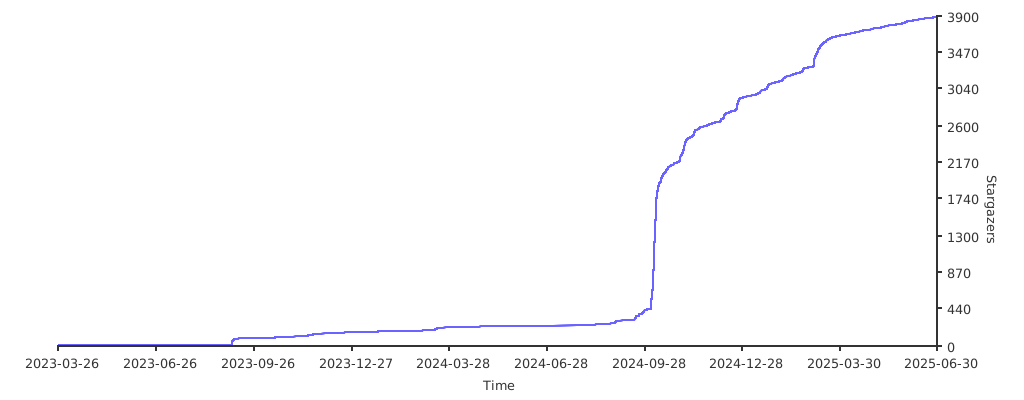
⭐ Stargazers over time
📈 Download Stats
🔗 Links
1 maintainer

Release files for gptme 0.31.1.dev20260511
For a detailed explanation of source distributions (sdists) and built distributions (wheels), please see the package formats documentation.
Source distribution (sdist)
| File | Size | Uploaded | |
|---|---|---|---|
| gptme-0.31.1.dev20260511.tar.gz | 1.5 MB | Details |
Built distribution (wheel)
| File | Interpreter | ABI | Platform | Reset |
|---|---|---|---|---|
| gptme-0.31.1.dev20260511-py3-none-any.whl | Python 3 | none | any | Details |
Total release size: 2.7 MB
Release files / gptme-0.31.1.dev20260511.tar.gz
| Download URL | gptme-0.31.1.dev20260511.tar.gz |
|---|---|
| Size | 1.5 MB |
| Tags | Source |
|
SHA-256 checksum How to use checksums |
2c3e394ddd410c0c6979715093b53dac60a29bf74f9a1c955d5cb36958de6786
|
|
BLAKE2b-256 checksum How to use checksums |
fe943207bf7a7203320e0afa2de161084bafb22d3237c45f9aae98fa69607e50
|
| Upload date | |
|
Uploaded using Trusted Publishing? What is trusted publishing? |
No |
| Uploaded via |
poetry/2.4.1 CPython/3.12.3 Linux/6.17.0-1010-azure
|
Release files / gptme-0.31.1.dev20260511-py3-none-any.whl
| Download URL | gptme-0.31.1.dev20260511-py3-none-any.whl |
|---|---|
| Size | 1.2 MB |
| Tags | Python 3 |
|
SHA-256 checksum How to use checksums |
20af36be18ed47de0afddd9819567a4218f470860ad1345be09fe8f97cacdeaa
|
|
BLAKE2b-256 checksum How to use checksums |
0dcde4a3dfdecb065a6294c42b125529ea8f5ace0f8d3b9c3b6d287d71841d44
|
| Upload date | |
|
Uploaded using Trusted Publishing? What is trusted publishing? |
No |
| Uploaded via |
poetry/2.4.1 CPython/3.12.3 Linux/6.17.0-1010-azure
|














