
GPU Stack Inspector
Explain why your AI code uses the GPU in one Python environment but not another.



nvidia-smi shows your GPU, yet torch.cuda.is_available() is True in one environment and False in another.
GPU Stack Inspector inspects several Python interpreters from one command, shows what differs between them, and
explains which difference matters, with the evidence:
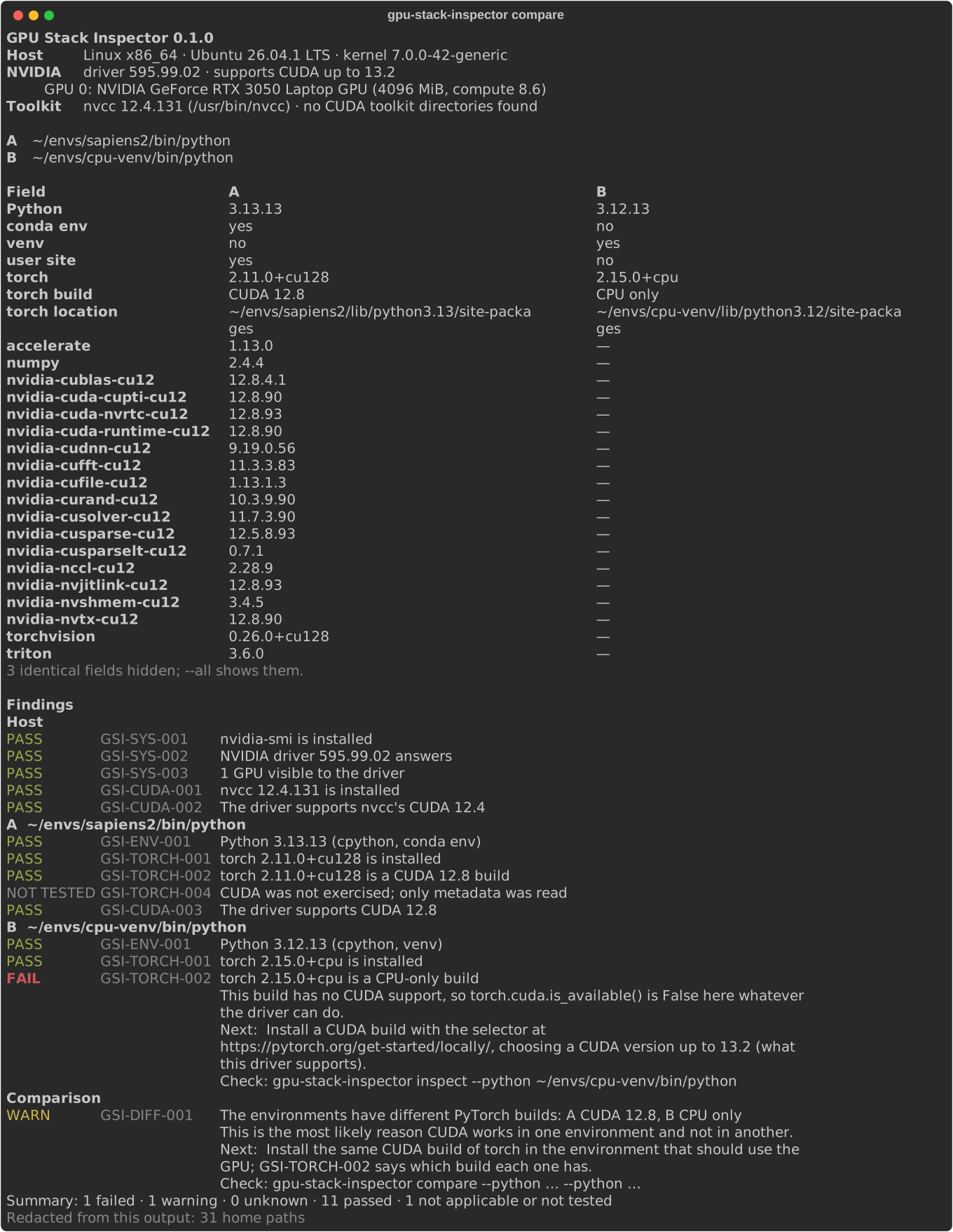
Status: 0.1.0 is the first release, validated on one laptop with five real environments. Reports from other machines are very welcome.
Install
The tool needs Python 3.11 or newer; the interpreters it inspects can be Python 3.8 or newer.
uv tool install git+https://github.com/BhuwanJoshi-01/gpu-stack-inspector   # until the PyPI release
pipx install git+https://github.com/BhuwanJoshi-01/gpu-stack-inspector      # or with pipx
Use
gpu-stack-inspector compare --python ~/envs/works/bin/python --python ~/envs/broken/bin/python
gpu-stack-inspector inspect --python ~/envs/broken/bin/python      # one environment in detail
gpu-stack-inspector probe --runtime --python ~/envs/broken/bin/python   # opt-in: really runs a tiny CUDA operation
gpu-stack-inspector report --python ~/envs/broken/bin/python --output gpu-report.md   # redacted, for an issue
gpu-stack-inspector rules list                                     # every check; `rules explain CODE` for one
Without --python it inspects the python your shell runs. See the command reference.
What it checks
- The machine: driver tools, whether the driver answers and which CUDA versions it supports, the GPUs and their
compute capability,
CUDA_VISIBLE_DEVICES. - Each interpreter: whether it starts, whether it is the one your shell runs, whether torch is installed where it
is needed, and which build it is (CUDA with its version, CPU-only, ROCm), decided from the version tag,
torch/version.py, the CUDA libraries intorch/lib, thenvidia-*requirements and conda's records, without importing torch. - Compatibility: the driver against the CUDA version torch was built for and against nvcc, using dated, source-tagged NVIDIA compatibility data.
- The comparison: every field that differs, and whether the environments have different PyTorch builds.
- At runtime (
probe --runtimeonly): importing torch and running an operation on the GPU, step by step.
Every finding has a stable code, the evidence it rests on, what to do next and the command to check it afterwards. Troubleshooting explains the common ones.
What it promises
- Read-only. It never installs, upgrades or changes anything, and never needs
sudo. It writes nothing except a report file you name. - Your environments stay untouched. A fixed probe program reads each interpreter's metadata. torch is only
imported with
probe --runtime, because creating a CUDA context uses GPU memory and can hang on a broken system. - Unknown is not a pass. A check that could not run is unknown or not tested, never green.
- Shareable output. Home paths, user and host names, secrets and tokens are redacted before anything is printed or written, JSON included, and each report says what was redacted. No network access, no telemetry.
Details in privacy.
Tested on
An Ubuntu 26.04 laptop with an RTX 3050 (driver 595.99.02) and five real environments: conda and uv, Python 3.8 to 3.13, CUDA 11.3 to 13.0 builds and a CPU-only build. CI runs the tests on Linux and Windows and the probe in Python 3.8 to 3.10 and PyPy. Windows and WSL with a GPU, containers and macOS are not validated; see the support matrix.
Alternatives
If you only need to check a single environment, these may already be enough:
- cuda-doctor checks the GPU, driver, toolkit, compiler and PyTorch of the environment it is installed in.
- env-doctor checks the driver, CUDA, cuDNN and frameworks, and compares machines in a fleet dashboard.
- cudadoc includes a GPU validation suite.
GPU Stack Inspector focuses on comparing environments on the same machine.
Documentation
Command reference · Troubleshooting · Privacy · Support matrix · JSON output · Architecture · Sample reports · Roadmap
Contributing
Test reports, fixtures from unusual systems, bug reports and pull requests are welcome; see CONTRIBUTING.md. Security problems, including a report that leaks private data, go through SECURITY.md.
License
1 maintainer

Metadata
1 maintainer
Release files for gpu-stack-inspector 0.1.0
For a detailed explanation of source distributions (sdists) and built distributions (wheels), please see the package formats documentation.
Source distribution (sdist)
| File | Size | Uploaded | Provenance | Actions |
|---|---|---|---|---|
| gpu_stack_inspector-0.1.0.tar.gz | 57.6 kB | With provenance | Details for gpu_stack_inspector-0.1.0.tar.gz |
Built distribution (wheel)
| File | Interpreter | ABI | Platform | Actions Reset |
|---|---|---|---|---|
| gpu_stack_inspector-0.1.0-py3-none-any.whl | Python 3 | none | any | Details for gpu_stack_inspector-0.1.0-py3-none-any.whl |
Total release size: 131.1 kB
Release files / gpu_stack_inspector-0.1.0.tar.gz
| Download URL | gpu_stack_inspector-0.1.0.tar.gz |
|---|---|
| Size | 57.6 kB |
| Tags | Source |
|
SHA-256 checksum How to use checksums |
b2fc2dba8ff0190eb143334e638a46adc236091fa8e16f9041c4834fc39363cd
|
|
BLAKE2b-256 checksum How to use checksums |
4eb8bdd6d77d25bb57f9946252c49c42d69dd08db9b8fd70542b1848a7666ff9
|
| Upload date | |
|
Uploaded using Trusted Publishing? What is trusted publishing? |
Yes |
| Uploaded via |
twine/7.0.0 CPython/3.13.16
|
Provenance
Provenance describes where a file came from. On PyPI, provenance is shared via attestations, which provide a verifiable record of the build or publishing details. View details, limitations and caveats.


PyPI Publish Attestation
PyPI verified that this artifact, at this checksum, originated from the publisher listed below.
Signed by GitHub Actions, verified by PyPI on Nov 4, 2026.
Transparency logRelease files / gpu_stack_inspector-0.1.0-py3-none-any.whl
| Download URL | gpu_stack_inspector-0.1.0-py3-none-any.whl |
|---|---|
| Size | 73.5 kB |
| Tags | Python 3 |
|
SHA-256 checksum How to use checksums |
edc24bfb63a8c5d603ae711709b389e867be667dbe601632efbc13d1b2014f21
|
|
BLAKE2b-256 checksum How to use checksums |
ef17ebf5125583b5a3628c5688dced2c45f5b95cc1a28ad5d81b2d00e40627d6
|
| Upload date | |
|
Uploaded using Trusted Publishing? What is trusted publishing? |
Yes |
| Uploaded via |
twine/7.0.0 CPython/3.13.16
|
Provenance
Provenance describes where a file came from. On PyPI, provenance is shared via attestations, which provide a verifiable record of the build or publishing details. View details, limitations and caveats.
PyPI Publish Attestation
PyPI verified that this artifact, at this checksum, originated from the publisher listed below.
Signed by GitHub Actions, verified by PyPI on Nov 4, 2026.
Transparency logSecurity for gpu-stack-inspector 0.1.0
Provenance
Provenance describes where a file came from. On PyPI, provenance is shared via attestations, which provide a verifiable record of the build or publishing details. View details, limitations and caveats.
Full provenance
Both files in this release have been uploaded with provenance metadata.
Attestation for gpu_stack_inspector-0.1.0.tar.gz
PyPI Publish Attestation
PyPI verified that this artifact, at this checksum, originated from the publisher listed below.
Signed by GitHub Actions, verified by PyPI on Nov 4, 2026.
Transparency logA note on package security
PyPI is a repository for distributing packages, not a service for auditing them. While third-party security researchers and our staff do their best to detect and remove malicious packages, PyPI cannot guarantee the quality, security or suitability of any given package.
To learn more about protecting yourself from malicious actors, visit our package security documentation.













