
gpython
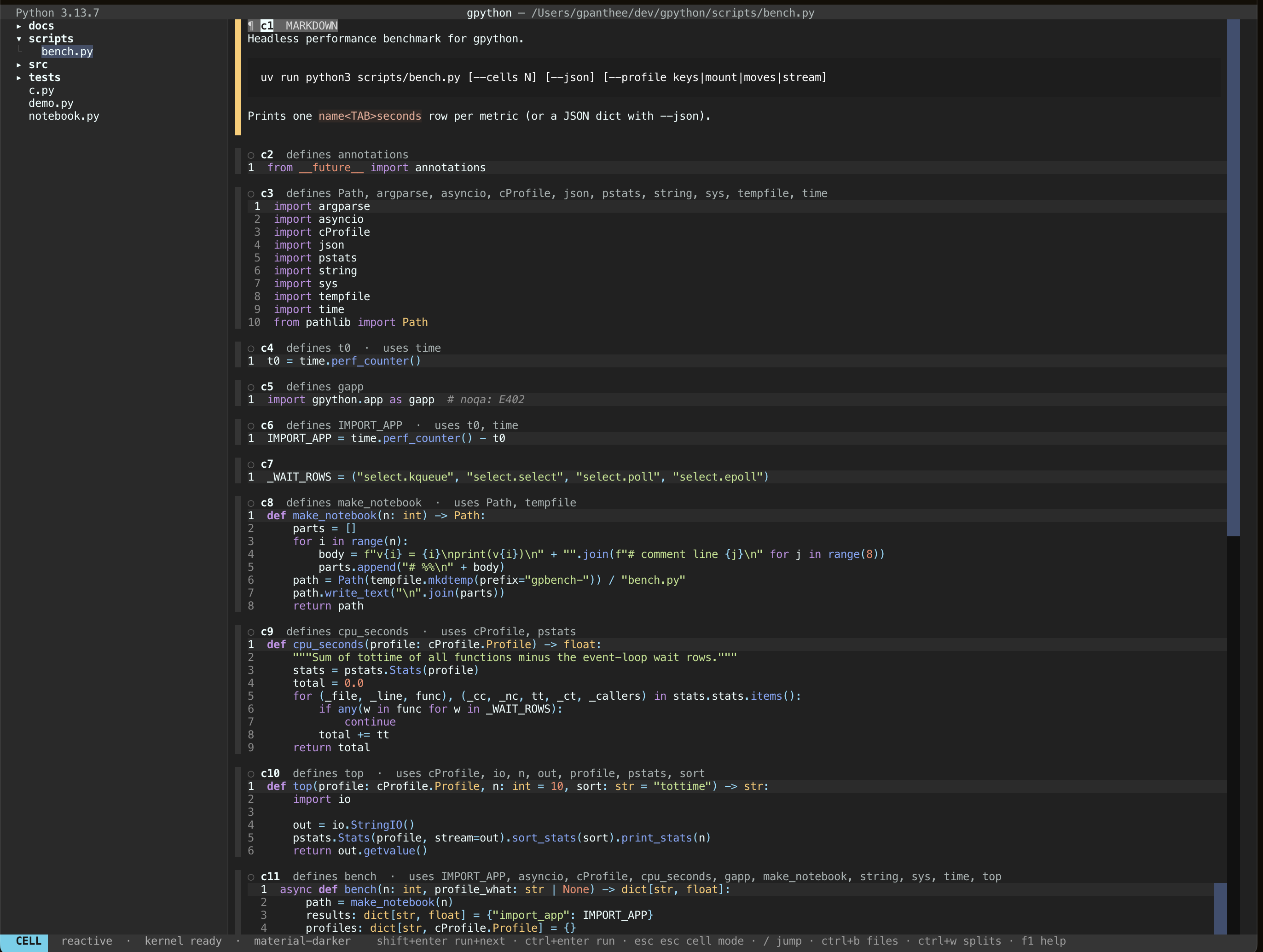
A Python notebook in the terminal, inspired by marimo: cells know which variables they define and use, and runs follow that graph.
Running a cell first runs the stale cells it depends on (never run, edited
since, or their inputs changed), then the cell. What happens to the cells
below it, the ones that use its variables, is the run mode (f3, saved):
- lazy (the default): they are only marked stale. You run what you want,
when you want, without moving:
r 6runs cell c6,r rthis cell,r Cthe cells down to this one,r athe cells after it,r Aall,r sthe stale ones (f4);r krestarts the kernel,r Rrestarts and runs all,r iinterrupts (the same keys work in the editor's normal mode, wherespace r …is a synonym). - reactive: they re-run automatically, like marimo.
Install
The package on PyPI is called gpynb; the command it installs is gpython.
Needs Python 3.13 or newer.
uv tool install gpynb        # installs the `gpython` command globally
uv tool upgrade gpynb        # later, to update
uvx --from gpynb gpython     # or run it once without installing anything
pipx install gpynb           # if you use pipx instead of uv
From a checkout, ./gpython runs the working copy (it creates the venv on
first use); uv run gpython does the same.
Usage
gpython                    # empty untitled notebook
gpython script.py          # a plain script is split into cells automatically
gpython a.py b.py          # several files: one tab each (gt / gT switch)
gpython notebooks/         # a directory: opens the file explorer there
gpython --no-vim nb.py     # plain editing, no modal keys
gpython --theme nord nb.py # colour theme for this run (ctrl+t picks one and remembers it)
Files: .py notebooks (plain scripts, # %% cells, Jupytext markdown cells),
marimo notebooks (@app.cell) and .ipynb; see Files.
Keys
Three modes, shown in the top bar: INSERT (typing), NORMAL (vim keys in
the editor) and CELL (Jupyter's command mode: the whole cell is selected and
keys act on cells). escape goes INSERT → NORMAL → CELL; enter or i goes back
into the editor. Clicking a cell's header selects it. f1 (or ? in cell mode)
shows every key; the list lives in src/gpython/keymap.py.
Everywhere:
| Key | Action |
|---|---|
shift+enter |
Run cell (markdown: render it), then go to the cell below (a new cell only on the last one) |
ctrl+enter / ctrl+shift+enter / ctrl+e |
Run cell (markdown: render it), stay |
alt+enter |
Run cell and insert a new cell below |
f5 / f4 |
Run all / run stale cells |
f6 |
Python environment: switch venv/interpreter, new uv or python venv, install packages |
ctrl+k |
Interrupt running code |
ctrl+n / ctrl+shift+n |
New cell below / above |
ctrl+d |
Delete cell (cells that used its variables are marked stale, or re-run when reactive; u in cell mode undoes) |
alt+↑/↓, ctrl+↑/↓ |
Previous / next cell |
ctrl+home / ctrl+end |
First / last cell |
alt+shift+↑/↓ |
Move the cell up / down |
ctrl+s / :w |
Save (asks for a name if untitled) |
ctrl+b |
Toggle the file explorer (see Files, windows and tabs) |
ctrl+w … |
Window commands: s split, v vsplit, h j k l move, q close, o only, T to tab |
f1 |
Help |
f2 |
Toggle variables panel (hidden at start) |
f3 |
Toggle run mode, saved: lazy (default, cells that use the variables are only marked stale) / reactive (they re-run) |
ctrl+p |
Command palette: run all, restart kernel, … |
ctrl+q / :q |
Quit (asks when there are unsaved changes; :q! does not) |
Vim normal mode (in the editor):
| Key | Action |
|---|---|
escape |
Leave the editor: cell mode |
J / K |
Next / previous cell (3J jumps three) |
j / k |
Down / up a line; past the edge moves to the next cell |
gg / G / 3G |
First / last / third line of this cell |
dd |
Delete line, like vim (3dd three lines; u undoes). To delete the cell: esc, then dd |
gJ |
Join lines (vim's J) |
/ |
Jump: /3 third cell (as numbered in the headers), /text next match after the cursor (smart case, highlighted) |
n / N |
Next / previous match of the last search, across cells (3n skips three) |
* / # |
Search forward / backward for the word under the cursor |
gt / gT / 2gt |
Next / previous / second tab |
: |
Ex command |
Also h j k l w b e 0 ^ $, counts, i a I A o O, x X s S dw d$ dj D cc cw C yy p P u ctrl+r.
Cell mode. Whether you are in cell mode or in the editor is one choice for the whole
notebook: moving across a rendered markdown or hidden-code cell (which is always
selected as a cell), deleting, undoing, searching or switching tabs keeps it; escape,
enter/i and clicks change it.
| Key | Action |
|---|---|
j / k (3j) |
Select next / previous cell |
gg / G / 3G |
Select first / last / third cell |
enter / i |
Edit the cell (normal / insert mode); on markdown, show its source |
a / b |
Insert a cell above / below |
dd |
Delete cell (3dd three; u brings them back) |
u (or z) |
Undo the last cell action: delete, move, insert, markdown/code switch |
yy / x / p / P |
Copy / cut / paste below / paste above |
J / K |
Move the cell down / up |
m / y |
Markdown / code cell |
h |
Hide / show the cell's code (marimo hide_code) |
o / O |
Collapse output / clear output |
l |
Toggle line numbers |
gt / gT |
Next / previous tab |
/ |
Jump to /3, or select the next cell matching /text |
n / N |
Select the next / previous cell matching the last search |
escape |
Clear pending keys and the search highlight |
:, ? |
Ex command, help |
Ex commands: :w [file], :wa, :q, :q!, :wq, :qa, :wqa, :e file,
:sp [file], :vs [file], :only, :tabnew [file], :tabclose, :tabn,
:tabp, :ls, :noh, :Ex, :run, :runabove, :runbelow, :stale, :restart,
:clear, :set vim|novim|lazy|nolazy|nu|nonu, :vars, :md, :code,
:theme [name], :N (go to cell N), :help. :set novim, line numbers, the
run mode and the theme are remembered in ~/.config/gpython/config.toml.
Cell headers read ✓ c3 [4] 0.42s defines x · uses y: display position,
execution count (like Jupyter's In [4]) and run time.
Editing: Enter indents after : or an open bracket and dedents after
return/pass/…; backspace in leading whitespace removes one indent level;
Tab inserts four spaces.
shift+enter and ctrl+enter need a terminal that reports them (Ghostty,
Kitty, WezTerm, iTerm2). In Terminal.app use ctrl+e and ctrl+n.
Markdown cells
A markdown cell shows rendered text (headings, lists, code, links) instead of an editor, and it never runs.
- Make one:
ctrl+nfor a new cell, thenescape escape(cell mode; oneescapewith--no-vim) andm. Or type:mdin any cell.yor:codeturns it back into code. Turning a code cell into markdown removes its variables, so the cells that used them are marked stale (reactive mode re-runs them, and they fail). - Edit: select the cell and press
enter(ori), or double-click it. - Render:
escape escape(back to cell mode),shift+enter(render and go to the next cell),ctrl+enter(render and stay), or just move to another cell. - Files: in
.pynotebooks a markdown cell is# %% [markdown]followed by lines starting with#(the Jupytext format). In plain scripts without markers, a top-level"""text"""string is a markdown cell..ipynbmarkdown cells load and save as markdown cells.
A code cell whose last line is a bare string ("""note""") does not print
that string as its result.
Files, windows and tabs
gpython opens several notebooks at once, the way vim opens several files:
each notebook is a window, windows can be split, and tabs group windows.
Every notebook has its own kernel (its own variables, its own __file__).
File explorer (ctrl+b, :Ex, :e with no name). A tree of the
notebook's folder on the left: folders and .py/.ipynb files, hidden files
and other extensions behind .. Keys inside it:
| Key | Action |
|---|---|
j / k, gg / G |
Move |
h / l |
Collapse (or go to the parent) / expand a folder; l on a file opens it |
enter / o / t |
Open the file in its own tab (a folder expands); a blank untitled window is reused |
e |
Open the file in the current window (like :e) |
s / v |
Open in a horizontal / vertical split |
- |
Go up: the parent folder becomes the root |
C |
Make the folder under the cursor the root |
% |
New notebook in the folder under the cursor |
/, n |
Search file names, repeat |
. |
Show hidden and non-notebook files |
R |
Reload |
q, escape, ctrl+b |
Hide the explorer |
ctrl+b toggles the explorer from anywhere. The explorer stays open after a
file is opened; ctrl+w h from the leftmost window (or ctrl+w w) goes back to
it. A file that is already open is shown (its tab focused) instead of being
opened twice. Clicking a file opens it too.
Windows (ctrl+w then a key, as in vim; not in insert mode, where
ctrl+w deletes a word):
| Key | Action |
|---|---|
ctrl+w s / :sp [file] |
Split: a new window below (an untitled notebook, or file) |
ctrl+w v / :vs [file] |
Vertical split: a new window to the right |
ctrl+w h j k l |
Focus the window to the left / below / above / right |
ctrl+w w / ctrl+w p |
Next / previous window (the explorer counts as the first) |
ctrl+w q / :q |
Close this window (asks if unsaved; closing the last one quits) |
ctrl+w o / :only |
Keep only this window |
ctrl+w T |
Move this window to a new tab |
ctrl+w =, + - < > |
Equalize / resize |
When a tab has several windows each shows a status line with its file name, dirty mark and kernel state; the active window's line is highlighted.
Tabs: :tabnew [file], gt / gT / 2gt (normal and cell mode),
:tabn, :tabp, :tabclose, :tabonly. The tab line appears above the
notebook once there are two tabs (or a hidden buffer, see below); click a tab
to switch. gpython a.py b.py opens one tab per file.
Buffers (as in vim): every opened notebook is a buffer with its own
kernel, numbered in opening order. Closing a window (:q, ctrl+w q,
:tabclose) only hides its notebook: variables and outputs stay, and the tab
line lists hidden buffers (click one to show it).
| Command | Action |
|---|---|
:ls / :buffers |
List buffers: %a current, a shown, h hidden, + unsaved |
:b N / :b name |
Show that buffer in the current window (a partial, unique name works) |
:bn / :bp |
Next / previous buffer in the current window |
:bd [N] |
Delete the buffer and stop its kernel (asks if unsaved; :bd! does not) |
:e file |
Open a file in the current window (refuses if unsaved; :e! file discards) |
:w saves the current notebook, :wa saves every buffer, :q on the last
window quits (asking about any unsaved buffer), :qa quits, :wqa saves
everything and quits. Hidden buffers keep their kernel process alive; :bd
frees it.
Themes
ctrl+t opens a theme picker with live preview: move through the list and
the whole notebook (editor syntax colours included) changes as you go;
enter keeps the theme and writes it to ~/.config/gpython/config.toml,
escape restores the one you had. Every later session starts in the saved
theme. :theme name does the same without the picker and is saved too;
--theme name applies to that run only; :theme alone shows the current one.
The default theme, terminal (also :theme default), uses your terminal's
own colours and background, so gpython looks like whatever colorscheme the
terminal has. Syntax colours are the terminal's 16 named colours.
Themes: terminal, catppuccin (mocha, macchiato, frappe, latte), gruvbox (dark, light), material (oceanic, palenight, darker, lighter), nord, dracula, tokyo-night, solarized (dark, light), monokai, plus Textual's built-in themes.
Python environments and packages
Each notebook's kernel runs in a Python environment. The header chip shows
which one (Python 3.12.4 · .venv ▾); the bottom bar shows the kernel state
with a dot (green ready, yellow starting or installing, red failed) and the
live output of a running install.
At start a notebook uses the environment it last used; otherwise the nearest
.venv / venv (next to the file, up to the project root) that has
ipykernel; otherwise gpython's own interpreter. A project venv without
ipykernel is pointed out once.
f6 (or a click on the header chip) opens the environment picker:
- Switch: every venv, uv env and conda env next to the notebook and in
~/.virtualenvs,~/.venvs, conda'senvs, plus uv's managed Pythons andpython3.xonPATH. Type to filter, or type a path to a venv or a python. Picking a venv without ipykernel installs it first. Picking a bare interpreter offers to make a venv from it. Switching starts a fresh kernel (cells become stale) and is remembered for that notebook. - New uv env:
uv venv <folder> [--python 3.12], then ipykernel, then switch. Any Python version uv can download works. - New venv: the same with
python -m venvand pip, no uv needed. - Install packages:
uv pip installinto the kernel's environment (pip without uv). New imports work without restarting the kernel. - Add to project:
uv add, writing topyproject.tomland syncing into the kernel's environment.
The same as commands: :env (picker) or :env name|path, :venv [folder] [python], :uv venv [folder] [python], :pip numpy pandas, :pip list,
:pip uninstall x, :uv add httpx, :uv <anything> (runs in the project).
Inside cells, %uv pip install x and %uv add x target the kernel's own
interpreter, and %pip uses uv in environments that have no pip.
Rules (same as marimo)
- A name may be defined in only one cell.
- Names starting with
_are private to their cell. - In-place changes (
xs.append(1),d["k"] = v) at a cell's top level are tracked: readers below run after the mutator, and running the mutator first re-runs the cell that created the object so it starts fresh.
Files
Notebooks are plain .py files. # %% markers (VS Code / Jupytext) are
honoured; files without markers are split at top-level statements and saved
back without markers, so a script stays a script. __file__ and the working
directory match the notebook, like running it as a script.
marimo notebooks (import marimo as mo … @app.cell functions) open as
cells and save back byte-identical when nothing changed: cell names, the
hide_code=True decorator argument (such cells open with their code hidden;
h in cell mode shows it) and mo.md(...) cells are kept. In the
kernel a small marimo shim provides mo.md, mo.Html, mo.hstack,
mo.vstack and mo.ui placeholders so such notebooks run. Not kept: other
decorator arguments and comments after a cell's return.
Jupyter notebooks (.ipynb) open with their code and markdown cells,
their stored outputs and execution counts, and save back as .ipynb with the
current outputs (notebook metadata preserved).
Layout
graph.py dependency analysis · kernel.py IPython kernel in a subprocess
via jupyter_client · notebook.py file formats (# %%, scripts, marimo,
.ipynb) · vim.py modal editor and completion popup · cell.py one cell ·
pane.py one notebook window · windows.py tabs and split layout ·
explorer.py file tree · themes.py / themepicker.py / config.py ·
outputs.py rich outputs · keymap.py the key table (help and this README) ·
app.py + app.tcss the Textual app.
uv run pytest -q
Releases: bump version in pyproject.toml, commit, then push a vX.Y.Z tag;
GitHub Actions builds and uploads to PyPI through trusted publishing.
1 maintainer

Metadata
1 maintainer
Release files for gpynb 0.1.1
For a detailed explanation of source distributions (sdists) and built distributions (wheels), please see the package formats documentation.
Source distribution (sdist)
| File | Size | Uploaded | Provenance | Actions |
|---|---|---|---|---|
| gpynb-0.1.1.tar.gz | 108.6 kB | Without provenance | Details for gpynb-0.1.1.tar.gz |
Built distribution (wheel)
| File | Interpreter | ABI | Platform | Actions Reset |
|---|---|---|---|---|
| gpynb-0.1.1-py3-none-any.whl | Python 3 | none | any | Details for gpynb-0.1.1-py3-none-any.whl |
Total release size: 225.7 kB
Release files / gpynb-0.1.1.tar.gz
| Download URL | gpynb-0.1.1.tar.gz |
|---|---|
| Size | 108.6 kB |
| Tags | Source |
|
SHA-256 checksum How to use checksums |
1460ff8d5c4f3669c7d65563728ff35a09b8aaf23a213e96e366da5e96b4cb2f
|
|
BLAKE2b-256 checksum How to use checksums |
3d69097781e273c2f2fdcaaa5b53da57b9ff212561fbf10760cee36af3f5f960
|
| Upload date | |
|
Uploaded using Trusted Publishing? What is trusted publishing? |
Yes |
| Uploaded via |
uv/0.13.6 {"installer":{"name":"uv","version":"0.13.6","subcommand":["publish"]},"python":null,"implementation":{"name":null,"version":null},"distro":{"name":"Ubuntu","version":"24.04","id":"noble","libc":null},"system":{"name":null,"release":null},"cpu":null,"openssl_version":null,"setuptools_version":null,"rustc_version":null,"ci":true}
|
Release files / gpynb-0.1.1-py3-none-any.whl
| Download URL | gpynb-0.1.1-py3-none-any.whl |
|---|---|
| Size | 117.1 kB |
| Tags | Python 3 |
|
SHA-256 checksum How to use checksums |
818af900482ffe59252aeb7fbfff74a9faac7efb38f822e4d7930bf7bae47f08
|
|
BLAKE2b-256 checksum How to use checksums |
658a31bed8f0e1da46af49835c43af947e9f52a613dd42cf535bfb42da665d68
|
| Upload date | |
|
Uploaded using Trusted Publishing? What is trusted publishing? |
Yes |
| Uploaded via |
uv/0.13.6 {"installer":{"name":"uv","version":"0.13.6","subcommand":["publish"]},"python":null,"implementation":{"name":null,"version":null},"distro":{"name":"Ubuntu","version":"24.04","id":"noble","libc":null},"system":{"name":null,"release":null},"cpu":null,"openssl_version":null,"setuptools_version":null,"rustc_version":null,"ci":true}
|
Security for gpynb 0.1.1
Provenance
Provenance describes where a file came from. On PyPI, provenance is shared via attestations, which provide a verifiable record of the build or publishing details. View details, limitations and caveats.
No provenance found
None of the files in this release were uploaded with provenance metadata.
A note on package security
PyPI is a repository for distributing packages, not a service for auditing them. While third-party security researchers and our staff do their best to detect and remove malicious packages, PyPI cannot guarantee the quality, security or suitability of any given package.
To learn more about protecting yourself from malicious actors, visit our package security documentation.














