





Installation • Quickstart • Documentation • How it works • Performance • Citation
Differentiable ensemble solvers for differential equations on GPUs, in JAX.
gradsolve solves large ensembles of ordinary differential equations on a GPU: many trajectories with
different parameters or initial conditions at once. It returns an exact reverse-mode gradient
through the solve. One call each: gradsolve.solve for the forward solve, gradsolve.grad_closure
for a function you can hand to jax.grad. The gradient comes from a record-and-replay adjoint: the
forward pass records the step sizes the adaptive solver accepted, and the backward pass replays them
as a fixed-length scan, which costs far less than differentiating the adaptive loop itself. At matched
accuracy and in double precision, the reverse-mode gradient of a Lorenz ensemble costs 5.6 to 14.1
times less than diffrax's checkpointed adjoint across an A100, an H100 and an RTX 4090.
Installation
pip install gradsolve
Optional extras add engines gradsolve can route to:
pip install 'gradsolve[diffrax]'   # the diffrax engine: general adaptive solves (forward, and reverse on explicit request)
pip install 'gradsolve[warp]'      # fused NVIDIA Warp kernels (CPU or NVIDIA GPU)
pip install 'gradsolve[cuda12]'    # JAX CUDA 12 wheels plus the Warp kernels; needs nvcc on PATH
pip install 'gradsolve[all]'       # diffrax and warp together
pip install 'gradsolve[reproduce]' # matplotlib, jupyter, nbconvert, pandas: the tutorials and notebooks
From source:
git clone https://github.com/ECLIPSE-AI4Science/gradsolve
cd gradsolve && pip install -e '.[test]' && pytest -q
Importing gradsolve enables float64 in JAX, because its solvers and error control are tuned for
double precision. Set GRADSOLVE_X64=0 in the environment before importing to opt out.
Quickstart
A problem is any object with the six members below; there is no base class to inherit.
gradsolve maps f_jax over the whole ensemble.
import gradsolve, jax, jax.numpy as jnp, numpy as np

class Lorenz:                          # a problem: any object with these six members
    name = "user_lorenz"               # a label; a registered name (built-in or via register_jax_field) selects a fused kernel
    dim = 3                            # number of state components
    t0, t1 = 0.0, 1.0                  # time span
    is_stiff = False                   # False: explicit engines; True: implicit engines for stiff systems

    def f_jax(self, t, y, p):          # the right-hand side dy/dt of one trajectory: y has shape (dim,), p its parameters
        rho = p[0]                     # sigma = 10 and beta = 8/3 are fixed; rho is the parameter
        return jnp.stack([10.0 * (y[1] - y[0]), rho * y[0] - y[1] - y[0] * y[2], y[0] * y[1] - (8.0 / 3.0) * y[2]])

problem = Lorenz()
y0 = np.tile([1.0, 0.0, 0.0], (16, 1))           # 16 trajectories, shape (n, dim)
params = np.linspace(20, 30, 16)[:, None]        # one rho per trajectory, shape (n, P)

result = gradsolve.solve(problem, y0, params, device="cpu")     # the router picks the engine
print(result.solver, result.y_final.shape)       # diffrax (16, 3)   (tsit5_replay without the diffrax extra)

final_states = gradsolve.grad_closure(problem, y0, params, device="cpu")   # records the accepted step sizes once
loss = lambda p: jnp.sum(final_states(p) ** 2)
gradient = jax.grad(loss)(jnp.asarray(params))
print(gradient.shape)                            # (16, 1): d loss / d rho, one gradient per trajectory
Ten runnable tutorials live in examples/, the last one on a GPU, and a guided
notebook in examples/notebooks/getting_started.ipynb.
Documentation
- eclipse-ai4science.github.io/gradsolve: the pages below as a website.
docs/index.md: the documentation index, with links to the contributing guide and changelog.docs/quickstart.md: install, first solve, first gradient.docs/guide.md: the problem contract, routing, stiff problems, the record-and-replay adjoint, memory.docs/api.md:solve,grad_closure,register_jax_field, the engine registry.examples/README.md: the tutorials.benchmarks/README.md: time gradsolve against diffrax (reverse mode) and against DiffEqGPU.jl (forward only) on your own hardware.
How it works
Record and replay. An adaptive solver chooses its step sizes as it goes, and differentiating
through that choice is expensive. gradsolve runs the forward solve once, records the sequence of
accepted step sizes for every trajectory, and computes the gradient by replaying that fixed sequence
as a jax.lax.scan, which JAX differentiates in reverse mode by construction. The result is the
exact discrete adjoint of the replayed integration with the step sizes held fixed. Because the step
sizes are data rather than a function of the parameters, a closure from grad_closure is valid near
the parameters it was recorded at; call grad_closure again to re-record after a large move.
Routing. solve and grad_closure pick an engine from the state dimension, the stiffness
flag, and whether a gradient is needed (gradsolve.dispatch.choose_engine). Read res.route or
f.route to see which engine ran and why.
| Problem | Forward | Gradient |
|---|---|---|
A registered field (built-ins such as Lorenz, Van der Pol, Robertson, HIRES, or your own via register_jax_field) with dim ≤ 64 and the warp extra installed |
fused CUDA or Warp kernel, one thread per trajectory | the fused forward records the accepted step sizes; a pure-JAX replay gives the gradient |
Anything else: an unregistered f_jax, dim > 64, or a registered field without the warp extra |
diffrax when installed, otherwise the record-and-replay engine | record-and-replay through your own f_jax (tsit5_replay nonstiff, rodas5p_replay stiff) |
An explicit engine= |
any engine in the registry, including the fixed-step scans | as listed in docs/api.md |
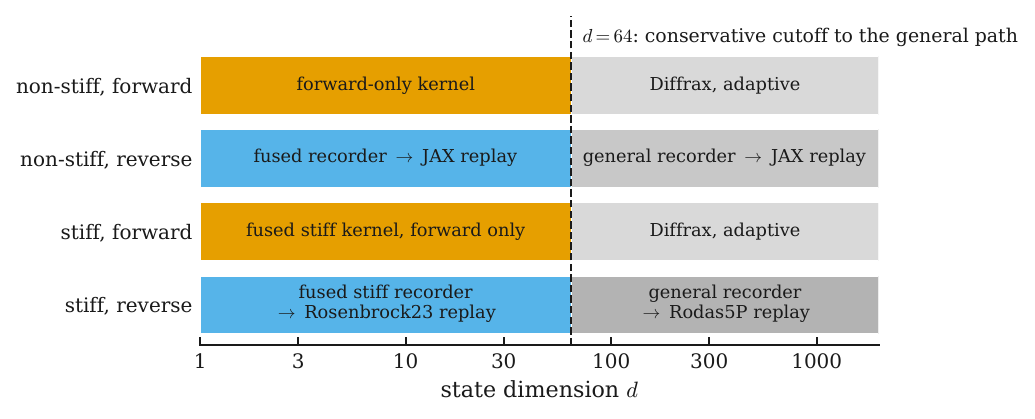
The map is drawn from the routing table in the source (gradsolve.dispatch.DECISION_MAP).
Your own fused kernel. gradsolve.register_jax_field(name, f_jax, dim, n_params, stiff=False)
translates a JAX right-hand side (and its Jacobian, for stiff problems) into the same fused Warp
field the built-in problems use, so a problem with that name routes to the fused engines.
examples/08_fused_kernel_from_jax.py shows the whole flow.
Performance
Every measurement below is in double precision and compares solvers at the same achieved accuracy
(the error actually reached, not the tolerance requested), on an A100, with the cross-GPU panel
adding an H100 and an RTX 4090. To re-measure on your own hardware, the notebooks in
benchmarks/ time the reverse-mode comparison against diffrax and the
forward-only comparison against DiffEqGPU.jl.
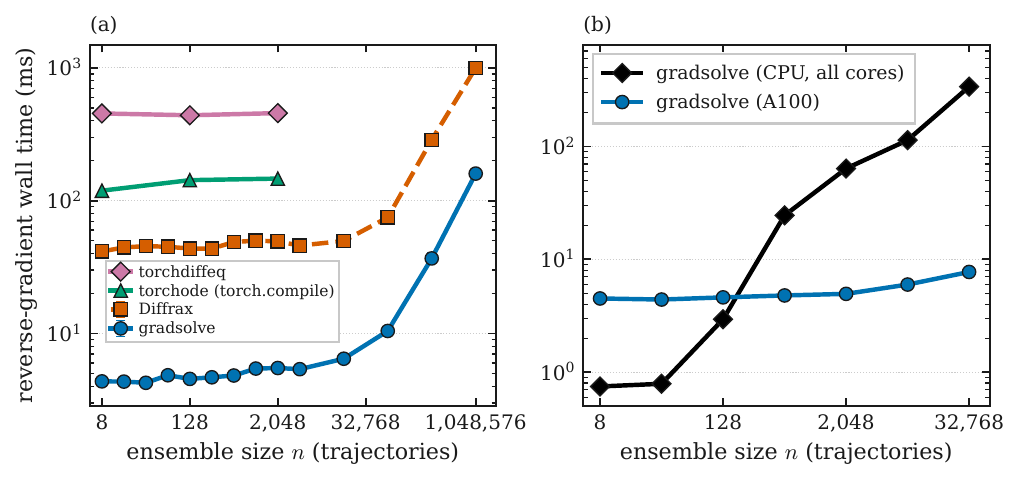
Wall time of one reverse-mode gradient against ensemble size on an A100, for gradsolve, diffrax, torchode and torchdiffeq (left), and gradsolve on a CPU against the A100 (right).
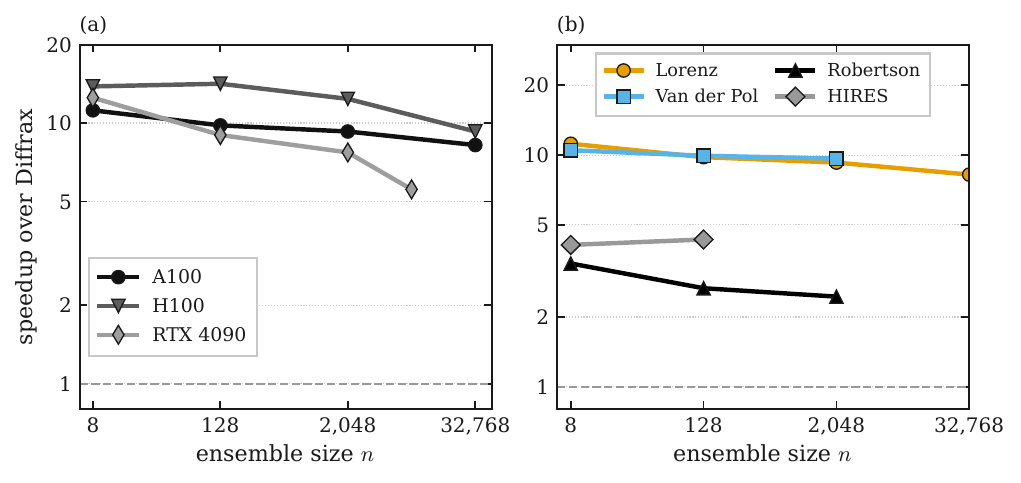
Speedup over diffrax for the reverse-mode gradient on three GPUs (left) and across problem families on the A100 (right).
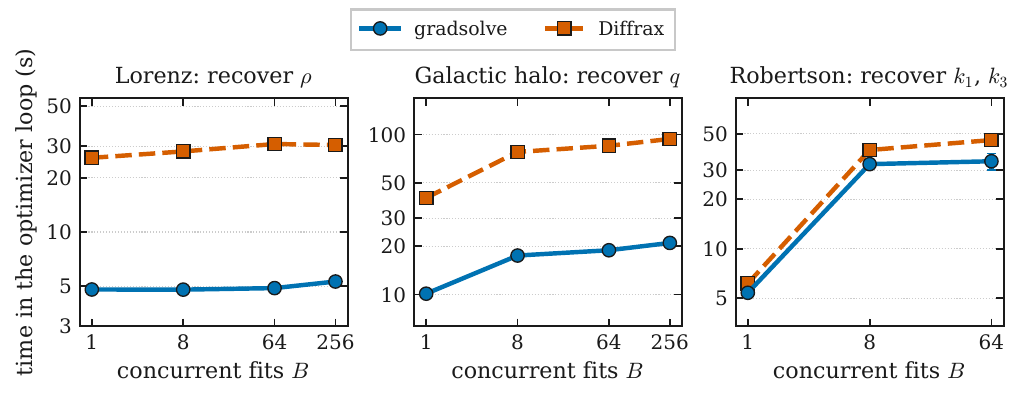
Time spent in the optimiser loop to fit parameters, against the number of fits run concurrently, on the A100.
Citation
If you use gradsolve in your research, please cite the article that describes it (arXiv:2609.02876):
@misc{spuriomancini2026,
  title         = {GRADSOLVE: fast exact gradients for ODE ensembles on GPUs},
  author        = {Alessio Spurio Mancini},
  year          = {2026},
  eprint        = {2609.02876},
  archivePrefix = {arXiv},
  primaryClass  = {cs.MS},
  url           = {https://arxiv.org/abs/2609.02876},
}
GitHub's "Cite this repository" button reads CITATION.cff, which points at the same
article.
Citing what your solve used
gradsolve implements published methods, and some of its engines run on Diffrax or NVIDIA Warp.
.route.actual on a SolveResult or on a grad_closure closure names the engine that ran;
please also cite what that engine used:
- Diffrax (the
diffraxengine: the forward fallback whenever a fused kernel cannot serve a problem and Diffrax is installed, and the reverse engine when asked for by name): Kidger, P. (2021), On Neural Differential Equations, PhD thesis, University of Oxford. That engine runs Diffrax'sTsit5(non-stiff) orKvaerno5(stiff) with aPIDControllerandRecursiveCheckpointAdjoint;diffrax.citation(...), called with the arguments you would pass todiffeqsolve, prints the BibTeX for those. - NVIDIA Warp (
warp_ode,warp_rosenbrock,warp_replay,fused_rosenbrock_backward): Macklin, M. (2022), Warp: A High-performance Python Framework for GPU Simulation and Graphics, NVIDIA GTC, https://github.com/NVIDIA/warp. - Tsit5 (
fixed_step_tsit5,tsit5_replay,warp_ode,warp_replay,cuda_tsit5): Tsitouras, Ch. (2011), Computers & Mathematics with Applications 62, 770–775, doi:10.1016/j.camwa.2011.06.002. - Vern7 (
vern7_replay): Verner, J. H. (2010), Numerical Algorithms 53, 383–396, doi:10.1007/s11075-009-9290-3. - Rosenbrock23 (
warp_rosenbrock,cuda_rosenbrock23,fused_rosenbrock_backward): Shampine, L. F. and Reichelt, M. W. (1997), The MATLAB ODE Suite, SIAM Journal on Scientific Computing 18, 1–22, doi:10.1137/S1064827594276424. - Rodas5P (
rodas5p_replay): Steinebach, G. (2023), BIT Numerical Mathematics 63, 27, doi:10.1007/s10543-023-00967-x. - Kvaerno5 (inside the
diffraxengine on stiff problems): Kværnø, A. (2004), BIT Numerical Mathematics 44, 489–502, doi:10.1023/B:BITN.0000046811.70614.38. - Linearly implicit Euler (
fixed_step_imex): Hairer, E. and Wanner, G. (1996), Solving Ordinary Differential Equations II, Springer, doi:10.1007/978-3-642-05221-7.
License
MIT. See LICENSE.
1 maintainer

Download files
Download the file for your platform. If you're not sure which to choose, learn more about installing packages.
Source Distribution
Built Distribution
Filter files by name, interpreter, ABI, and platform.
If you're not sure about the file name format, learn more about wheel file names.
Copy a direct link to the current filters
File details
Details for the file gradsolve-0.2.1.tar.gz.
File metadata
- Download URL: gradsolve-0.2.1.tar.gz
- Upload date:
- Size: 544.8 kB
- Tags: Source
- Uploaded using Trusted Publishing? Yes
- Uploaded via:
twine/6.1.0 CPython/3.13.13
File hashes
| Algorithm | Hash digest | |
|---|---|---|
| SHA256 |
6beacbd0f58a37b05d6b06c19a6c470a87a4d6002ede5b4e7177a8536d04f9a5
|
|
| MD5 |
5e65be81a77819da17f345b1100e48b3
|
|
| BLAKE2b-256 |
60710f30daa8528575509d12d42a70394ced6da56a703a081d3b8e6a35cba33c
|
Provenance
The following attestation bundles were made for gradsolve-0.2.1.tar.gz:
Publisher:
release.yml on ECLIPSE-AI4Science/gradsolve
-
Statement:
-
Statement type:
https://in-toto.io/Statement/v1 -
Predicate type:
https://docs.pypi.org/attestations/publish/v1 -
Subject name:
gradsolve-0.2.1.tar.gz -
Subject digest:
6beacbd0f58a37b05d6b06c19a6c470a87a4d6002ede5b4e7177a8536d04f9a5 - Sigstore transparency entry: 2696552322
- Sigstore integration time:
-
Permalink:
ECLIPSE-AI4Science/gradsolve@3e11c1222640a028d60e15cfe6ab55e557bc4c11 -
Branch / Tag:
refs/tags/v0.2.1 - Owner: https://github.com/ECLIPSE-AI4Science
-
Access:
public
-
Token Issuer:
https://token.actions.githubusercontent.com -
Runner Environment:
github-hosted -
Publication workflow:
release.yml@3e11c1222640a028d60e15cfe6ab55e557bc4c11 -
Trigger Event:
push
-
Statement type:
File details
Details for the file gradsolve-0.2.1-py3-none-any.whl.
File metadata
- Download URL: gradsolve-0.2.1-py3-none-any.whl
- Upload date:
- Size: 166.3 kB
- Tags: Python 3
- Uploaded using Trusted Publishing? Yes
- Uploaded via:
twine/6.1.0 CPython/3.13.13
File hashes
| Algorithm | Hash digest | |
|---|---|---|
| SHA256 |
fc3187d2bec7a765aed05e18d40002b121bb7cbb28537d0769489aed4698d079
|
|
| MD5 |
403d61ff48c9ef6ac82404204ecfa24f
|
|
| BLAKE2b-256 |
232dc3b569a8f3dcc13c707ad4a871801ee906e7f1b97a8ef5a8d240baa8f4e1
|
Provenance
The following attestation bundles were made for gradsolve-0.2.1-py3-none-any.whl:
Publisher:
release.yml on ECLIPSE-AI4Science/gradsolve
-
Statement:
-
Statement type:
https://in-toto.io/Statement/v1 -
Predicate type:
https://docs.pypi.org/attestations/publish/v1 -
Subject name:
gradsolve-0.2.1-py3-none-any.whl -
Subject digest:
fc3187d2bec7a765aed05e18d40002b121bb7cbb28537d0769489aed4698d079 - Sigstore transparency entry: 2696552492
- Sigstore integration time:
-
Permalink:
ECLIPSE-AI4Science/gradsolve@3e11c1222640a028d60e15cfe6ab55e557bc4c11 -
Branch / Tag:
refs/tags/v0.2.1 - Owner: https://github.com/ECLIPSE-AI4Science
-
Access:
public
-
Token Issuer:
https://token.actions.githubusercontent.com -
Runner Environment:
github-hosted -
Publication workflow:
release.yml@3e11c1222640a028d60e15cfe6ab55e557bc4c11 -
Trigger Event:
push
-
Statement type:













