
grantscan
Which of our papers acknowledged this grant?
Research groups have to answer that question repeatedly: for a funder's final
report, for a renewal, for an institutional review. The answer is buried in the
acknowledgment paragraph of every paper the group has published, and the codes
themselves are unmemorable strings like RTG 4200/1 or 900123456.
Answering it by hand means opening papers one at a time and reading the small print at the end of each. Answering it with a normal search is worse than it sounds, because a code that reads cleanly on the page rarely survives being extracted from a PDF: it breaks across a line, loses its spaces, or fuses to the word beside it. Searching for what you can see gets you a fraction of what is there.
grantscan reads a folder of papers once and then answers that question in milliseconds, for one code or for a whole reporting portfolio, showing you the sentence each answer rests on so you can judge it rather than trust it.
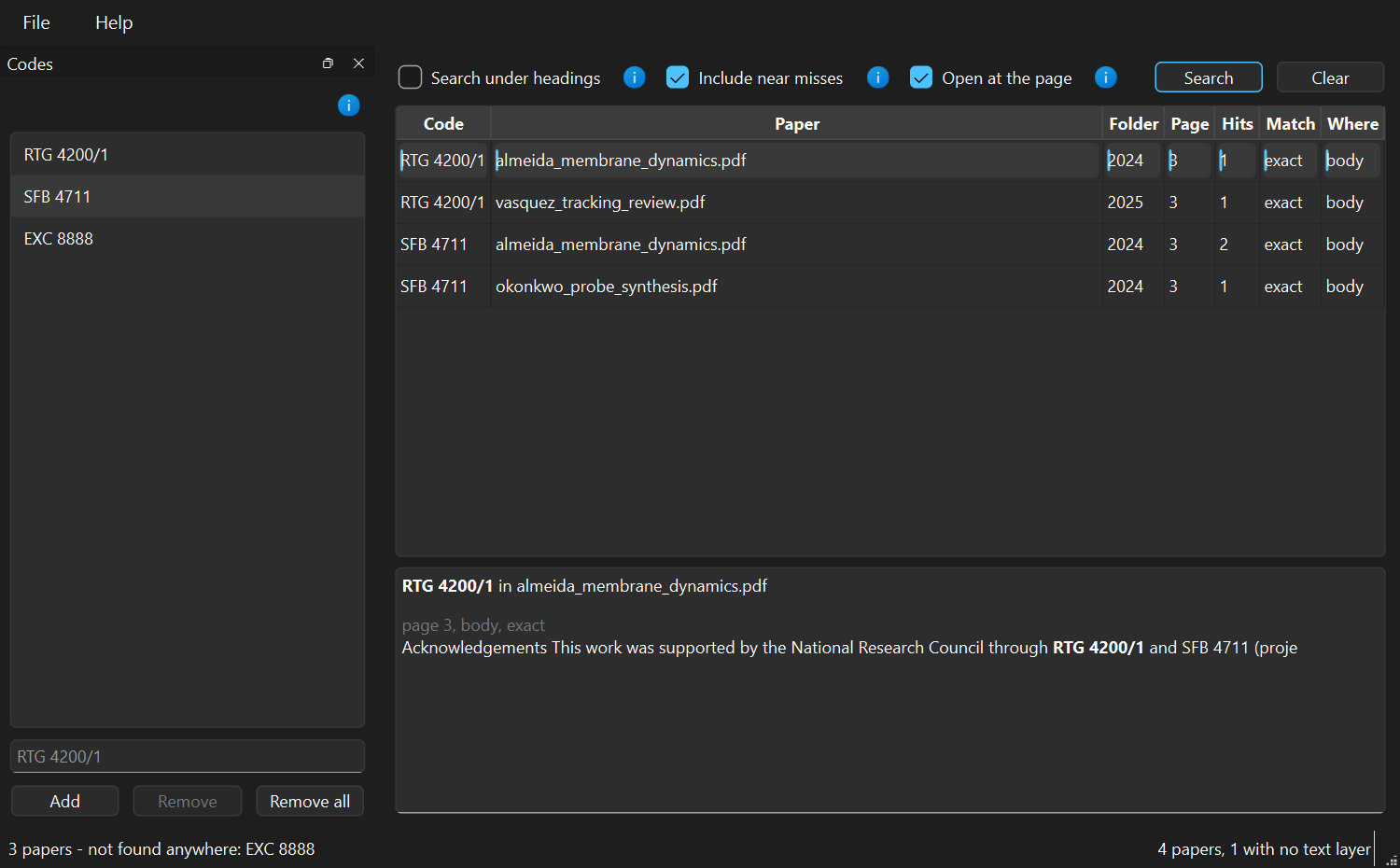
It also answers the question a spreadsheet cannot: which of the codes you asked about appear in no paper at all. For a report you have to sign, that is usually the line that matters.
Getting it
Download grantscan.exe from the latest release and double-click
it. It needs no installation, no Python, and no network.
Or, with Python 3.12 or newer:
pip install grantscan
grantscan
Using it
The user guide is written for the people who will use this rather than work on it. In short: add your folders, list the codes you care about, press Search.
Papers are read on your computer. Nothing is sent anywhere.
Working on it
DESIGN.md explains how it is put together and why, including what was
measured to decide it.
uv sync
uv run pytest
uv run ruff check .
uv run ruff format .
uv run mypy
uv run grantscan
Dependencies are managed with uv add, never by editing pyproject.toml.
| package | what it does |
|---|---|
core/ |
normalising, parsing a code, locating sections, matching. Pure functions. |
model/ |
the corpus, its text store, and the only module importing a PDF library |
presenter/ |
thread pool, search generations, exact-then-fuzzy staging |
export/ |
writing a run to a workbook |
view/ |
PySide6. The only package importing Qt. |
Licence
MIT. It reads PDFs with pypdfium2 over Google's PDFium, which is BSD-3-Clause, and draws its interface with Qt through PySide6, which is LGPL-3.0.
1 maintainer

Metadata
1 maintainer
Release files for grantscan 0.1.0
For a detailed explanation of source distributions (sdists) and built distributions (wheels), please see the package formats documentation.
Source distribution (sdist)
| File | Size | Uploaded | Provenance | |
|---|---|---|---|---|
| grantscan-0.1.0.tar.gz | 28.1 kB | With provenance | Details |
Built distribution (wheel)
| File | Interpreter | ABI | Platform | Reset |
|---|---|---|---|---|
| grantscan-0.1.0-py3-none-any.whl | Python 3 | none | any | Details |
Total release size: 64.8 kB
Release files / grantscan-0.1.0.tar.gz
| Download URL | grantscan-0.1.0.tar.gz |
|---|---|
| Size | 28.1 kB |
| Tags | Source |
|
SHA-256 checksum How to use checksums |
ba49982087ed72c182524d377ae96b91a2702fe0f064ce985042e6e6a38b0e0c
|
|
BLAKE2b-256 checksum How to use checksums |
ed2ef9e671aec091aae3c6994f1634c5a6acb25a118cca219b2a333cae14cba9
|
| Upload date | |
|
Uploaded using Trusted Publishing? What is trusted publishing? |
Yes |
| Uploaded via |
twine/7.0.0 CPython/3.13.14
|
Provenance
Provenance describes where a file came from. On PyPI, provenance is shared via attestations, which provide a verifiable record of the build or publishing details. View details, limitations and caveats.


PyPI Publish Attestation
PyPI verified that this artifact, at this checksum, originated from the publisher listed below.
Signed by GitHub Actions, verified by PyPI on Aug 8, 2026.
Transparency logRelease files / grantscan-0.1.0-py3-none-any.whl
| Download URL | grantscan-0.1.0-py3-none-any.whl |
|---|---|
| Size | 36.7 kB |
| Tags | Python 3 |
|
SHA-256 checksum How to use checksums |
70cfe6db8c979cdccfeefc0db5d75a0999f635a5e15f7092efd125f90c79663a
|
|
BLAKE2b-256 checksum How to use checksums |
ad5c5d2029a3845f47133d3e788c69b3b4ba51fe3e1dde992ef3b30c230dec3a
|
| Upload date | |
|
Uploaded using Trusted Publishing? What is trusted publishing? |
Yes |
| Uploaded via |
twine/7.0.0 CPython/3.13.14
|
Provenance
Provenance describes where a file came from. On PyPI, provenance is shared via attestations, which provide a verifiable record of the build or publishing details. View details, limitations and caveats.
PyPI Publish Attestation
PyPI verified that this artifact, at this checksum, originated from the publisher listed below.
Signed by GitHub Actions, verified by PyPI on Aug 8, 2026.
Transparency logSecurity for grantscan 0.1.0
Provenance
Provenance describes where a file came from. On PyPI, provenance is shared via attestations, which provide a verifiable record of the build or publishing details. View details, limitations and caveats.
Full provenance
All 2 files in this release have been uploaded with provenance metadata.
Attestation for grantscan-0.1.0.tar.gz
PyPI Publish Attestation
PyPI verified that this artifact, at this checksum, originated from the publisher listed below.
Signed by GitHub Actions, verified by PyPI on Aug 8, 2026.
Transparency logA note on package security
PyPI is a repository for distributing packages, not a service for auditing them. While third-party security researchers and our staff do their best to detect and remove malicious packages, PyPI cannot guarantee the quality, security or suitability of any given package.
To learn more about protecting yourself from malicious actors, visit our package security documentation.













