
Utility package to work with equivariant matrices and graphs.

Project description
graph2mat: Equivariant matrices meet machine learning

The aim of graph2mat is to pave your way into meaningful science by providing the tools to interface to common machine learning frameworks (e3nn, pytorch) to learn equivariant matrices.
It also provides a set of tools to facilitate the training and usage of the models created using the package:
- Training tools: It contains custom
pytorch_lightningmodules to train, validate and test the orbital matrix models. - Server: A production ready server (and client) to serve predictions of the trained
models. Implemented using
fastapi. - Siesta: A set of tools to interface the machine learning models with SIESTA. These include tools for input preparation, analysis of performance...
The package also implements a command line interface (CLI): graph2mat. The aim of this CLI is
to make the usage of graph2mat's tools as simple as possible. It has two objectives:
- Make life easy for the model developers.
- Facilitate the usage of the models by non machine learning scientists, who just want good predictions for their systems.
Installation
It can be installed with pip. Adding the tools extra will also install all the dependencies needed to use the tools provided.
pip install graph2mat[tools]
If you want to use graph2mat with e3nn you can also ask for the e3nn extra dependencies:
pip install graph2mat[tools,e3nn]
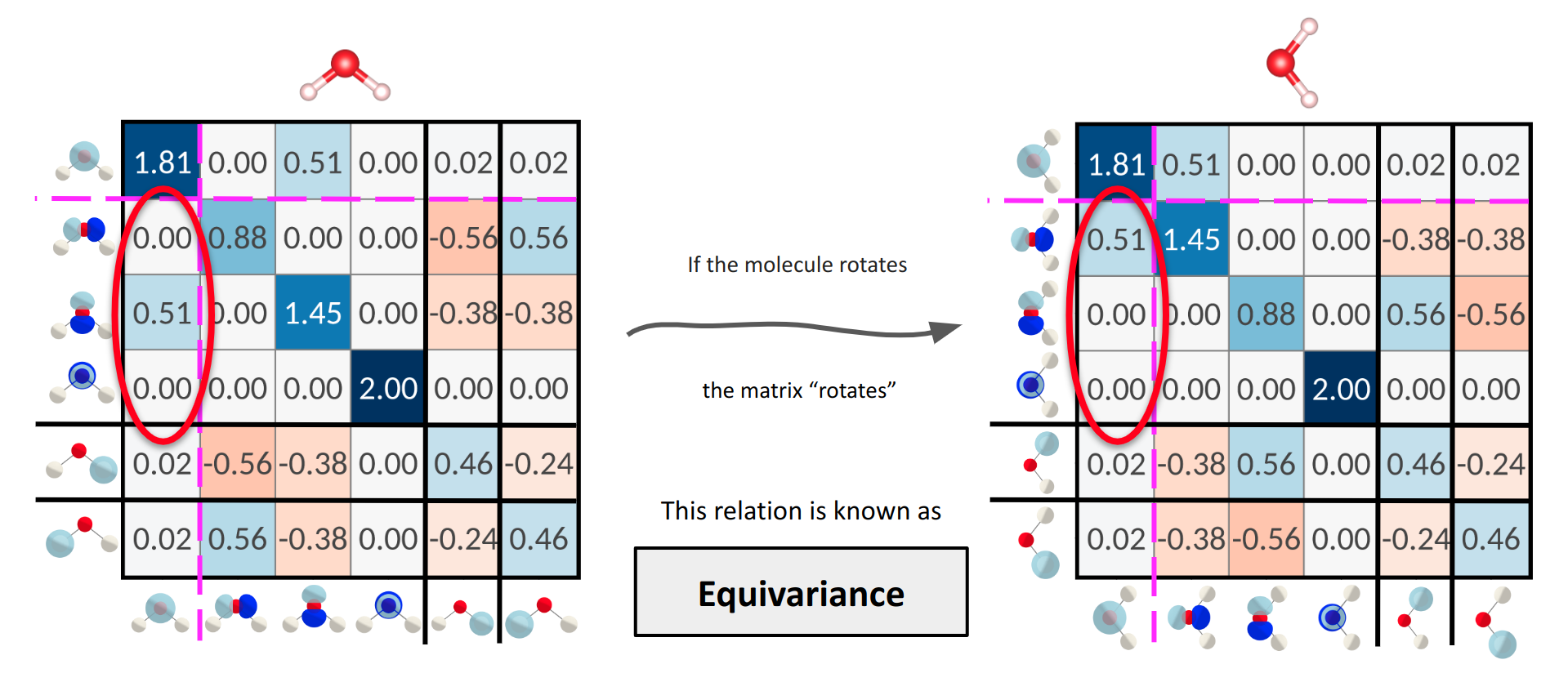
What is an equivariant matrix?
Contributions
We are very open to suggestions, contributions, discussions...
- If you have questions or want do discuss an idea, please start a discussion
- If you have a feature suggestion or bug report, please open an issue
We are looking forward to your contributions!
The graph2mat package was originally created by Peter Bjørn Jorgensen (@peterbjorgensen) and Pol Febrer (@pfebrer) in the frame of a collaboration to machine learn density matrices.
Since then, the following users have contributed to the code:

Citation
If you use graph2mat for one of your works, please cite our original paper:
@article{febrer2025graph2mat,
  title={Graph2Mat: universal graph to matrix conversion for electron density prediction},
  author={Febrer, Pol and J{\o}rgensen, Peter Bj{\o}rn and Pruneda, Miguel and Garc{\'\i}a, Alberto and Ordej{\'o}n, Pablo and Bhowmik, Arghya},
  journal={Machine Learning: Science and Technology},
  volume={6},
  number={2},
  pages={025013},
  year={2025},
  publisher={IOP Publishing}
}
We'll be very happy to see what you have done with it :)
Release history Release notifications | RSS feed


Download files
Download the file for your platform. If you're not sure which to choose, learn more about installing packages.
Source Distribution
File details
Details for the file graph2mat-0.0.8.tar.gz.
File metadata
- Download URL: graph2mat-0.0.8.tar.gz
- Upload date:
- Size: 1.2 MB
- Tags: Source
- Uploaded using Trusted Publishing? Yes
- Uploaded via: twine/4.0.2 CPython/3.11.13
File hashes
| Algorithm | Hash digest | |
|---|---|---|
| SHA256 |
453174d18c0035209eb1e7564d03de2aa1faca5fec06deceb4952783cae32a71
|
|
| MD5 |
45a37df41fa8151ddbd7ba6491458b24
|
|
| BLAKE2b-256 |
662223209fa9604661c1ffbdecc50e30ffe73a3a34df755a70470ba6ff6f0955
|






