
Graphbrain
Graphbrain is an Artificial Intelligence open-source software library and scientific research tool. Its aim is to facilitate automated meaning extraction and text understanding, as well as the exploration and inference of knowledge. It is part of socsemics, a research project funded by the European Research Council and focused on the fragmentation in online public spaces.
The ambition of this project is not simply to contribute to advancing the state-of-the-art in AI, but principally to be an effective interdisciplinary research tool. More specifically, we are interested in advancing the possibilities of automated meaning extraction for research in fields such as Computational Social Sciences, Cognitive Science and the Humanities.
Graphbrain is built around a unifying concept: the Semantic Hypergraph (SH), which makes it possible to represent a natural language sentence such as “Einstein first published the theory of relativity in 1905” as an ordered, recursive hyperlink of the form:
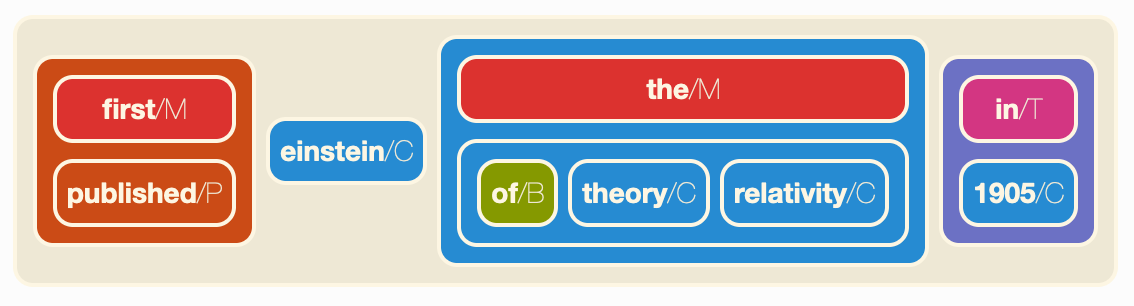
The aim of SH and Graphbrain is to enable hybrid approaches, combining symbolic AI and statistical/connectionist Machine Learning methods. This is for two main reasons: to facilitate understandability and reproducibility for human researchers and to combine the strengths of both approaches.
Graphbrain is written in Python, to both take advantage and facilitate integration with the rich environment of scientific libraries available in this language. It is released under the highly permissive MIT open source license.
Installation and manual
Installation instructions, the manual and more information can be found here: http://graphbrain.net.
Contributing
Pull requests are welcome. For major changes, please open an issue first to discuss what you would like to change.
Please make sure to update tests as appropriate.
Funding
The creation of this software library and the associated research that made it possible were funded by CNRS and the ERC Consolidator Grant Socsemics (grant #772743).

License
1 maintainer

Metadata
1 maintainer
Release files for graphbrain 0.7.0
For a detailed explanation of source distributions (sdists) and built distributions (wheels), please see the package formats documentation.
Source distribution (sdist)
| File | Size | Uploaded | Provenance | |
|---|---|---|---|---|
| graphbrain-0.7.0.tar.gz | 7.1 MB | Without provenance | Details |
Built distribution (wheel)
| File | Interpreter | ABI | Platform | Reset |
|---|---|---|---|---|
| graphbrain-0.7.0-py3-none-any.whl | Python 3 | none | any | Details |
Total release size: 7.3 MB
Release files / graphbrain-0.7.0.tar.gz
| Download URL | graphbrain-0.7.0.tar.gz |
|---|---|
| Size | 7.1 MB |
| Tags | Source |
|
SHA-256 checksum How to use checksums |
9240af23e30799641bc1fc11be1645d8479ad82ba904c1d25b40413395f9dd50
|
|
BLAKE2b-256 checksum How to use checksums |
2874c2b5ef0ed1902618d0a5fad25c19a5c4409cbe5956b305dc7efc19040eb9
|
| Upload date | |
|
Uploaded using Trusted Publishing? What is trusted publishing? |
No |
| Uploaded via |
uv/0.6.17
|
Release files / graphbrain-0.7.0-py3-none-any.whl
| Download URL | graphbrain-0.7.0-py3-none-any.whl |
|---|---|
| Size | 245.3 kB |
| Tags | Python 3 |
|
SHA-256 checksum How to use checksums |
cbad632020ef8874482286b6c71efc4bbaae2cc81b0d30ca063512d0c4e935aa
|
|
BLAKE2b-256 checksum How to use checksums |
0d2c711a54757b8b63edb5e27d5cd29ce92ff656950f55b11d5d02e0295ff46d
|
| Upload date | |
|
Uploaded using Trusted Publishing? What is trusted publishing? |
No |
| Uploaded via |
uv/0.6.17
|
Security for graphbrain 0.7.0
Provenance
Provenance describes where a file came from. On PyPI, provenance is shared via attestations, which provide a verifiable record of the build or publishing details. View details, limitations and caveats.
No provenance found
None of the files in this release were uploaded with provenance metadata.
A note on package security
PyPI is a repository for distributing packages, not a service for auditing them. While third-party security researchers and our staff do their best to detect and remove malicious packages, PyPI cannot guarantee the quality, security or suitability of any given package.
To learn more about protecting yourself from malicious actors, visit our package security documentation.














