
Filters for Graphene SQLAlchemy integration
Verified details
These details have been verified by PyPIProject links
GitHub Statistics
Maintainers

Project description
Graphene-SQLAlchemy-Filter



Filters for Graphene SQLAlchemy integration
Choosing the Right Library
❗Important: This project does not support graphene-sqlalchemy v3.
Starting from v3, filtering is already included in the upstream library.
Use the following table to decide which package fits your needs:
| Graphene-SQLAlchemy version | What to use | Notes |
|---|---|---|
| v2.x | ✅ graphene-sqlalchemy-filter |
Provides flexible filtering integration. |
| v3.x | ❌ Not supported here | Built-in filtering is already available in graphene-sqlalchemy itself. |
Quick start
Create a filter and add it to the graphene field.
from graphene_sqlalchemy_filter import FilterableConnectionField, FilterSet


class UserFilter(FilterSet):
    is_admin = graphene.Boolean()

    class Meta:
        model = User
        fields = {
            'username': ['eq', 'ne', 'in', 'ilike'],
            'is_active': [...],  # shortcut!
        }

    @staticmethod
    def is_admin_filter(info, query, value):
        if value:
            return User.username == 'admin'
        else:
            return User.username != 'admin'


class Query(ObjectType):
    all_users = FilterableConnectionField(UserConnection, filters=UserFilter())
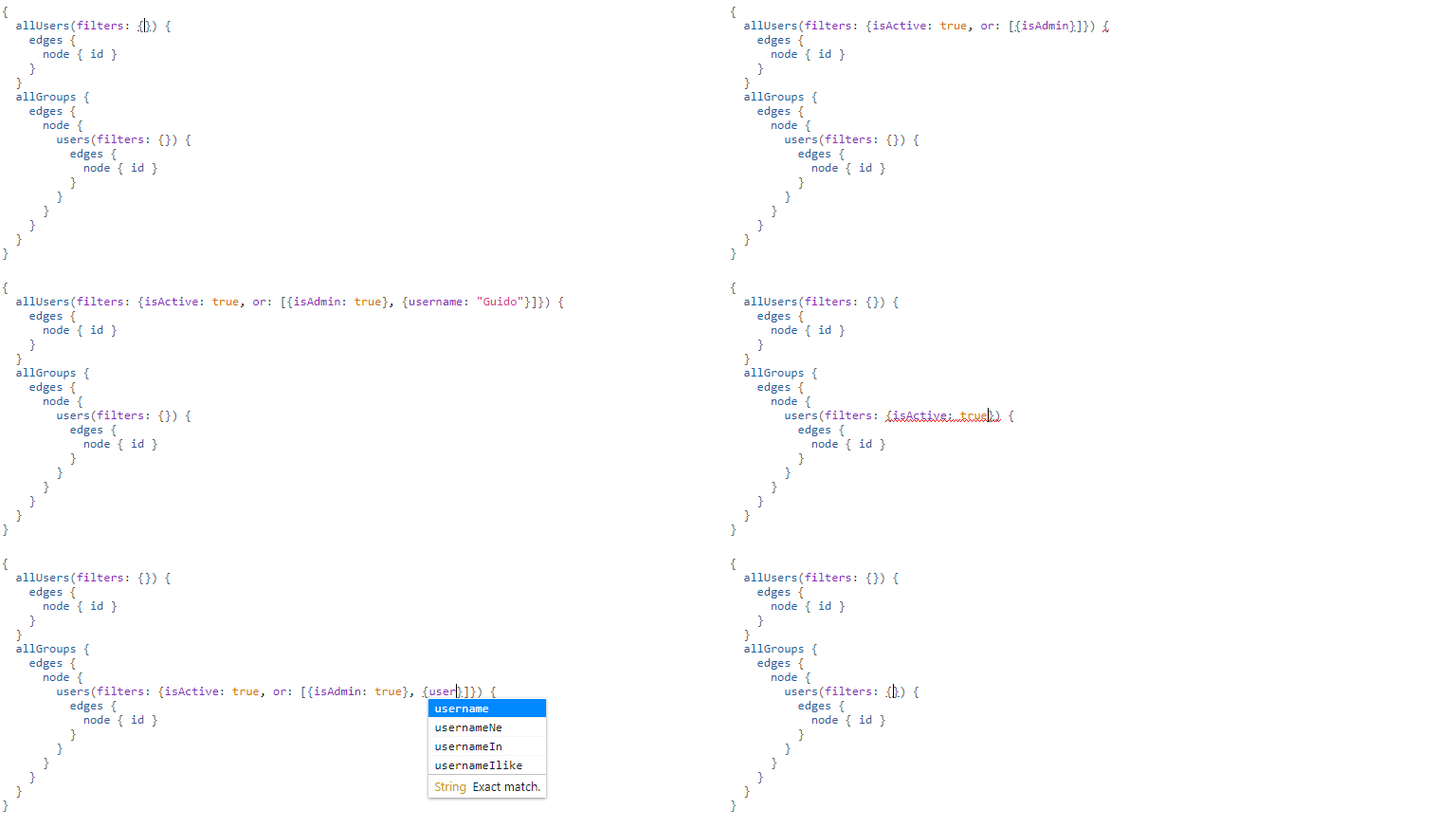
Now, we're going to create a query.
{
  allUsers (
    filters: {
      isActive: true,
      or: [
        {isAdmin: true},
        {usernameIn: ["moderator", "cool guy"]}
      ]
    }
  ){
    edges {
      node {
        id
        username
      }
    }
  }
}
Filters
FilterSet class must inherit graphene_sqlalchemy_filter.FilterSet or your subclass of this class.
There are three types of filters:
Automatically generated filters
class UserFilter(FilterSet):
   class Meta:
       model = User
       fields = {
           'username': ['eq', 'ne', 'in', 'ilike'],
           'is_active': [...],  # shortcut!
       }
Metaclass must contain the sqlalchemy model and fields.
Automatically generated filters must be specified by fields variable.
Key - field name of sqlalchemy model, value - list of expressions (or shortcut).
Shortcut (default: [...]) will add all the allowed filters for this type of sqlalchemy field (does not work with hybrid_property).
| Key | Description | GraphQL postfix |
|---|---|---|
eq |
equal | |
ne |
not equal | Ne |
like |
like | Like |
ilike |
insensitive like | Ilike |
is_null |
is null | IsNull |
in |
in | In |
not_in |
not in | NotIn |
lt |
less than | Lt |
lte |
less than or equal | Lte |
gt |
greater than | Gt |
gte |
greater than or equal | Gte |
range |
in range | Range |
contains |
contains (PostgreSQL array) | Contains |
contained_by |
contained_by (PostgreSQL array) | ContainedBy |
overlap |
overlap (PostgreSQL array) | Overlap |
Simple filters
class UserFilter(FilterSet):
    is_admin = graphene.Boolean()

    @staticmethod
    def is_admin_filter(info, query, value):
        if value:
            return User.username == 'admin'
        else:
            return User.username != 'admin'
Each simple filter has a class variable that passes to GraphQL schema as an input type and function <field_name>_filter that makes filtration.
The filtration function takes the following arguments:
info- ResolveInfo graphene objectquery- sqlalchemy query (not used in that filters type)value- the value of a filter
The return value can be any type of sqlalchemy clause. This means that you can return not_(and_(or_(...), ...)).
Metaclass is not required if you do not need automatically generated filters.
Filters that require joins
Sometimes a filter needs columns that live on a different table. These “join filters” work just like simple filters, but they must:
- create (or reuse) a SQLAlchemy alias for the related table,
- join that alias to the current query, and
- return both the (possibly modified) query and a SQLAlchemy boolean clause.
Use the built-ins: cls._join and cls._outerjoin
FilterSet provides two helper methods that are idempotent:
cls._join(query, target_alias, onclause, ...)cls._outerjoin(query, target_alias, onclause, ...)
These helpers inspect the current query and skip adding the same alias twice. That means you can safely reuse the same alias object across multiple filters without generating duplicate JOINs or “ambiguous column” errors.
Important: Always obtain the alias with cls.aliased(query, Model, name=...). Reusing the same alias name via cls.aliased(...) ensures you get the same alias object for the lifetime of that query, so _join / _outerjoin can recognize it and de-duplicate the JOIN.
Example: multiple filters sharing the same join
Two filters on Membership both need the joined User. Using the same alias name ("member_user") makes them share the same JOIN.
class MembershipFilter(FilterSet):
    username = graphene.String(description="Username of the member user")
    user_id = graphene.Int(description="ID of the member user")

    @classmethod
    def username_filter(cls, info, query, value):
        user = cls.aliased(query, User, name="member_user")
        query = cls._join(query, user, Membership.user_id == user.id)
        return query, (user.username == value)

    @classmethod
    def user_id_filter(cls, info, query, value):
        user = cls.aliased(query, User, name="member_user")
        query = cls._join(query, user, Membership.user_id == user.id)
        return query, (user.id == value)

    class Meta:
        model = Membership
        fields = {"is_moderator": [...]}
{
  allMemberships(filters: {and: [{userId: 1}, {username: "Ally"}, {isModerator: true}]}) {
    edges { node { id } }
  }
}
If a client applies both username and user_id at once, the final SQL will contain only one JOIN ... AS member_user ... even though both filters called _join.
When to use _join vs _outerjoin
- Use
_join(INNER JOIN) when a matching related row is required for the result to qualify. - Use
_outerjoin(LEFT OUTER JOIN) when you may filter on presence or absence of related rows.
Both helpers take the same arguments you’d pass to SQLAlchemy’s .join() / .outerjoin().
Best practices & gotchas
- Always return
(query, clause)from a filter method. Modifications to the query (joins) must be returned for the framework to compose them with other filters. - Alias once, reuse often. Call
cls.aliased(query, Model, name="…")in each filter that needs the same table and reuse the samenameto get the same alias object. - Different semantics → different aliases. If two filters must join the same table with different roles/conditions, give them different alias names (e.g.,
"author_user"vs"reviewer_user")._joinonly de-duplicates identical alias targets; intentionally separate roles should use separate aliases. - Don’t mix different ON conditions with the same alias. If you need different join predicates, either (a) combine them into the WHERE clause using the one join you already have, or (b) introduce a second alias with a different name.
- Order-independent. Because
_join/_outerjoinare idempotent, the final query is stable regardless of the order in which filters are applied. - Performance. It’s safe (and cheap) to call
_join/_outerjoinin multiple filters; duplicate calls are skipped.
Model aliases
Use cls.aliased(query, Model, name="...") to obtain a SQLAlchemy alias object that is scoped to the current query. It mirrors sqlalchemy.orm.aliased(...) in signature and behavior, with one additional parameter: query (the SQLAlchemy Query instance).
- Idempotent within the query: when you call
cls.aliased(...)with the sameModelandname, you’ll get back the same alias object for the lifetime of that query. This enables_join/_outerjointo recognize and de-duplicate identical joins. - Naming matters: reuse the same
nameacross different filters that refer to the same logical relationship (e.g.,"member_user"). Different logical roles or different join predicates should use different names (e.g.,"author_user"vs."reviewer_user"). - Works with
_join/_outerjoin: always acquire the alias viacls.aliased(...)before joining. The helpers will skip the join if that alias is already present on the query. - Do not reuse an alias for different ON conditions: if two filters need different join predicates, either (a) keep a single join and express the differences in the WHERE clause using the same alias, or (b) create a second alias with a different
name.
In short: cls.aliased(...) is the canonical way to declare and reuse aliases across multiple filters operating on the same query, ensuring stable, duplicate-free JOINs.
Default filters (_default_filter)
You can define a _default_filter on your FilterSet to always apply a condition, even when no filters argument is provided.
- If your default condition doesn't need joins, return a SQLAlchemy clause.
- If it needs joins, return a tuple
(query, clause), same as in “filters that require join”. - Default filters are applied to both top-level fields and nested GraphQL connections.
Example (no join):
class UserFilter(FilterSet):
    @staticmethod
    def _default_filter(info, query):
        # Only active users by default
        return User.is_active.is_(True)

    class Meta:
        model = User
        fields = {'username': ['eq', 'ilike']}
With a join:
class MembershipFilter(FilterSet):
    @classmethod
    def _default_filter(cls, info, query):
        m = cls.aliased(query, Membership, name='only_mods')
        query = cls._join(query, m, and_(User.id == m.user_id, m.is_moderator.is_(True)))
        return query, m.id.isnot(None)

    class Meta:
        model = Membership
        fields = {}
Effect in GraphQL (applies even without passing filters):
{
  allUsers {
    edges { node { id username } }
  }
  # Also works for nested connections:
  group(id: "...") {
    users {
      edges { node { id username } }
    }
  }
}
Features
Filter registration and nested fields filters
Filters can be registered for each SQLAlchemy model in a subclass of FilterableConnectionField.
Register your filters by inheriting FilterableConnectionField and setting filters (key - SQLAlchemy model, value - FilterSet object).
class CustomField(FilterableConnectionField):
    filters = {
        User: UserFilter(),
    }
Overriding SQLAlchemyObjectType.connection_field_factory allows you to generate nested connections with filters.
class UserNode(SQLAlchemyObjectType):
    class Meta:
        model = User
        interfaces = (Node,)
        connection_field_factory = CustomField.factory
Important:
- Pagination (first/after, last/before) is performed in Python (keep this in mind when working with large amounts of data)
- Nested filters work via dataloaders
- This module optimizes one-to-many relationships, to optimize many-to-one relationships use sqlalchemy_bulk_lazy_loader
- Nested filters require
graphene_sqlalchemy>=2.1.2
Example
# Filters

class UserFilter(FilterSet):
   class Meta:
       model = User
       fields = {'is_active': [...]}


class CustomField(FilterableConnectionField):
    filters = {
        User: UserFilter(),
    }


# Nodes

class UserNode(SQLAlchemyObjectType):
    class Meta:
        model = User
        interfaces = (Node,)
        connection_field_factory = CustomField.factory


class GroupNode(SQLAlchemyObjectType):
    class Meta:
        model = Group
        interfaces = (Node,)
        connection_field_factory = CustomField.factory


# Connections

class UserConnection(Connection):
    class Meta:
        node = UserNode


class GroupConnection(Connection):
    class Meta:
        node = GroupNode


# Query

class Query(ObjectType):
    all_users = CustomField(UserConnection)
    all_groups = CustomField(GroupConnection)
{
  allUsers (filters: {isActive: true}){
    edges { node { id } }
  }
  allGroups {
    edges {
      node {
        users (filters: {isActive: true}) {
          edges { node { id } }
        }
      }
    }
  }
}
Rename GraphQL filter field
class CustomField(FilterableConnectionField):
    filter_arg = 'where'


class Query(ObjectType):
    all_users = CustomField(UserConnection, where=UserFilter())
    all_groups = FilterableConnectionField(GroupConnection, filters=GroupFilter())
{
  allUsers (where: {isActive: true}){
    edges { node { id } }
  }
  allGroups (filters: {nameIn: ["python", "development"]}){
    edges { node { id } }
  }
}
Rename expression
class BaseFilter(FilterSet):
    GRAPHQL_EXPRESSION_NAMES = dict(
        FilterSet.GRAPHQL_EXPRESSION_NAMES,
        **{'eq': 'equal', 'not': 'i_never_asked_for_this'}
    )

    class Meta:
        abstract = True


class UserFilter(BaseFilter):
    class Meta:
        model = User
        fields = {'first_name': ['eq'], 'last_name': ['eq']}
{
  allUsers (filters: {iNeverAskedForThis: {firstNameEqual: "Adam", lastNameEqual: "Jensen"}}){
    edges { node { id } }
  }
}
Custom shortcut value
class BaseFilter(FilterSet):
    ALL = '__all__'

    class Meta:
        abstract = True


class UserFilter(BaseFilter):
    class Meta:
        model = User
        fields = {'username': '__all__'}
Localization of documentation
class BaseFilter(FilterSet):
    DESCRIPTIONS = {
        'eq': 'Полностью совпадает.',
        'ne': 'Не совпадает.',
        'like': 'Регистрозависимая проверка строки по шаблону.',
        'ilike': 'Регистронезависимая проверка строки по шаблону.',
        'is_null': 'Равно ли значение `null`. Принимает `true` или `false`.',
        'in': 'Проверка вхождения в список.',
        'not_in': 'Проверка не вхождения в список.',
        'lt': 'Меньше, чем указанное значение.',
        'lte': 'Меньше или равно указанному значению.',
        'gt': 'Больше, чем указанное значение.',
        'gte': 'Больше или равно указанному значению.',
        'range': 'Значение входит в диапазон значений.',
        'and': 'Объединение фильтров с помощью ``AND``.',
        'or': 'Объединение фильтров с помощью ``OR``.',
        'not': 'Отрицание указанных фильтров.',
    }

    class Meta:
        abstract = True
Custom expression
def today_filter(field, value: bool):
    today = func.date(field) == date.today()
    return today if value else not_(today)


class BaseFilter(FilterSet):
    # Add expression.
    TODAY = 'today'

    EXTRA_EXPRESSIONS = {
        'today': {
            # Add the name of the expression in GraphQL.
            'graphql_name': 'today',
            # Update allowed filters (used by shortcut).
            'for_types': [types.Date, types.DateTime],
            # Add a filtering function (takes the sqlalchemy field and value).
            'filter': today_filter,
            # Add the GraphQL input type. Column type by default.
            'input_type': (
                lambda type_, nullable, doc: graphene.Boolean(nullable=False)
            ),
            # Description for the GraphQL schema.
            'description': 'It is today.',
        }
    }

    class Meta:
        abstract = True


class PostFilter(BaseFilter):
    class Meta:
        model = Post
        fields = {'created': ['today'], 'updated': [...]}
{
  allPosts (filters: {createdToday: false, updatedToday: true}){
    edges { node { id } }
  }
}
Custom column types
ALLOWED_FILTERS and EXTRA_ALLOWED_FILTERS only affect shortcut.
If you do not use the shortcut, you can skip the next steps described in the section.
class MyString(types.String):
    pass


class BaseFilter(FilterSet):
    # You can override all allowed filters
    # ALLOWED_FILTERS = {types.Integer: ['eq']}

    # Or add new column type
    EXTRA_ALLOWED_FILTERS = {MyString: ['eq']}

    class Meta:
        abstract = True
Project details
Verified details
These details have been verified by PyPIProject links
GitHub Statistics
Maintainers
Release history Release notifications | RSS feed


Download files
Download the file for your platform. If you're not sure which to choose, learn more about installing packages.
Source Distribution
Built Distribution
Filter files by name, interpreter, ABI, and platform.
If you're not sure about the file name format, learn more about wheel file names.
Copy a direct link to the current filters
File details
Details for the file graphene_sqlalchemy_filter-1.14.0.tar.gz.
File metadata
- Download URL: graphene_sqlalchemy_filter-1.14.0.tar.gz
- Upload date:
- Size: 31.7 kB
- Tags: Source
- Uploaded using Trusted Publishing? Yes
- Uploaded via: twine/6.1.0 CPython/3.13.7
File hashes
| Algorithm | Hash digest | |
|---|---|---|
| SHA256 |
2f646df19f6d771099ff8472211ffde727055a72d5d30c1ba7e807894cd2894b
|
|
| MD5 |
7b120745df5cae71fcd75cbcff86a8fc
|
|
| BLAKE2b-256 |
d8d48ba6ee3d03fd4132e0b112e8b1da3793a8093628e41d33ebf34aded9d082
|
Provenance
The following attestation bundles were made for graphene_sqlalchemy_filter-1.14.0.tar.gz:
Publisher:
ci.yml on art1415926535/graphene-sqlalchemy-filter
-
Statement:
-
Statement type:
https://in-toto.io/Statement/v1 -
Predicate type:
https://docs.pypi.org/attestations/publish/v1 -
Subject name:
graphene_sqlalchemy_filter-1.14.0.tar.gz -
Subject digest:
2f646df19f6d771099ff8472211ffde727055a72d5d30c1ba7e807894cd2894b - Sigstore transparency entry: 539397290
- Sigstore integration time:
-
Permalink:
art1415926535/graphene-sqlalchemy-filter@09b3343bf1a6d03645fd03a565711991b0d6e350 -
Branch / Tag:
refs/tags/1.14.0 - Owner: https://github.com/art1415926535
-
Access:
public
-
Token Issuer:
https://token.actions.githubusercontent.com -
Runner Environment:
github-hosted -
Publication workflow:
ci.yml@09b3343bf1a6d03645fd03a565711991b0d6e350 -
Trigger Event:
push
-
Statement type:
File details
Details for the file graphene_sqlalchemy_filter-1.14.0-py3-none-any.whl.
File metadata
- Download URL: graphene_sqlalchemy_filter-1.14.0-py3-none-any.whl
- Upload date:
- Size: 18.4 kB
- Tags: Python 3
- Uploaded using Trusted Publishing? Yes
- Uploaded via: twine/6.1.0 CPython/3.13.7
File hashes
| Algorithm | Hash digest | |
|---|---|---|
| SHA256 |
cfd6f45806e6fe3e1e9c891ffde1e4e9c71eae099615c90f6274c46cf7f48ae7
|
|
| MD5 |
c07e0fd4b1fe9751684fb3ba9d42cfb4
|
|
| BLAKE2b-256 |
727cf130f018baff52eaf4801062224b37f5ff450c5210e720aefaf63ba8359e
|
Provenance
The following attestation bundles were made for graphene_sqlalchemy_filter-1.14.0-py3-none-any.whl:
Publisher:
ci.yml on art1415926535/graphene-sqlalchemy-filter
-
Statement:
-
Statement type:
https://in-toto.io/Statement/v1 -
Predicate type:
https://docs.pypi.org/attestations/publish/v1 -
Subject name:
graphene_sqlalchemy_filter-1.14.0-py3-none-any.whl -
Subject digest:
cfd6f45806e6fe3e1e9c891ffde1e4e9c71eae099615c90f6274c46cf7f48ae7 - Sigstore transparency entry: 539397307
- Sigstore integration time:
-
Permalink:
art1415926535/graphene-sqlalchemy-filter@09b3343bf1a6d03645fd03a565711991b0d6e350 -
Branch / Tag:
refs/tags/1.14.0 - Owner: https://github.com/art1415926535
-
Access:
public
-
Token Issuer:
https://token.actions.githubusercontent.com -
Runner Environment:
github-hosted -
Publication workflow:
ci.yml@09b3343bf1a6d03645fd03a565711991b0d6e350 -
Trigger Event:
push
-
Statement type:






