
GRiD




A GPU-accelerated library for robot dynamics, kinematics, and collisions, with analytical derivatives and Hessians for supported numerical operations.
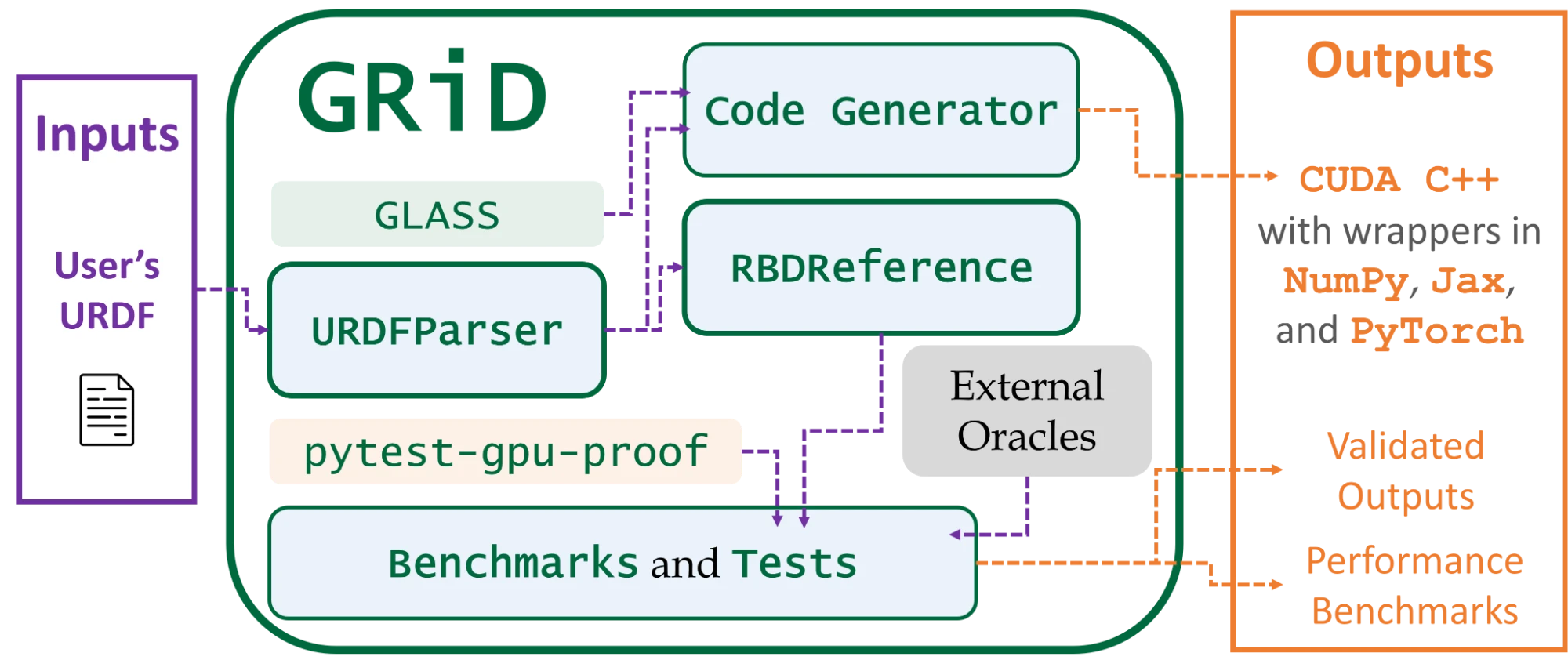
GRiD turns a URDF into optimized, per-robot CUDA C++ for rigid-body dynamics, kinematics, their analytical
first- and second-order derivatives and a trajectory-optimization plant layer, then hands you that code three
ways — a numpy handle, a jax.jit-able FFI surface, or torch.autograd-aware ops — from one content-addressed
.so cache. One CUDA block per problem, batched, bit-deterministic and thread-count invariant; the same
model and API rebuild for each target architecture (one artifact per sm_XX), with runtime memory
adaptation from embedded Jetson class devices to desktop GPUs. Website: https://a2r-lab.org/GRiD/.
GRiD builds on our URDFParser, RBDReference, and GLASS packages (URDF parsing, Pinocchio-validated reference dynamics, and GPU linear algebra), together with its own bundled code generator. Using its scripts, users can easily generate and test optimized rigid body dynamics CUDA C++ code for their URDF files.
Status: 0.5.1 (the first packaged release was 0.5.0) is alpha software. APIs may still change between minor versions; see CHANGELOG.md for what has landed since the paper and what is known to be missing. The original ICRA 2022 paper describes the implementation preserved in the archival robot-acceleration/GRiD repository, not the feature set or performance of this release. See the project website for the overview. Collision routines use the generated CUDA interface; numerical Python interface coverage is documented separately.
I want to…
| Task | Start here |
|---|---|
| Call GRiD from Python (numpy/JAX/torch) | grid_rbd.load_robot("robot.urdf", backend=...) — Python wrappers docs · agent guide |
| Generate CUDA for a new robot | grid-generate config/robot_assets/iiwa14.urdf — see Quick Start below |
| Fit a humanoid build in RAM | fast robot setup (algorithm_list=, enable_mujoco_kernels=False) |
| Add an algorithm | adding an algorithm |
| Run tests / fix a red receipt CI job | CUDA validation + test/run_gpu_proof.sh --help |
| Benchmark | benchmarks |
| Debug a CUDA-vs-numpy mismatch | docs/agent_debugging_guide.md — the bug-class bible |
| Get MuJoCo/mjx-convention I/O | handle.mujoco.<method>(...) — values AND derivatives/second-order |
| Everything else | How do I…? on the docs site |
Start-here track: examples/README.md routes the four usage tracks — the examples/notebooks/ Python-bindings tour (01-quickstart → 07-inline-cuda), the runnable bindings/examples/ scripts, codegen scripts, and hand-written-CUDA walkthroughs.
A checkout contains submodules: run git submodule update --init --recursive after cloning without --recursive. A PyPI install bundles them.
Quick Start
Install from PyPI (Linux x86-64, Python 3.10–3.12; no GPU or compiler needed to install — robot CUDA is
compiled by register_robot using the nvcc on your PATH):
pip install grid-rbd            # code generator + numpy backend + grid-generate / grid-spherize CLIs
pip install "grid-rbd[jax]"     # + JAX FFI surface   (install a CUDA jax wheel yourself)
pip install "grid-rbd[torch]"   # + torch backend     (install a CUDA torch wheel yourself)
pip install "grid-rbd[all]"     # jax + torch
Or work from a checkout (creates a local venv, editable install, registers the CLIs):
git clone --recursive https://github.com/A2R-Lab/GRiD.git && cd GRiD
bash install/base_install.sh
source .venv/bin/activate
Generate CUDA code for your robot (ten ready-to-use URDFs ship in
config/robot_assets/ — iiwa14, go2, fr3, g1, h1_2, …):
# Via the installed CLI (works on a clean base install):
grid-generate config/robot_assets/iiwa14.urdf                # arm, fixed base
grid-generate config/robot_assets/go2.urdf -f                # quadruped, floating base
grid-generate path/to/robot.urdf [-t EE_JOINT_NAME] [-n NAMESPACE] [-f] [--algorithm-list LIST] [-o OUT.cuh]

# Or via a hardcoded zero-config example (these two pull their URDFs from the
# robot_descriptions package — a DEV dependency; install install/requirements-dev.txt first):
python examples/codegen/generate_iiwa14.py       # iiwa14 fixed base
python examples/codegen/generate_go2_floating.py # Go2 floating base
Validate and debug:
# Print CPU reference values for all algorithms:
python examples/codegen/print_reference_values.py path/to/robot.urdf

# Compile and run the CUDA print kernel (requires nvcc):
python examples/codegen/print_grid.py path/to/robot.urdf
Write your own CUDA kernel against the generated header:
# Step-by-step walkthrough + compiling/validated example kernels:
#   examples/cuda/README.md   (and examples/cuda/wrapper_types.md)
bash examples/cuda/build_and_validate.sh   # generate → nvcc → run → validate
Requires a C++17-capable host compiler (e.g., g++ ≥ 7, clang++ ≥ 5). The benchmark and codegen runtime compile with
-std=c++17— needed for inline variables in the bench common header. With the[torch]extra the per-robot.sofollows torch's ATen requirement (-std=c++20from torch 2.14; needs CUDA 12+ and g++ ≥ 10).
Usage
grid-generate PATH_TO_URDF— generategrid.cuh; add-dfor full debug mode,-ffor floating base,-t JOINT_NAMEto target a specific end-effector jointpython examples/codegen/print_reference_values.py PATH_TO_URDF— print CPU reference values for all algorithms to validate CUDA outputpython examples/codegen/print_grid.py PATH_TO_URDF— compile and run the CUDA print kernel against the generated header
Floating-Base Conventions
Floating-base parsing and the Python reference path now accept a public floating-base convention flag. The default is Pinocchio-compatible:
floating_base_convention="pinocchio":q = [x, y, z, qx, qy, qz, qw],v = [vx, vy, vz, wx, wy, wz]floating_base_convention="legacy":q = [x, y, z, qw, qx, qy, qz],v = [wx, wy, wz, vx, vy, vz]
GRiD normalizes both public conventions into one shared internal floating-base
representation, so the code generator and RBDReference stay consistent under
the hood while callers can choose the input/output ordering they need.
Developer Testing
Contributor-facing test workflows (floating-convention regression suite, CUDA equivalence env overrides, shared-memory targets) moved to CONTRIBUTING.md; the receipt/verification policy lives in the CUDA validation guide.
Current Support
GRiD supports open-chain and tree models with revolute, prismatic, fixed, floating, mimic, and additional joint types. Support is operation-specific; see the joint and algorithm restrictions and backend inventory.
GRiD implements the full modern rigid-body-dynamics stack: RNEA / CRBA / ABA /
Minv / forward dynamics; analytical first-order gradients (ID + FD, incl.
external-force gradients); the second-order derivatives (IDSVA-SO both frames
with a codegen-time dispatcher, FDSVA-SO); the kinematics family (EE pose /
Jacobian / Hessian, general-frame frame_jacobian/J̇/OSC inertia, runtime
multi-EE targets); integrators + integrator gradients; the centroidal family
(CoM, CCRBA, dccrba, CMM time-variation, Coriolis matrix, energy/ID
regressors); the inertial-parameter (π) family (the joint-torque regressor
Y with its analytic gradient ∂Y/∂(q,v) and the FD parameter gradient
∂q̈/∂π); contact-frame wrench mapping (contact_fext /
register_robot(contact_frames=...)); runtime tool/payload welding
(attach_tool/tool_fext); runtime multi-target positions; the collision
family (two-tier config_free); a trajectory-optimization grid_plant
cost/step layer; and
runtime-mutable inertia/transform/joint-dynamics tables. The complete
per-algorithm catalog with citations and per-feature detail lives in the
CUDA support status page.
RBDReference additionally provides numpy reference oracles — validated against Pinocchio — for generalized gravity, nonlinear effects, kinetic/potential/mechanical energy, the Coriolis matrix, the centroidal quantities (CoM, CoM Jacobian, CCRBA, centroidal momentum) and their derivatives (the analytic dccrba ∂A/∂q tensor — replacing the prior finite-difference oracle — and cmm_time_variation Ȧ), the inverse-dynamics and kinetic/potential-energy regressors, the general-frame Jacobian / J̇ / OSC inertia described above, and the plant/cost/barrier layer above.
Dual-surface equivalence. Every algorithm exists on two surfaces that are tested for numerical agreement: the RBDReference numpy implementation (the oracle, checked against Pinocchio) and the generated CUDA C++ kernels (checked against that same numpy reference). This keeps the GPU codegen honest against an independent, Pinocchio-validated baseline.
Mimic-joint support: per-robot gating is now essentially eliminated. Non-gradient algorithms (RNEA, forward dynamics, ABA, CRBA, …) work for robots with mimic joints, and every gradient emits a correct mimic-reduced result on both the fixed and floating base: inverse_dynamics_gradient/forward_dynamics_gradient, end_effector_pose_gradient/end_effector_pose_hessian, the second-order idsva_so/fdsva_so, the external-force gradients (f_ext_gradient), and the integrator gradients. The centroidal family — com, ccrba, energy, and the centroidal derivatives dccrba/cmm_time_variation — now also runs on mimic robots (the per-body Jacobian and per-unit motion columns carry the mimic multiplier α, validated against the mimic-aware reference). dccrba/cmm_time_variation additionally run on big floating-base robots (e.g. g1/h1_2-floating) via the sweep-pool spill path. No algorithm raises NotImplementedError for mimic robots anymore.
Additional algorithms and features are in development. If you have a particular algorithm or feature in mind please let us know by posting a GitHub issue. We'd also love your collaboration in implementing the Python reference implementation of any algorithm you'd like implemented!
Repo map
| Directory | Owns | Entry doc |
|---|---|---|
grid_codegen/ |
the code-generation engine: emits grid.cuh AND the checked-in generated binding regions, all driven by the abi_specs.py table |
codegen architecture |
bindings/ |
the grid-rbd Python package (numpy/jax/torch handles over a cached per-robot .so) |
bindings/README.md · agent guide |
external/ |
the peer-product submodules: GLASS (GPU linear algebra), RBDReference (Pinocchio-validated numpy oracle), URDFParser |
each submodule's README |
examples/ |
the start-here track: notebooks/ (Python tour), codegen/, cuda/ |
examples/README.md |
test/ |
pytest suites + the split-suite/receipt machinery (run_split_suite.py, run_gpu_proof.sh, compile_sched.py) |
CUDA validation |
config/ |
ten sample URDFs (robot_assets/) + tuned per-GPU launch configs (launch_configs/) + autotune_robot.sh |
config/robot_assets/URDF_SOURCES.md |
docs/ |
the Sphinx site (source/) + agent_debugging_guide.md (the bug-class bible) |
docs site |
install/ |
install scripts (base_install.sh, developer_install.sh) + requirements files |
installation guide |
C++ API
The generated external interface has three layers: *_device (algorithm-specific
buffer and scratch contract, with placement owned by the device function),
*_kernel (global entry point with batched timestep loop), and the
host wrapper (CPU launcher with H↔D copies). Internal *_inner helpers support
composition without repeating shared setup. See the
codegen architecture docs
for the rationale and concrete signatures.
Python API (grid-rbd)
For Python users the grid-rbd package (in bindings/) wraps
the per-robot codegen behind a register-then-run UX with numpy, jax,
and torch backends. It ships in the same grid-rbd distribution as the code generator, so
pip install grid-rbd (or pip install -e . from a checkout, what install/base_install.sh runs)
installs the codegen toolkit and the grid_rbd wrapper together. The base install is minimal;
pick a backend extra for the surface you want:
pip install grid-rbd            # base: numpy backend only
pip install "grid-rbd[jax]"     # + JAX FFI surface
pip install "grid-rbd[torch]"   # + torch backend (CUDA wheel matching your GPU arch)
pip install "grid-rbd[all]"     # jax + torch
See the install matrix in bindings/README.md
for what each extra unlocks (and the torch CUDA-wheel note).
import grid_rbd

# numpy (default), jax, or torch; urdf_string= also accepted instead of urdf_path
handle = grid_rbd.register_robot("iiwa14", urdf_path="iiwa.urdf", backend="torch")

qdd = handle.forward_dynamics(q, qd, u)   # autograd-aware torch.Tensor
qdd.sum().backward()                      # gradients flow to q, qd, u
The torch backend exposes autograd-aware inverse_dynamics / forward_dynamics /
aba / integrator (analytic backward passes) plus CUDA-Graphs capture,
and the handle also surfaces the grid_plant cost/barrier methods. inverse_dynamics
(alias rnea) takes an optional qdd= (the
autograd gradient is qdd-aware, returning the correct ∂τ/∂(q,q̇) including the
∂(M·q̈)/∂q term), and all three backends expose the value ops coriolis_matrix,
kinetic_energy_regressor, potential_energy_regressor, dccrba, and
cmm_time_variation (forward-only on jax/torch). The π-regressor family
(inverse_dynamics_regressor, the differentiable
inverse_dynamics_wrt_params/forward_dynamics_wrt_params, and the
forward_dynamics_parameter_gradient ∂q̈/∂π), runtime tool welding
(attach_tool/tool_fext, via enable_tool=True), and multi-contact
wrench mapping (contact_fext, via register_robot(contact_frames=[...]))
are bound as well. For true fp64 compute build with
register_robot(..., dtype="float64") (its own cache entry); allow_fp64=True
is only the numpy handle's fp64-in/fp64-out convenience cast on an fp32 build
(ignored when dtype="float64"). See
bindings/README.md and the
Python wrappers docs.
Citing GRiD
To cite GRiD in your research, please use the following bibtex for our paper "GRiD: GPU-Accelerated Rigid Body Dynamics with Analytical Gradients":
@inproceedings{plancher2022grid,
  title={GRiD: GPU-Accelerated Rigid Body Dynamics with Analytical Gradients},
  author={Brian Plancher and Sabrina M. Neuman and Radhika Ghosal and Scott Kuindersma and Vijay Janapa Reddi},
  booktitle={IEEE International Conference on Robotics and Automation (ICRA)},
  year={2022},
  month={May}
}
Performance
Release measurements from the 27 September 2026 run on one NVIDIA RTX 5090 with an Intel Core Ultra 9 285K cover RNEA, its analytical gradient (∇RNEA), and its analytical Hessian (∇²RNEA) on iiwa14 (fixed base, 7 velocities), go2 (floating base, 18), and G1 (floating base, 35) at batch sizes 16–1024. The release measurements page gives the method, every timing boundary, and the caveats; the benchmark harness reproduces the collection.
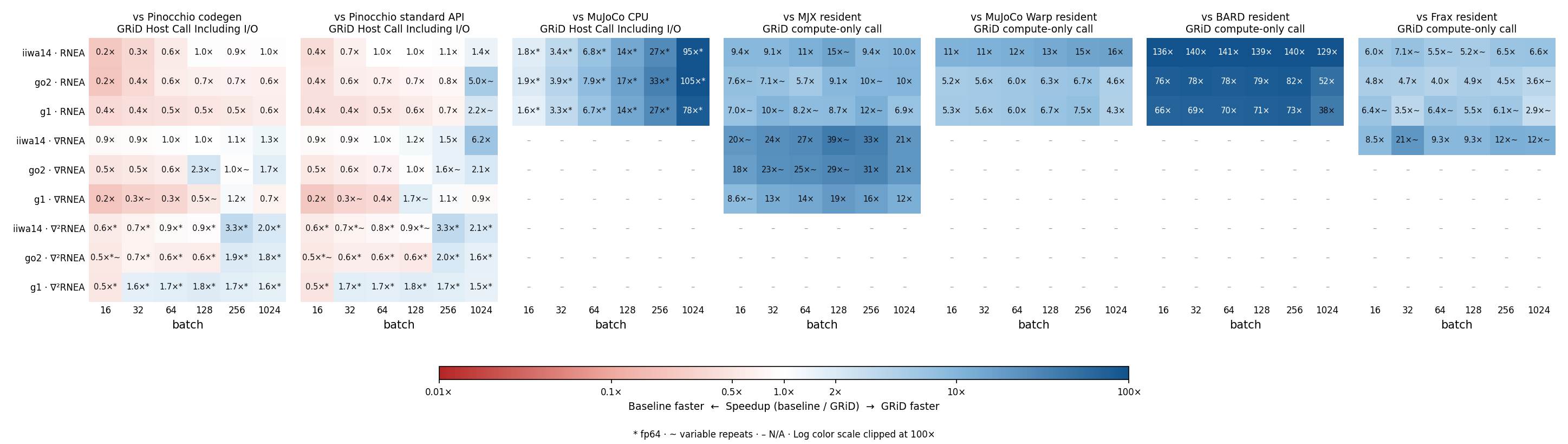
Ratios are baseline time divided by GRiD time; above 1× favors GRiD. Each column names its timing boundary: GRiD host
calls including copies against the CPU libraries, and GRiD compute-only calls against the GPU libraries' resident
calls. * marks cells where the evaluated baseline path required fp64 and ~ a side whose run means span more than
1.5×. Colors are clipped at 100×.
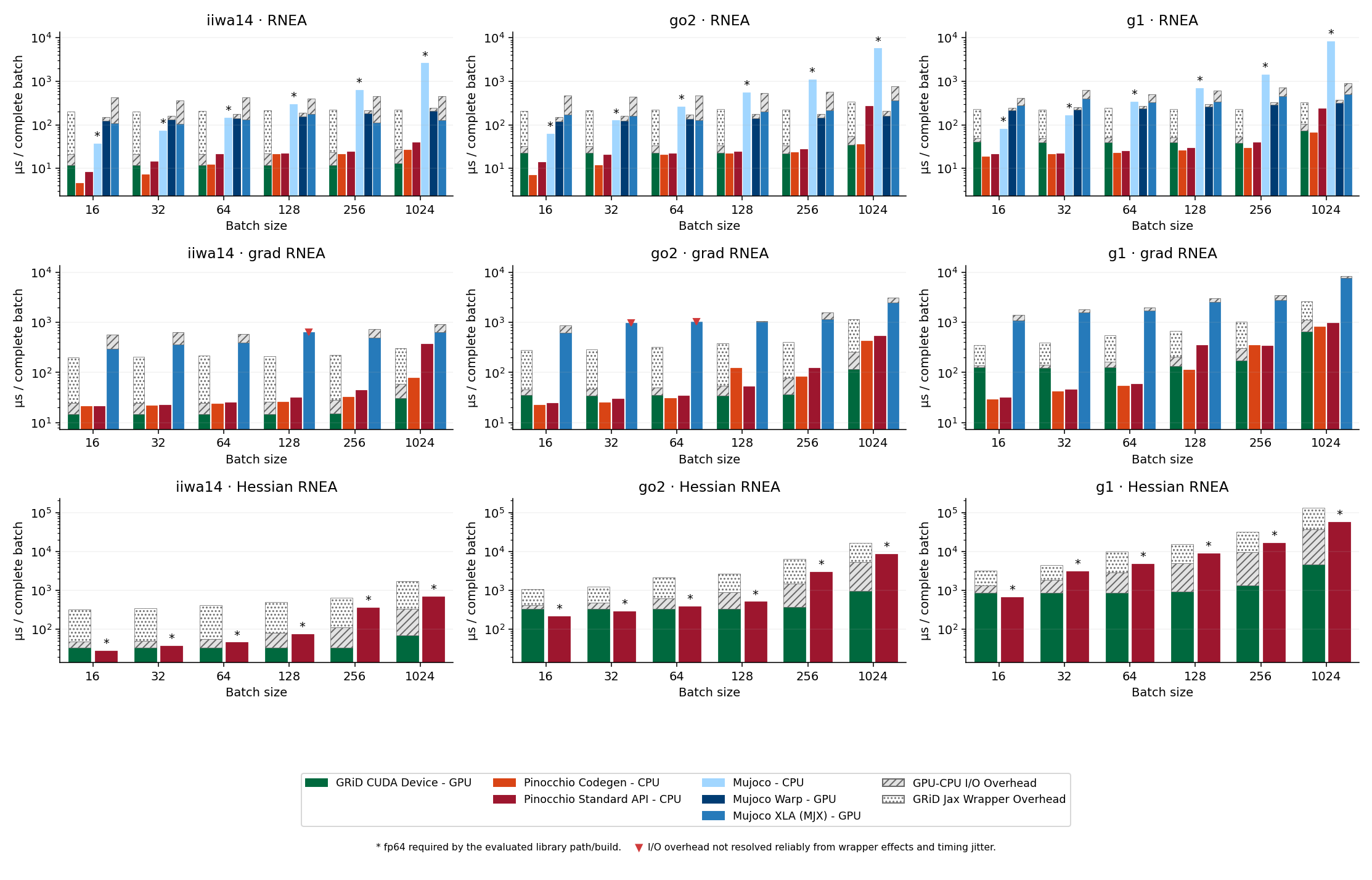
Microseconds per complete batch on a log axis. GRiD's bar splits into its CUDA compute-only call, the GPU–CPU I/O increment, and the JAX wrapper increment. These are differences of measured call times, not isolated measurements of each component.
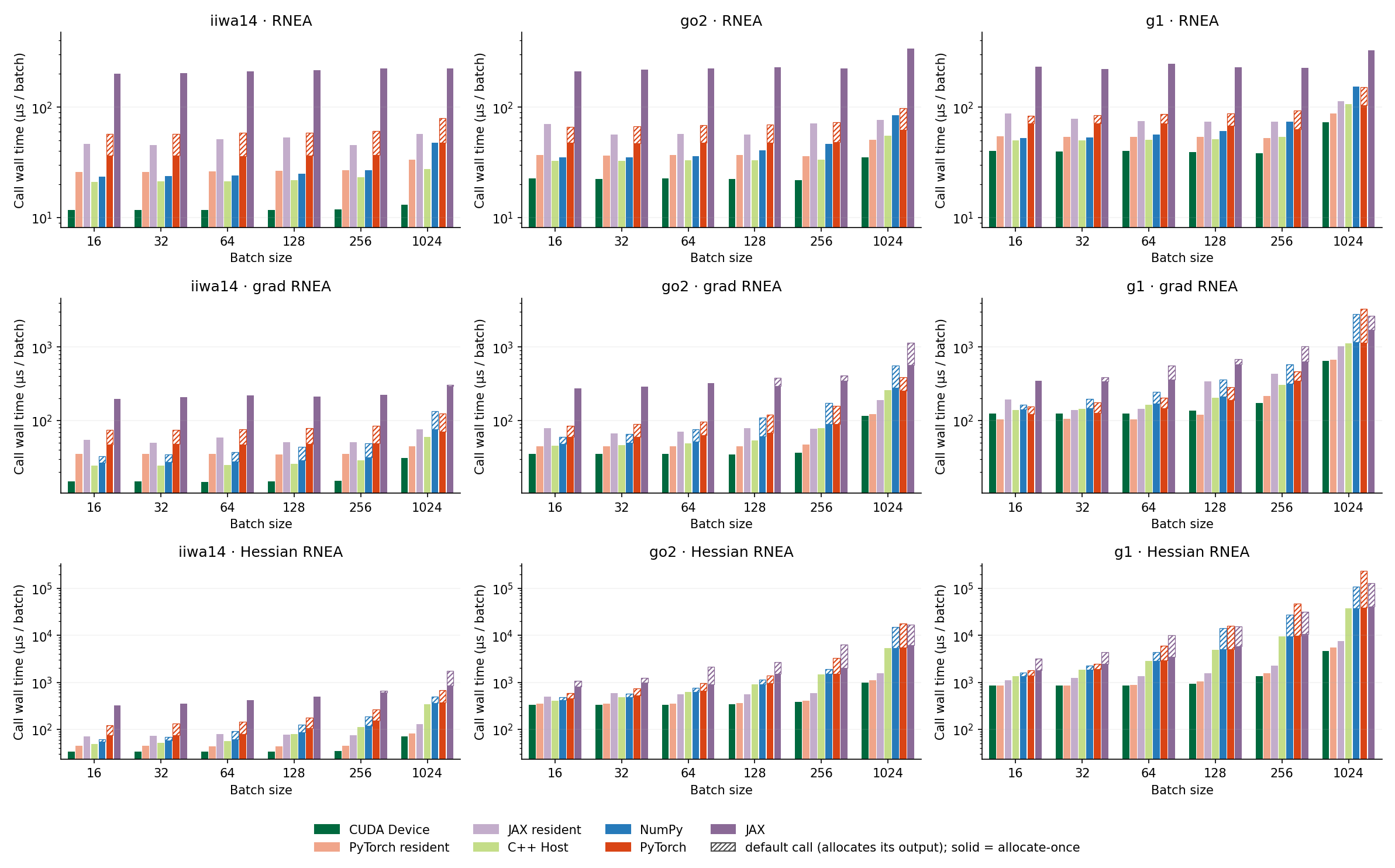
Call wall times through each API boundary: native CUDA, the C++ host call, NumPy, PyTorch, and JAX. Pick the boundary your application uses. For the Python surfaces the solid bar is the call with its buffers allocated once and reused (measured 2 October 2026), and the hatched cap reaches the default call, which allocates its output every time. With reused buffers, NumPy and PyTorch land within a few percent of the C++ host call on large outputs.
Installation
The Quick Start above covers the common-case install. For CUDA Toolkit setup, developer dependencies (Pinocchio, robot_descriptions, benchmarks), and Docker, see the full installation guide.
Troubleshooting
Bench harness nvcc hangs on floating-base kernels (sm_8x)
On Ampere (sm_86 / CUDA 12.6) the bench harness can wedge nvcc /
ptxas at 100 % CPU when compiling heavy floating-base GRiD harnesses.
Pass --ptxas-opt-level 2 to test/benchmarks/run_multi_version.py — it
forwards -Xptxas -O2 to floating-base compiles only. Blackwell (sm_120) does
not hit this. Typical user code that includes grid.cuh and calls the
batch host wrappers (e.g. grid::forward_dynamics<T>(...)) does not
trigger the hang — it's specific to the timing-bench template surface.
Contributing
Contributions welcome — see CONTRIBUTING.md for the workflow (and CLAUDE.md for the repo conventions AI agents and humans both follow).
Contributors
 Brian Plancher |
 Zachary Pestrikov |
 Kwamena A |
 Danelle Tuchman |
 Ann Li |
 = |
 EmreAdabag |
 Cael Yasutake |
 Naren Loganathan |
 emilyburnett2003 |
 pruyontrarakk |
 Kimiya Shahamat |
1 maintainer

Metadata
1 maintainer
Release files for grid-rbd 0.5.1
For a detailed explanation of source distributions (sdists) and built distributions (wheels), please see the package formats documentation.
Source distribution (sdist)
| File | Size | Uploaded | |
|---|---|---|---|
| grid_rbd-0.5.1.tar.gz | 1.4 MB | Details |
Built distributions (wheels)
| File | Interpreter | ABI | Platform | Reset |
|---|---|---|---|---|
| grid_rbd-0.5.1-cp312-cp312-manylinux_2_34_x86_64.whl | CPython 3.12 | CPython 3.12 | Linux glibc 2.34+ x86-64 | Details |
| grid_rbd-0.5.1-cp311-cp311-manylinux_2_34_x86_64.whl | CPython 3.11 | CPython 3.11 | Linux glibc 2.34+ x86-64 | Details |
| grid_rbd-0.5.1-cp310-cp310-manylinux_2_34_x86_64.whl | CPython 3.10 | CPython 3.10 | Linux glibc 2.34+ x86-64 | Details |
Total release size: 6.7 MB
Release files / grid_rbd-0.5.1.tar.gz
| Download URL | grid_rbd-0.5.1.tar.gz |
|---|---|
| Size | 1.4 MB |
| Tags | Source |
|
SHA-256 checksum How to use checksums |
1819b8cf17130cfd8b15980bcf5d8cb13e33a74b71d94f66d8f1fc6b411ea84e
|
|
BLAKE2b-256 checksum How to use checksums |
b9530c148f477069fb6aa28dea6c8496db900ecc8f02f34f85866caeff8f0272
|
| Upload date | |
|
Uploaded using Trusted Publishing? What is trusted publishing? |
Yes |
| Uploaded via |
twine/7.0.0 CPython/3.13.14
|
Provenance
Provenance describes where a file came from. On PyPI, provenance is shared via attestations, which provide a verifiable record of the build or publishing details. View details, limitations and caveats.


PyPI Publish Attestation
PyPI verified that this artifact, at this checksum, originated from the publisher listed below.
Signed by GitHub Actions, verified by PyPI on Oct 11, 2026.
Transparency logRelease files / grid_rbd-0.5.1-cp312-cp312-manylinux_2_34_x86_64.whl
| Download URL | grid_rbd-0.5.1-cp312-cp312-manylinux_2_34_x86_64.whl |
|---|---|
| Size | 1.8 MB |
| Tags | CPython 3.12 Linux glibc 2.34+ x86-64 |
|
SHA-256 checksum How to use checksums |
456ba992ca17f935e42b8cd08119a77e8ea871f6f83c74dc7275e73ce3a02821
|
|
BLAKE2b-256 checksum How to use checksums |
2a2991d53de9a823695878dd0e4d9bd286c2c8eb1fae4382956aa6f3001be942
|
| Upload date | |
|
Uploaded using Trusted Publishing? What is trusted publishing? |
Yes |
| Uploaded via |
twine/7.0.0 CPython/3.13.14
|
Provenance
Provenance describes where a file came from. On PyPI, provenance is shared via attestations, which provide a verifiable record of the build or publishing details. View details, limitations and caveats.
PyPI Publish Attestation
PyPI verified that this artifact, at this checksum, originated from the publisher listed below.
Signed by GitHub Actions, verified by PyPI on Oct 11, 2026.
Transparency logRelease files / grid_rbd-0.5.1-cp311-cp311-manylinux_2_34_x86_64.whl
| Download URL | grid_rbd-0.5.1-cp311-cp311-manylinux_2_34_x86_64.whl |
|---|---|
| Size | 1.8 MB |
| Tags | CPython 3.11 Linux glibc 2.34+ x86-64 |
|
SHA-256 checksum How to use checksums |
3f31796083cb115bf1de451a42edfbb0c6f3ac26e3d47fce1e7079e8b53fc775
|
|
BLAKE2b-256 checksum How to use checksums |
f21f4ba1f19c079fba70b36d148210532a636c3472d75cc3dc03f916ed4fb44b
|
| Upload date | |
|
Uploaded using Trusted Publishing? What is trusted publishing? |
Yes |
| Uploaded via |
twine/7.0.0 CPython/3.13.14
|
Provenance
Provenance describes where a file came from. On PyPI, provenance is shared via attestations, which provide a verifiable record of the build or publishing details. View details, limitations and caveats.
PyPI Publish Attestation
PyPI verified that this artifact, at this checksum, originated from the publisher listed below.
Signed by GitHub Actions, verified by PyPI on Oct 11, 2026.
Transparency logRelease files / grid_rbd-0.5.1-cp310-cp310-manylinux_2_34_x86_64.whl
| Download URL | grid_rbd-0.5.1-cp310-cp310-manylinux_2_34_x86_64.whl |
|---|---|
| Size | 1.8 MB |
| Tags | CPython 3.10 Linux glibc 2.34+ x86-64 |
|
SHA-256 checksum How to use checksums |
9c308cd3545fc9e3dcc8669fa33300ed0860d6a8213d13e6f19ba3b781700bb1
|
|
BLAKE2b-256 checksum How to use checksums |
2b97230f4fdef2edbbd40a790018fd9f05b040403fc5cb3add95564b8169e91e
|
| Upload date | |
|
Uploaded using Trusted Publishing? What is trusted publishing? |
Yes |
| Uploaded via |
twine/7.0.0 CPython/3.13.14
|
Provenance
Provenance describes where a file came from. On PyPI, provenance is shared via attestations, which provide a verifiable record of the build or publishing details. View details, limitations and caveats.
PyPI Publish Attestation
PyPI verified that this artifact, at this checksum, originated from the publisher listed below.
Signed by GitHub Actions, verified by PyPI on Oct 11, 2026.
Transparency log













