
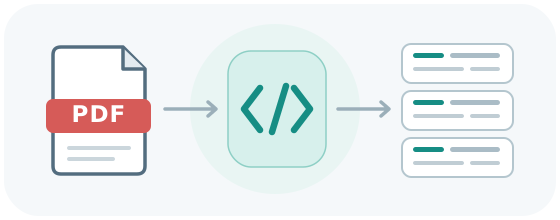




grobid-tei is a reusable Python client for an independently managed GROBID
service and a parser for its TEI XML output. It supports Python 3.10 and newer.
It does not start Docker or manage the GROBID service lifecycle.
Installation
pip install grobid-tei
For a local checkout, install the package and its test tools with uv:
uv pip install .
uv sync --extra test
Pre-commit checks
Install pre-commit and enable the repository hooks:
uv tool install pre-commit
pre-commit install
pre-commit run --all-files
The hooks check common file issues, format with Black, lint with Ruff, ensure Python 3.10-compatible syntax, and run the test suite. The copied TEI XML fixture is excluded from whitespace-fixing hooks so its source representation is preserved.
Start GROBID
grobid-tei requires a reachable GROBID service. You can use a local GROBID
installation or connect to a service hosted elsewhere; this package does not
start or manage the service.
Convenient local option: Docker
If Docker is installed, start the GROBID 0.9.1 service and publish its API port:
docker run -d --name grobid -p 8070:8070 grobid/grobid:0.9.1-full
GROBID may take a little while to initialize. Check that it is ready; repeat the
check after a short wait if it does not return true yet:
curl http://localhost:8070/api/isalive
When running Python on the same host, use http://localhost:8070 as the
GrobidClient service URL. The service must be reachable when constructing a
client because it discovers and caches the GROBID version by default. Pass
skip_version=True to defer that lookup. Stop the container when finished with
docker stop grobid.
Convert a PDF to TEI
Once a GROBID service is available, configure its base URL explicitly:
from pathlib import Path

from grobid_tei import GrobidClient, TEIDocument

client = GrobidClient(service_url="http://localhost:8070", timeout=180)
if not client.is_available():
    raise RuntimeError("GROBID is not available")

tei_xml = client.process_fulltext(Path("paper.pdf"))
Path("paper.tei.xml").write_bytes(tei_xml)

document = TEIDocument.from_bytes(tei_xml)
print(document.metadata())
print(document.metadata(abstract=True))
print(document.abstract())
print(document.references(include_citation_counts=True))
process_fulltext returns XML bytes. To enable GROBID consolidation explicitly,
pass consolidate_header=True and/or consolidate_citations=True.
Parse a raw citation
process_citation parses one bibliographical reference and returns TEI XML
bytes, which can be read with TEIDocument:
from grobid_tei import GrobidClient, TEIDocument

client = GrobidClient(service_url="http://localhost:8070")
citation_xml = client.process_citation(
    "Venkatesh, V., Morris, M. G., Davis, G. B., & Davis, F. D. (2003). "
    "User acceptance of information technology: Toward a unified view. "
    "MIS Quarterly, 27(3), 425–478. https://doi.org/10.2307/30036540",
    consolidate_citations=True,
)
citation_document = TEIDocument.from_bytes(citation_xml)
reference = citation_document.references()[0]
print(reference.fields)
# Example result (GROBID's extracted fields may vary):
# {
#     "author": "Venkatesh, V. and Morris, M. G. and Davis, G. B. and Davis, F. D.",
#     "title": "User acceptance of information technology: Toward a unified view",
#     "year": "2003",
#     "entrytype": "article",
#     "journal": "MIS Quarterly",
#     "volume": "27",
#     "number": "3",
#     "pages": "425--478",
#     "doi": "10.2307/30036540",
# }
Parse multiple raw citations
Pass each reference separately to process_citation_list. It returns TEI XML
bytes containing the parsed references, which can be extracted with
TEIDocument.references():
from grobid_tei import GrobidClient, TEIDocument

client = GrobidClient(service_url="http://localhost:8070")
citations = [
    "Venkatesh, V., Morris, M. G., Davis, G. B., & Davis, F. D. (2003). "
    "User acceptance of information technology: Toward a unified view. "
    "MIS Quarterly, 27(3), 425–478. https://doi.org/10.2307/30036540",
    "Davis, F. D. (1989). Perceived usefulness, perceived ease of use, and "
    "user acceptance of information technology. MIS Quarterly, 13(3), "
    "319–340. https://doi.org/10.2307/249008",
]
citation_list_xml = client.process_citation_list(citations)
citation_list_document = TEIDocument.from_bytes(citation_list_xml)
for reference in citation_list_document.references():
    print(reference.fields)
Citation consolidation is disabled by default; pass
consolidate_citations=True to enable it for the list.
Parse an existing TEI file
No running GROBID service is needed to parse an existing file:
from pathlib import Path

from grobid_tei import TEIDocument

document = TEIDocument.from_file(Path("paper.tei.xml"))
print(document.grobid_version())
print(document.keywords())
print(document.author_details())

for paragraph in document.iter_paragraphs():
    print(paragraph)
Public API
GrobidClient(service_url=..., timeout=180.0, skip_version=False)discovers and caches the server version at initialization by default. Setskip_version=Trueto defer discovery untilversion()orcheck_compatibility()is called. The cache belongs to that client instance; create a new client to discover the version again. The client also providesis_available(),version(), optionalcheck_compatibility(),process_fulltext(...),process_citation(...), andprocess_citation_list(...).check_compatibility()rejects known-incompatible versions and warns, but proceeds, for versions not yet tested with this package. Compatibility checking is not run automatically during processing.IncompatibleGrobidVersionErroridentifies a known-incompatible server version.TEIDocument.from_bytes(...)andTEIDocument.from_file(...)create a parsed document. It providesto_bytes(),grobid_version(),metadata(),abstract(),keywords(),author_details(),references(),citations_by_section(),iter_paragraphs(), andannotate_reference_ids(...).TEIReferenceis a mapping of generic lowercase bibliographic fields (title,author,year,doi,journal, and similar), with the GROBID identifier in.tei_idand an optional citation count in.in_text_citation_count. The identifiers and count are not included in its bibliographic field mapping.GrobidServiceErrordescribes service request failures;TEIParsingErrordescribes unsafe or invalid TEI XML. Both inherit fromGrobidTEIError.
The parser uses defusedxml for safe XML parsing. annotate_reference_ids()
applies only a caller-supplied mapping from TEI IDs to caller IDs; it performs no
reference matching or workflow decisions.
License
This project is licensed under the MIT License.
1 maintainer

Metadata
1 maintainer
Release files for grobid-tei 0.3.0
For a detailed explanation of source distributions (sdists) and built distributions (wheels), please see the package formats documentation.
Source distribution (sdist)
| File | Size | Uploaded | Provenance | Actions |
|---|---|---|---|---|
| grobid_tei-0.3.0.tar.gz | 751.4 kB | With provenance | Details for grobid_tei-0.3.0.tar.gz |
Built distribution (wheel)
| File | Interpreter | ABI | Platform | Actions Reset |
|---|---|---|---|---|
| grobid_tei-0.3.0-py3-none-any.whl | Python 3 | none | any | Details for grobid_tei-0.3.0-py3-none-any.whl |
Total release size: 764.1 kB
Release files / grobid_tei-0.3.0.tar.gz
| Download URL | grobid_tei-0.3.0.tar.gz |
|---|---|
| Size | 751.4 kB |
| Tags | Source |
|
SHA-256 checksum How to use checksums |
5b159c83d1c3505d3571e4802ccc1d0966380e9942413dd36c73bcd8881935cb
|
|
BLAKE2b-256 checksum How to use checksums |
5280f67c2a1a4acd567b14fa2d09f4c0264edc0c5a4e713a99dc97f641c884d2
|
| Upload date | |
|
Uploaded using Trusted Publishing? What is trusted publishing? |
Yes |
| Uploaded via |
twine/7.0.0 CPython/3.13.16
|
Provenance
Provenance describes where a file came from. On PyPI, provenance is shared via attestations, which provide a verifiable record of the build or publishing details. View details, limitations and caveats.


PyPI Publish Attestation
PyPI verified that this artifact, at this checksum, originated from the publisher listed below.
Signed by GitHub Actions, verified by PyPI on Nov 6, 2026.
Transparency logRelease files / grobid_tei-0.3.0-py3-none-any.whl
| Download URL | grobid_tei-0.3.0-py3-none-any.whl |
|---|---|
| Size | 12.7 kB |
| Tags | Python 3 |
|
SHA-256 checksum How to use checksums |
60ef756b5d6ccc5c951f1c875ccba478f918642e85bbdd9e8e94fde890f4378e
|
|
BLAKE2b-256 checksum How to use checksums |
4ea7c15075b81aea520fdd4502984e9c3125ccf46a638af49a40a92973182710
|
| Upload date | |
|
Uploaded using Trusted Publishing? What is trusted publishing? |
Yes |
| Uploaded via |
twine/7.0.0 CPython/3.13.16
|
Provenance
Provenance describes where a file came from. On PyPI, provenance is shared via attestations, which provide a verifiable record of the build or publishing details. View details, limitations and caveats.
PyPI Publish Attestation
PyPI verified that this artifact, at this checksum, originated from the publisher listed below.
Signed by GitHub Actions, verified by PyPI on Nov 6, 2026.
Transparency logSecurity for grobid-tei 0.3.0
Provenance
Provenance describes where a file came from. On PyPI, provenance is shared via attestations, which provide a verifiable record of the build or publishing details. View details, limitations and caveats.
Full provenance
All 2 files in this release have been uploaded with provenance metadata.
Attestation for grobid_tei-0.3.0.tar.gz
PyPI Publish Attestation
PyPI verified that this artifact, at this checksum, originated from the publisher listed below.
Signed by GitHub Actions, verified by PyPI on Nov 6, 2026.
Transparency logA note on package security
PyPI is a repository for distributing packages, not a service for auditing them. While third-party security researchers and our staff do their best to detect and remove malicious packages, PyPI cannot guarantee the quality, security or suitability of any given package.
To learn more about protecting yourself from malicious actors, visit our package security documentation.














