

Shrink anything you feed an LLM. Keep the words that change the answer.


Most of the text that ends up in a context window is padding. Documents you stuff into RAG, tool results an agent loops back to itself, transcripts, tickets, logs: models answer just as well without the articles, the copulas, and the "it is important to note that". grug deletes the padding and refuses to touch what actually carries meaning: negations, numbers, names, code, URLs, markdown structure. Then it checks its own output and warns you if anything load-bearing went missing anyway.
Before (94 tokens)                          After `grug compress --rate 0.5` (65 tokens)

It is important to note that the billing    billing pipeline rewritten run streaming
pipeline has been rewritten to run on the   ingest service. migration not automatic:
streaming ingest service. The migration     accounts legacy monthly plan must moved
is not automatic: accounts on the legacy    hand before cutover date. practice
monthly plan must be moved by hand before   measured median lag 1.2 seconds across
the cutover date. In practice we measured   4,800 accounts, and p99 lag of 9.6
a median lag of 1.2 seconds across 4,800    seconds. key economic point easy wrong:
accounts, and a p99 lag of 9.6 seconds.     bills scale volume, not price.
The key economic point is easy to get
wrong: bills scale with volume, not price.
Every number made it through, and so did both negations. The second one
(not price) is the whole point of the paragraph. Zero warnings from the verifier.
Why this exists
Compressing LLM input is not new. The problem with existing compressors is that they score words by how much information they seem to carry, and a word like "not" is three characters of function word that looks eminently droppable. Drop it and the compressed text asserts the opposite of the source, in fluent prose that nothing downstream will question.
That risk is the same whether the text is a prompt, a retrieved document, or the output of a tool call an agent is about to reason over. grug is built around not taking it:
- Negations, digits, code, URLs, and the words relating two numbers can never be
dropped.
3 of 12never comes back as3 12. This lives in the engine, not in a setting you could forget to turn on. - Every result gets checked afterwards for lost negations, numbers, and names,
and the warnings land in
result.warnings. The CLI exit codes are made for CI. - The default backend is pure Python. No torch, no downloads, milliseconds per
document.
import grugnever imports torch even when the extras are installed. - Word lists, regex rules, phrase rewrites, and whole languages are data you can add and remove, not code you have to fork.
The numbers
600 questions over 694k tokens of MeetingBank transcripts, compressed at rate 0.33, answered by Claude Sonnet 4.6, scored against reference answers:
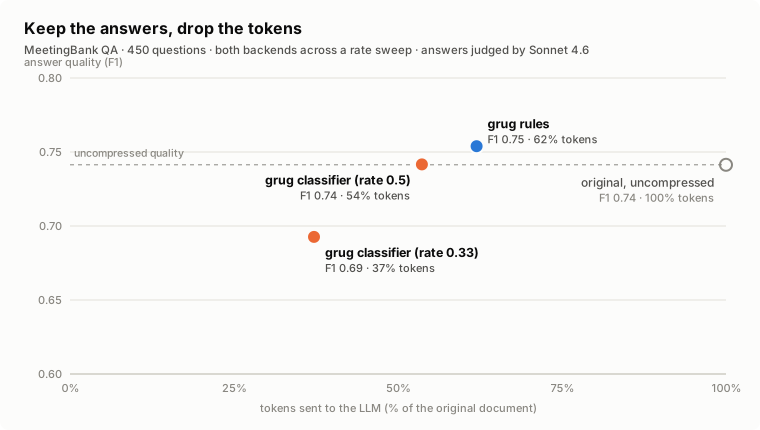
Compression only helps if the meaning survives it. Scored for dropped negations on the same run, neither grug backend lost a single one:
| Backend | Tokens kept | Exact match | F1 | Negations lost |
|---|---|---|---|---|
| original (no compression) | 100% | 0.62 | 0.75 | n/a |
| grug rules | 62% | 0.61 | 0.76 | 0% |
| grug classifier (mbert-control) | 37% | 0.58 | 0.70 | 0% |
| LLMLingua-2 | 30% | 0.56 | 0.69 | 43% |
Two things stand out. Compressing with grug rules scored higher F1 than
sending the full document, on 62% of the tokens -- which sounds wrong until you
remember that what it deletes is noise. Exact match is a hair lower, 0.61
against 0.62, so it is a wash there rather than a win. And the classifier
reaches a third of the tokens at slightly better answer quality than
LLMLingua-2, losing no negations where LLMLingua-2 loses 43%.
Reproduce it with grug benchmark qa. Raw results are in
benchmarks/.
Quick start
pip install grugify
import grug

result = grug.compress(document, rate=0.5)
result.text  # the compressed document
result.ratio  # what was achieved, not what was asked for
result.warnings  # faithfulness report; [] means nothing suspicious
Or from the shell:
grug compress notes.md                  # writes notes.grug.md, stats to stderr
grug compress - < in.txt > out.txt      # stdin to stdout
grug verify original.txt compressed.txt # faithfulness checks on their own
If you want deeper compression than the rule lists can reach, install the trained
classifier with pip install 'grugify[classifier]':
result = grug.compress(
    document,
    rate=0.33,
    backend="classifier",
    backend_kwargs={"model_name": "akshayballal/grug-mbert-control-meetingbank"},
)
Two backends
| Backend | Install | Method | Rates it reaches | Speed |
|---|---|---|---|---|
rules |
included | Deletes words its rule set nominates; the engine vetoes everything load-bearing | floors out around 0.6, when it runs out of safe words to drop | milliseconds |
classifier |
grugify[classifier] |
A fine-tuned encoder scores every word and the top-rate fraction survives, in order |
0.2 to 0.5 | about 0.2s per 400-token chunk on CPU, after a one-off model load |
Both are extractive: the output is a subsequence of the input, so neither can
invent a fact. rate means the same thing everywhere, the fraction of tokens to
keep. A backend that cannot hit it exactly reports what it actually achieved in
result.ratio.
The classifier takes any Hugging Face token-classification checkpoint with a trained preserve/discard head and a fast tokenizer (ModernBERT, mmBERT, EuroBERT all work). Training your own is three commands; see TRAINING.md.
The rules engine
The default backend splits responsibility in two. Rules nominate words to drop.
The engine decides, and its vetoes always win. A token budget derived from rate
controls how deep the cutting goes. Everything on the rules side is composable:
from grug.backends.rules import ENGLISH, PatternRule, RulesBackend, WordClassRule

rules = (
    ENGLISH.rules.remove("pronouns")  # subtract a word class
    .add(WordClassRule("corp-speak", {"synergy", "leverage"}, priority=5))
    .add(PatternRule("hedges", r"(arguabl|probabl|possibl)\w*", priority=15))
)

backend = RulesBackend(
    rules=rules,
    keep_words={"pipeline"},  # exact vetoes
    keep_patterns=(r"[A-Z]{2,}",),  # regex vetoes, e.g. keep acronyms like "IT"
)
A new language is a data pack, not a fork:
from grug.backends.rules import Language, RuleSet, WordClassRule, register_language

register_language(
    Language(
        code="de",
        rules=RuleSet(WordClassRule("artikel", {"der", "die", "das"}, priority=10)),
        negations=frozenset({"nicht", "kein", "keine", "ohne"}),
    )
)
backend = RulesBackend(language="de")
Because the vetoes belong to the engine, a badly written custom rule cannot break
the guarantees. There is a test where a hostile rule nominates every single word
in the document, and the negations, numbers, and code spans still come through.
examples/rules_backend.py walks through all of it.
Faithfulness
>>> grug.verify("bills scale with volume, not price", "bills scale volume price")
["negation lost: 'not' (1× → 0×) — meaning may be inverted"]
Prevention first: the rules engine will not drop negations, digits, or the connectives between numbers at any rate, and the classifier pins negations, digits, detected entities, and markdown structure before it ranks anything.
Verification second: every compression is checked for negation loss, negation
scope loss, number loss, lost relations between numbers (3 of 12 collapsing
to 3 12), and entity loss. The verifier speaks the backend's language: give
the rules backend a German pack and its negations are what get checked, while
the capitalisation-based entity heuristics stand down for languages that
capitalise every noun. There is no NER model and no ML in the
verifier, just regex and exact matching. That costs some precision on entities
and buys a checker that works on exactly the kind of terse, ungrammatical text a
model-based checker would choke on, in microseconds.
A clean run means nothing suspicious was found, not that the compression is provably faithful. Treat it like a smoke alarm.
CI gating
| Code | Meaning |
|---|---|
0 |
Compressed, no faithfulness warnings |
1 |
Error: bad file, unknown backend, missing dependency |
2 |
Compressed, but the verifier flagged something |
Exit code 2 means "a human should read this diff", not "this failed".
Markdown awareness
Documents are parsed with a real CommonMark parser (markdown-it-py) rather than pattern-matched, so structure survives:
| Element | Treatment |
|---|---|
| Fenced / indented code, tables | Bypass the compressor, re-emitted byte for byte |
| Whole source files | Passed through unchanged (--compress-code overrides) |
| Headings, bullets, blockquote markers | Marker preserved, the text after it compresses |
| Inline code spans and URLs | Swapped for opaque placeholders, restored verbatim |
Numbers and identifiers with separators (1,250, us-east-1, v2.1.0-rc3) |
Protected as spans |
| Blank lines | Hard chunk boundaries, so no backend can collapse a paragraph break |
Long documents are chunked to roughly 450 tokens on sentence boundaries and rejoined with the original layout.
CLI reference
grug compress docs/*.md --rate 0.4        # many files, each to <name>.grug.md
grug compress notes.md --json -q          # full CompressionResult as JSON
grug backends                             # what is registered and installed
grug train --help                         # reproduce the classifier (TRAINING.md)
grug benchmark qa --help                  # reproduce the numbers above
| Flag | Effect |
|---|---|
--rate, -r |
Fraction of tokens to keep. Default 0.5. |
--backend, -b |
Backend name. Default rules. |
--model |
Checkpoint for --backend classifier. |
--device |
cpu, cuda, mps, or auto. |
--no-verify |
Skip the faithfulness checks. |
--json |
Emit the full result as JSON on stdout. |
--quiet, -q |
Suppress the stats line. |
Write your own backend
Subclass one ABC and register it. It then shows up in grug.compress(),
grug.Compressor, and the CLI without any changes to grug:
from grug.base import CompressionResult, CompressorBackend


class ShoutyBackend(CompressorBackend):
    name = "shouty"
    description = "Keeps only the long words."

    def compress(self, text: str, rate: float = 0.5, **kwargs) -> CompressionResult:
        self._validate_rate(rate)
        cutoff = 3 + int((1 - rate) * 5)
        kept = " ".join(w for w in text.split() if len(w) > cutoff)
        return CompressionResult.build(text, kept, self.name)
To ship it as a package, advertise it through an entry point and pip install
is all a user needs:
[project.entry-points."grug.backends"]
shouty = "my_package.backend:ShoutyBackend"
Contributing
git clone https://github.com/akshayballal95/grug && cd grug
uv sync --all-extras          # or: pip install -e '.[dev,tokens]'
uv run pytest -m "not slow"   # fast suite, no model downloads
uv run ruff check src tests examples scripts
The codebase is small on purpose: two backends, one verifier, one chunker. If you are looking for somewhere to start, a language pack for the rules engine, a benchmark on your own data, or a trained checkpoint for a new encoder would all be welcome PRs.
License
MIT. The bundled benchmark uses the MeetingBank-LLMCompressed dataset; check its license before shipping a checkpoint trained on it.
grug not need many words. grug need right words.
This README, compressed by grug itself.
1 maintainer

Metadata
1 maintainer
Release files for grugify 0.1.0
For a detailed explanation of source distributions (sdists) and built distributions (wheels), please see the package formats documentation.
Source distribution (sdist)
| File | Size | Uploaded | |
|---|---|---|---|
| grugify-0.1.0.tar.gz | 121.0 kB | Details |
Built distribution (wheel)
| File | Interpreter | ABI | Platform | Reset |
|---|---|---|---|---|
| grugify-0.1.0-py3-none-any.whl | Python 3 | none | any | Details |
Total release size: 214.8 kB
Release files / grugify-0.1.0.tar.gz
| Download URL | grugify-0.1.0.tar.gz |
|---|---|
| Size | 121.0 kB |
| Tags | Source |
|
SHA-256 checksum How to use checksums |
60f4691391247d43bd8dabcd17cc778ddde1c0df1c72cd723690416784ad69ba
|
|
BLAKE2b-256 checksum How to use checksums |
47e393d0ae8bf2e93afaaab90a329f89cb7754e73948ab62502747a63cd36b74
|
| Upload date | |
|
Uploaded using Trusted Publishing? What is trusted publishing? |
No |
| Uploaded via |
uv/0.9.5
|
Release files / grugify-0.1.0-py3-none-any.whl
| Download URL | grugify-0.1.0-py3-none-any.whl |
|---|---|
| Size | 93.8 kB |
| Tags | Python 3 |
|
SHA-256 checksum How to use checksums |
4354b2837225d7422ec67984d1ecd47a8e08c54a5a330339dfc022eff4c2680a
|
|
BLAKE2b-256 checksum How to use checksums |
23aea61799d3eddd28f4ce2815a975a69063fd4fcebd056430f17940bdd96ec2
|
| Upload date | |
|
Uploaded using Trusted Publishing? What is trusted publishing? |
No |
| Uploaded via |
uv/0.9.5
|













