
trialdesign


Design a two-arm clinical trial before the data exist. trialdesign is a Python command-line
package for:
- fixed-design sample size (continuous, binary and time-to-event endpoints), for superiority or non-inferiority,
- group-sequential boundaries with O'Brien-Fleming-type, Pocock-type, Hwang-Shih-DeCani, Kim-DeMets or user-specified spending, and non-binding (default) or binding futility,
- promising-zone sample size re-estimation at an interim, with the Cui-Hung-Wang test,
- survival accrual, follow-up and dropout: patients, study duration and the calendar time of each look,
- a Bayesian beta-binomial go/no-go interim with predictive probability of success and assurance,
- exact and Monte Carlo operating characteristics, and a Markdown design report.
Every number is checked against R (rpact, gsDesign, stats). See Validated against.
Install
pip install gsdtrial
The package is published on PyPI as gsdtrial, because the name trialdesign there belongs to
an unrelated project. You still import trialdesign and run trialdesign. That other project
also installs a trialdesign import, so don't install both in the same environment.
Python 3.11 or later; depends on numpy, scipy, typer and matplotlib. For the latest
development version: pip install git+https://github.com/rushadnihal/trialdesign.
30-second quickstart
A phase 3 survival trial with hazard ratio 0.70, 80% power, one-sided alpha 0.025, two interim
looks, O'Brien-Fleming-type efficacy and Pocock-type non-binding futility
(examples/phase3_survival.toml):
trialdesign design --endpoint survival --hr 0.7 --prob-event 0.75 \
    --looks 0.33,0.67,1 --spending obf --futility pocock
trialdesign 0.2.0 | group-sequential design (output abridged) | alpha is one-sided
  fixed events (alpha_two_sided 0.05)  246.7871
  inflation_factor                     1.2437
  max_events                           307
  max_n_total                          410

Boundaries
Look  Info fraction  Cumulative events  Efficacy z  Nominal p (1-sided)  Cumulative alpha  Futility z
1            0.3300                102      3.7307             9.55e-05          9.55e-05      0.4530
2            0.6700                206      2.5039               0.0061            0.0062      1.3293
3            1.0000                307      1.9937               0.0231            0.0250      1.9937
Then simulate it and write a report with plots:
trialdesign simulate --config examples/phase3_survival.toml --nsim 200000 --seed 2026
trialdesign report --config examples/phase3_survival.toml --out results/
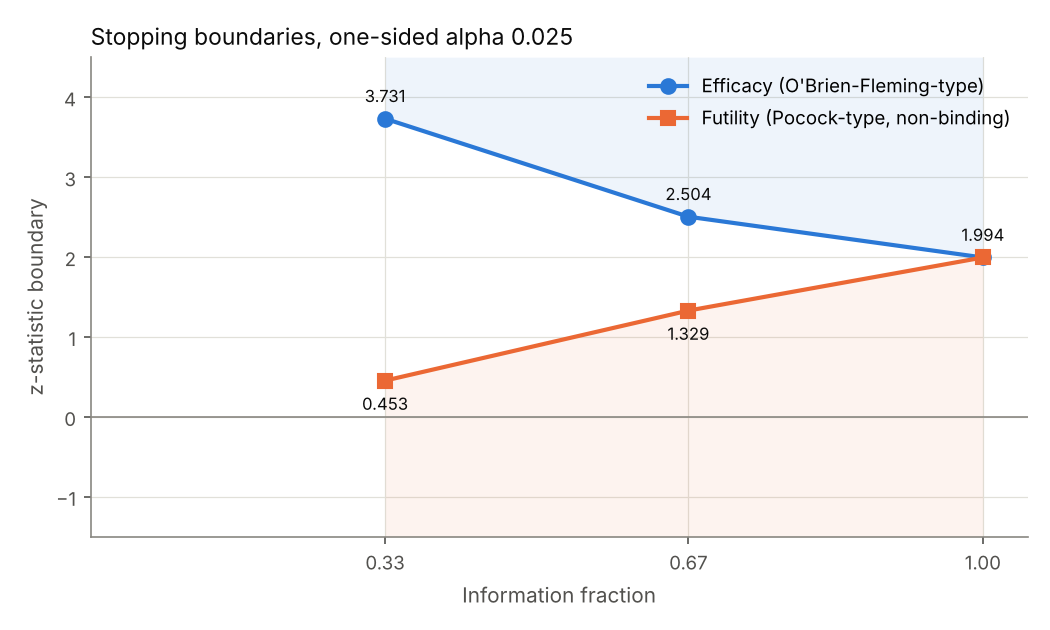
Operating characteristics of this design. Exact values come from recursive numerical integration; simulated values use 200,000 trials (seed 2026), each with its Monte Carlo SE and z = (simulated − exact) / SE:
| Quantity | Exact | Simulated | MC SE | z vs exact |
|---|---|---|---|---|
| Type I error (futility ignored) | 0.0250 | 0.0251 | 0.0003 | +0.33 |
| Power (futility followed) | 0.8000 | 0.7994 | 0.0009 | −0.63 |
| Expected events under H0 | 142.6 | 142.6 | 0.14 | +0.24 |
| Expected events under H1 | 227.0 | 226.9 | 0.15 | −0.59 |
Futility is non-binding: boundaries and type I error are computed as if futility were ignored, so alpha is controlled whether or not the data monitoring committee stops. Following futility cuts the expected number of events under H0 from 307 to 143.
A Bayesian phase 2 interim works the same way
(examples/phase2_binary_bayes.toml):
trialdesign bayes --pc 0.30 --pt 0.45 --n 60 --interim 30 --go 0.9 --nogo 0.1 --xc 6 --xt 12
docs/design_memo.md
uses it to design a fictional phase 2 trial, written the way it would be presented to a
clinical team, with an addendum that sizes the follow-on phase 3 with sample size
re-estimation.
For non-inferiority, give the effect under H0: --delta0 for a difference in means or rates
(treatment minus control), --hr0 for a hazard ratio. Here both arms respond at 85% and
treatment must not be worse by 10 points
(examples/phase3_ni_binary.toml):
trialdesign design --endpoint binary --pc 0.85 --pt 0.85 --delta0 -0.10   # 207 per arm
trialdesign design --endpoint survival --hr 1.0 --hr0 1.3 --looks 3       # 504 events
For a survival design, an accrual model turns events into patients and calendar time
(Lachin-Foulkes, exponential events and dropout, as in rpact). Give the control median and
two of accrual time, accrual rate and follow-up; the third is solved
(examples/phase3_survival_accrual.toml):
trialdesign design --endpoint survival --hr 0.7 --looks 3 --median-control 12 \
    --accrual-time 24 --followup 12 --dropout 0.05
# 250 events, 391 patients; looks expected at months 16.6, 25.1 and 36.0
Piecewise accrual takes one rate per segment, e.g. --accrual-time 6 --accrual-rate 10,25 --followup 12 for a 6-month ramp-up (the end of accrual is solved).
The non-inferiority test is one-sided in the direction of the alternative. For a binary endpoint the variance
under H0 uses the Farrington-Manning restricted maximum likelihood rates, as rpact and
gsDesign::nBinomial do.
Sample size re-estimation
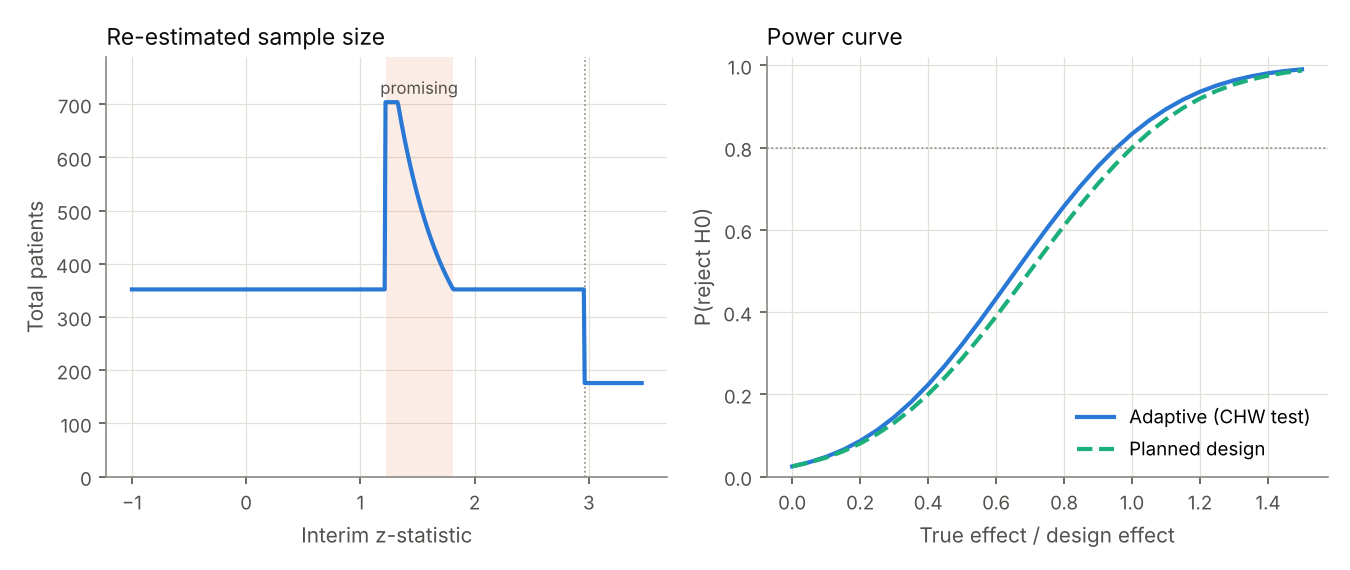
trialdesign ssr plans a two-look design and adds a promising-zone rule (Mehta and Pocock
2011): if the conditional power at the observed interim trend lies between --cp-min and
--cp-target, the second stage grows until it reaches --cp-target, up to --max-factor
times the planned maximum. The final test weights the stages by their planned information
(Cui, Hung and Wang 1999), so alpha is controlled exactly whatever the interim shows
(examples/phase3_ssr.toml):
trialdesign ssr --config examples/phase3_ssr.toml            # zones and exact OCs
trialdesign ssr --config examples/phase3_ssr.toml --z1 1.5   # apply the rule to an interim
Zone                 Interim z1  Observed / design effect  Total patients
Unfavourable            < 1.213                   < 0.611             352
Promising        1.213 to 1.813            0.611 to 0.913      352 to 704
Favourable       1.813 to 2.963                  >= 0.913             352
Efficacy (stop)        >= 2.963                                       176
Operating characteristics are exact (one-dimensional integration over the interim z), with a
simulated check. With these defaults (CP 0.36 to 0.8, cap 2x, interim at half), power at
the design effect rises from 0.800 to 0.834 for 37 more patients on average; at 70% of the
design effect, from 0.500 to 0.548. Pooling all patients in a naive final test would also hold
alpha for this promising-zone rule (0.0244), but not for a rule that adapts in every zone
(0.0303 with --cp-min 0), which is why the weighted test is always used.
Spending functions and binding futility
--efficacy and --futility take any of these, in flags and in [sequential]:
| Value | Spending | Cumulative error spent by information fraction t |
|---|---|---|
obf |
Lan-DeMets O'Brien-Fleming-type | 2 - 2 Phi(z_(1-a/2) / sqrt(t)) |
pocock |
Lan-DeMets Pocock-type | a log(1 + (e - 1) t) |
hsd:<gamma> |
Hwang-Shih-DeCani, e.g. hsd:-4 |
a (1 - exp(-gamma t)) / (1 - exp(-gamma)) |
kd:<rho> |
Kim-DeMets power, e.g. kd:3 |
a t^rho |
user:<f1>,...,1 |
User-specified, e.g. user:0.1,0.4,1 |
a times the given fraction at each look |
Futility is non-binding unless you ask otherwise. --binding-futility (or
binding_futility = true) solves the efficacy and futility boundaries together, assuming every
futility stop is made: the efficacy boundaries drop and the trial gets smaller, but alpha holds
only if the committee always stops. The output then shows how far alpha rises if futility is
ignored. For the quickstart trial with --efficacy hsd:-4 --futility hsd:-2:
| Max events | Final z | Type I error, futility followed | Type I error, futility ignored | |
|---|---|---|---|---|
| Non-binding | 264 | 1.9996 | 0.0233 | 0.0250 |
| Binding | 258 | 1.9648 | 0.0250 | 0.0268 |
Binding futility is not available with sample size re-estimation.
Command line
| Command | Does |
|---|---|
trialdesign design |
Fixed or group-sequential sample size and boundaries, with exact operating characteristics |
trialdesign simulate |
Monte Carlo operating characteristics under H0 and H1, next to the exact values |
trialdesign bayes |
Bayesian go/no-go interim: exact OCs, posterior, PPoS and decision for observed data, assurance |
trialdesign ssr |
Promising-zone sample size re-estimation: zones, exact OCs, the rule applied to an interim z |
trialdesign report |
report.md plus PNG plots of the boundaries and operating characteristics |
Each command takes flags, a TOML design file (--config), or both; flags override the file.
Output is a plain table, or JSON with --json. Only report --out writes to disk, and every
simulation prints its seed and the package version. Alpha always names its sidedness: fixed
designs report two-sided alpha (default 0.05), group-sequential designs one-sided (default
0.025). Run trialdesign COMMAND --help for every option.
Python API
from trialdesign import bayes, boundaries, fixed, simulate

d = boundaries.group_sequential_design(
    [1 / 3, 2 / 3, 1.0],
    alpha_one_sided=0.025,
    power=0.80,
    efficacy_spending="obf",
    futility_spending="obf",  # or "hsd:-2", "kd:2", "user:0.25,0.5,1"
    binding_futility=False,  # the default
)
d.efficacy, d.futility, d.inflation_factor
d.max_sample_size(fixed.events_survival(0.70).events)  # max events = fixed events x IF

sim = simulate.simulate_design(d, n_sim=200_000, seed=2026)
sim.type_i_error, sim.h0_ignore_futility.reject_prob_se  # futility ignored
sim.power, sim.h1.reject_prob_se

b = bayes.bayesian_interim_design(n_interim=30, n_final=60)  # control patients per analysis
b.ppos(6, 12), b.decide(6, 12)  # PPoS and go / no-go / continue at the interim
b.operating_characteristics(0.30, 0.30).prob_success  # exact type I error
b.assurance(0.30, (4.5, 5.5)).prob_success  # Beta(4.5, 5.5) design prior on p_T
bayes.calibrate_success_threshold(30, 60, alpha_one_sided=0.025)  # 0.9789
Methods in one paragraph. Every group-sequential design is reduced to a drift on the
canonical z-scale. Efficacy boundaries spend alpha with any of the spending functions above and
are solved by Jennison and Turnbull's recursive numerical integration, cross-checked against
scipy's multivariate normal to 1e-4. Futility spends beta under the alternative; when it is
binding, efficacy and futility boundaries are solved look by look over the same continuation
region. The simulator draws independent increments of the score process, one
(n_sim, looks) matrix per batch, so 100,000 trials take well under a second. The Bayesian
interim computes PPoS exactly by enumerating the beta-binomial posterior predictive, so
decisions carry no Monte Carlo error and operating characteristics and assurance are exact.
The default final success threshold, 0.98, is calibrated so the reference design (30 of 60
patients per arm at the interim) has a worst-case type I error of 0.0232, below one-sided
0.025, over common response rates from 0.05 to 0.95. bayes --calibrate re-calibrates it for
other designs.
Validated against
Reference values were produced once in R and saved to JSON, so CI stays Python-only.
| What | Reference | Cases | Tolerance |
|---|---|---|---|
| Fixed sample size, normal | stats::power.t.test |
3 | 1e-4 |
| Fixed sample size, binary | stats::power.prop.test, gsDesign::nBinomial |
4 | 1e-4 |
| Events, time to event | gsDesign::nEvents (Schoenfeld) |
2 | 1e-4 |
| Spending functions | gsDesign::sfLDOF, sfLDPocock |
2 | 1e-9 |
| Efficacy boundaries and inflation factor | rpact::getDesignGroupSequential |
8 | 1e-3 |
| Non-binding futility boundaries | gsDesign::gsDesign(test.type = 4) |
4 | 1e-3 |
| Maximum events | gsDesign::gsDesign(n.fix) |
2 | 0.05 events |
| Expected sample size | gsDesign |
12 | 1e-3 |
| Posterior P(p_T > p_C), PPoS, exact OCs, assurance | independent base-R script | 20 | 1e-9 |
| Non-inferiority sample size and events | rpact::getSampleSizeMeans, getSampleSizeRates, getSampleSizeSurvival (thetaH0) |
9 | 1e-4 |
| Non-inferiority group-sequential maximum | rpact with a group-sequential design |
3 | 0.05 |
| Survival accrual: patients, accrual end, follow-up, study duration | rpact::getSampleSizeSurvival |
6 | 0.01 patients, 0.001 months |
| Conditional power at an interim (inverse normal) | rpact::getConditionalPower |
5 | 1e-6 |
| Re-estimation OCs: power, early stopping, expected patients | rpact::getSimulationMeans (100,000 runs) |
4 | 3 MC SE |
| Hwang-Shih-DeCani, Kim-DeMets and user-specified spending: boundaries, inflation factor, expected sample size | rpact::getDesignGroupSequential (asHSD, asKD, asUser and beta-spending versions) |
9 | 1e-5 |
| Binding futility boundaries, inflation factor, expected sample size | rpact::getDesignGroupSequential(bindingFutility = TRUE) |
5 | 1e-5 |
| Calendar time and patients at each look | rpact::getSampleSizeSurvival with a group-sequential design |
2 | 0.001 months, 0.05 patients |
Values: tests/reference_values.json (R 4.5.3, gsDesign 3.11.0,
rpact 5.0.0), tests/bayes_reference_values.json and
tests/ni_reference_values.json and
tests/accrual_reference_values.json and
tests/ssr_reference_values.json and
tests/spending_reference_values.json (rpact 3.4.0).
Scripts: tests/r/. On top of these, property tests check that one look gives
z = 1.96, that the per-look rejection probabilities under H0 sum to alpha, that PPoS is 0 or 1
with no patients left and increases with treatment responders, and that every simulated rate
lies within a few Monte Carlo SEs of its exact value.
To regenerate (needs gsDesign and rpact; the Bayesian script needs base R only):
Rscript tests/r/reference_values.R > ref.json && mv ref.json tests/reference_values.json
Rscript tests/r/bayes_reference_values.R > bayes.json && mv bayes.json tests/bayes_reference_values.json
Rscript tests/r/ni_reference_values.R > ni.json && mv ni.json tests/ni_reference_values.json
Rscript tests/r/accrual_reference_values.R > acc.json && mv acc.json tests/accrual_reference_values.json
Rscript tests/r/ssr_reference_values.R > ssr.json && mv ssr.json tests/ssr_reference_values.json
Rscript tests/r/spending_reference_values.R > sp.json && mv sp.json tests/spending_reference_values.json
Development
pip install -e ".[dev]"
pytest
ruff check . && ruff format --check .
Changes are listed in CHANGELOG.md.
Releases are built and published by .github/workflows/release.yml
when a v* tag is pushed; see RELEASING.md.
Future work
The package is deliberately narrow: two arms and one primary endpoint. Not yet covered:
- multi-arm, platform and basket trials;
- equivalence (two one-sided tests);
- blinded or event-driven (survival) sample size re-estimation, and enrichment designs;
- multiplicity across several endpoints (graphical testing);
- response-adaptive randomisation;
- Stan or PyMC models and dynamic borrowing;
- a patient-level time-to-event simulator.
License
MIT
1 maintainer

Metadata
1 maintainer
Release files for gsdtrial 0.2.0
For a detailed explanation of source distributions (sdists) and built distributions (wheels), please see the package formats documentation.
Source distribution (sdist)
| File | Size | Uploaded | Provenance | Actions |
|---|---|---|---|---|
| gsdtrial-0.2.0.tar.gz | 395.6 kB | With provenance | Details for gsdtrial-0.2.0.tar.gz |
Built distribution (wheel)
| File | Interpreter | ABI | Platform | Actions Reset |
|---|---|---|---|---|
| gsdtrial-0.2.0-py3-none-any.whl | Python 3 | none | any | Details for gsdtrial-0.2.0-py3-none-any.whl |
Total release size: 473.9 kB
Release files / gsdtrial-0.2.0.tar.gz
| Download URL | gsdtrial-0.2.0.tar.gz |
|---|---|
| Size | 395.6 kB |
| Tags | Source |
|
SHA-256 checksum How to use checksums |
4eaddec7104ac847d1dc08953b076202aa7be1d4a3e1e44e35be5bf5220d1ae9
|
|
BLAKE2b-256 checksum How to use checksums |
13c7f13ef30250f41cac99e5fd9d68952d64c6dec9abf9a77947d038355fe17e
|
| Upload date | |
|
Uploaded using Trusted Publishing? What is trusted publishing? |
Yes |
| Uploaded via |
twine/7.0.0 CPython/3.13.16
|
Provenance
Provenance describes where a file came from. On PyPI, provenance is shared via attestations, which provide a verifiable record of the build or publishing details. View details, limitations and caveats.


PyPI Publish Attestation
PyPI verified that this artifact, at this checksum, originated from the publisher listed below.
Signed by GitHub Actions, verified by PyPI on Nov 23, 2026.
Transparency logRelease files / gsdtrial-0.2.0-py3-none-any.whl
| Download URL | gsdtrial-0.2.0-py3-none-any.whl |
|---|---|
| Size | 78.4 kB |
| Tags | Python 3 |
|
SHA-256 checksum How to use checksums |
167e9bf837a09ef3541370444842052dbe3665ef025cff37e798cf56ab281531
|
|
BLAKE2b-256 checksum How to use checksums |
0fd13f06cf0072a790f66ed13caa735edef51b4633161606ca22306d79eb70c9
|
| Upload date | |
|
Uploaded using Trusted Publishing? What is trusted publishing? |
Yes |
| Uploaded via |
twine/7.0.0 CPython/3.13.16
|
Provenance
Provenance describes where a file came from. On PyPI, provenance is shared via attestations, which provide a verifiable record of the build or publishing details. View details, limitations and caveats.
PyPI Publish Attestation
PyPI verified that this artifact, at this checksum, originated from the publisher listed below.
Signed by GitHub Actions, verified by PyPI on Nov 23, 2026.
Transparency logSecurity for gsdtrial 0.2.0
Provenance
Provenance describes where a file came from. On PyPI, provenance is shared via attestations, which provide a verifiable record of the build or publishing details. View details, limitations and caveats.
Full provenance
Both files in this release have been uploaded with provenance metadata.
Attestation for gsdtrial-0.2.0.tar.gz
PyPI Publish Attestation
PyPI verified that this artifact, at this checksum, originated from the publisher listed below.
Signed by GitHub Actions, verified by PyPI on Nov 23, 2026.
Transparency logA note on package security
PyPI is a repository for distributing packages, not a service for auditing them. While third-party security researchers and our staff do their best to detect and remove malicious packages, PyPI cannot guarantee the quality, security or suitability of any given package.
To learn more about protecting yourself from malicious actors, visit our package security documentation.














