
GSG: A generative self-supervised graph learning framework for spatial transcriptomics


Project description
A masked generative graph representation learning framework empowering precise spatial domain identification


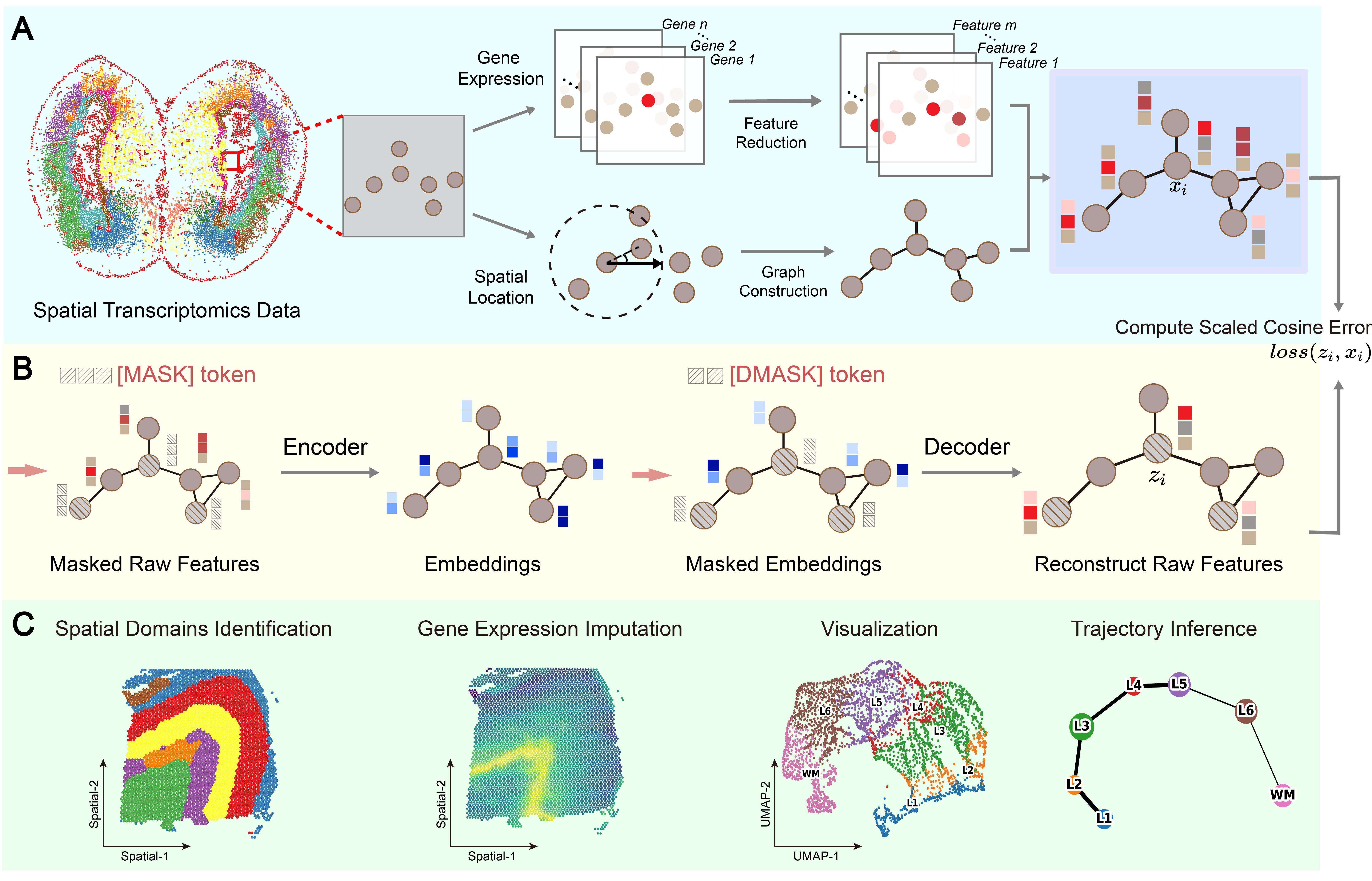
✨ Overview
Recent advances in spatial transcriptomics (ST) have opened new avenues for preserving spatial information while measuring gene expression. Yet, the challenge of seamlessly integrating this data into accurate and transferable representation remains. Here, we introduce a generative self-supervised graph (GSG) learning framework to achieve an effective joint embedding of location and gene expression within ST data. Our approach surpasses existing methods in identifying spatial domains within the human dorsolateral prefrontal cortex. Moreover, it can offer reliable analyses across various techniques, including Stereo-seq, Slide-seq, and seqFISH, irrespective of spatial resolution. Furthermore, GSG addresses dropout defects, enhancing gene expression by smoothing spatial patterns, extracting critical features, reducing batch effects, and enabling the integration of disparate datasets. Additionally, we performed spatial transcriptomic analysis on fetal human hearts, and applied GSG to extract biological insights. These experiments highlight GSG's accuracy in identifying spatial domains, uncovering specific APCDD1 expression in fetal endocardium, and implicating its role in congenital heart disease. Our results showcase GSG's superiority and underscore its valuable contributions to advancing spatial-omics analysis.
🛠️ Installation
[!NOTE] !!! The recommended operating system is Ubuntu 18.04 LTS. Some packages may not download correctly on Windows.
Use python virutal environment with conda
conda create -n gsg python=3.7 -y
conda activate gsg
# Need install cudnn based on your CUDA version.Refer to https://developer.nvidia.com/cudnn-archive
# conda install cudnn[=version]
Install GSG from PyPi:
pip install GSG
🚀 Quick Start
See our model document details from Docs.
We provide the scripts for reproducing the quantitative and visualization results of the paper in /docs/tutorials/.
📚 Citation
Wang C, Zhang T, Sun H, et al. A masked generative graph representation learning framework empowering precise spatial domain identification[J]. Bioinformatics, 2026, 42(6). ++https://doi.org/10.1093/bioinformatics/btag333.++
📩 Contact
If you have any questions, feel free to contact chuyao25@mails.jlu.edu.cn.
Release history Release notifications | RSS feed


Download files
Download the file for your platform. If you're not sure which to choose, learn more about installing packages.
Source Distribution
Built Distribution
Filter files by name, interpreter, ABI, and platform.
If you're not sure about the file name format, learn more about wheel file names.
Copy a direct link to the current filters
File details
Details for the file gsg-0.6.1.tar.gz.
File metadata
- Download URL: gsg-0.6.1.tar.gz
- Upload date:
- Size: 11.1 kB
- Tags: Source
- Uploaded using Trusted Publishing? No
- Uploaded via: twine/4.0.2 CPython/3.7.12
File hashes
| Algorithm | Hash digest | |
|---|---|---|
| SHA256 |
dfce85c3a1a14b92eb174bc0a6de4a9bea2b02a3c58f25038d09b9e3c9b7ead9
|
|
| MD5 |
23f5f06448ff0df5785d824fe823575c
|
|
| BLAKE2b-256 |
ba474a355c6f26360396e3bd27dd9acab43f44a40ae5b09409c1a3f16c2e139d
|
File details
Details for the file gsg-0.6.1-py3-none-any.whl.
File metadata
- Download URL: gsg-0.6.1-py3-none-any.whl
- Upload date:
- Size: 13.3 kB
- Tags: Python 3
- Uploaded using Trusted Publishing? No
- Uploaded via: twine/4.0.2 CPython/3.7.12
File hashes
| Algorithm | Hash digest | |
|---|---|---|
| SHA256 |
d1f05a71e3706bb93f99b0af9c1dfd2e70f78227c12fb3b7c83a7f7c947d14a7
|
|
| MD5 |
f8e6704d742ad28153f0fd8e2823041f
|
|
| BLAKE2b-256 |
6327b335f11cde108f9cd1e2be60d2b31679caeb044ceed349a49fa6297cb94b
|






