
gsj-harness-rollout-server

A rollout server for the gsj corpus: given a task (case, timestep, prompt), it runs a pinned coding agent (pi 0.83.0) in an isolated sandbox whose git checkout and retrieval are both truncated at timestep, captures every token and logprob the model produced, and emits one validated, training-ready trajectory — task → sandbox → agent → trace, nothing else (no storage, scheduling, rewards, weights, versioning, or training; those belong to the trainer that calls it).
What these traces are for, today. Training-ready names the trace's shape — token ids, a loss mask and the captured logprobs, the form a trainer consumes. What has been proven is narrower, and each part of it is measured below or in the verdict and charter it links:
- Sound now, for provenance work — every claim the validators make. The cutoff holds: a forged timestep claim is refused
401from inside the sandbox, and gate G5 audits every retrieved page ≤ T from the trace alone. The pins are checked — the system prompt, the skill cards, the tool roster, the thinking-mode tail and the no-compaction settings, each against its pinned value, by the samechecks.pyon both sides of the wire. The reconstruction is faithful:loss_maskexact at zero tolerance andprompt_idsbyte-identical against the predecessor's golden reference, on the Mac pair and again on the H200 pair, and the logprobs are real captures. - Not in the trace — the estate's to record, the consumer's to account for. The sampling policy: pi sends no sampling parameters, so the engine's configuration is the policy; no OpenAI-compatible API reports it, and on a borrowed endpoint the temperature that produced the logprobs is recorded nowhere (charter §7 row 22 — open, half by decision, half owned by the first production bring-up). The codec too: no trace carries it — the pins walk verified it at bring-up on the reference estate, and a borrowed endpoint exposes neither the tokenizer's nor the template's bytes. The reward is the trainer's outright, like storage and weight sync: every callback carries
reward: null, and the citation reward was deferred at CP-88 rather than stacked on the page grader, which pays for form — 1.0 for a bare list of rubric headings with in-cutoff page numbers, checking nothing about whether those pages were read. - Trained: single optimizer steps and two two-step runs — no training result. Single steps in the slime (CP-17) and verl (CP-21) loops, a stranger's loop (CP-26), the first thinking-on run (CP-32, 72 episodes) and one full-archive step (CP-87); and two two-step runs on the H200 — CP-69 (reward 1/191 → 78/128, which the record reads as near-verbatim format-copying of a seed trajectory: CP-17's mode-collapse onset, measured at scale) and CP-87 (192 episodes per collection, 1/192 → 75/192: a templating policy adding page numbers to the heading list the grader pays for, not a substantive improvement). The verdict refuses to call the first loop a training result, and the record reads none of them as substantive learning.
Episode execution and trajectory reconstruction are NVIDIA's Polar, vendored by commit with three carried patches; our own code is the 2,034-line shell that points Polar at our corpus, retrieval service, agent, and checks. The evaluation behind it ended in ADOPT (provisional 2026-08-09, converted 2026-08-11 on production hardware) — docs/VERDICT.md is the standalone statement, with the conditions that would reverse it.
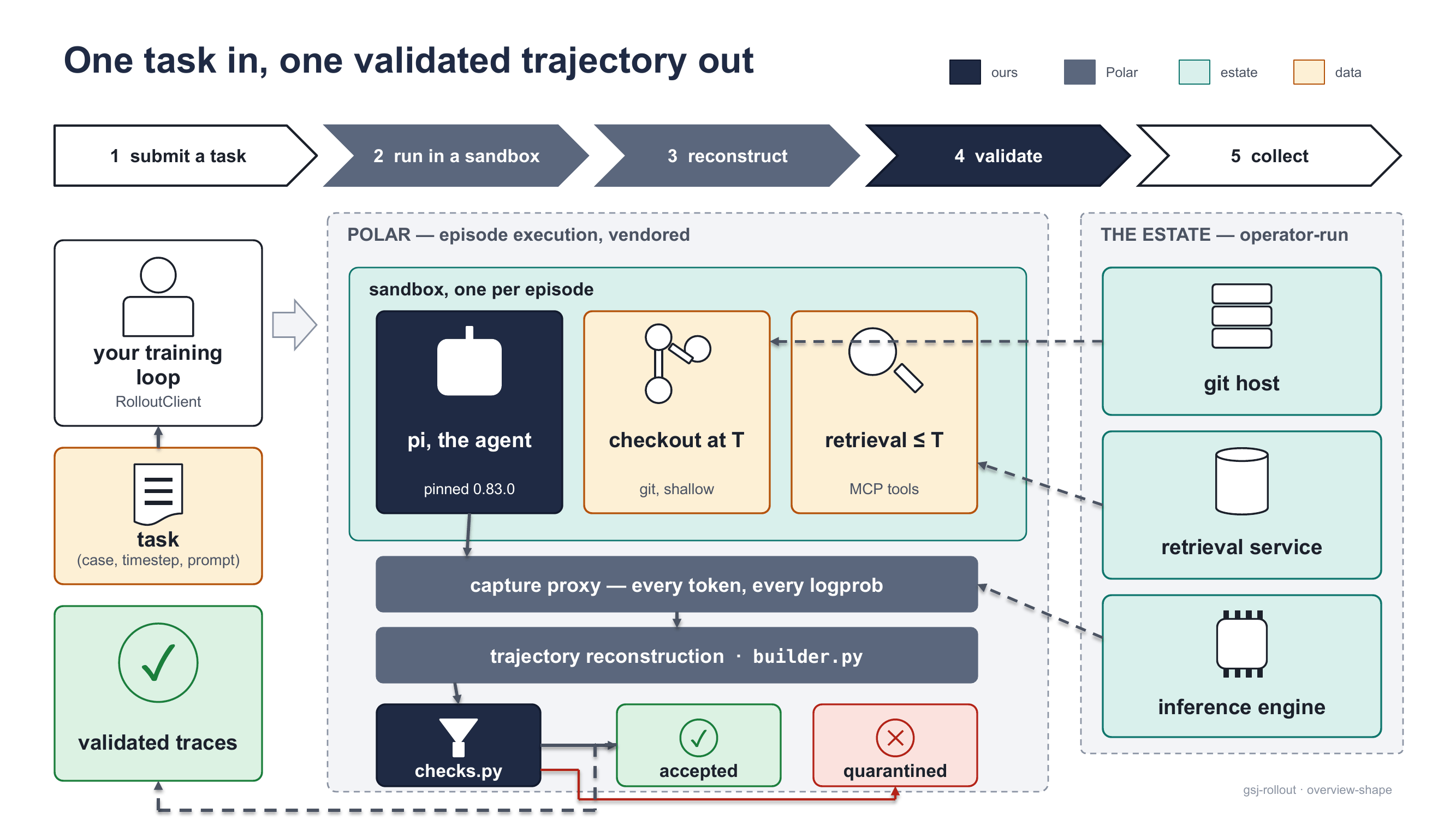
One task triple in, one validated trace out. Everything around the sandbox is Polar's, the operator's estate, or the trainer's; ours is the harness, the builder, the receiver, and the checks.
Install — three routes, by what each one gets you
The wheel is not the server. It carries the trainer client, the validators, the corpus pipeline and the estate tool; episode execution is NVIDIA's Polar, which publishes no Python artifact of any kind, so only the third route below runs an episode.
1 · A trainer client — runs no episodes. It submits tasks to a server somebody else operates, polls them, and re-checks every trace that comes back with the same checks the server ran (RolloutClient, checks, gsj-rollout submit). It cannot start a sandbox or stand an estate. Any Python ≥ 3.12; three dependencies, pydantic, httpx, pyyaml.
python3 -m venv .venv && . .venv/bin/activate   # stock Ubuntu 24.04 lacks python3-venv (the venv fails: ensurepip is not available): `sudo apt install python3-venv` first
pip install gsj-harness-rollout-server
# not a bare `pip install` outside a venv: Ubuntu >= 23.04 refuses it — `error: externally-managed-environment` (PEP 668) — and stock 24.04 has no pip outside one at all
2 · An estate, no Polar — stands the services up, and runs no episode by itself. From a corpus directory, one command validates the corpus and stands up Forgejo (one repository per case, one branch per timestep), the MCP retrieval service with the corpus ingested, the taskbank, a validated rollout.yaml and a pins skeleton; the receiver (gsj-rollout serve) runs from the wheel too. What it cannot do is execute an episode — up's closing block says so and names both routes to Polar. Needs Docker with the Compose v2 plugin, git, and your model endpoint.
docker pull ghcr.io/mhganainy/gsj-pi-harness:pi0.83.0-3   # the sandbox image: `up` checks for it and never pulls it
pip install gsj-harness-rollout-server pyarrow           # in the venv above; pyarrow is the taskbank's parquet writer, deliberately not a core dependency (ADR-0022 §5) — `up` refuses without it
mkdir -p runs                                            # `up` never creates its runs root (CP-90); from a wheel it is ./runs
python -m gsj_rollout.estate up --corpus <root> --engine-url <endpoint> --engine-model <served model> -y
3 · A server that runs episodes — route 2 plus Polar's two processes. The wheel carries neither way to get Polar:
- the published image
ghcr.io/mhganainy/gsj-polar:f0e8343a-gsj0.1.18— public, anonymously pullable, cut at every release from this repo's vendored Polar plus that release's PyPI wheel (A-28). The twodocker runinvocations that start its processes, one clause per flag, are on bring your own § Polar's two processes; no clone. - a checkout, with Polar's own venv — which must also host
gsj_rollout, because Polar loads our harness and builder by import path:
# prerequisite: `uv` — a fresh Ubuntu has none (exit 127 at `uv venv`): `pip install uv` in the venv, or `curl -LsSf https://astral.sh/uv/install.sh | sh`
git clone https://github.com/MHGanainy/gsj-harness-rollout-server && cd gsj-harness-rollout-server
python3.12 -m venv .venv && . .venv/bin/activate && pip install -e ".[dev]" uv
cd vendor/polar && uv venv --python 3.12 .venv && uv pip install -p .venv/bin/python -e . && uv pip install -p .venv/bin/python -e ../.. && cd ../..
gsj-rollout serve --config rollout.yaml    # renders topology.rendered.yaml, prints the two Polar commands, runs the receiver
Release 0.1.18 — Docker pull progress. Estate pulls now inherit Docker's stdout directly: native layer progress in a terminal, state changes that may stay quiet during a large redirected transfer. Custom host-byte sampling, layer tallies and pull heartbeats are removed. After Docker's ordinary process wait returns, the existing stderr reader gets up to ten seconds to finish, returning sooner when it finishes; inherited stdout adds no separate wait. This grace changes descendant-pipe timing, is not an execution timeout, and does not guarantee partial stderr: capture still waits for the whole read. Caller diagnostics, image policy, readiness and recovery are preserved; retrieval remains 0.5.1.
Quick start
from gsj_rollout import RolloutClient, load_config
from gsj_rollout.config import render_task_request
cfg = load_config("rollout.yaml")            # one YAML describes the whole deployment
request = render_task_request(cfg, task_id="demo", instruction="Fix the failing test.", case_id="case_0001", timestep=12)
traces = RolloutClient(cfg.polar.rollout.base_url).collect([request])   # Polar's rollout API, not the receiver; list[Trace], only checks-clean sessions come back
gsj-rollout submit --config rollout.yaml --case case_0001 --timestep 12 --prompt "Fix the failing test."
# exit codes: 0 all collected · 1 partial · 2 usage · 3 server unreachable
The two roles
| Server role | Trainer role | |
|---|---|---|
| You need | the four estate services — an inference engine (vLLM, pinned chat template), a Forgejo git host (one repository per case, one branch per timestep), the MCP retrieval service, the ingested corpus — plus Polar's two processes, from the published gsj-polar image (the two docker run invocations: bring your own § Polar's two processes) or from this checkout with Polar's venv under vendor/polar/ |
Python ≥ 3.12, anywhere: pip install gsj-harness-rollout-server (0.1.18, wheel-only: gsj_rollout/, both pins sets, the G2 reference capture, ingest_corpus.py, estate.py). No vendor/, no Polar |
| You run | gsj-rollout serve --config <yaml>, then the two printed Polar commands yourself: serve_rollout (rollout API + scheduler — the trainer's base_url) and serve_gateway (gateway + capture proxy, one sandbox per episode, loading pi_harness.py and builder.py by import path) |
RolloutClient: submit · wait · collect — collect submits, polls GET /rollout/task/{id}, re-runs checks on every result, returns the Traces of clean sessions |
| You validate | every callback: clean → traces/, bad → quarantine/ with its findings — the same checks.py on both sides of the wire |
checks.validate_session_result(result) — the identical validators the receiver ran, because nothing upstream is trusted |
| Start here | Server guide; a foreign model or corpus, from an endpoint URL to an accepted episode: bring your own; an estate from nothing: gsj-rollout-demo |
Trainer guide; a loop against an existing server: gsj-harness-rollout-server-examples + its RUNBOOK.md |
One trap worth naming at the door. checks validates traces against pinned approved sets (tool rosters, system prompts, skill cards, settings), and the wheel ships this estate's pins — on any other estate every hash gate fails *_not_approved, loudly, by design. Point GSJ_PINS_PATH at your own pins file before the first import of gsj_rollout.checks; resolution is GSJ_PINS_PATH → repo checkout → packaged copy (a UserWarning when the packaged copy is what resolved), and an unusable path raises PinsConfigurationError rather than falling through. The thinking-on reference set rides at gsj_rollout/pins/thinking-on/pins.gsj.json — gate G6 compares against per-mode pins data. Format and reasoning: docs/checks-spec.md.
The timestep cutoff
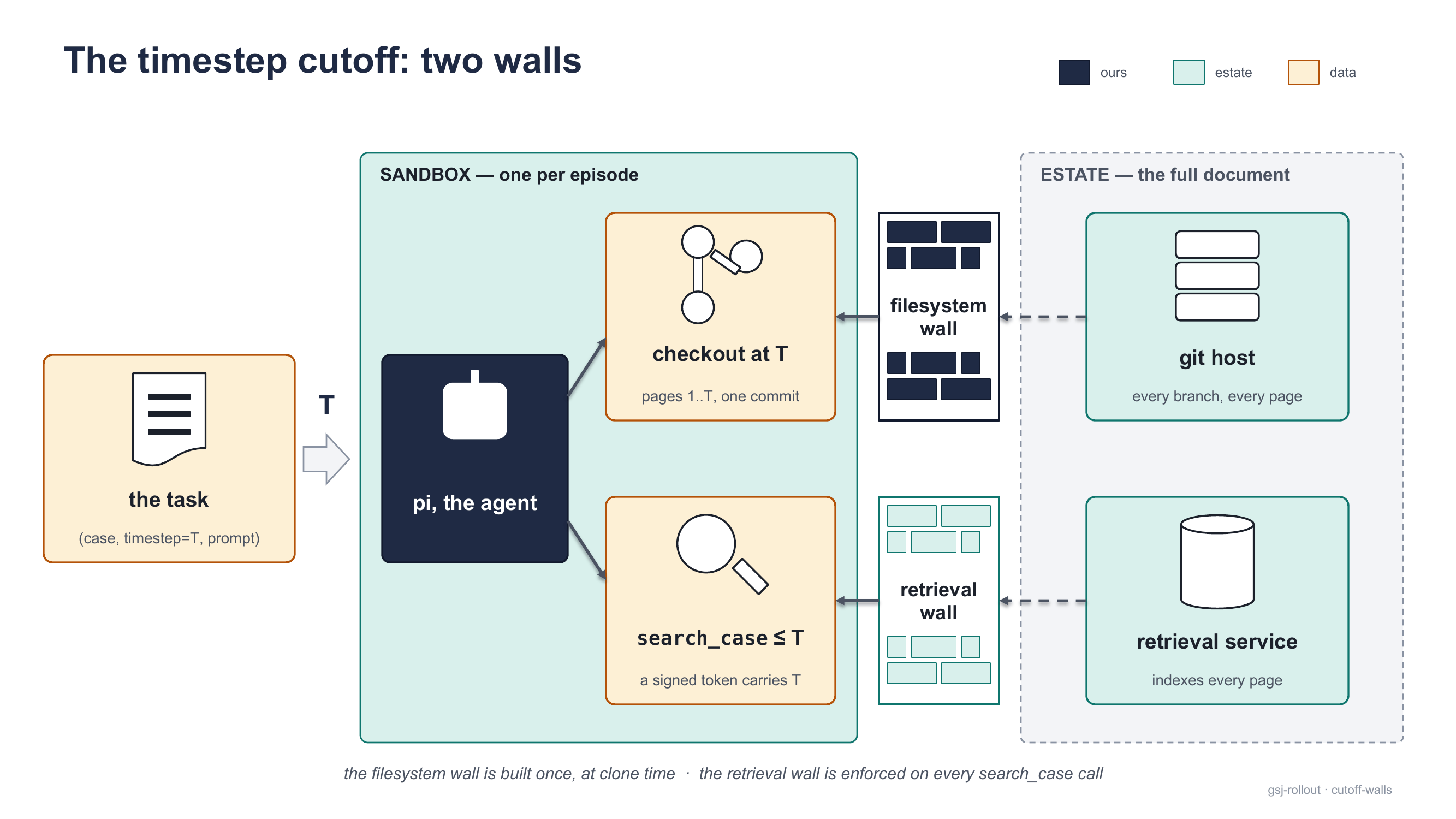
timestep is a boundary the agent cannot cross — one wall on the filesystem, one in front of retrieval — enforced twice and audited once.
- The filesystem wall. The sandbox clone is branch
timestep-T,--depth 1, remote removed, reflogs scrubbed — git history cannot reach a page past T even offline. - The retrieval wall. The harness mints an HS256 token host-side with claims
{case_id, timestep, episode_id, exp}; the signing secret never enters the sandbox; the service verifies the signature, then filters topage ≤ Tbefore ranking, with T from the verified claims only. The agent may read its own token but cannot widen its timestep — any mutation invalidates the signature (tampered claims, timestep 12→18 with the original signature: HTTP 401). - The audit.
checks.pygate G5, from the trace alone: every retrieved page ≤ T; the checkout shallow, zero remotes, branch== timestep-T; checkout pages contiguous1..T.
Documentation
- The guide, seven flat pages under
docs/guide/: index · how it works · validation and pins · server guide · trainer guide · bring your own model and corpus · troubleshooting - Normative: Verdict (read first) · Charter (scope laws; assumptions §4; gap register §7; standing rules §8) · Checks spec · Corpus contract
What has been proven
| claim | measured — as of 2026-08-24 (the audit re-executed every suite and census that day; per-checkpoint figures carry their report's date) | evidence |
|---|---|---|
| traces match the predecessor's golden reference | loss_mask exact at zero tolerance; prompt_ids byte-identical (2965/2965) — on the Mac pair and again on the H200 pair |
CP-09, CP-09′; docs/golden/COMPARISON.md |
| the logprobs are real captures | H200 replay-vs-replay bit-deterministic (0.000000); capture-vs-replay floor mean ≈ 0.005–0.007 on both traces symmetrically (platform-classified, per the contract); Mac identical-context agreement mean |Δ| = 0.000114 | CP-09′, CP-09 |
| the cutoff holds under a forged claim | tampered token (timestep 12→18, original signature) rejected HTTP 401 from inside the sandbox; valid token 200; live episode retrieved pages [1, 5, 7, 9, 11], all ≤ 12 | CP-07 |
| two trainers, two loops, zero server changes | slime: 27 qualifying traces → one optimizer step → weight sync (logprobs moved at 5623/5782 positions) → 8/8 re-collect; verl: 110 qualifying → one step → sync (310/310 tensors, exactly one AdamW step) → 8/8; gsj_rollout/ untouched both times |
CP-17, CP-21 |
| two model families, no code change | Qwen3-0.6B (both golden pairs); Llama-3.1-8B — 8 completions merged into one full chain, quarantine empty, gates green | CP-04′/CP-09′, CP-38 |
| a stranger can run it from nothing | fresh machine, demo README the only input: clone → pip → estate up → first episode accepted, ≈ 5 minutes wall with the four images already on the daemon — cold, add ~1.6 GiB of pulls (Forgejo ~80 MB, the retrieval service 1.28 GiB, the harness 200 MiB — compressed, from the registry manifests at CP-104; Forgejo's 277 MB is its extracted size, and the demo's Polar image adds ~160 MB): minutes on a fast pipe, most of an hour at ~155 KB/s (round three, 2026-09-07; redirected pulls can remain quiet while a large layer transfers; terminals show Docker's native layer progress) — plus the model endpoint; every image pulls natively on ARM since CP-64 (the two manual pulls this row once needed are history — a round-four stranger caught the stale claim); a copy-on-create daemon (vfs) costs a 17× slower sandbox create (19.4 s against overlay2's 1.1 s on the identical task) and 3.7× the disk (31 G of data root against 8.4 G, for the same 4.061 GB of images) — measured against an overlay2 control at round five, named by up since CP-96 and priced to that pair since CP-99; round four's "minutes per create and ~13 GB per sandbox" was one loaded host, inferred, and is retired |
CP-36 |
| the shell stays thin | ours 2,034/2,034 lines (the size law's equality since CP-75; 1,999/2,000 at the audit) vs Polar's ~14,200 driven; the predecessor spent ~1,800 lines on episode execution alone | audit 2026-08-24; VERDICT §1 |
| the fixture suites | root 161 + corpus 58 + mcp-service 89, all green by execution | audit 2026-08-24 |
The badge covers none of this — not the golden pairs, fidelity, the loops, or any episode (episodes need an estate and GPU time). Green means the fixtures still pass, not that the harness runs.
What it does not do
- It has taken optimizer steps and trained nothing, and says so. Each loop in the table above (CP-17, CP-21) is exactly one optimizer step bracketed by two collections, and the post-sync 8/8 reward reads as the onset of mode collapse, not competence; the two two-step runs since (CP-69, CP-87) read the same way at scale — reward uptake on form, not substance. Concurrent collection-and-training and weight sync at cadence have zero data points.
- The trainer's problems stay the trainer's: storage, retention, mixing, staleness, collation, reward — every callback carries
reward: null— and weight sync. Dropped deliberately, at the start (charter §7 rows 16–21). - Sampling and codec provenance are the estate's, not the trace's. pi sends no sampling parameters, so the engine's configuration is the sampling policy — an unpinned engine silently samples at neutral defaults (measured). Codec identity is verified at bring-up by the pins walk, not per-trace.
- Two open gaps, of a 32-row capability register (21 parity, 7 dropped by decision, 1 better, 1 TBD): row 12 — G4 codec evidence never rides the callback, receiver-side by decision; row 22 — per-episode binding of traces to engine identity (serve argv, generation config, codec), owned by the first production bring-up. The separate anonymous-read gap is closed: the reference estate and demo require Forgejo sign-in and use credentialed clones (CP-58/59; re-measured at CP-82). This repository defense leaves the engine and MCP reachable, as episodes require; it does not close row 22's provenance gap.
- Model-agnostic in mechanism, Qwen-fitted in defaults. One foreign family is one data point; a different reasoning geometry is the wall. Thinking-on requires the symmetric served template.
Repository layout
| Path | What it is |
|---|---|
gsj_rollout/ |
the server, eight modules (pi_harness, builder, receiver, checks, config, client, cli, the package surface: RolloutClient, Trace, checks, load_config, RunConfig) — the whole of what the wheel ships, plus the pins, ingest_corpus.py and estate.py copied in at build time |
vendor/polar/ |
Polar at the commit in POLAR_SHA, patched (vendor/patches/ P1–P3, vendor/apply_patches.sh --verify, re-vendor recipe vendor/REVENDOR.md); ships in no wheel or sdist of ours — it does reach you inside the demo's published gsj-polar image, built from it (A-28) |
estate/ |
this repository's test estate: estate.sh front door, estate.py (the estate's one tool — scaffold · validate · up · ingest · update · status · down), corpus/, mcp-service/, forgejo/, serving/ — outside the line budget |
docs/ · pins/ |
the guide, the four normative documents, and the seven Polar run bodies CI/tests/pins-walk read; the approved sets (reference + thinking-on/) with derive scripts — the single source for the wheel copies |
tests/ |
the root suite (176 tests, no estate needed) and the tracked golden fixtures tests/fixtures/golden-mac/ |
pytest -q requires the Docker CLI and Compose plugin for credential parsing checks; no Docker daemon or running estate is needed.
The CP-06 feasibility spike (stub backend, spike harness, the stub-side wire captures, p1_verdict.py, wire_diff.py) left the tree at CP-68 and is frozen at tag spike-cp06 — commit a769771, tree 2082a24f; restore with git checkout spike-cp06 -- spike.
Where the record lives
The development record is maintained privately. The per-checkpoint reports and prompts, the 43 ADRs, the 2026-08-24 adversarial audit (24 agents; no live gate, pin value, or code path wrong; zero of 91 findings refuted), and the raw docs/golden//docs/polar/ artifacts exist unchanged in the operator's working tree, not in this repository — so the evidence column above, the shelf map in docs/README.md, and two report paths in the shipped pins.gsj.json provenance resolve only there; for anyone else those claims reduce from "checkable at the cited path" to "asserted". What stays checkable from a clone: the code, the three suites, the pins walk, the wheel assertions, and the evidence bodies they execute against.
Licence
Apache-2.0 — LICENSE. vendor/polar/ is NVIDIA's, carries its own Apache-2.0 LICENSE, and ships in no released artifact of ours — no wheel, no sdist; it does reach you inside the demo's gsj-polar image, which is built from it (CP-99: a stranger quoted this sentence back as "Polar ships in no released artifact" while a public image carrying it was one docker pull away). The wheel contains gsj_rollout/, the two pins sets, the G2 reference capture (pins/container/system_prompt.container.derived.txt), ingest_corpus.py and estate.py (as gsj_rollout.ingest_corpus / gsj_rollout.estate — gsj_rollout.bringup on wheels 0.1.3–0.1.5) — nothing else, asserted at build time (18 entries since 0.1.3). Predecessor: gsj-envloader @ v0.8.0, archived 2026-08-25 — still the goldens' collecting stack, readable at v0.8.0; no longer the fallback, a term that expired at the verdict's conversion on 2026-08-11. Its frozen sandbox/ recipe also supplied the harness image's arm64 build at CP-64, and its staging/BRINGUP.md remains the cold-start reference linked from the living estate recipe. Reuse is recorded here; the archive stays frozen.
Provenance
- The front door (CP-105): what the traces are for, moved above the fold from the sections below it, the verdict (the CP-17 loop "not a training result") and the charter (§7 row 22; the single steps at CP-26, CP-32 and CP-87, the CP-69 and CP-87 two-step runs, and the CP-88 phase-6 deferral) — no claim in it new; the install routes labelled by what each gets you, the wheel-runs-no-episode statement having reached the door at CP-99; the one new fact, measured at CP-105 on
ubuntu:24.04: stock 24.04 lacks the venv package, so the venv line fails untilpython3-venvis installed. - The verdict provisional at CP-12, converted at CP-17 · the predecessor archived at CP-45 (2026-08-25, ADR-0026), the fallback term expired at CP-17 (2026-08-11) · the wheel's contents asserted at build time — CP-19,
ingest_corpus.pyin the wheel since CP-34. - The filesystem wall — CP-11 · gate G6 as per-mode pins data, the thinking-on set in the wheel — ADR-0024 · the two ARM image pulls registered — wishlist row 40 · an unpinned engine at neutral defaults — CP-09 finding F1 · codec at bring-up via the pins walk, G4 estate-side — ADR-0011.
- One optimizer step per loop, 8/8 read as mode-collapse onset — CP-21 · zero data points on concurrent collect-and-train and cadence sync — charter A-13 · the trainer's problems dropped — CP-00, charter §7 rows 16–21 · row 22 and credentialed-clone/egress owned by the first production bring-up — CP-40 · "Qwen-fitted in defaults" — CP-38's own words · the symmetric served template — charter A-22.
1 maintainer

Metadata
1 maintainer
Release files for gsj-harness-rollout-server 0.1.18
For a detailed explanation of source distributions (sdists) and built distributions (wheels), please see the package formats documentation.
Built distribution (wheel)
| File | Interpreter | ABI | Platform | Reset |
|---|---|---|---|---|
| gsj_harness_rollout_server-0.1.18-py3-none-any.whl | Python 3 | none | any | Details |
Release files / gsj_harness_rollout_server-0.1.18-py3-none-any.whl
| Download URL | gsj_harness_rollout_server-0.1.18-py3-none-any.whl |
|---|---|
| Size | 186.9 kB |
| Tags | Python 3 |
|
SHA-256 checksum How to use checksums |
995013873f545a3127e0bccdc4e3e8ebe8286554264aa81fed66a8b9693d3b00
|
|
BLAKE2b-256 checksum How to use checksums |
dab6dd153a7d9db02bf75e16e3e50a7d576d208e5da6c3327447905edd6fe5b4
|
| Upload date | |
|
Uploaded using Trusted Publishing? What is trusted publishing? |
Yes |
| Uploaded via |
twine/7.0.0 CPython/3.13.14
|
Provenance
Provenance describes where a file came from. On PyPI, provenance is shared via attestations, which provide a verifiable record of the build or publishing details. View details, limitations and caveats.


PyPI Publish Attestation
PyPI verified that this artifact, at this checksum, originated from the publisher listed below.
Signed by GitHub Actions, verified by PyPI on Sep 12, 2026.
Transparency log













