
Gus
Your agent doesn't need the whole file. It needs the six lines that answer the question.




68% less context per question · the right code in the top 5, 4 times in 5 · no API keys, no services
Measured on 33 held-out, hand-checked questions about httpx and ky at pinned commits, with the default model, against reading the one file that holds the answer. Tokens are real tiktoken counts. When Gus misses, the file read is still counted. The optional quality model puts the right code first 70% of the time instead of 45%. How it's measured.
Wires into Claude Code · Cursor · Codex CLI · Antigravity CLI · any MCP client · any shell
You ask your agent where cookies are persisted between requests. It opens httpx/_client.py: 2,019 lines,
about 13,700 tokens, to find a six-line property. Then it does the same thing for the next question, and the
one after that, until the context window is full of code it read once and never needed.
Gus is a local context-retrieval layer for AI coding agents. The agent asks a question and gets back only the
functions, classes, doc sections and PDF passages that matter, with file paths and line ranges.
Agents call it as an MCP tool (get_context); humans, scripts and shell-only agents use gus search.
Before / after
$ cat httpx/_client.py                         # what an agent reads without Gus
                                               # 13,702 tokens, 2,019 lines

$ gus search "where are cookies persisted between requests"
                                               # 282 tokens, 38 lines, top 5 hits
49× less context, and the hits are the ones you'd have picked by hand:
$ gus search "where are cookies persisted between requests" --top-k 3
httpx/_client.py:318-323
      @property
      def cookies(self) -> Cookies:
          """
          Cookie values to include when sending requests.
          """
          return self._cookies

httpx/_client.py:413-422
      def _merge_cookies(self, cookies: CookieTypes | None = None) -> CookieTypes | None:
          """
          Merge a cookies argument together with any cookies on the client,
          to create the cookies used for the outgoing request.
          """
          if cookies or self.cookies:
              merged_cookies = Cookies(self.cookies)
              merged_cookies.update(cookies)
              return merged_cookies
          return cookies

httpx/_client.py:325-327
      @cookies.setter
      def cookies(self, cookies: CookieTypes) -> None:
          self._cookies = Cookies(cookies)
Numbers
One lucky example proves nothing, so Gus is scored on questions phrased the way agents ask them ("strip the Authorization header when redirected to a different origin"), with answers written from reading the code before any tuning, and a held-out test split that ranking changes are never tuned on.
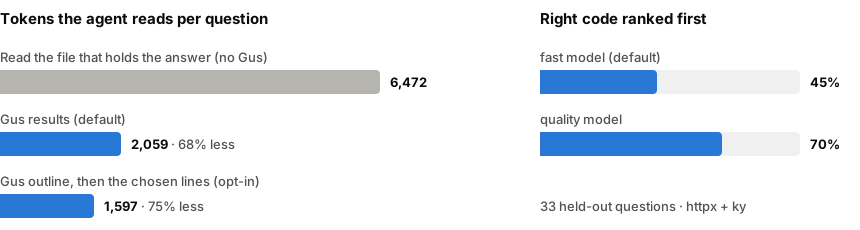
| Model | Right code first | In top 3 | In top 5 | Tokens per question |
|---|---|---|---|---|
| No Gus: read the file that holds the answer | 6,472 | |||
fast (default, any CPU) |
45% | 70% | 82% | 2,059 (−68%) |
quality (EmbeddingGemma, CPU or GPU) |
70% | 82% | 85% | 2,118 (−67%) |
Tokens are counted with tiktoken (o200k_base). They include the file the agent still has to open when the
answer isn't in Gus's results, so a miss costs more than a hit, not nothing. On hits alone, the right chunk is a
median 98% smaller than its file. Ranking was also tuned against 42 questions on a private FastAPI + React
app, which aren't in these numbers.
Quality is the constraint, token savings are the goal inside it. full results are the default because
they give the agent the code itself. outline mode trims that to 1,597 tokens (−75%), but it shows what each hit
is rather than its body, so it's opt-in for locating things, not the default for understanding them.
Install
Requires Python 3.10+. The package is gus-mcp; the command it installs is gus.
uv tool install gus-mcp            # fast model only (small, CPU)
uv tool install 'gus-mcp[onnx]'    # + quality model on CPU
uv tool install 'gus-mcp[gpu]'     # + quality model on an NVIDIA GPU (~2 GB of CUDA libs)
pipx install gus-mcp               # pipx works the same way (extras too)
Or pip install 'gus-mcp[onnx]', etc. From GitHub: uv tool install 'gus-mcp[onnx] @ git+https://github.com/SUD747/gus'.
Install either onnx or gpu, not both: they provide the same onnxruntime module. If gus isn't found
after installing, run uv tool update-shell (or pipx ensurepath) and open a new terminal.
Quick start
$ cd your-project
$ gus init
gus init asks which embedding model to use, builds the index, and wires Gus into every agent it finds.
Restart your agent. It now has a get_context tool.
Models download from Hugging Face on first use (30 MB fast, 1.2 GB quality). After that, Gus works offline.
What gus init asks, and what it writes
$ gus init
Embedding model for this project:
  1) fast     potion-base-8M       30 MB download, indexes even large repos in seconds on any CPU
  2) quality  EmbeddingGemma-300M  1.2 GB download, needs gus-mcp[onnx] (CPU) or [gpu] (NVIDIA);
              puts the right code first 70% of the time vs 45% (see README, Embedding models)
Choose [1]: 2
Run the quality model on:
  1) cpu  works everywhere; ~12 chunks/s, so a 20,000-chunk repo takes ~30 min to index the first time
  2) gpu  NVIDIA CUDA via gus-mcp[gpu]; ~190 chunks/s on a laptop RTX 4050
Choose [1]: 2
...
done (onnx-community/embeddinggemma-300m-ONNX on gpu) — restart your agent so it picks up the `gus` MCP server
Without a terminal (scripts, CI, an agent running the command), gus init asks nothing: it keeps the
project's existing choice, or uses fast/CPU. Pass --model fast|quality and --device cpu|gpu to choose
explicitly. If the chosen model or device needs a package that isn't installed, gus init stops and prints
the install command.
| Agent | File written | When |
|---|---|---|
| Claude Code | .mcp.json |
always |
| Cursor | .cursor/mcp.json |
if .cursor/ exists (or --all) |
| Antigravity CLI | ~/.gemini/config/mcp_config.json (global, one entry for all projects) |
if Antigravity CLI is installed (or --all) |
| Antigravity IDE | .agents/mcp_config.json |
if .agents/ exists (or --all) |
| Codex CLI | .codex/config.toml |
if .codex/ exists (or --all); Codex only loads project config for trusted projects |
It merges into existing files without touching other servers, and running it again is safe. It also appends
a short note to any of CLAUDE.md, AGENTS.md, .cursorrules that already exist, and to
.cursor/rules/gus.mdc if that directory exists. The note tells agents how to query Gus well (exact names,
then search again with names from the results), to open the file for surrounding code and use grep to find
every usage, and to fall back to gus search from the shell when the MCP tool isn't available.
The config entries use absolute paths to the gus executable and the project root, because agents launch
MCP servers with their own PATH (the Antigravity CLI entry has no project path; it starts servers in the
project directory). Re-run gus init on each machine instead of committing those entries.
To wire it up by hand, any MCP client works with:
{ "mcpServers": { "gus": { "command": "gus", "args": ["serve", "/abs/path/to/project"] } } }
Commands
gus init   [path] [--all] [--model fast|quality|<id>] [--device cpu|gpu]
                                              wire into agent configs + build index
gus serve  [path]                             MCP server over stdio (what agents launch)
gus search "<query>" [--top-k N] [--format text|json] [--detail full|outline] [--root DIR]
gus index  [path]                             build / update the index
gus stats  [path]                             files, chunks, size, last indexed time
gus help   [command]                          all commands, or one command's options
gus -v                                        version
With no path, commands use the nearest ancestor that has a .gus/ index, then the git top level, then cwd.
You rarely need gus index: queries keep the index up to date.
Result shape
get_context and --format json return:
[
  {
    "path": "httpx/_client.py",
    "line_start": 318,
    "line_end": 323,
    "snippet": "    @property\n    def cookies(self) -> Cookies: ...",
    "score": 0.0313,
    "kind": "decorated_definition"
  }
]
Outline mode
detail="outline" (MCP) or --detail outline (CLI) returns what each hit is instead of its whole body:
the first line of its doc comment, the signature, the signatures of anything defined inside it, and up to two
lines that best match the query (marked …). The agent picks a hit and reads just that line range.
$ gus search "error when an async request is sent with the sync client" --detail outline --top-k 2
httpx/_client.py:1717-1749
  async def _send_single_request(self, request: Request) -> Response:
  Sends a single request, without handling any redirections.
  … if not isinstance(request.stream, AsyncByteStream):
  … "Attempted to send a sync request with an AsyncClient instance."

httpx/_client.py:1001-1034
  def _send_single_request(self, request: Request) -> Response:
  Sends a single request, without handling any redirections.
  … if not isinstance(request.stream, SyncByteStream):
  … "Attempted to send an async request with a sync Client instance."
full is the default. Outline plus opening the right hit uses about 20% fewer tokens than full, but it
hides code the agent may need, so it's meant for locating things, not for understanding them.
PDFs and images
PDF hits also carry "page". If a hit's source page or section contains images, it carries a "note":
docs/manual.pdf:page 12
  3.2.2 Memory optimisation
  ...
  [note] this page also contains 1 image(s) not indexed by Gus — open the source file directly if visual content is needed
Pages with no text at all (scans, full-page figures) are still indexed as a note saying the page is only images, so the agent knows to open it. Gus only extracts text. It doesn't OCR or interpret images; it tells the agent where they are.
Embedding models
| Choice | Top result | Top 3 | Top 5 | Indexing speed | Query right after editing a 2,000-line file | Download |
|---|---|---|---|---|---|---|
fast: potion-base-8M (default) |
45% | 70% | 82% | ~20,000 chunks/s (CPU) | 90 ms | 30 MB |
quality on cpu: EmbeddingGemma-300M |
70% | 82% | 85% | ~12 chunks/s | 8.6 s | 1.2 GB + gus-mcp[onnx] |
quality on gpu: EmbeddingGemma-300M |
70% | 82% | 85% | ~190 chunks/s | 0.7 s | 1.2 GB + gus-mcp[gpu] |
Speeds are from a 20-thread laptop CPU and an RTX 4050 laptop GPU. CPU and GPU give identical results; only speed differs.
Pick fast for large repos, machines without much memory, or if you want indexing to be instant.
Pick quality if you want the agent to get the right code first more often and can afford the setup:
- On CPU, the first index of a 20,000-chunk repo takes about half an hour (about 2 minutes on a GPU), using around 1.2 GB of memory. Progress is shown, and an interrupted index resumes where it stopped.
- Gus re-indexes changed files before every query, so a query right after editing a big file waits for that file to be re-embedded.
- GPU means NVIDIA CUDA. If a GPU is requested but can't be used, Gus warns and falls back to the CPU.
- The model is distributed under Google's Gemma terms of use.
The choice is saved in .gus/config.json (per machine, never committed), and every later gus serve,
gus search and gus index in the project uses it. To switch, run gus init --model … --device … again;
changing the model rebuilds the index. GUS_MODEL and GUS_DEVICE override the saved choice for one command.
Known limits
- Very large repos (over ~100,000 chunks) will get slower queries: vector search is brute force.
- Git-ignored files, binaries, symlinks, lockfiles, minified assets, and files over 1 MB (PDFs over 25 MB)
aren't indexed. Outside a git repo, only the root
.gitignoreis honoured. - Files in languages without a bundled grammar are chunked into line windows instead of functions.
- Images in PDFs and Markdown are not read; Gus flags them so the agent can open the source.
- GPU acceleration requires an NVIDIA GPU with CUDA.
- Tested on Linux, with macOS in CI. Windows hasn't been tested yet.
- Gus won't index your home directory or the filesystem root on its own. Run it inside a project (a git repo,
or a directory where you ran
gus init).
FAQ
Does my code leave my machine? No. Indexing, embedding and search all run locally. The only network access is downloading the embedding model from Hugging Face the first time.
Isn't this just grep?
Grep finds a string you already know, and every line that contains it. Gus ranks whole functions by what they
do, so a question phrased in plain words works even when you don't know the names. Exact identifiers still
work too: keyword search is part of the ranking, and it matches refreshToken and refresh_token alike.
Will results go stale while the agent edits files? No. Every query re-indexes changed files first, so the agent sees its own edits.
What if the answer isn't in the results? The agent reads the file, the way it would have anyway. That cost is counted in the numbers above.
My agent has no MCP support.
Use gus search from the shell. gus init leaves a note in CLAUDE.md / AGENTS.md telling agents to do so.
Contributing
Bug reports, questions about results, and pull requests are welcome. See CONTRIBUTING.md for setup, the evaluation, and how retrieval changes are judged. To report a security issue, see SECURITY.md.
License
MIT, see LICENSE. The optional EmbeddingGemma model has its own terms (see above).
Gus changes how an agent gathers context, and that can change its results in either direction. In our A/B benchmark (33 questions, Claude Haiku), overall accuracy was about the same with and without Gus, but 2 questions were answered correctly only without it. How it affects your agent depends on your codebase, model and questions.
1 maintainer

Download files
Download the file for your platform. If you're not sure which to choose, learn more about installing packages.
Source Distribution
Built Distribution
Filter files by name, interpreter, ABI, and platform.
If you're not sure about the file name format, learn more about wheel file names.
Copy a direct link to the current filters
File details
Details for the file gus_mcp-0.1.0.tar.gz.
File metadata
- Download URL: gus_mcp-0.1.0.tar.gz
- Upload date:
- Size: 42.5 kB
- Tags: Source
- Uploaded using Trusted Publishing? No
- Uploaded via:
uv/0.12.13 {"installer":{"name":"uv","version":"0.12.13","subcommand":["publish"]},"python":null,"implementation":{"name":null,"version":null},"distro":{"name":"Arch Linux","version":null,"id":null,"libc":null},"system":{"name":null,"release":null},"cpu":null,"openssl_version":null,"setuptools_version":null,"rustc_version":null,"ci":null}
File hashes
| Algorithm | Hash digest | |
|---|---|---|
| SHA256 |
15a4ba398c56da36318ad0684d0724e3dcddd65a2aca70203319d3ee3f317d76
|
|
| MD5 |
97d0e341bbaf259f54c55d9eb233843e
|
|
| BLAKE2b-256 |
d45ef8006e8a2fcb48a21e99e122c8112ebd67ce4a0148fdc990cb676df595dd
|
File details
Details for the file gus_mcp-0.1.0-py3-none-any.whl.
File metadata
- Download URL: gus_mcp-0.1.0-py3-none-any.whl
- Upload date:
- Size: 29.5 kB
- Tags: Python 3
- Uploaded using Trusted Publishing? No
- Uploaded via:
uv/0.12.13 {"installer":{"name":"uv","version":"0.12.13","subcommand":["publish"]},"python":null,"implementation":{"name":null,"version":null},"distro":{"name":"Arch Linux","version":null,"id":null,"libc":null},"system":{"name":null,"release":null},"cpu":null,"openssl_version":null,"setuptools_version":null,"rustc_version":null,"ci":null}
File hashes
| Algorithm | Hash digest | |
|---|---|---|
| SHA256 |
65c50492da870d5995c5285bfabee7e14422750d7ea2fdb862dc83b9c7931c9f
|
|
| MD5 |
4e55e033ca674fdf2f3abe5a1691cade
|
|
| BLAKE2b-256 |
e7cad549dd5b7f546f6a834f6f10ee02b104523601f93daf2bc5ca4368a9f407
|













