
gym-zelda-1





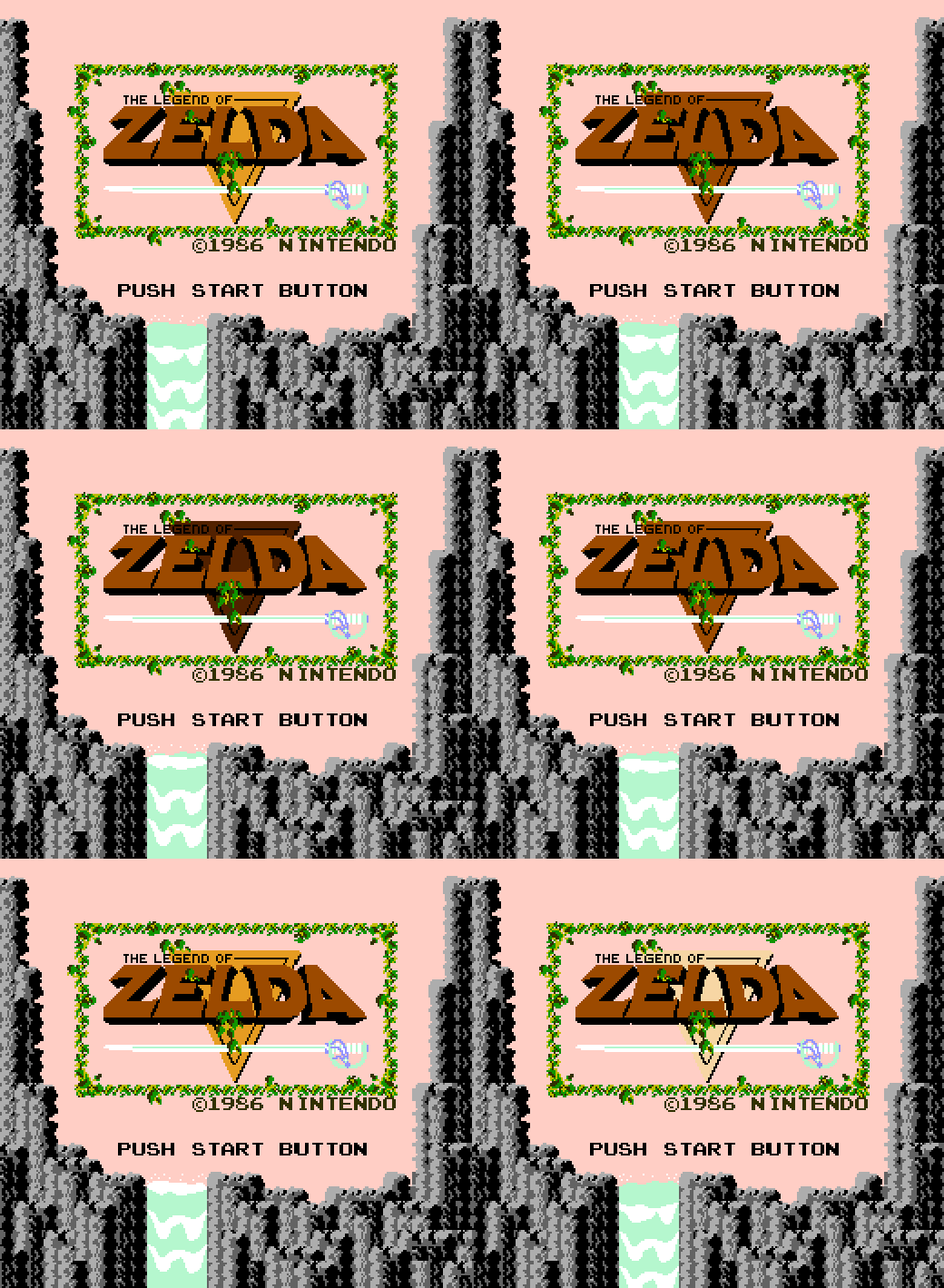
A Gymnasium environment for The Legend of Zelda (i.e., Zelda 1) on The Nintendo Entertainment System (NES) based on the nes-py emulator. This wrapper keeps a deliberately narrow, lower-maturity scope: it exposes Zelda RAM state and NES control semantics for experimentation, while expecting users to supply their own legally obtained ROM and task-specific training wrappers. CI currently tests CPython 3.13 and 3.14 on macOS, Linux, and Windows.
Installation
The preferred installation of gym-zelda-1 is from pip:
pip install gym-zelda-1
Python 3.13 or newer is required. The supported CI targets are CPython 3.13 and 3.14.
gym-zelda-1 does not distribute Nintendo ROM assets. Provide your own legally
obtained Zelda ROM through the package's expected local workflow.
Usage
Python
You must import gym_zelda_1 before trying to make an environment.
This is because Gymnasium environments are registered at runtime. By default,
gym_zelda_1 environments use the full NES action space of 256
discrete actions. To constrain this, gym_zelda_1.actions provides
an action list called MOVEMENT (20 discrete actions) for the
nes_py.wrappers.JoypadSpace wrapper.
import gymnasium as gym
from nes_py.wrappers import JoypadSpace
import gym_zelda_1
from gym_zelda_1.actions import MOVEMENT

env = gym.make('Zelda1-v0', render_mode='human')
env = JoypadSpace(env, MOVEMENT)

observation, info = env.reset(seed=123)
for step in range(5000):
    action = env.action_space.sample()
    observation, reward, terminated, truncated, info = env.step(action)
    done = terminated or truncated
    env.render()

    if done:
        observation, info = env.reset()

env.close()
NOTE: gym_zelda_1.make is just an alias to gymnasium.make for
convenience.
NOTE: remove calls to render in training code for a nontrivial
speedup.
Command Line
gym_zelda_1 features a command line interface for playing
environments using either the keyboard, or uniform random movement.
Print the command-line help with:
gym_zelda_1 -h
gym_zelda_1 --mode human --actionspace movement
gym_zelda_1 --mode random --steps 500 --render --actionspace movement
gym_zelda_1 --mode random --steps 5000 --no-render --seed 123 --actionspace movement --no-progress
Use --actionspace full for the default 256-action NES controller space, or
--actionspace movement for the gym_zelda_1.actions.MOVEMENT preset with
nes_py.wrappers.JoypadSpace. Human mode always requires rendering; headless
--no-render playback is available in random mode.
Step
Info about the rewards and info returned by the step method.
Zelda1-v0 is a navigation and state-inspection sandbox. It exposes Zelda RAM
state through info, preserves the full NES action and observation contract,
and leaves task objectives such as route completion, dungeon progress, or time
limits to caller-provided wrappers.
Reward Function
The reward is always 0.0. This neutral reward is deliberate: the current v0
environment does not infer long-horizon Zelda progress from partial RAM signals.
Use external wrappers when training against a specific navigation, combat, or
collection objective.
Termination and Truncation
The environment has no internal terminal condition. terminated is always
False for Zelda1-v0; death is treated as a non-terminal recovery sequence.
When Link reaches zero health, the environment advances through the death and
continue flow before subsequent gameplay continues.
Low health is characterized by the health meter as being above zero and at or
below one heart. The pulse 2 audio RAM byte can identify transient death and
continue cues (Death Spiral and Continue Screen), but these cues are not
used as episode lifecycle signals in v0. The registered Zelda1-v0 spec does
not set max_episode_steps, so Gymnasium does not add a registration-level
TimeLimit; truncated remains False unless a caller applies an external
limit wrapper.
info dictionary
The info dictionary returned by the step method contains the following
keys:
| Key | Type | Description |
|---|---|---|
current_level |
int |
The current level Link is in (0 for overworld) |
x_pos |
int |
Link's x position in the screen (from the left) |
y_pos |
int |
Link's y position in the screen (from the top) |
direction |
str |
Link's direction as one of {"N", "S", "E", "W"} |
has_candled |
bool |
Whether Link has candled the current room |
pulse_1 |
str |
The signal playing through pulse 1 |
pulse_2 |
str |
The signal playing through pulse 2 |
killed_enemies |
int |
The number of enemies killed |
number_of_deaths |
int |
The number of times Link has died |
sword |
str |
The kind of sword Link has |
number_of_bombs |
int |
The number of bombs in Link's inventory |
arrows_type |
str |
The kind of arrows in Link's inventory |
has_bow |
bool |
Whether Link has the bow in his inventory |
candle_type |
str |
The type of candle in Link's inventory |
has_whistle |
bool |
Whether Link has the whistle in his inventory |
has_food |
bool |
Whether Link has food in his inventory |
potion_type |
str |
The type of potion in Link's inventory |
has_magic_rod |
bool |
Whether Link has the magic rod in his inventory |
has_raft |
bool |
Whether Link has the raft in his inventory |
has_magic_book |
bool |
Whether Link has the magic book in his inventory |
ring_type |
str |
The type of ring in Link's inventory |
has_step_ladder |
bool |
Whether Link has the step ladder in his inventory |
has_magic_key |
bool |
Whether Link has the magic key in his inventory |
has_power_bracelet |
bool |
Whether Link has the power bracelet in his inventory |
has_letter |
bool |
Whether Link has the letter in his inventory |
is_clock_possessed |
bool |
Whether the clock is possessed |
rupees |
int |
The number of rupees Link has collected |
keys |
int |
The number of keys in Link's inventory |
heart_containers |
int |
The number of heart containers that Link has |
hearts |
float |
The number of remaining health Link has |
has_boomerang |
bool |
Whether Link has the boomerang in his inventory |
has_magic_boomerang |
bool |
Whether Link has the magic boomerang in his inventory |
has_magic_shield |
bool |
Whether Link has the magic shield in his inventory |
max_number_of_bombs |
int |
The maximum number of bombs Link can carry |
Publishing
PyPI releases are published by the Publish to PyPI GitHub Actions workflow
through PyPI trusted publishing, not by local twine credentials. Configure
the PyPI project publisher with owner Kautenja, repository gym-zelda-1,
workflow filename publish.yml, and environment pypi.
Releases should follow the current GitHub Actions flow:
- Create and push a tag that matches
pyproject.toml's version, with or without a leadingv. - Let the CI workflow build and attach release artifacts for that tag.
- Publish a GitHub Release from that tag to trigger the trusted-publishing workflow.
Citation
Please cite gym-zelda-1 if you use it in your research.
@misc{gym-zelda-1,
  author = {Christian Kauten},
  howpublished = {GitHub},
  title = {{The Legend of Zelda} for {Gymnasium}},
  URL = {https://github.com/Kautenja/gym-zelda-1},
  year = {2019},
}
References
The following references contributed to the construction of this project.
- The Legend of Zelda: RAM Map. Data Crystal ROM Hacking.
- The Legend of Zelda: Memory Addresses. NES Hacker.
1 maintainer

Metadata
1 maintainer
Release files for gym-zelda-1 0.3.0
For a detailed explanation of source distributions (sdists) and built distributions (wheels), please see the package formats documentation.
Source distribution (sdist)
| File | Size | Uploaded | |
|---|---|---|---|
| gym_zelda_1-0.3.0.tar.gz | 82.2 kB | Details |
Built distribution (wheel)
| File | Interpreter | ABI | Platform | Reset |
|---|---|---|---|---|
| gym_zelda_1-0.3.0-py3-none-any.whl | Python 3 | none | any | Details |
Total release size: 160.2 kB
Release files / gym_zelda_1-0.3.0.tar.gz
| Download URL | gym_zelda_1-0.3.0.tar.gz |
|---|---|
| Size | 82.2 kB |
| Tags | Source |
|
SHA-256 checksum How to use checksums |
57bd0226866dc22d5faeb9e863c2b325a8ac9581543ab614a00266672793b3fe
|
|
BLAKE2b-256 checksum How to use checksums |
b97f028abfda2a1f3429ce665fabd6780255ed8f8cf85c50da9a7bc5ffc990a8
|
| Upload date | |
|
Uploaded using Trusted Publishing? What is trusted publishing? |
Yes |
| Uploaded via |
twine/6.1.0 CPython/3.13.12
|
Provenance
Provenance describes where a file came from. On PyPI, provenance is shared via attestations, which provide a verifiable record of the build or publishing details. View details, limitations and caveats.


PyPI Publish Attestation
PyPI verified that this artifact, at this checksum, originated from the publisher listed below.
Signed by GitHub Actions, verified by PyPI on May 18, 2026.
Transparency logRelease files / gym_zelda_1-0.3.0-py3-none-any.whl
| Download URL | gym_zelda_1-0.3.0-py3-none-any.whl |
|---|---|
| Size | 78.1 kB |
| Tags | Python 3 |
|
SHA-256 checksum How to use checksums |
3d130db3ca8303e99dd691c6faca4a26096532383041b76e01e56ef8b530987d
|
|
BLAKE2b-256 checksum How to use checksums |
52f460897dd39a265c3c7472834c36a1a5a7a3dc55d2e8a2548e5a3e9e61e78d
|
| Upload date | |
|
Uploaded using Trusted Publishing? What is trusted publishing? |
Yes |
| Uploaded via |
twine/6.1.0 CPython/3.13.12
|
Provenance
Provenance describes where a file came from. On PyPI, provenance is shared via attestations, which provide a verifiable record of the build or publishing details. View details, limitations and caveats.
PyPI Publish Attestation
PyPI verified that this artifact, at this checksum, originated from the publisher listed below.
Signed by GitHub Actions, verified by PyPI on May 18, 2026.
Transparency log













