




Author: Andreas A. Buchheit
Contact: andreas.buchheit@uni-saarland.de, buchheit-research.org
Dear Visitor, welcome to the Graph Zeta Library!
This library permits the efficient and precise evaluation of the high-dimensional oscillatory lattice sums appearing in high-order linked-cluster expansions of quantum lattice models based on graph zeta functions. For state-of-the-art series expansions, it replaces cluster-scale Monte Carlo runs with precise evaluations within minutes on standard desktop hardware. In addition, it allows one to resolve the full Brillouin zone grid at the cost of a single momentum evaluation, providing access to finely resolved dispersion relations. Supported are general 1D, 2D, and 3D lattices and power-law interactions accompanied by short-ranged terms. Regarding models, we currently provide the graphs and prefactors for the long-range transverse-field Ising model (LRTFIM, order 13 for 0qp and order 11 for 1qp). The method is general and additional default models, such as the Heisenberg model, will be included as time progresses.
GZL evaluates each graph lattice sum, called a graph zeta function if power-law kernels are involved, by first factorizing it over blocks. Each block is then evaluated by the cheapest available strategy depending on its treewidth tw, while exploiting redundancies through caching. Basic blocks, such as bridges and cycles, admit analytic forms in terms of generalized zeta functions. Series-parallel blocks with tw ≤ 2 are computed at linear cost in the number of graph nodes and log-linear cost in the size of the momentum grid using a semi-analytical algebra based on Epstein zeta functions and rapidly decaying Fourier series. This makes accurate evaluation possible even for exponents close to the spatial dimension d. Finally, blocks with tw > 2 are evaluated by tensor-network bucket elimination, yielding polynomial scaling of numerical work and memory in momentum grid size with exponents only growing with tw rather than with the number of vertices. Through use of FFT, the full momentum-dependent single-particle excitation is recovered on a momentum grid at the cost of a single momentum evaluation, where Monte Carlo methods would require one run per momentum.
For all details on the numerical method, including the proofs, as well as numerical benchmarks, see arXiv:2609.18918. The method is integrated into linked-cluster perturbation theory in arXiv:2609.18761, including a detailed study of the long-range transverse-field Ising model (LRTFIM), with dispersion relations for different microscopic interaction models for the 3D quantum magnet KTmSe₂.
Installation
GZL requires Python 3.11 or newer and is available on PyPI via
pip install gzl
From a clone of this repository, the library can be installed in editable mode:
pip install -e .
Either installation puts the gzl command on the path, whose subcommands are listed by gzl --help. gzl selftest checks an installation against the shipped data and against values whose answers are known independently, and gzl info prints the versions and paths a bug report needs.
Both installations include the full runtime stack consisting of NumPy, SciPy, EpsteinLib, NetworkX, and h5py, which permits the direct use of the evaluate_graph front-end and of the corpus loaders. As EpsteinLib is built from source during installation, a C compiler is required on Linux and macOS (e.g. via the Command Line Tools).
The [dev] extra adds pytest, pytest-xdist and mpmath for running the test suite:
pip install -e ".[dev]"
The tests are then run from the root of the repository via
pytest -v
Long-running stability sweeps are skipped by default and can be included via pytest --runslow.
The TFIM graph corpora and the Monte Carlo reference series are shipped within the package. Details are given in Shipped reference data.
Basic example
The series coefficients of the one-quasiparticle gap of the LRTFIM on the cubic lattice, for ν = 4 up to order 9, are obtained over the whole Brillouin zone by
from gzl import compute_series_coefficients

corpus   = "tfim1qp"   # or "tfim0qp" for the ground-state series
A        = "cubic"     # or "chain", "square", "triangular", or an np.array
nu       = 4.0         # a float, an array (a sweep), or an Interaction
n_points = 8           # Brillouin-zone grid points per dimension

res = compute_series_coefficients(corpus, nu, A, n_points, order_max=9)
for order, value in res.items():
    print(order, value[0, 0, 0])       # k = 0
within seconds on a single core. Each coefficient is an array over the Brillouin-zone grid, of which the example prints the zero-momentum component. A single ν carries no further axis. A sweep, nu = [3.5, 4.0], prepends one. The coefficients agree with the Monte Carlo values of S. Fey, PhD thesis, FAU Erlangen-Nürnberg (2020), Table F.10, within their statistical errors.
The same coefficients are obtained from the command line by
gzl series --corpus tfim1qp --A cubic --nu 4 --n-points 8 \
           --order-max 9 --output coefficients.csv
which writes one row per order and Brillouin-zone grid point to coefficients.csv. The rows with k_index 0 hold the zero-momentum values printed above.
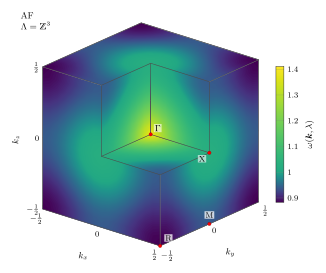
Dispersion relation for an antiferromagnetic coupling λ = −0.03 at higher order r = 10 and finer resolution with 16³ = 4096 momentum points, requiring approximately 10 minutes on a single core (taken from arXiv:2609.18918).
The definition of the graph zeta function and the quick start continue in the README on GitHub. For an extensive discussion of all front-ends, general interaction kernels, the worked examples, the engines and the full API reference, see DOCUMENTATION.md.
1 maintainer

Release files for gzl 1.0.0
For a detailed explanation of source distributions (sdists) and built distributions (wheels), please see the package formats documentation.
Source distribution (sdist)
| File | Size | Uploaded | |
|---|---|---|---|
| gzl-1.0.0.tar.gz | 1.2 MB | Details |
Built distribution (wheel)
| File | Interpreter | ABI | Platform | Reset |
|---|---|---|---|---|
| gzl-1.0.0-py3-none-any.whl | Python 3 | none | any | Details |
Total release size: 2.5 MB
Release files / gzl-1.0.0.tar.gz
| Download URL | gzl-1.0.0.tar.gz |
|---|---|
| Size | 1.2 MB |
| Tags | Source |
|
SHA-256 checksum How to use checksums |
0857677b38539cb56efe3105c6f7514a1132329d814eea13393872e3b011e296
|
|
BLAKE2b-256 checksum How to use checksums |
c251257438733cd52aa356c618e833d0577153a896612ccc1d8736695016966a
|
| Upload date | |
|
Uploaded using Trusted Publishing? What is trusted publishing? |
Yes |
| Uploaded via |
twine/7.0.0 CPython/3.13.14
|
Provenance
Provenance describes where a file came from. On PyPI, provenance is shared via attestations, which provide a verifiable record of the build or publishing details. View details, limitations and caveats.


PyPI Publish Attestation
PyPI verified that this artifact, at this checksum, originated from the publisher listed below.
Signed by GitHub Actions, verified by PyPI on Sep 25, 2026.
Transparency logRelease files / gzl-1.0.0-py3-none-any.whl
| Download URL | gzl-1.0.0-py3-none-any.whl |
|---|---|
| Size | 1.3 MB |
| Tags | Python 3 |
|
SHA-256 checksum How to use checksums |
efa2e6fe3fbe92980fcecec3b64f956adab10ea0a256693a83a66f76611803cc
|
|
BLAKE2b-256 checksum How to use checksums |
1c9e388533245c24142e13340e173541bf42a49a0a9f0dfdba3e92db0ab50dee
|
| Upload date | |
|
Uploaded using Trusted Publishing? What is trusted publishing? |
Yes |
| Uploaded via |
twine/7.0.0 CPython/3.13.14
|
Provenance
Provenance describes where a file came from. On PyPI, provenance is shared via attestations, which provide a verifiable record of the build or publishing details. View details, limitations and caveats.
PyPI Publish Attestation
PyPI verified that this artifact, at this checksum, originated from the publisher listed below.
Signed by GitHub Actions, verified by PyPI on Sep 25, 2026.
Transparency log












