
H2ORB – H₂O Result Browser
A result browser and reporting tool for test-management data. The current integration analyses AQUA test results through a server-side REST API proxy: credentials and direct communication with AQUA remain on the server, while users work through a browser interface.
H2ORB is an independent project and is not affiliated with or endorsed by any test-management vendor.
Current state
This repository contains a locally runnable FastAPI application with an asynchronous AQUA v26.30.0.0 REST client. Projects and folders can be selected in the browser and the application loads the corresponding scenarios, test cases, latest executions, and AQUA defects through its server-side proxy.
The domain layer already implements the central aggregation rules:
- every test case occurrence is evaluated in its own test scenario;
- only the latest execution within that scenario is considered;
- failed executions are classified as
F(regular defect),N(defect marked as noise), orN?(not yet linked to a defect); Xis the derived total of all failed results:X = F + N + N?;- compact rates and aggregate totals are calculated bottom-up for every tree level.
Results are displayed in a compact German/English desktop interface as an expandable explorer tree.
Project and folder rows are followed by test
scenario (TS), test case (TC), execution (TE), and defect (DF) nodes. A test case contributes
exactly one result. Execution and defect detail rows do not contribute additional results. Counts
are aggregated bottom-up to scenarios, folders, and the selected project. See
docs/result-tree.md for the complete presentation and aggregation rules.
Passed test cases are grouped below each scenario, while an optional failure-focused view shows
only F, N, and N? results and automatically opens their containing paths.
The in-page report preview includes AQUA defect descriptions and links to scenarios, test cases,
executions, and defects. The same report can be downloaded as Markdown. Its complete contract is
specified in docs/report-contract.md.
The manual/automated distinction uses AQUA's standard TestExecutionType values (Manual and
Automated). The application deliberately does not depend on company-specific fields, labels, or
workflow terminology.
Screenshots
Expandable result tree
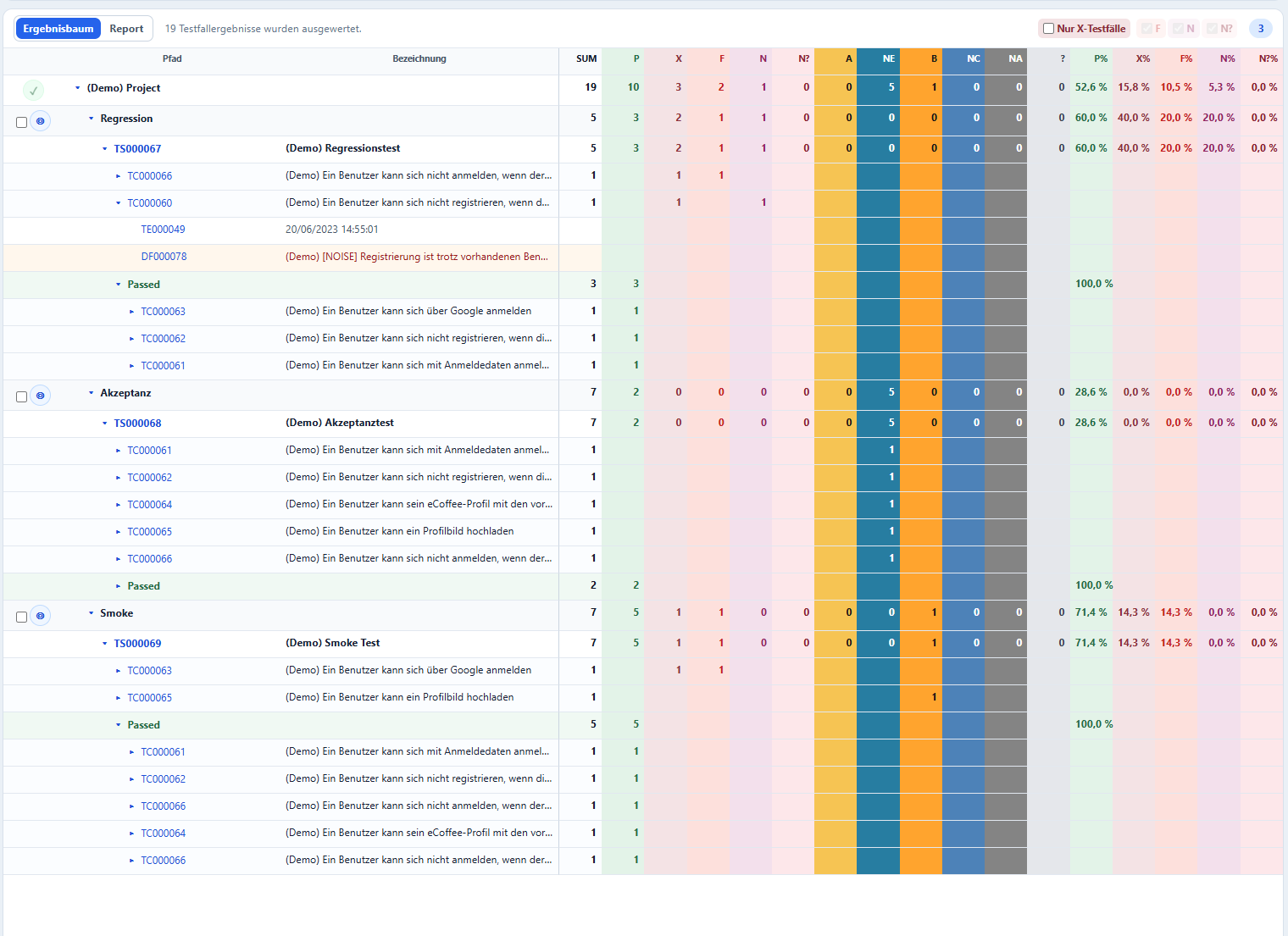
The desktop-oriented result tree keeps paths, scenarios, test cases, executions, defects, status counts, and rates visible in one compact view. Passed test cases are grouped separately below each scenario.
Failure-focused analysis
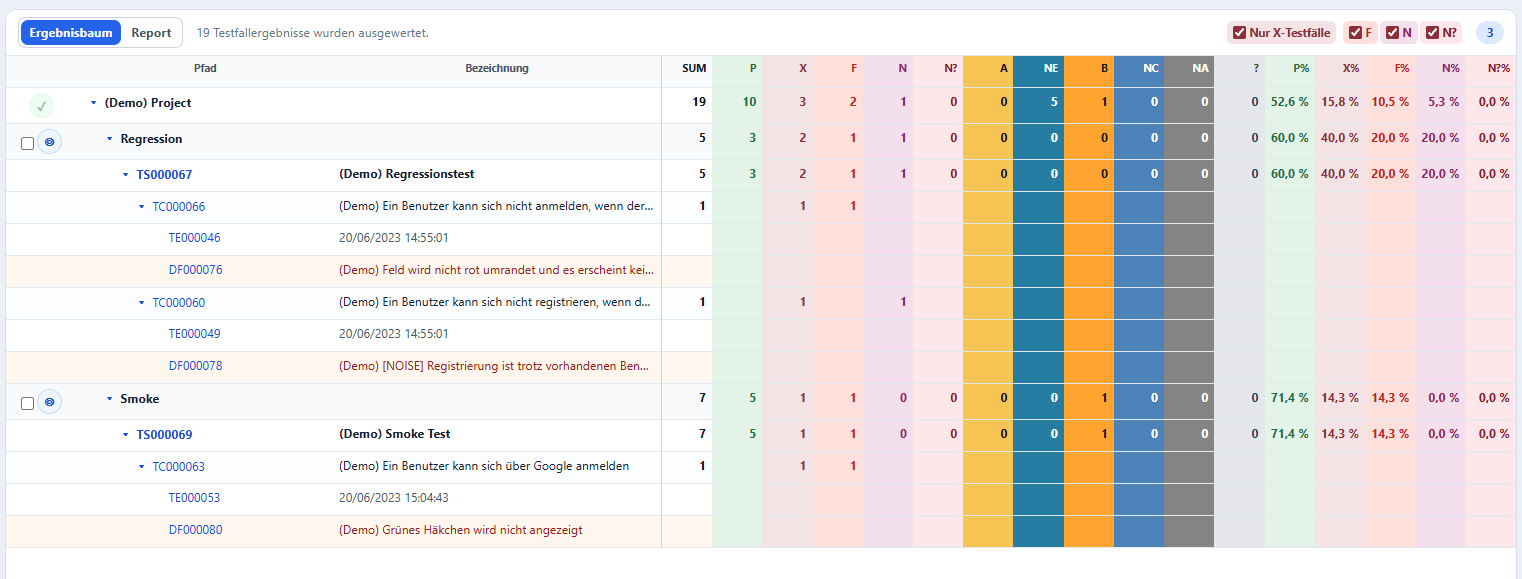
The Nur X-Testfälle filter hides successful and otherwise irrelevant results. The remaining
failures can be narrowed further to regular defects (F), confirmed noise (N), and unclassified
failure candidates (N?).
Select report summary sections
Folder checkboxes select additional summary rows. The selected root folder is always included as the highlighted overall result.

Test completion report
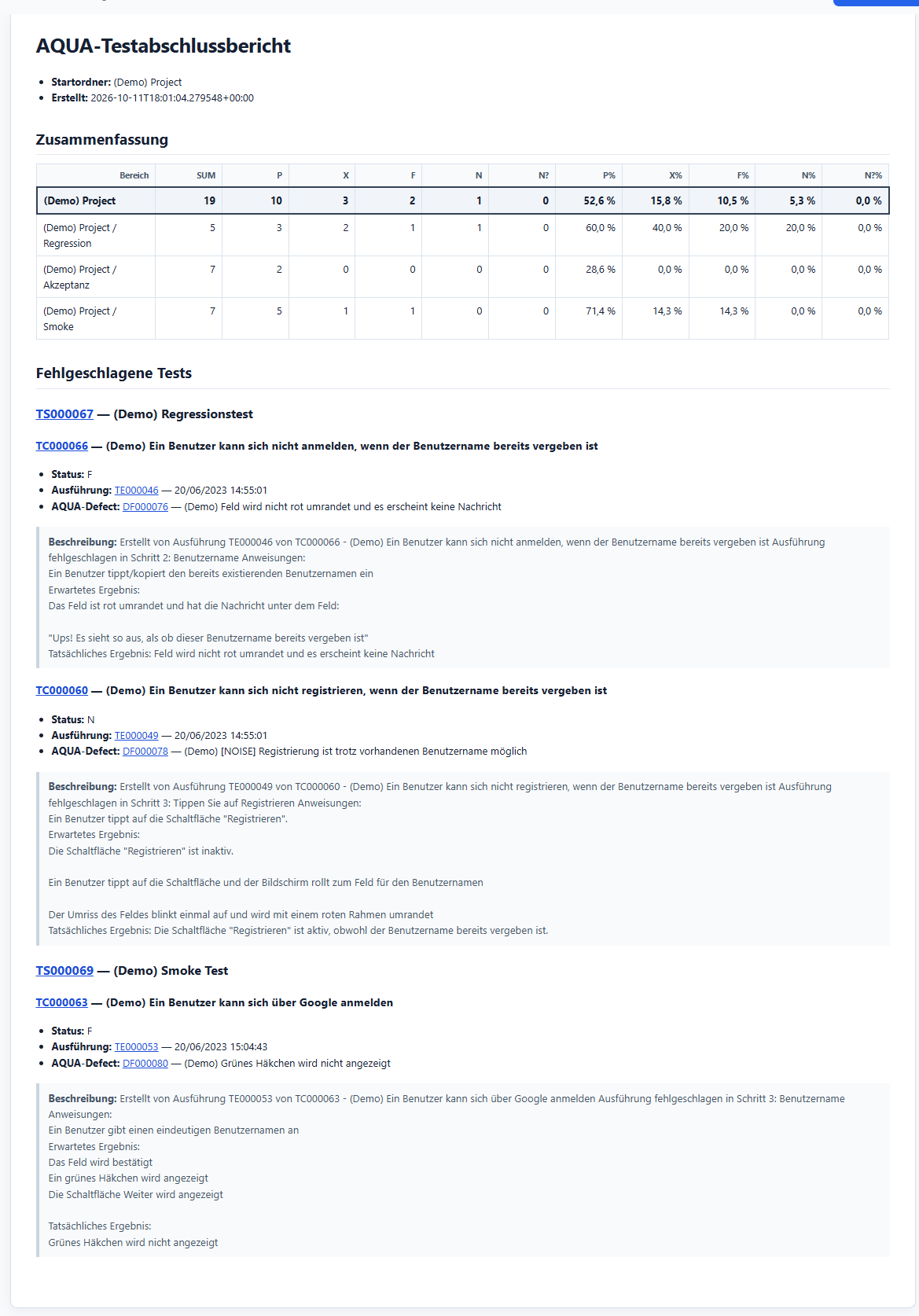
The report combines the selected summary rows with failed test details, latest executions, AQUA defects, defect descriptions, and direct links back to AQUA. It can also be downloaded as Markdown.
Install from PyPI
Python 3.12 or newer is required:
py -m pip install h2orb
h2orb
Open http://127.0.0.1:8000 after configuring the required ARB_ environment variables.
Local setup
Python 3.12 or newer is required.
py -3.12 -m venv .venv
.venv\Scripts\Activate.ps1
python -m pip install -e ".[dev]"
Copy-Item .env.example .env
python -m h2orb
Open http://127.0.0.1:8000. API documentation is available at http://127.0.0.1:8000/docs.
Configuration uses environment variables prefixed with ARB_. Do not commit .env or real AQUA
credentials.
Security notice for the current version
The current version uses the AQUA credentials configured centrally through environment variables. Consequently, every person who can reach the H2ORB web interface can read the AQUA projects and test data available to that account.
- Run H2ORB only in a trusted internal network.
- Do not publish port
8000directly on the Internet. - Restrict access with firewall rules; a reverse proxy with HTTPS and access control is recommended.
- Use a dedicated, read-only AQUA account with only the projects H2ORB is intended to display.
- Keep
.env, passwords, certificate keys, and access tokens outside the image and repository. - Treat generated reports as potentially confidential test data.
The next version is planned to request personal AQUA credentials and keep separate server-side sessions for individual users. Until that authentication is implemented, network-level access control is mandatory.
Docker
Run the published image
After creating a local .env from .env.example, pull and run the public linux/amd64 image:
docker pull hrabovszki/h2orb:main
docker run --detach --name h2orb `
  --restart unless-stopped `
  --env-file .env `
  --env ARB_HOST=0.0.0.0 `
  --publish 8000:8000 `
  hrabovszki/h2orb:main
Use an immutable version or sha-* tag for reproducible deployments. The main tag tracks the
latest successful build from the main branch.
Build locally
Build and start the local container with the existing .env configuration:
docker compose up --build -d
docker compose ps
Open http://127.0.0.1:8000. Stop and remove the container with:
docker compose down
The image runs as an unprivileged h2orb user, exposes port 8000, and checks /health. The .env
file is excluded from the build context and is injected only when the container starts.
To test the AQUA connection from the built Linux image:
docker compose run --rm h2orb python -m h2orb.check_connection
If AQUA uses an internal certificate authority, mount its PEM bundle read-only and configure the path inside the container:
services:
  h2orb:
    environment:
      ARB_AQUA_CA_BUNDLE: /certificates/company-ca.pem
    volumes:
      - ./certificates/company-ca.pem:/certificates/company-ca.pem:ro
TLS verification remains enabled. Do not add certificates, .env, passwords, or access tokens to
the image.
Publish from Gitea to Docker Hub
Gitea Actions verifies the Python project inside a Python 3.12 Docker build stage, then publishes the tested
linux/amd64 image as hrabovszki/h2orb. Configure these repository secrets in
Gitea before running .gitea/workflows/docker-publish.yaml:
DOCKERHUB_USERNAME: Docker Hub account nameDOCKERHUB_TOKEN: Docker Hub personal access token with read, write, and delete permissions
A push to main publishes the moving main tag and an immutable sha-* tag. A tag such as
v0.1.0 publishes 0.1.0, 0.1, 0, and latest. Prerelease tags never move latest.
After a successful image push, the workflow also synchronizes this README and the short description
to the Docker Hub overview page.
Never store the Docker Hub password or token in Git. Use a scoped access token instead of the account password.
License
H2ORB is source-available under the H2ORB Community License. Non-commercial use is permitted; commercial use requires a separate commercial license. This is not an OSI-approved open-source license.
Development checks
ruff check .
pytest
Project structure
src/h2orb/
├── api/          # HTTP routes exposed to the browser
├── aqua/         # AQUA REST API adapter
├── domain/       # framework-independent models and rules
├── services/     # application use cases
├── static/       # browser assets
└── templates/    # server-rendered HTML
Place the reviewed Swagger reference under docs/aqua-api/. Check it for internal host names,
credentials, tokens, or other sensitive information before committing it.
The current endpoint mapping is documented in docs/aqua-api/endpoint-mapping.md.
1 maintainer

Metadata
1 maintainer
Release files for h2orb 0.1.1
For a detailed explanation of source distributions (sdists) and built distributions (wheels), please see the package formats documentation.
Source distribution (sdist)
| File | Size | Uploaded | Provenance | Actions |
|---|---|---|---|---|
| h2orb-0.1.1.tar.gz | 380.9 kB | Without provenance | Details for h2orb-0.1.1.tar.gz |
Built distribution (wheel)
| File | Interpreter | ABI | Platform | Actions Reset |
|---|---|---|---|---|
| h2orb-0.1.1-py3-none-any.whl | Python 3 | none | any | Details for h2orb-0.1.1-py3-none-any.whl |
Total release size: 416.6 kB
Release files / h2orb-0.1.1.tar.gz
| Download URL | h2orb-0.1.1.tar.gz |
|---|---|
| Size | 380.9 kB |
| Tags | Source |
|
SHA-256 checksum How to use checksums |
f4c29d896b877be665cba92da345a6deb8f2a1b828c9c6e6cb3ba8993aa6c5a3
|
|
BLAKE2b-256 checksum How to use checksums |
b4d1f219b3aa3e25d492ea2f8a09bf9f7e7d757a1647a17069b22347457e1120
|
| Upload date | |
|
Uploaded using Trusted Publishing? What is trusted publishing? |
No |
| Uploaded via |
twine/7.0.0 CPython/3.13.5
|
Release files / h2orb-0.1.1-py3-none-any.whl
| Download URL | h2orb-0.1.1-py3-none-any.whl |
|---|---|
| Size | 35.7 kB |
| Tags | Python 3 |
|
SHA-256 checksum How to use checksums |
7da940617dee4f6d39549c02fade3ec46de896c8905cf88a4de492454a78db97
|
|
BLAKE2b-256 checksum How to use checksums |
0652b0e0a34587a767c2f897bd634d8a9ac9954265d0fc8a980424480729aaad
|
| Upload date | |
|
Uploaded using Trusted Publishing? What is trusted publishing? |
No |
| Uploaded via |
twine/7.0.0 CPython/3.13.5
|
Security for h2orb 0.1.1
Provenance
Provenance describes where a file came from. On PyPI, provenance is shared via attestations, which provide a verifiable record of the build or publishing details. View details, limitations and caveats.
No provenance found
None of the files in this release were uploaded with provenance metadata.
A note on package security
PyPI is a repository for distributing packages, not a service for auditing them. While third-party security researchers and our staff do their best to detect and remove malicious packages, PyPI cannot guarantee the quality, security or suitability of any given package.
To learn more about protecting yourself from malicious actors, visit our package security documentation.














