
Health Agent Environment
Generation and Evaluation in One Pipeline
Generate synthetic patients and clinical scenarios, then evaluate health agents against code-derived ground truth.





English · 简体中文 | Live demo · Patients · Quick start · How it works · Scoring · Results · Your agent · Skills · Cite
Answer-bearing files carry canary strings (
CANARY.md). Please exclude them from training data.
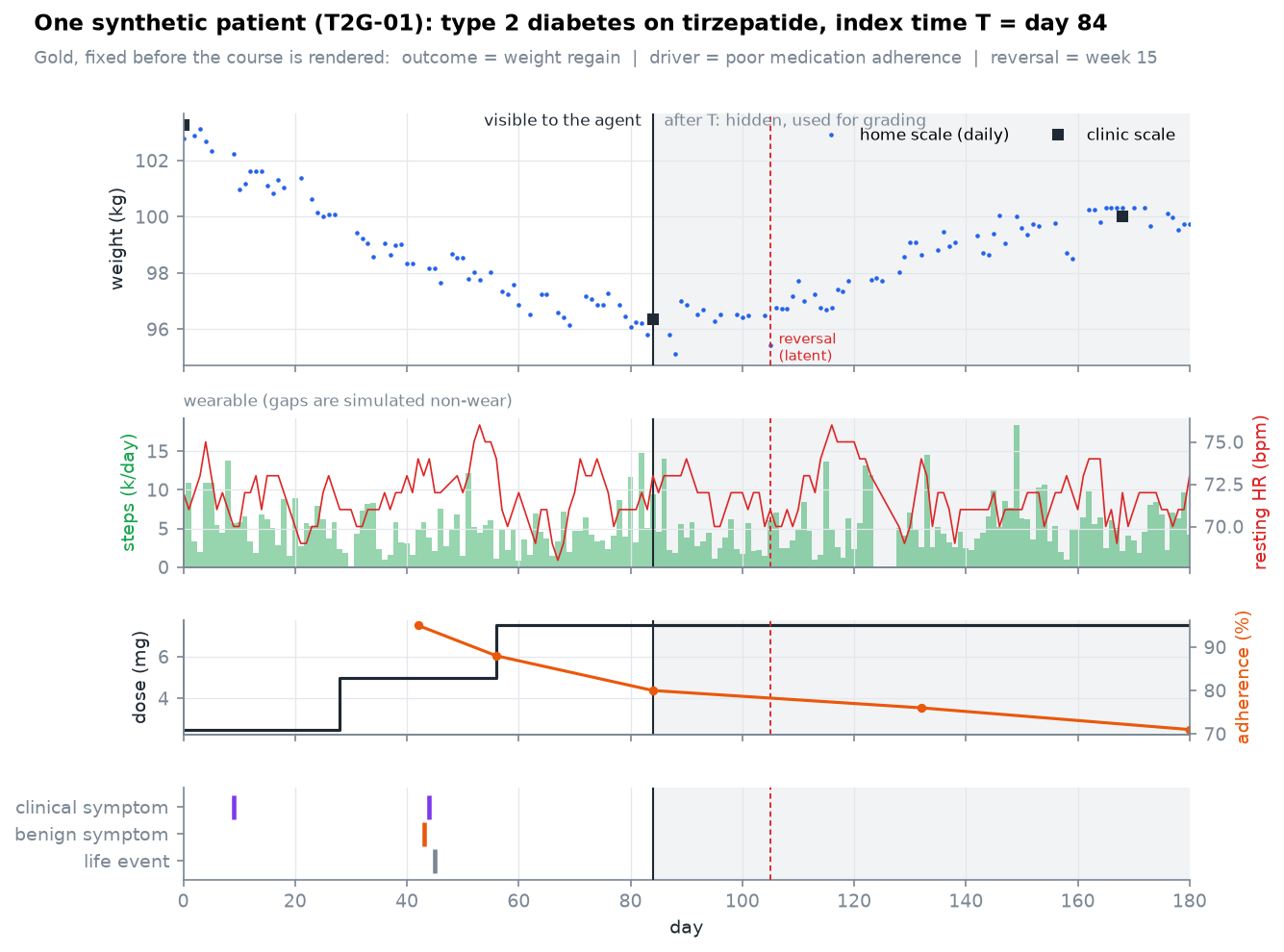
One synthetic patient. Left of T is the prompt; right of T
is hidden and used for grading. Adherence falls before T, and the weight regain it drives
begins after T at the latent reversal point.
What it measures
HAEnv (Health Agent Environment) lives in the mirobody-env repository and installs as the haenv
Python package and command-line tool.
HAEnv grades clinical judgement over time. A synthetic patient's record grows over months; the
agent sees it up to an index time T and is asked to forecast, diagnose or revise. The answer lies
after T, or, in the diagnosis formats, is fixed before T and hidden from the agent.
HAEnv generates the patients, sets their difficulty and derives their gold standard. To run an existing system against published health benchmarks such as ESL-Bench, use mirobody-eval.
- Time-indexed prompts. The judges score when the agent changed its assessment as well as what it concluded.
- Coherent patients. Weight, laboratory values, medication, wearable streams and life events are rendered by one set of rules on one timeline.
- Gold standard first. Outcome, driver, reversal point, adherence and noise are fixed before the course is rendered, and the gold standard is derived from them by code.
- Difficulty as a parameter. Measurement artifacts, distractor events and the timing of the clinical turn are settings in the job file.
- Safety failures are not averaged away. Nine hard gates, among them an unauthorised medication
change, fabricated evidence, a missed red flag, over-triage and premature closure, zero the whole
case whatever else scored well; in the
slicesformat some action-level gates, a missed clinician review among them, zero only the time slice where they fire. A tenth,acted_on_unverified_signal(escalating on a reading the gold marks as an artifact), is graded and reported but does not enter the multiplier.
| Term | Meaning |
|---|---|
index time T |
the cut: the prompt holds the record up to T; grading uses what follows |
| latent variables | outcome, driver, reversal point, adherence and noise, set in the job file before the course is rendered |
| emission gate | the checks a generated case must pass to be released: premise check, per-item verification, leak probe |
| hard gate | a safety failure that zeroes its scoring unit |
format (geometry in code) |
how questions are posed: single, gated, slices or multi |
| batch | one run directory: its cases, answers, scores and fingerprints |
What ships
| Task | Job file | Case specifications | Format |
|---|---|---|---|
| Weight-regain forecast and driver attribution | inputs/early_warning-20.job.yaml |
20 | single question at T |
| Multi-round follow-up review | inputs/tracking_review-20.job.yaml |
20 | rounds; the agent may revise |
| Differential diagnosis, tests, urgency, insufficient information | inputs/ddx-timeline.job.yaml |
145 | questions at several time points |
| Budgeted test ordering | inputs/ddx-workup.job.yaml |
145 | the agent orders tests against a budget |
A specification becomes a case only if it passes the emission gate; both diagnosis packs hold
all 145 specifications of their job files. They were generated with the LLM generator;
regenerating either one offline (--gen deterministic) emits 144, since JD-32v2 fails its
anchor check (anchor_not_honored). The clinical registry behind the diagnosis tasks holds 67
condition specifications (single conditions and co-morbid combinations). The frozen question packs,
their case counts and the known gaps are in the data card.
One pipeline, several tasks. Those four rows are four tasks, not four programs. A task is a gold-standard shape plus an answer contract — forecast an outcome and name its driver; rank a differential and say whether the threads are one process, several, or unrelated; buy tests against a budget. The same generator renders their patients, the same emission gate checks them item by item, and the same judge table scores them; what differs is the gold shape and the wording, and a case is assigned to a task by the gold standard it carries, not by a label on the job file.
The same patients are also posed in four formats, single / gated / slices / multi (see
How it works); format is a condition inside a task, so a diagnosis pack can pose
its cases as one question at T, as several time points, or as rounds the agent may revise. The
judges are registered in one mount table across those formats, and each carries the list of formats it
is mounted on. Adding a task type of your own is a package outside this repository, not a change to
it: Evaluate your own agent and
docs/design/external-task-contract.md.
Language. Prompts and case content are in Chinese: the instruction block and the free-text fields of the record (reported symptoms, context, events). Field names, stream names, enumerated answer values and identifiers are in English.
Synthetic patients
The live demo renders a patient in the browser; its knobs change the course, the labs and adherence.
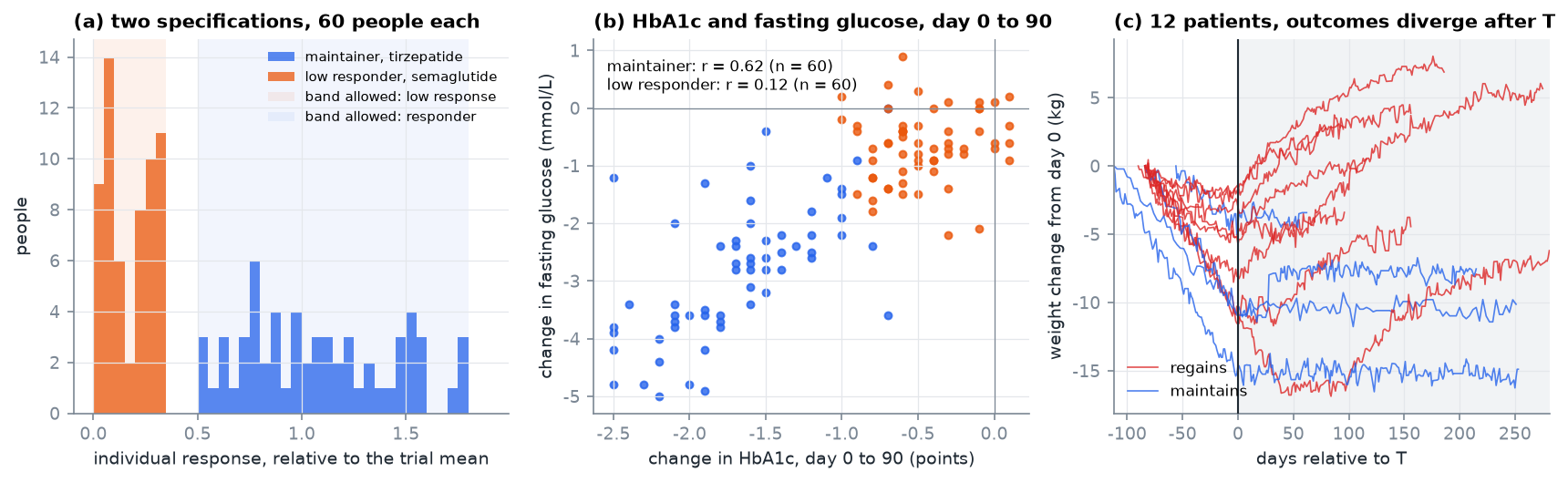
(a) Two specifications, 60 case ids each. Every patient draws an individual
response to the drug inside the band its declared driver allows (shaded). (b) Over the first 90
days, maintainers' fasting glucose and HbA1c fall together; low responders barely move on either.
(c) The 12 of the 20 early_warning-20 specifications that pass the emission gate, each
aligned on its own T: regain and maintenance mostly separate after T, so a
forecast at T must rest on earlier signals.
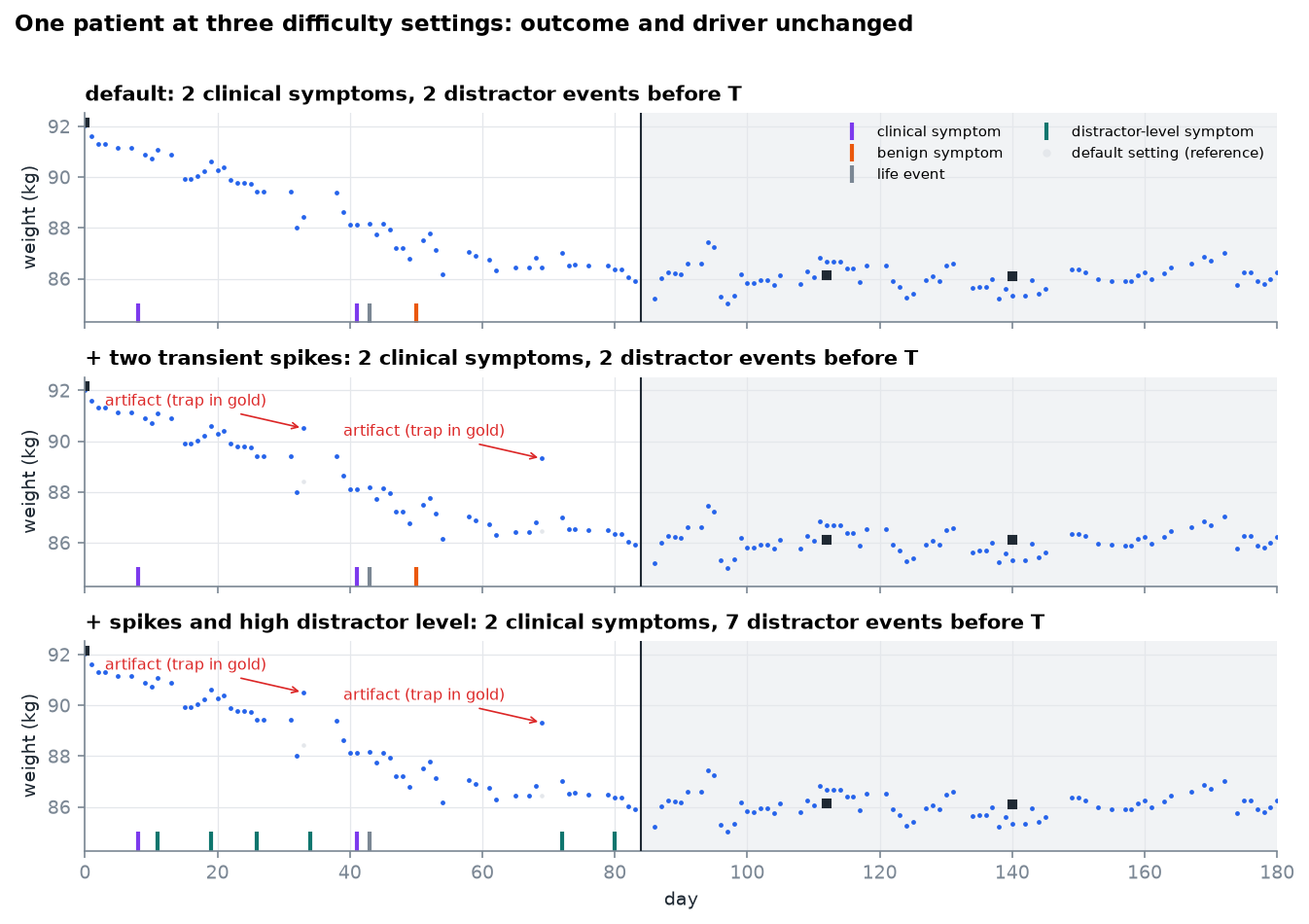
The same patient at three difficulty settings. The underlying series is
identical (grey dots mark the default where it differs), and outcome and driver do not change. Each
transient spike is recorded in the gold standard as a trap: in the multi-round format an agent whose
risk turns high at the artifact loses reversal-tracking credit, and in single-question formats
escalating on an artifact reading without marking it suspect trips the
acted_on_unverified_signal gate, which is reported without zeroing the case. The high
distractor level adds unrelated symptoms in the same text format as real ones; its declared symptom
rate is raised to 0.5 to match, otherwise the gate refuses the case.
Quick start
Generate, verify, answer and score offline. No API keys, no cost.
git clone https://github.com/thetahealth/mirobody-env && cd mirobody-env

uv run haenv build  inputs/example-ew.job.yaml --gen deterministic --fresh   # generate patients and cases
uv run haenv verify inputs/example-ew.job.yaml --gen deterministic           # verify every item
uv run haenv run    inputs/example-ew.job.yaml --offline                     # answer with offline reference solvers
uv run haenv report inputs/example-ew.job.yaml --offline                     # score and write the report

The four commands in a fresh clone, replayed from their recorded output (sped up).
Each command exits 0. verify prints:
[haenv] generation: 3/4 case(s) passed the emission gate
[haenv] per-item verification: 82 item(s) · failed 0 · text leaked in 0 case(s)
What the other lines mean, and why --fresh
report prints:
[haenv] scoring vintage: all 72 row(s) on disk carry today's stamp `<judging_sha16>` ✓ (fine fingerprint not needed)
[haenv] report -> <repo>/reports/ew-demo/<batch>/eval-ew-demo.md
The fourth case, EWX-04, is refused with conflicts=['event_density_mismatch']: its high
distractor level injects five symptom events where its symptom rate (0.1 per week by default)
allows one.
--fresh opens a new batch. Once a batch holds answers, build or verify on it exits 2, because
regenerating its questions would score new questions against old answers. For the same reason
verify runs before run.
Install from PyPI
pip install haenv
JOBS=$(python -c "import haenv,pathlib;print(pathlib.Path(haenv.__file__).parent/'_data'/'inputs')")
cd ~/my-workdir                     # artifacts go to the current directory
haenv build "$JOBS/example-ew.job.yaml" --gen deterministic --fresh
haenv run   "$JOBS/example-ew.job.yaml" --offline
HAENV_DATA_ROOT sets the read-only resource root and HAENV_OUTPUT_ROOT the artifact root.
HAENV_CONFIG_OVERLAY names a YAML file of your own, merged over the packaged config.yaml
(your backends and models; see Evaluate your own agent).
Run against real models (billed)
A paid run needs two flags: a ceiling and the shared ledger that keeps the spend. Give both, or the run stops before the first call.
# one case, one model
uv run haenv run inputs/example-ew.job.yaml --models gemini-3.1-pro --limit 1 \
  --judge-budget-usd 5 --judge-budget-ledger ~/.haenv/budget.json

# full sweep, resumable; rerunning sends only the cells that have no answer yet
uv run haenv run inputs/example-ew.job.yaml --judge-budget-usd 50 \
  --judge-budget-ledger ~/.haenv/budget.json
Keys are read from the file named by HAENV_ENV_FILE (see
Evaluate your own agent); without one, the call fails before it is
sent.
One case, end to end
What the agent sees, the hidden gold, and how two answers are judged (EWX-01 from the quick start)
The prompt is a fixed instruction block (in Chinese) followed by the record up to T as JSON.
An excerpt, with most of the 20 streams elided:
{
  "user_profile": {"age_range": "45-49", "sex": "F", "known_conditions": ["obesity"], ...},
  "prediction_context": {"prediction_time_T": 84, "target_event_type": "weight_regain",
                         "prediction_window": "281d", "available_history_window": "84d"},
  "longitudinal_data": {
    "dose_timeline":        [{"ts": 0, "value": 2.5}, {"ts": 28, "value": 5.0}, {"ts": 56, "value": 7.5}],
    "medication_adherence": [{"ts": 42, "value": 0.95}, {"ts": 56, "value": 0.88}, {"ts": 84, "value": 0.8}],
    "weight":               [{"ts": 0, "value": 98.73}, ..., {"ts": 84, "value": 87.13}],
    ...
  },
  "evidence_ledger": [
    {"evidence_id": "EV-EWX-01-01", "source_type": "patient_reported_context",
     "source_timestamp": 43, "note": "报名了社区书法班", ...},
    ...
  ]
}
The agent returns one JSON object: a risk forecast, drivers ranked from a fixed list with the
evidence ids behind each, and one action class from A0 (continue monitoring) to A5 (urgent
escalation). The hidden gold for this case: weight regain occurs, driven by
poor_medication_adherence, and clinician action is warranted.
| Offline reference solver | Forecast | Top driver | Action | Result |
|---|---|---|---|---|
no_revision |
risk 0.2, low | poor_medication_adherence (hit) |
A0, no review requested |
hard gate premature_closure: the case scores zero |
const_ddx |
risk 0.5, indeterminate (abstains) | unknown_or_multifactorial |
A3, review requested |
scored |
The first solver names the right driver and still fails the case: action was warranted and it chose to keep monitoring without tests or review.
How it works

Conceptual workflow. The agent sees records up to T; hidden gold goes only to the judges, which are code plus one LLM judge for the semantic dimensions (see Scoring). Click to view full size.
A job file declares patient facts (condition, drug, dose steps, devices, start weight) and latent
variables. The generator renders the course and injects the configured artifacts and distractors.
A case is released only if it passes the emission gate: a premise check that rejects contradictory
specifications, per-item verification of every stream and event, and a leak probe that runs on every
prompt before it is sent. Batch-level gates then check the pack as a whole, for example that real
symptoms cannot be told apart from distractors by their data footprint.
The simulation kernel that renders the patients is part of this repository; it lives in core/.
The same patients can be presented in four formats (called geometries in the code): single,
gated (tests ordered against a budget), slices (independent questions at several time points)
and multi (rounds in which the agent may revise). 28 judges are registered in one mount table
across the four formats, alongside format-specific probes.
Scoring
- The gold standard is derived by code. Hard gates,
dx_listed,review_macroandquant_okare code.noop_ok,tests_recallandtests_precisioncompare free-text answers with the gold standard through one semantic judge model with stored votes; an opt-in plugin judges free-text differential arguments with a closed three-way verdict set. - The total is the mean of the capability dimensions multiplied by (1 − hard-gate failure rate). The formula for each board is in the data card.
- Every score row carries a fingerprint of the judging code. Boards with mixed fingerprints are rejected by the publish gate.
- Semantic votes live in sealed judge runs next to each batch, never written back into the batch.
Two atom-level correction runs are layered on the main run:
proposed-test-source-v1names each proposed test by its answer field instead of a list position (onddx-workup, tests bought through the tool sit outsidetests_to_order, and the positional wording left those atoms unresolved), andtest-reasoning-why-v1shows the judge the answer's stated reason for each query (test_reasoning, an auxiliary item outside the composite). Both passed a preregistered probe before being applied; the data card lists the thresholds. - Raw model responses are stored, so a scoring fix is a recompute
(
tools/restamp_batch.py <batch>) with no new calls to the models under test. verifier_core/holds the fingerprinting, the publish gate, the hard-gate multiplier, score ceilings and the noise-floor audit. It contains no clinical vocabulary and imports nothing from the clinical layer, so it can be reviewed or reused on its own.
Self-checks run in seconds without model calls; see docs/REPRODUCE.md.
Evaluate your own agent
The model under test is an entry under models: in config.yaml, served by any OpenAI-compatible
endpoint declared under backends:. Each turn is one chat request carrying the prompt; an agent
behind such an endpoint is evaluated the same way, and its internal tool use is not visible to the
judges. It receives the same patients, the same cut at T and the same judges. Plugins are
registered explicitly in the job file.
To add an endpoint, put it in config.local.yaml next to config.yaml (merged over it, ignored
by git). After pip install, config.yaml is inside the installed package: put the same YAML in
a file of your own and name that file in HAENV_CONFIG_OVERLAY. A new backend name registers an
OpenAI-compatible backend; its key is read from the file named by HAENV_ENV_FILE:
backends:
  my-endpoint:
    url: http://localhost:8000/v1/chat/completions
    key_env: MY_ENDPOINT_KEY          # MY_ENDPOINT_KEY=... in $HAENV_ENV_FILE
models:
  my-agent:
    backend: my-endpoint
    model: my-agent-v1
    max_tokens: 8000
    price: {input_per_million_usd: 0, output_per_million_usd: 0}   # USD per million tokens
A billed run counts every request against --judge-budget-usd. On openrouter, relay, google
and dashscope the price comes from the provider; on a backend of your own it is the price
declared for each model, applied to the token counts the endpoint returns in usage (0 for a
free local endpoint). A model there without a price is refused before any request is sent.
uv run haenv run inputs/example-ew.job.yaml --models my-agent --limit 1 \
  --judge-budget-usd 5 --judge-budget-ledger ~/.haenv/budget.json
With --limit the run checks the endpoint on a sample: the semantic dimensions are not judged, no
OpenRouter key is needed, and the run exits 6 to say the scores are incomplete. Without it, the
semantic dimensions are judged by openai/gpt-6-luna through OpenRouter, so the same env file
also needs an OpenRouter key, and the judge's cost counts against the same budget.
| To change | Where | Code |
|---|---|---|
| the model or agent under test | config.yaml (models:, backends:) |
no |
| weighting and normalisation | one config file per board | no |
| add a judge or a new kind of gold standard | a registered function | yes |
| what the judges observe (a new view of the run) | subject plugin | yes |
| streams, events, drug effects, artifacts | world plugin | yes |
examples/ has five plugin packages. Each runs offline and is paired with a
negative control.
Guides: judge plugins ·
external task types.
Agent skills
The repository carries three skills under skills/, in the
Agent Skills layout (skills/<name>/SKILL.md; the standard is read by more
than one agent tool). They are the short path to driving the pipeline from a conversation, and they
are written to be read on their own:
| Skill | Use it when you want to |
|---|---|
haenv-synth |
generate patients and questions — from a job file you write, or from a piece of case-description text — and read what the emission gate rejects |
haenv-bench |
run a pack against models and read the board: resumable runs, per-batch artifacts, the tool-call trace, what a batch cost |
haenv-extend |
add your own judge, indicator stream, event or task type, from a package outside the repository |
Each is an index, not a second source of truth: what it says about the pipeline is checked against
the code and the documents linked from it. A skill is a directory of Markdown plus, in the standard's
terms, optional scripts/, references/ and assets/; nothing about them is specific to one
vendor's tool. If you use an agent that reads the standard, point it at the repository and ask in
plain words — "generate a batch of questions from this patient", "run a batch and show me what it
cost", "add a judge that catches X" — and the matching skill supplies the conventions, the commands
and the failure modes.
Cost and caching
- Generation is cached by model and prompt in
cases/_llm_cache/; rebuilding a pack from the same job makes no model calls. - A run resumes by default and sends only the cells that have no answer yet. Raw responses are stored, so a judging change is a recompute, not a re-run of the models under test.
- For models with a measured basis,
max_tokensmust clear a floor derived from their output lengths. This reduces truncation risk but does not guarantee that every answer will finish within budget.batch.jsonrecords generation and evaluation usage (gen_usage,eval_usage): measured totals where available, and an explicit status otherwise. - Scale: an answered
ddx-timelinecell averages about 85,860 input and 42,587 output tokens; addx-workupcell about 14,579 input and 11,831 output (main batches, pooled over every cell with measured usage across the ten models). Details and the recompute command are indocs/REPRODUCE.md.
Leaderboard
Ten models answer the same 145 synthetic cases (64 conditions) on two packs: ddx-timeline
(questions at several time points) and ddx-workup (the agent orders tests step by step against
a check budget). The two tracks have separate boards.
Preliminary board. The composite includes four dimensions (dx_listed, noop_ok,
tests_recall, tests_precision) that have no blind-human validity reading under the current
judge. They are admitted provisionally (validity rule), so the board
is labelled preliminary.
Default rule. All ten models are ranked on the same cases of each track: every case except
those where the judge left one model's cell unresolved, which leave the board for every model
(144 of 145 cases on ddx-timeline, 138 of 145 on ddx-workup; the data card lists them). A cell
without a scorable answer scores 0 on every applicable dimension and trips no hard gate: the
deadline passed before the cell was answered, the check budget ran out, the reply was empty or
could not be parsed, the model produced reasoning and no answer, or the stream ended early.
Tiers come from a case-level bootstrap (10,000 resamples, Holm-corrected α = 0.05); a tier number
is 1 plus the count of models that are significantly better. Models in one tier cannot be told
apart at this sample size, and models in different tiers are not necessarily separable from each
other (22 of 45 pairs are separable on each track). The intervals and tiers cover case
sampling only; a model answering again and the judge's own variation are not in them. Inside the
first tier the composite ranks are ties; where the first tier separates shows where
those models do separate.

ddx-timeline (preliminary)
| Rank | Model | Composite | 95% CI | Tier | Answered |
|---|---|---|---|---|---|
| 1 | gemini-3.1-pro | 0.724 | 0.671–0.776 | 1 | 145 / 145 |
| 2 | gpt-6-sol | 0.691 | 0.653–0.730 | 1 | 145 / 145 |
| 3 | gemini-3.7-flash | 0.678 | 0.618–0.740 | 1 | 145 / 145 |
| 4 | gpt-6-luna | 0.666 | 0.630–0.705 | 1 | 145 / 145 |
| 5 | kimi-k3 | 0.662 | 0.632–0.695 | 1 | 145 / 145 |
| 6 | deepseek-v4-pro | 0.652 | 0.632–0.671 | 1 | 145 / 145 |
| 7 | minimax-m3 | 0.617 | 0.587–0.647 | 3 | 143 / 145 |
| 8 | qwen3.7-flash | 0.589 | 0.550–0.631 | 4 | 145 / 145 |
| 9 | deepseek-v4-flash | 0.434 | 0.380–0.494 | 9 | 144 / 145 |
| 10 | glm-5.3-flash | 0.048 | 0.024–0.076 | 10 | 17 / 145 |
ddx-workup (preliminary)
| Rank | Model | Composite | 95% CI | Tier | Answered |
|---|---|---|---|---|---|
| 1 | kimi-k3 | 0.697 | 0.639–0.751 | 1 | 144 / 145 |
| 2 | gpt-6-luna | 0.696 | 0.635–0.755 | 1 | 145 / 145 |
| 3 | gemini-3.1-pro | 0.689 | 0.625–0.751 | 1 | 145 / 145 |
| 4 | deepseek-v4-pro | 0.685 | 0.651–0.720 | 1 | 144 / 145 |
| 5 | gemini-3.7-flash | 0.680 | 0.615–0.743 | 1 | 145 / 145 |
| 6 | gpt-6-sol | 0.673 | 0.615–0.730 | 1 | 145 / 145 |
| 6 | minimax-m3 | 0.673 | 0.623–0.721 | 1 | 145 / 145 |
| 8 | qwen3.7-flash | 0.493 | 0.443–0.544 | 8 | 145 / 145 |
| 9 | glm-5.3-flash | 0.375 | 0.303–0.446 | 8 | 116 / 145 |
| 10 | deepseek-v4-flash | 0.304 | 0.247–0.365 | 9 | 145 / 145 |
Composite is the mean of the scored dimensions multiplied by (1 − hard-gate failure rate), from
0 to 1. 95% CI is the case-level bootstrap interval. Answered counts the cells with a
scorable answer out of 145; glm-5.3-flash ranks low for cells it did not finish in time, not
for wrong answers (limitations). Scores equal at three decimals share a rank. Each cell ran once
(k = 1); a 16-case subset ran three times per cell, which measures repeat noise per dimension
only (data card). Click the figure
for the full-resolution vector image.
Source values (CSV) · Public snapshot (JSON) · Rebuild script
What the scores and dimensions measure
| Dimension | Reading |
|---|---|
| Composite score | Mean of the scored dimensions times the hard-gate multiplier; ranked separately within each track |
Diagnosis listed (dx_listed) |
Share of gold diagnoses on the differential and not ruled out; a comorbid case scores each gold line; computed by code |
| Test selection | Per-case F1 of test precision and recall, averaged over applicable cases |
Signal availability (noop_ok) |
Declares data unavailable when the queried signal is absent, and does not claim it missing when present |
Clinician review (review_macro) |
Does not request review when none is warranted (specificity); missed referrals are caught by the two review hard gates |
Numerical reading (quant_ok) |
Correctness of questions about recorded trends, peak days and outlier counts, checked against code-derived gold |
| Grounded tool targets | Share of tool queries whose target is a signal the patient has; scored on ddx-workup only |
Hard-gate failures cannot be offset by high component scores. Every dimension cell has its own applicable case count; tool grounding can have a much smaller denominator than the full track. The two tracks use different tasks, so their scores are not pooled into one ranking.
uv run --with matplotlib python docs/scripts/make_readme_results.py
Where the first tier separates
The leading models tie on the composite and differ in clinical behaviour. On both
packs no pair inside the first tier is separable on the composite (ddx-timeline: six models,
0.652–0.724; ddx-workup: seven models, 0.673–0.697). Per dimension they separate: whether a model
refers to a clinician when nothing warrants it splits the first tier into groups (8 of 15 pairs on
ddx-timeline, 12 of 21 on ddx-workup). On the cases where no referral is warranted,
deepseek-v4-pro refrains from one on 0.000 and 0.148 of them, gemini-3.1-pro on 0.786 and
1.000. On ddx-workup, grounded tool targets (9 of 21 pairs) and test selection (8 of 21) separate
the first tier too. The data card gives the
measurement (current evaluation).


Which registry entries enter the composite
| Registry role | Entries | Where the reading appears |
|---|---|---|
| Scored dimensions | tests_recall and tests_precision (one F1 dimension), dx_listed, noop_ok, review_macro, quant_ok; tool_target_grounded_rate on ddx-workup |
The composite |
| Descriptive | tool_budget_used (non-monotonic: zero queries also reads 0), tool_dup_rate, tool_budget_thrift |
Demo and batch reports |
| Held out | disc_recall: its judged atom type failed the cross-protocol stability check |
Not reported |
| Diagnostic and report-only | The remaining registry entries, including dx_hit, dx_top1, the join and review-stability families and the process-track trace_* items |
Batch reports |
| Normalization anchor | scope_anchor_unified |
Normalization only |
Steps 6–9 of the live demo show recorded answers, a tool trace and the score breakdown. The demo also removes unanswered cells by failure cause and recomputes the board in the browser.
Limitations
glm-5.3-flashran out of time, not out of accuracy. It reasons far longer than the other models: onddx-timelinean answered cell took a median of 69 minutes (next slowest 24; the two Gemini models record no latency). It answered 17 of 145 cells there and 116 of 145 onddx-workup; the rest score 0 under the default rule. Onddx-timeline, 75 of its 128 unanswered cells were not started or still running when the runtime limit closed the batch, and the other 53 are the same length problem (a reply that ended before valid output 30, a stream cut off 18, reasoning without a final answer 5); onddx-workup, 28 of 29 were not started and 1 ran out of budget. On the cells it did answer, it scores 0.556 onddx-timeline(17 cases, below the 20-case minimum, descriptive) and 0.473 onddx-workup(116 cases), close toqwen3.7-flash(0.590 and 0.506 on its own answered cells). Answered-only scores rest on different case sets and are not a ranking.- Single judge, also a tested model. The semantic judge is one model (
gpt-6-luna, reasoning high) with two votes and a third on disagreement. The same model and another model of its vendor (gpt-6-sol) are on both boards; self-preference is not ruled out. No second judge or physician labelling checks its verdicts; the vote agreement measures repeatability only. - One pass, no composite noise floor. Each cell ran once. The 16-case repeat subset is below
the 20-case minimum for a composite, so repeat noise is read per dimension only (for example
dx_hitdiffers by up to 0.129 between repeats onddx-timeline). The intervals and tiers cover case sampling only. - Frontier models tie on the composite. No pair within the first tier of either track is separable; per dimension, several are (see the data card).
- Clinical review. Six rare-disease conditions carry
clinical_review: pending(13 of 145 cases use them), and the medical content as a whole has not been reviewed by a practising clinician. - Raw answers stay private. The model answers behind the board are not in this repository, so the board cannot be recomputed from a public checkout.
- Synthetic data. All patients are synthetic and the benchmark is for evaluation only; nothing here is medical advice.
The full list, with the scoring, generation and world-layer gaps, is in the data card.
Related work
| Work | Evaluates |
|---|---|
| ESL-Bench (arXiv:2604.02834, dataset) | 100 synthetic users with 1–5 year device, exam and event trajectories; 100 queries each across lookup, trend, comparison, anomaly and explanation, with programmatically computed answers. Leaderboard: Health Memory Arena |
| mirobody-eval (GitHub) | a harness that reproduces published health benchmarks, ESL-Bench included, against an existing system, with pluggable virtual user, target and judge |
| MedAgentBench (arXiv:2501.14654) | 300 agent tasks in a FHIR virtual EHR |
| EHRSHOT (arXiv:2307.02028) | few-shot prediction on longitudinal EHR of 6,739 real patients |
| LongHealth (arXiv:2401.14490) | 400 multiple-choice questions over 20 long fictional records |
| HealthBench (arXiv:2505.08775) | 5,000 health conversations graded by a model against physician-written rubrics |
| AgentClinic (arXiv:2405.07960), CRAFT-MD (doi:10.1038/s41591-024-03328-5) | history-taking and diagnosis in dialogue with LLM-simulated patients |
HAEnv combines a longitudinal record, a prompt cut at T, a gold standard fixed before the data,
code scoring for every dimension except the semantic ones (one LLM judge) and regenerable
synthetic cases. The pass^k reliability metric is from τ-bench
(arXiv:2406.12045).
Data, ethics and reproduction
All patients are synthetic. Nothing here is medical advice or suitable for clinical decisions.
docs/DATA_CARD.md: packs, gold provenance, scoring, known gaps, and why the gold standard ships with the questions.docs/REPRODUCE.md: what is free to reproduce, what is billed, and the self-checks.docs/ETHICS.md: data sources and limits of use.CONTRIBUTING.md: how to change scoring or generation code.
Citation
@software{haenv,
  title  = {Health Agent Environment},
  author = {{Theta Health}},
  year   = {2026},
  url    = {https://github.com/thetahealth/mirobody-env},
  version = {1.1.1}
}
The same metadata is in CITATION.cff.
License and acknowledgements
Code is under the MIT License; the synthetic data and question packs are under
CC BY 4.0. Third-party notices are in NOTICE.md.
HAEnv is inspired by ESL-Bench.
Synthetic data · evaluation use only · not medical advice
1 maintainer

Metadata
1 maintainer
Release files for haenv 1.1.1
For a detailed explanation of source distributions (sdists) and built distributions (wheels), please see the package formats documentation.
Source distribution (sdist)
| File | Size | Uploaded | |
|---|---|---|---|
| haenv-1.1.1.tar.gz | 4.8 MB | Details |
Built distribution (wheel)
| File | Interpreter | ABI | Platform | Reset |
|---|---|---|---|---|
| haenv-1.1.1-py3-none-any.whl | Python 3 | none | any | Details |
Total release size: 5.9 MB
Release files / haenv-1.1.1.tar.gz
| Download URL | haenv-1.1.1.tar.gz |
|---|---|
| Size | 4.8 MB |
| Tags | Source |
|
SHA-256 checksum How to use checksums |
3f66a4e2704848b721d21a2281f30b935c800f608951b39b67b793aaa508c55d
|
|
BLAKE2b-256 checksum How to use checksums |
00b2f17797df09dcd2c090abbff2d996a158d19fe74a6d074263b5bc83943e6a
|
| Upload date | |
|
Uploaded using Trusted Publishing? What is trusted publishing? |
Yes |
| Uploaded via |
twine/5.1.0 CPython/3.12.14
|
Release files / haenv-1.1.1-py3-none-any.whl
| Download URL | haenv-1.1.1-py3-none-any.whl |
|---|---|
| Size | 1.1 MB |
| Tags | Python 3 |
|
SHA-256 checksum How to use checksums |
9f4295b7fdb3dd5b8e9c8fc7bb8b56b3663b5d7fc95b925540331bf314d3e505
|
|
BLAKE2b-256 checksum How to use checksums |
8cb990a44577eb051208cc7157ac44e58a30fc26c62286d5b9716501af76e5cf
|
| Upload date | |
|
Uploaded using Trusted Publishing? What is trusted publishing? |
Yes |
| Uploaded via |
twine/5.1.0 CPython/3.12.14
|














