
hangtu
Plots, data checks and analyses for geotechnical engineers, in US or SI units. hangtu reads AGS4 data files into a project database, checks them, and turns them into ready-made tables of SPT, Atterberg, grain size and permeability results that go straight into its plots. The plots also work on your own CSV files.
Status: early release. Names and arguments may still change before 1.0.
Install
pip install hangtu # or: uv add hangtu
hangtu needs Python 3.12 or later and runs on Windows, macOS and Linux.
From an AGS file
import hangtu as ht

# Read the file into a project database (here an example site that ships with hangtu).
p = ht.Project.from_ags(
    ht.examples.path("site.ags"), db="site.sqlite", display_units="US", vertical_datum="NAVD88"
)
p.set_geology_map(ht.examples.path("strata.csv"))  # geology codes -> units, order, colors

report = p.qc()  # check the data
print(report)
report.to_csv("qc_report.csv")  # every finding, with its hole, depth and line in the file

fig, ax = ht.plot.spt_profile(p.spt(), n="spt_n60")
fig.savefig("spt_profile.png")
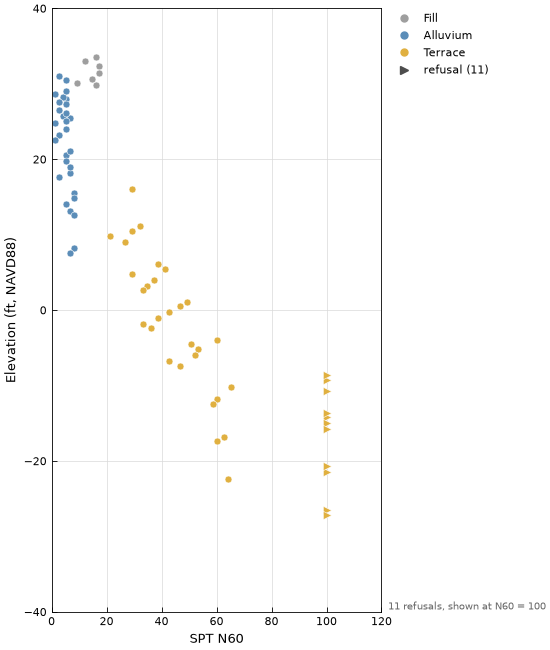
p.spt(), p.atterberg(), p.grain_size() and p.permeability() give one row per test, with its depth, elevation and geology unit joined on. They take filters such as holes=, geology= and depth=.
From your own CSV files
Save an empty template, fill it in (in Excel or anything else that saves CSV), then read it back with its units:
ht.template("spt").to_csv("my_spt.csv", index=False)  # an empty file to fill in

spt = ht.read_csv(
    ht.examples.path("spt.csv"),  # or your own file
    units={"ground_level": "ft", "depth": "ft", "elevation": "ft", "spt_penetration": "in"},
)
fig, ax = ht.plot.spt_histogram(spt[spt["soil_class"] == "coarse"], n="spt_n60")
ht.columns("spt") lists each template column with its description and unit. Both examples in full, with all four plots on one sheet, are in examples/.
What it does
- AGS4 ingest (versions 4.0.3 to 4.2) into a SQLite project database, with units read from the file and converted on the way in. Values such as
NP,<0.1and refusals are kept as flags, never as blanks. - Data checks (
p.qc()): about 40 rules on locations, geology, depths, SPT, Atterberg limits, grading and permeability, plus required fields. Results come as a summary and a CSV report, andp.diff()compares two versions of a file. - Datasets for SPT, Atterberg limits, grain size curves and permeability. Each test gets its depth (SPT at mid-drive), elevation and geology unit, and a geology map gives the units their order and colors.
- Plots: property profile (any property against depth or elevation, linear or log), SPT profile, SPT class histograms, and property by geology unit against a report's baseline. Each is an ordinary matplotlib figure.
- SPT analysis: N60 from the energy ratio, refusals and N classes.
- Units that follow the data: each column's units are declared once, and every plot converts to US or SI. hangtu never guesses a unit.
- Nothing is dropped silently: values beyond the axis limits, blanks and "less than" values are drawn or counted on the figure.
- Printable sheets (
ht.Sheet): several plots on one tabloid or letter page, saved as PDF, PNG or SVG.
Roadmap
| Version | Content |
|---|---|
| v0.1 | Plot framework; property profile, property by geology unit, SPT profile and SPT histograms, with SPT N60 and classes. AGS4 ingest, data checks, and SPT, Atterberg, grain size and permeability datasets |
| v0.2 | Plasticity chart, grain size curves and water content profile; the analyses behind them (USCS plasticity classes, D10/D30/D60, Cu and Cc) and the index property datasets that use them |
| v0.3 | Statistics: distribution fitting, group comparisons, Eurocode 7 characteristic values |
| Later | Triaxial and consolidation, AGSi, DIGGS input, and more |
The full specification is in SPEC.md, and each plot has its own spec in docs/plots.
Who it's for
Geotechnical engineers comfortable writing short Python scripts. The library assumes scripting skills picked up in engineering or science work, not a software-development background.
License
MIT
1 maintainer

Metadata
1 maintainer
Release files for hangtu 0.1.0
For a detailed explanation of source distributions (sdists) and built distributions (wheels), please see the package formats documentation.
Source distribution (sdist)
| File | Size | Uploaded | Provenance | |
|---|---|---|---|---|
| hangtu-0.1.0.tar.gz | 141.6 kB | With provenance | Details |
Built distribution (wheel)
| File | Interpreter | ABI | Platform | Reset |
|---|---|---|---|---|
| hangtu-0.1.0-py3-none-any.whl | Python 3 | none | any | Details |
Total release size: 312.0 kB
Release files / hangtu-0.1.0.tar.gz
| Download URL | hangtu-0.1.0.tar.gz |
|---|---|
| Size | 141.6 kB |
| Tags | Source |
|
SHA-256 checksum How to use checksums |
234670aff158acfa67caf87c0626d4ad6cd564a28982f7c528c8c70cdc4682e8
|
|
BLAKE2b-256 checksum How to use checksums |
61cc741cfb1595f8a7cf8608fc3b71100f65bd28401f1de3aed3a2257fa46cc8
|
| Upload date | |
|
Uploaded using Trusted Publishing? What is trusted publishing? |
Yes |
| Uploaded via |
twine/7.0.0 CPython/3.13.14
|
Provenance
Provenance describes where a file came from. On PyPI, provenance is shared via attestations, which provide a verifiable record of the build or publishing details. View details, limitations and caveats.


PyPI Publish Attestation
PyPI verified that this artifact, at this checksum, originated from the publisher listed below.
Signed by GitHub Actions, verified by PyPI on Oct 15, 2026.
Transparency logRelease files / hangtu-0.1.0-py3-none-any.whl
| Download URL | hangtu-0.1.0-py3-none-any.whl |
|---|---|
| Size | 170.4 kB |
| Tags | Python 3 |
|
SHA-256 checksum How to use checksums |
140753b9097f89368bbcfca22d484997dada0f42b81320b48cdce4afd0e25c99
|
|
BLAKE2b-256 checksum How to use checksums |
3231de1baeed2b850066d02413e9e43076e84b4217a39e32ff7acc8b83a81e5d
|
| Upload date | |
|
Uploaded using Trusted Publishing? What is trusted publishing? |
Yes |
| Uploaded via |
twine/7.0.0 CPython/3.13.14
|
Provenance
Provenance describes where a file came from. On PyPI, provenance is shared via attestations, which provide a verifiable record of the build or publishing details. View details, limitations and caveats.
PyPI Publish Attestation
PyPI verified that this artifact, at this checksum, originated from the publisher listed below.
Signed by GitHub Actions, verified by PyPI on Oct 15, 2026.
Transparency logSecurity for hangtu 0.1.0
Provenance
Provenance describes where a file came from. On PyPI, provenance is shared via attestations, which provide a verifiable record of the build or publishing details. View details, limitations and caveats.
Full provenance
All 2 files in this release have been uploaded with provenance metadata.
Attestation for hangtu-0.1.0.tar.gz
PyPI Publish Attestation
PyPI verified that this artifact, at this checksum, originated from the publisher listed below.
Signed by GitHub Actions, verified by PyPI on Oct 15, 2026.
Transparency logA note on package security
PyPI is a repository for distributing packages, not a service for auditing them. While third-party security researchers and our staff do their best to detect and remove malicious packages, PyPI cannot guarantee the quality, security or suitability of any given package.
To learn more about protecting yourself from malicious actors, visit our package security documentation.














