
Harmony Hub Setup






Configure a factory-reset Logitech Harmony Hub far enough for the official Harmony mobile app to finish account/profile restore.
This tool performs Phase 1 only:
- Connects to the hub over Bluetooth.
- Finds the target Wi-Fi network.
- Connects the hub to Wi-Fi.
- Sends the dummy discovery provisioning command (
mode=2). - Verifies the hub is still pre-account and reachable on the local network.
The official Harmony iPhone or Android app performs Phase 2:
- Finds the hub on the network.
- Logs in to the Logitech account.
- Restores the hub's devices, activities, and account profile.
Why this exists
Since early 2025, connecting to my Logitech Harmony Hub from the iPhone app has become increasingly difficult and buggy. The usual recovery path -- factory reset the hub and let the iPhone app re-provision it from my Logitech account -- has itself become fraught and unreliable on the iPhone in that same window. The hub frequently fails to join Wi-Fi during the app's setup flow even when the network is healthy and well in range, leaving the hub unreachable.
This tool exists to take that fragile Wi-Fi join out of the iPhone app's hands. It does the Bluetooth handshake, Wi-Fi join, and dummy discovery provisioning over RFCOMM from a Linux computer, then verifies the hub is sitting on the network in the pre-account state the app expects. From that point the iPhone app only has to do its Phase 2 work (find the hub on the network, sign in, restore the profile), which in my experience has been the more reliable half of the flow.
Disclaimer
This is an unofficial, third-party tool. It is not affiliated with, endorsed by, or supported by Logitech. "Harmony", "Logitech", and the Logitech logo are trademarks of their respective owners and are used here only to identify the device this tool interacts with.
The Bluetooth setup protocol used by this tool was reverse-engineered from the publicly distributed Harmony Android app and the hub's own observable behavior. Use this tool only with Harmony Hubs that you own.
Requirements
- Linux with Bluetooth support.
bluetoothctlfrom BlueZ available onPATH.uvfor running the project from source.- A Harmony Hub that has been factory reset.
- The Wi-Fi network name and password for the network the hub should join.
Factory Reset the Hub
Phase 1 setup assumes the hub starts from a clean factory-reset state.
Unplug your hub and then hold the Pair/Reset button on the back while plugging it back in. The light on the front of the hub will flicker red for approximately 30 seconds as the hub restores itself to factory defaults.
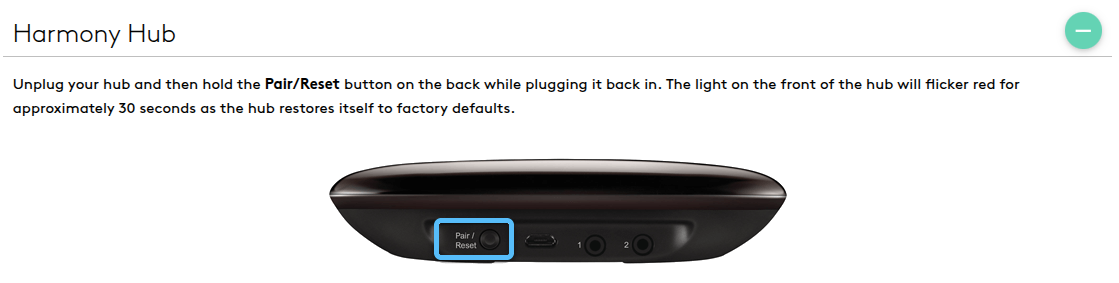
Once the flickering stops and the hub re-enters Bluetooth setup mode, continue with the next section.
Phase 1 Setup
Run:
uv run harmony-hub-setup setup \
  --ssid "Your Wi-Fi Name" \
  --password "Your Wi-Fi Password" \
  --encryption WPA2-PSK
The setup command prints numbered progress steps. Phase 1 is complete when it prints:
PHASE 1 COMPLETE
The hub is on Wi-Fi, in mode=2, and reachable through the local setup endpoint.
Open the Harmony mobile app and continue account/profile restore from there.
At that point, open the Harmony mobile app, select the hub found on the network, log in to the Logitech account, and let the app restore the profile.
Wi-Fi Credentials from a .env File
Instead of passing --ssid and --password on every run, you can put them in a
.env file in the directory you run the command from:
SSID=Your Wi-Fi Name
PASSWORD=Your Wi-Fi Password
ENCRYPTION=WPA2-PSK
Then run setup (or connect) with no Wi-Fi flags:
uv run harmony-hub-setup setup
SSID and PASSWORD are read from .env; ENCRYPTION is optional and defaults
to WPA2-PSK. Command-line flags take precedence over .env values, so you can
override a single field without editing the file:
uv run harmony-hub-setup setup --ssid "A Different Network"
Keep .env out of version control -- it holds your Wi-Fi password. This
repository already lists .env in its .gitignore.
Discover the Hub (Optional and Typically Unnecessary Step)
The above setup command runs discovery automatically. Should you wish to identify
your Harmony Hub's Bluetooth address, follow these directions.
After factory reset, plug in the hub and wait for it to enter Bluetooth setup mode. Then run:
uv run harmony-hub-setup discover
(This does not require a factory reset to discover the Bluetooth address.)
The command scans with bluetoothctl and prints nearby devices. A typical
result looks like:
Bluetooth devices:
  AA:BB:CC:DD:EE:FF  Harmony Hub  [Harmony candidate]
If a Harmony candidate is listed, use that address with --address. If setup is
run without --address, it will auto-discover and use the address only when
exactly one Harmony-looking device is found.
Then, pass the Bluetooth address explicitly:
uv run harmony-hub-setup \
  --address AA:BB:CC:DD:EE:FF \
  setup \
  --ssid "Your Wi-Fi Name" \
  --password "Your Wi-Fi Password" \
  --encryption WPA2-PSK
Example Output
A successful run looks like this (placeholders shown for the Bluetooth address, SSID, and IP):
No Bluetooth address provided; scanning for Harmony Hub candidates...
Bluetooth devices:
  AA:BB:CC:DD:EE:FF  Harmony Hub  [Harmony candidate]

Using discovered Harmony Hub: AA:BB:CC:DD:EE:FF Harmony Hub

Waiting for Harmony Hub Bluetooth...
(Factory reset the hub if you haven't already)

Connected on attempt 1!

[1/8] Verify Bluetooth command channel
  Hub alive (uuid=...)

[2/8] Scan for target Wi-Fi network
  Found target SSID (signal=212, security=WPA2-PSK, channel=2422)

[3/8] Get Bluetooth nonce
  Nonce received (32 chars).

[4/8] Connect hub to Wi-Fi (Your Wi-Fi Name)
  Wi-Fi command attempt 1 returned code=500; retrying.
  Wi-Fi command accepted on attempt 2.
  Connected! IP: 192.0.2.200

[5/8] Set discovery provisioning over Bluetooth
  Provision command accepted.

[6/8] Confirm pre-account Phase 1 handoff state over Bluetooth
  Bluetooth provision-info: mode=2, account=not set, secure=True

[7/8] Read Bluetooth setup gates
  RF info response: code=200
  Firmware: 4.15.600
  Wi-Fi: connected
  SSID: Your Wi-Fi Name
  IP: 192.0.2.200

[8/8] Verify local hub setup endpoint
  LAN ping OK: http://192.0.2.200:8088
  LAN system-info OK.
  Hub firmware: 4.15.600
  LAN provision-info OK.
  Provision mode: 2
  Account ID:      not set
  Auth token:      not set
  LAN Phase 1 handoff: mode=2, account=not set, secure=True
  LAN discovery-info OK.
  LAN paired-device info OK.
  LAN firmware check OK.

Final state
  Discovery server: https://svcs.myharmony.com/Discovery/Discovery.svc
  SUS channel:      Production
  Mode:             2

PHASE 1 COMPLETE
The hub is on Wi-Fi, in mode=2, and reachable through the local setup endpoint.
Open the Harmony mobile app and continue account/profile restore from there.
The PHASE 1 COMPLETE block at the end is the cue to switch to the Harmony
mobile app for Phase 2.
Phase 2: Restore Your Account in the App
Open the Harmony mobile app, select your hub from the list, and sign in to your Logitech account. The app will start restoring your hub's profile.
Press the Pair/Reset button when the app asks
Roughly a third of the way through the restore (around the Preparing Your Hub step), the app will pause and ask you to press the Pair/Reset button on the back of the hub again. This is expected every time -- it is not a sign that anything has gone wrong.
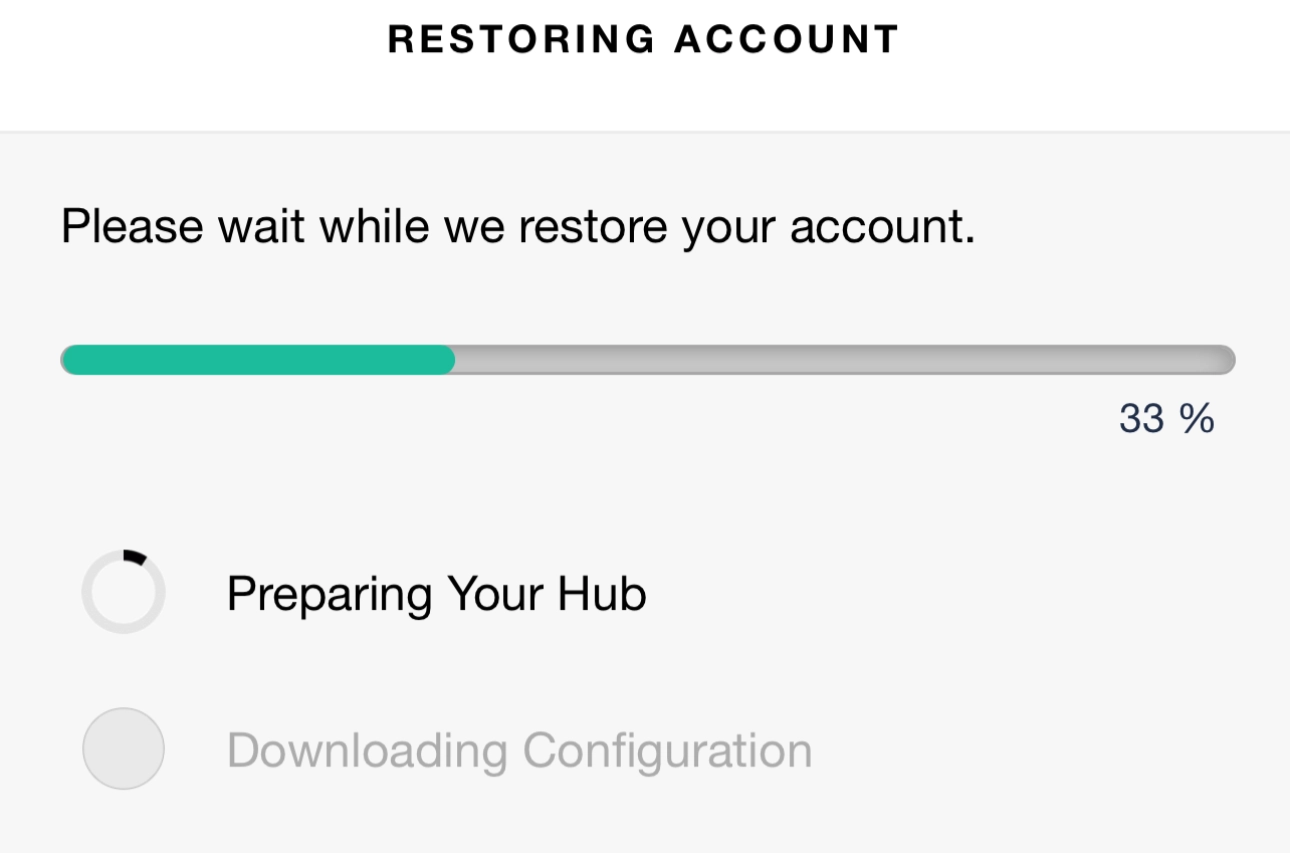
Press the button once, then let the app continue. The remainder of the restore should complete without further prompts.
Wait before unplugging
After the app reports restore is complete, leave the hub powered for at least two minutes before you unplug it to move it. This gives the hub time to fully persist the new configuration to flash. Unplugging too soon has been observed to roll the hub back to an unprovisioned state, forcing a fresh factory reset.
What Success Means
Successful Phase 1 means:
- Bluetooth setup commands worked.
- The hub joined Wi-Fi and has a local IP address.
- Local setup probes work over
http://<hub-ip>:8088. - Provision info reports
mode=2. - Account ID, auth token, email, username, and active remote ID are not set.
It does not mean the hub has been fully account-provisioned. Full restore is complete only after the Harmony mobile app finishes Phase 2.
Troubleshooting
If discovery finds no Harmony candidate:
- Confirm the hub was factory reset.
- Keep the hub powered on and near the computer.
- Run
bluetoothctl scan onmanually to confirm Linux can see Bluetooth devices. - Re-run setup with
--addressif you know the hub's Bluetooth address.
If setup fails during Wi-Fi connection:
- Confirm the SSID and password.
- Confirm the hub is close enough to the Wi-Fi access point.
- Re-run setup after another factory reset if the hub is in an unknown state.
If the mobile app cannot find the hub after Phase 1 completes:
- Confirm the phone is on the same network as the hub.
- Wait briefly for the hub to appear in the app.
- Run
harmony-hub-setup --address <address> statuswhile Bluetooth is still available to inspect the hub state.
Releasing (maintainer)
Releases are cut from the project root with release X.Y.Z (or release for
an interactive version prompt). The tool bumps pyproject.toml, commits,
tags, pushes -- which triggers the PyPI publish workflow via GitHub Actions
Trusted Publishing. Release notes auto-generate from commit messages between
tags, so commits should read well as changelog entries.
1 maintainer

Metadata
1 maintainer
Release files for harmony-hub-setup 0.3.0
For a detailed explanation of source distributions (sdists) and built distributions (wheels), please see the package formats documentation.
Source distribution (sdist)
| File | Size | Uploaded | Provenance | |
|---|---|---|---|---|
| harmony_hub_setup-0.3.0.tar.gz | 16.0 kB | Without provenance | Details |
Built distribution (wheel)
| File | Interpreter | ABI | Platform | Reset |
|---|---|---|---|---|
| harmony_hub_setup-0.3.0-py3-none-any.whl | Python 3 | none | any | Details |
Total release size: 34.6 kB
Release files / harmony_hub_setup-0.3.0.tar.gz
| Download URL | harmony_hub_setup-0.3.0.tar.gz |
|---|---|
| Size | 16.0 kB |
| Tags | Source |
|
SHA-256 checksum How to use checksums |
c2cf13e982813449f1fdedb652c4da8d8a1eb2f58effbe46cad649c20b48de17
|
|
BLAKE2b-256 checksum How to use checksums |
d24376d082736c44d3c799c5c7eb8c9ba90bf6f249fcdb9abb7eb9c89df133ec
|
| Upload date | |
|
Uploaded using Trusted Publishing? What is trusted publishing? |
Yes |
| Uploaded via |
uv/0.11.28 {"installer":{"name":"uv","version":"0.11.28","subcommand":["publish"]},"python":null,"implementation":{"name":null,"version":null},"distro":{"name":"Ubuntu","version":"24.04","id":"noble","libc":null},"system":{"name":null,"release":null},"cpu":null,"openssl_version":null,"setuptools_version":null,"rustc_version":null,"ci":true}
|
Release files / harmony_hub_setup-0.3.0-py3-none-any.whl
| Download URL | harmony_hub_setup-0.3.0-py3-none-any.whl |
|---|---|
| Size | 18.5 kB |
| Tags | Python 3 |
|
SHA-256 checksum How to use checksums |
4732f73bbca5255ad005c2534b15fcb8a2e1be9a3fa2dd328e63e2ff92dd8228
|
|
BLAKE2b-256 checksum How to use checksums |
d465914928799a4fb9d6ad4745e1fdfb93227d52f063e1ebfe43d694ed44fa9f
|
| Upload date | |
|
Uploaded using Trusted Publishing? What is trusted publishing? |
Yes |
| Uploaded via |
uv/0.11.28 {"installer":{"name":"uv","version":"0.11.28","subcommand":["publish"]},"python":null,"implementation":{"name":null,"version":null},"distro":{"name":"Ubuntu","version":"24.04","id":"noble","libc":null},"system":{"name":null,"release":null},"cpu":null,"openssl_version":null,"setuptools_version":null,"rustc_version":null,"ci":true}
|
Security for harmony-hub-setup 0.3.0
Provenance
Provenance describes where a file came from. On PyPI, provenance is shared via attestations, which provide a verifiable record of the build or publishing details. View details, limitations and caveats.
No provenance found
None of the files in this release were uploaded with provenance metadata.
A note on package security
PyPI is a repository for distributing packages, not a service for auditing them. While third-party security researchers and our staff do their best to detect and remove malicious packages, PyPI cannot guarantee the quality, security or suitability of any given package.
To learn more about protecting yourself from malicious actors, visit our package security documentation.














