
harness-evolve


Improve an AI agent's harness (its prompts, tool descriptions and settings) from the agent's own failure traces, and keep a change only when it beats measured run-to-run noise.
Agents are noisy: run the same agent on the same task twice and the result can flip. Tune a prompt, rerun, see +3 points, and you may have measured nothing. harness-evolve measures that noise first, then accepts an edit only if it clears it, checks it doesn't break the cases that already work, and reports the result on cases it never saw, against the cheapest alternative: just running the original agent twice.
Results
Used on a production code-diagnosis agent (agent-platform), on SWE-bench Verified with DeepSeek-V4.1-Flash:
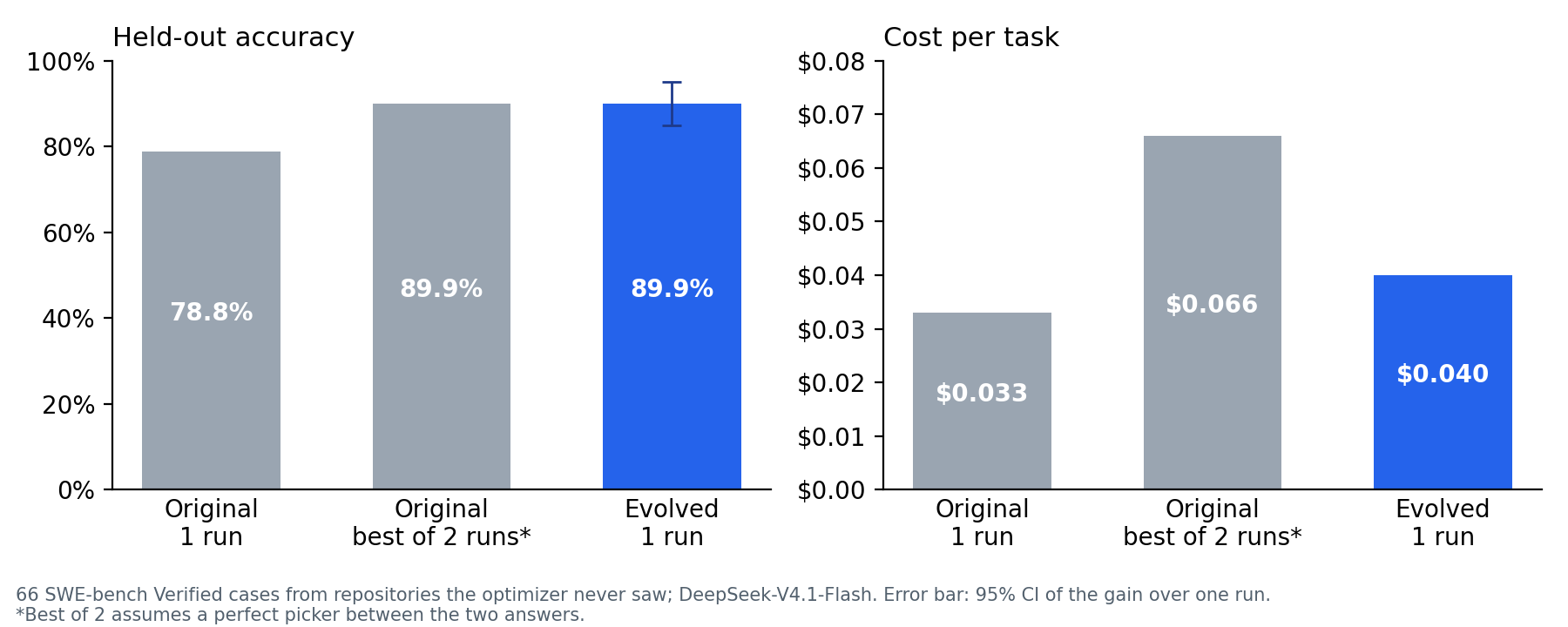
| Held-out: 66 cases from repositories the optimizer never saw | Original harness | Evolved harness |
|---|---|---|
| Finds the file the fix must change (single run) | 78.8% | 89.9% (+11.1, 95% CI +6.1 to +16.2) |
| Gives up with no answer | 19.7% | 5.6% |
| Solves it on all 3 trials (reliability) | 60.6% | 78.8% |
The evolved harness matched running the original twice (best-of-2) at about 60% of the cost. Two edits were accepted in a 7.4-hour run, and the evolved harness went to production.
It also says no. An earlier run of the same optimizer on Claude Sonnet 5 accepted nothing, and so did a three-round run on the same project's fix agent: every candidate edit either stayed inside the noise band or broke a guard case. Halfway through that run, one edit led 7 to 4, and a single measurement would have reported it as a gain.
Quickstart: the math example
The example (examples/math_agent/) is a small math agent (a calculator tool and a submit tool) on
GSM-Hard, GSM8K questions with large, awkward numbers that leave room to improve. Everything that shapes
its behaviour is in examples/math_agent/harness/, the directory the optimizer edits:
- prompts:
system.prompt,task.prompt,nudge.prompt(sent when a reply has no tool call),remind.prompt(stuck reminder),plan.prompt(planning step) tool_descriptions.json: what the model is told each tool doessettings.json:max_turns,nudges, stuck detection (remind_after,stop_after), and two structural switches,plan(off/on) andcalculator(on/off)
config.py declares the profile (setting bounds and switches), the evaluator and the case split;
bench.py holds the benchmark scenarios built on it (see Benchmarking the optimizer below).
pip install "harness-evolve[litellm]"        # the library and the harness-evolve command
git clone https://github.com/sidreddy88/harness-evolve && cd harness-evolve   # for the example
python examples/math_agent/fetch_data.py      # downloads 80 problems
export TOGETHER_API_KEY=...                   # or any litellm provider; set MODEL to match
harness-evolve run examples/math_agent/config.py --run-dir runs/math-1 --budget 2
harness-evolve status runs/math-1
harness-evolve diff runs/math-1               # accepted edits, as diffs to review
What to expect (our run, DeepSeek-V4.1-Flash, $1.06, before the stuck-detection settings and switches were added): the starting harness solved 76% of the 50 evolve problems, with a measured noise band of ±5.6 points. The proposer read the trajectories and aimed three edits at real failures (runs that never submit an answer, then wrong arithmetic); each gained +2 to +3 points, inside the noise, so none was accepted. With 50 cases only bigger gains are detectable; more cases narrow the band.
--budget is a hard cap in dollars. A run that stops (budget, Ctrl-C, a provider outage) resumes with
the same command, and nothing already paid for is paid again.
How a run works
round 0   run the starting harness on the evolve cases, 2 trials each
          -> the noise band (how much the pass rate moves between identical runs)
round r   propose one edit, aimed at failures in the trajectories (GEPA-style)
          -> structural checks (free)
          -> a critic screens for leakage, gaming and weakened safeguards (cheap)
          -> evaluate the candidate (the only expensive step)
          -> accept only if it beats the noise band, or is cheaper beyond cost noise
             at the same pass rate, and no guard case regresses
final     original vs evolved on held-out cases, k trials each, including the
          original's best-of-2 (the matched-budget rerun baseline)
Accepted edits are written as diffs under runs/<id>/proposals/ for you to review; your code is never
changed automatically.
Built for long unattended runs: every phase is checkpointed; every case's result is cached by the candidate's content hash; a hard budget is checked before each case; provider failures (billing, auth, rate limits) stop the run instead of being scored as failures; tripwires pause it when measurements look broken; a watchdog exits cleanly if it stops making progress.
Using it on your agent
The quickest start is a generated project:
harness-evolve init my-agent # harness/, cases.jsonl, run_case.py, config.py, README.md
It is a working one-call question-answering agent wired to the optimizer. Fill in four things,
following my-agent/README.md:
harness/: your agent's prompts, tool descriptions and settings.run_case.py: runs your agent on one case with the harness directory it is given, and prints one JSON line,{"passed": ..., "cost_usd": ..., "steps": [...]}. It can call an agent in any language or behind an API; or pointCOMMANDinconfig.pyat your own program and skip Python entirely (harness_evolve.command.CommandEvaluatorruns it once per case and trial).cases.jsonl: real tasks, 30+ (50+ to also keep a held-out set).config.py: a description of your agent, what an edit must never weaken, setting bounds.
Then harness-evolve run config.py --run-dir runs/r1 --budget 2. The config refuses to run until the
agent is described.
The rest of this section is what that project contains, if you'd rather wire it up yourself. You need five things.
1. A harness directory your agent reads at run time
my_harness/
  system.prompt              # templates, rendered with str.format
  task.prompt
  tool_descriptions.json     # {"search": "Search the docs ..."}
  settings.json              # {"max_turns": 12, "_doc": {"max_turns": "turn budget"}}
Load it with harness_evolve.load_harness(path). The optimizer edits copies of these files, never
adds or deletes files, and checks every edit still loads.
2. An evaluator
class MyEvaluator:
    async def evaluate(self, harness_dir, case_ids, trials) -> EvalOutcome:
        ...  # run your agent with harness_dir on each case, `trials` times
Return pass/fail and cost per trial, and trajectories if you can: the proposer reads them to find
out why runs fail. Raise ProviderFailure for billing, auth or outage errors. Never let the right
answer reach the proposer: put it after evidence.HIDDEN_MARKER in a trajectory's detail.
See examples/math_agent/evaluator.py.
If your agent runs in Harbor, you don't need to build
trajectory records yourself: harness_evolve.atif.harbor_job(job_dir) turns a Harbor job's ATIF
trajectories and rewards into records the proposer can read (from_atif does one trajectory).
3. A profile
from harness_evolve import AgentProfile, profiles
profiles.use(AgentProfile.build(
    name="support-bot", harness_root="my_harness/",
    agent_description="Answers support tickets with search and read tools; finishes by calling reply.",
    safety_mechanisms=["citing a source document for every claim"],
    setting_bounds={"max_turns": (3, 20)}))
The description and safety mechanisms become the proposer's and critic's instructions; setting bounds keep an edit from "saving cost" by starving the agent.
4. Cases: an evolve set (what it improves on, ideally 50+), optional guard cases (must keep passing) and held-out cases (never seen during evolution, for the final report).
5. A model for the proposer and critic, and a budget: litellm_llm("model-id", prices=(in, out))
or any async (system, prompt) -> LLMReply(text, cost_usd).
Then:
opt = Optimizer("runs/r1", "my_harness/", OptimizerConfig(evolve_cases=..., budget_usd=50),
                evaluator=MyEvaluator(), proposer_llm=llm, critic_llm=llm, critic_patterns=[])
asyncio.run(opt.run_until_stopped())
Or put a build(run_dir, budget_usd, rounds) function in a config file and use the CLI, as the
example does.
Benchmarking the optimizer
harness-evolve bench measures the optimizer itself, so a change to its method is judged by
evidence, not opinion. Known-answer scenarios have a right outcome: a scripted proposer puts one known
edit in front of the acceptance rules. A real fix to a planted flaw must be accepted, a harmful edit
must be rejected, and a neutral rewording must not be accepted (a false accept). Open scenarios run the
real proposer and report what it finds and what it gains on held-out cases, per dollar.
python examples/math_agent/fetch_data.py --n 260 --out examples/math_agent/data/problems-bench.jsonl
harness-evolve bench examples/math_agent/bench.py --out runs/bench-1
Results go to runs/bench-1/bench.md. Our first run (DeepSeek-V4.1-Flash, $9.37 in total):
| Scenario | Expected | Result |
|---|---|---|
accept-good: planted flaw (max_turns 1) + scripted fix |
accepted | PASS: +49 points |
| reject-bad: scripted "round answers to the nearest hundred" | not accepted | PASS: −21.5 points, rejected |
| reject-noise: scripted neutral rewording | not accepted | PASS: rejected |
| find-flaw: planted flaw, real proposer | (reported) | found the flaw from trajectories: held-out 28.3% → 79.0% |
| standard: normal harness, 200 problems, real proposer | (reported) | one prompt edit accepted: held-out accuracy unchanged (83.3% → 83.9%), ~11% cheaper |
The first version of reject-bad ("skip the calculator and estimate") was accepted: it didn't hurt this model at all and was 13% cheaper, so the optimizer was right and the test was wrong. A known-answer scenario's premise has to be measured, not assumed.
Later scenarios test stuck-detection thresholds (remind_after, stop_after in the example's settings),
starting from a harness that stops every run at its second calculator call ($3.89):
| Scenario | Expected | Result |
|---|---|---|
accept-threshold: planted flaw (stop_after 1) + scripted fix (8) |
accepted | PASS: +9.5 points |
| find-threshold: same flaw, real proposer | (reported) | found it from the stop messages in the trajectories and set stop_after to 4: held-out 71.7% → 78.5% (+6.9, 95% CI +4.0 to +10.2); within noise of rerunning the original twice |
A last scenario measures what confirm-before-accept (confirm=True) catches: 40 scripted neutral rewordings
in a row on a small evolve set (20 problems), so measurement noise is large ($3.83). One of the 40 passed
its first measurement (18% cheaper, beyond the 15.4% cost band), a false accept with confirm off; on fresh
trials it was 10% more expensive, and confirm rejected it. The other 39 were rejected outright. No pass-rate
change came near the noise band (largest +0.05 against 0.12): on a small evolve set, false accepts come from
cost noise.
Structural switches (switches in AgentProfile.build: settings with named options, such as a planning
step on or off, which the proposer is told to check before rewording) were tested with the example's
plan and calculator switches ($7.50):
| Scenario | Result |
|---|---|
find-switch: starts with plan on (an extra model call per problem), real proposer |
round 1 switched plan off: 22% cheaper on the evolve set, pass rate within noise; held-out 80.4% → 79.0% (within noise) at 34% lower cost per run, though runs that never submit rose from 2.3% to 5.6% |
| standard with switches, real proposer, 3 rounds | round 1 tried a switch first (plan on: +0.75 points at +41% cost, rejected); a tool-description edit and more nudges were rejected too; nothing accepted |
and scripted_llm (see examples/math_agent/bench.py). |
Limits
- It needs an automatic pass/fail check per case. No grader, no optimizer.
- A noisy agent needs more cases or trials before any gain is detectable; the noise band will tell you, and "nothing accepted" is a real answer.
- Every candidate costs a full evaluation. Slow or expensive agents make slow, expensive runs.
Credits
Full mapping of each component to its source, and what we changed: docs/methods.md.
- Reflective, trace-driven proposals: GEPA (Agrawal et al., "GEPA: Reflective Prompt Evolution Can Outperform Reinforcement Learning", ICLR 2026).
- The critic and the one-edit-per-round discipline: RRSI (google-research/rrsi, Apache-2.0); the critic's reject classes are adapted from its prompt.
- Comparing against reruns: AI2's finding that harness evolution rarely beats simply rerunning (arXiv 2607.12227), which is why the final report includes the matched-budget rerun baseline.
MIT license.
1 maintainer

Metadata
1 maintainer
Release files for harness-evolve 0.2.0
For a detailed explanation of source distributions (sdists) and built distributions (wheels), please see the package formats documentation.
Source distribution (sdist)
| File | Size | Uploaded | Provenance | Actions |
|---|---|---|---|---|
| harness_evolve-0.2.0.tar.gz | 194.7 kB | With provenance | Details for harness_evolve-0.2.0.tar.gz |
Built distribution (wheel)
| File | Interpreter | ABI | Platform | Actions Reset |
|---|---|---|---|---|
| harness_evolve-0.2.0-py3-none-any.whl | Python 3 | none | any | Details for harness_evolve-0.2.0-py3-none-any.whl |
Total release size: 266.0 kB
Release files / harness_evolve-0.2.0.tar.gz
| Download URL | harness_evolve-0.2.0.tar.gz |
|---|---|
| Size | 194.7 kB |
| Tags | Source |
|
SHA-256 checksum How to use checksums |
0698e057dbcfee844155368f00a3e8da1267167a33046e7b88ee3f24195be164
|
|
BLAKE2b-256 checksum How to use checksums |
281d0ea9194dde01a26989a367aefd6c6d294b55dfe803510b667d4f17f5985b
|
| Upload date | |
|
Uploaded using Trusted Publishing? What is trusted publishing? |
Yes |
| Uploaded via |
twine/7.0.0 CPython/3.13.14
|
Provenance
Provenance describes where a file came from. On PyPI, provenance is shared via attestations, which provide a verifiable record of the build or publishing details. View details, limitations and caveats.


PyPI Publish Attestation
PyPI verified that this artifact, at this checksum, originated from the publisher listed below.
Signed by GitHub Actions, verified by PyPI on Oct 12, 2026.
Transparency logRelease files / harness_evolve-0.2.0-py3-none-any.whl
| Download URL | harness_evolve-0.2.0-py3-none-any.whl |
|---|---|
| Size | 71.3 kB |
| Tags | Python 3 |
|
SHA-256 checksum How to use checksums |
dbed13134cdd1a9014e580783dd0e8c94996d2f5286ed4ac43b7bcd208fd776a
|
|
BLAKE2b-256 checksum How to use checksums |
c0542268fc488702e1417f7d5fb89d4ce50af819d2525ff053a284842546648a
|
| Upload date | |
|
Uploaded using Trusted Publishing? What is trusted publishing? |
Yes |
| Uploaded via |
twine/7.0.0 CPython/3.13.14
|
Provenance
Provenance describes where a file came from. On PyPI, provenance is shared via attestations, which provide a verifiable record of the build or publishing details. View details, limitations and caveats.
PyPI Publish Attestation
PyPI verified that this artifact, at this checksum, originated from the publisher listed below.
Signed by GitHub Actions, verified by PyPI on Oct 12, 2026.
Transparency logSecurity for harness-evolve 0.2.0
Provenance
Provenance describes where a file came from. On PyPI, provenance is shared via attestations, which provide a verifiable record of the build or publishing details. View details, limitations and caveats.
Full provenance
All 2 files in this release have been uploaded with provenance metadata.
Attestation for harness_evolve-0.2.0.tar.gz
PyPI Publish Attestation
PyPI verified that this artifact, at this checksum, originated from the publisher listed below.
Signed by GitHub Actions, verified by PyPI on Oct 12, 2026.
Transparency logA note on package security
PyPI is a repository for distributing packages, not a service for auditing them. While third-party security researchers and our staff do their best to detect and remove malicious packages, PyPI cannot guarantee the quality, security or suitability of any given package.
To learn more about protecting yourself from malicious actors, visit our package security documentation.














