
HARP, the HTTP API Runtime Platform
HARP is an open-source API Proxy toolkit designed to improve the reliability, performance, security, and observability of the APIs you use. It runs in your infrastructure, close to your applications.





Quick links: Documentation | Getting Started | Install (Docker) | Install (PIP) | Repository (Git) | CI/CD
Community: 


HARP is used both in development and production, and it works well for us. However, it is still under heavy active development and some features may not be as polished as you expect, and some APIs may change.
We are actively looking for feedback, please reach out with your thoughts, ideas, rants or issues. We can help.
What is HARP?
HARP is a python-based framework to build API proxies. From no-configuration 1 minute start to try it locally with an in memory database to a full production ready proxy with multiple storage backends and custom filtering, it got you covered.
The main goal is to improve the performance, reliability, security, and observability of the APIs you already use, without changing anything except the base URL of your API calls. Ultimately, you can use HARP to “fix the Internet,” or at least the subset your application depends on.
Out of the box, you’ll get standard-compliant caching (based on hishel), a world class http client (based on httpx), a circuit breaker, a python-based rules engine, an audit log and an observation dashboard. The features guide will tell you more.
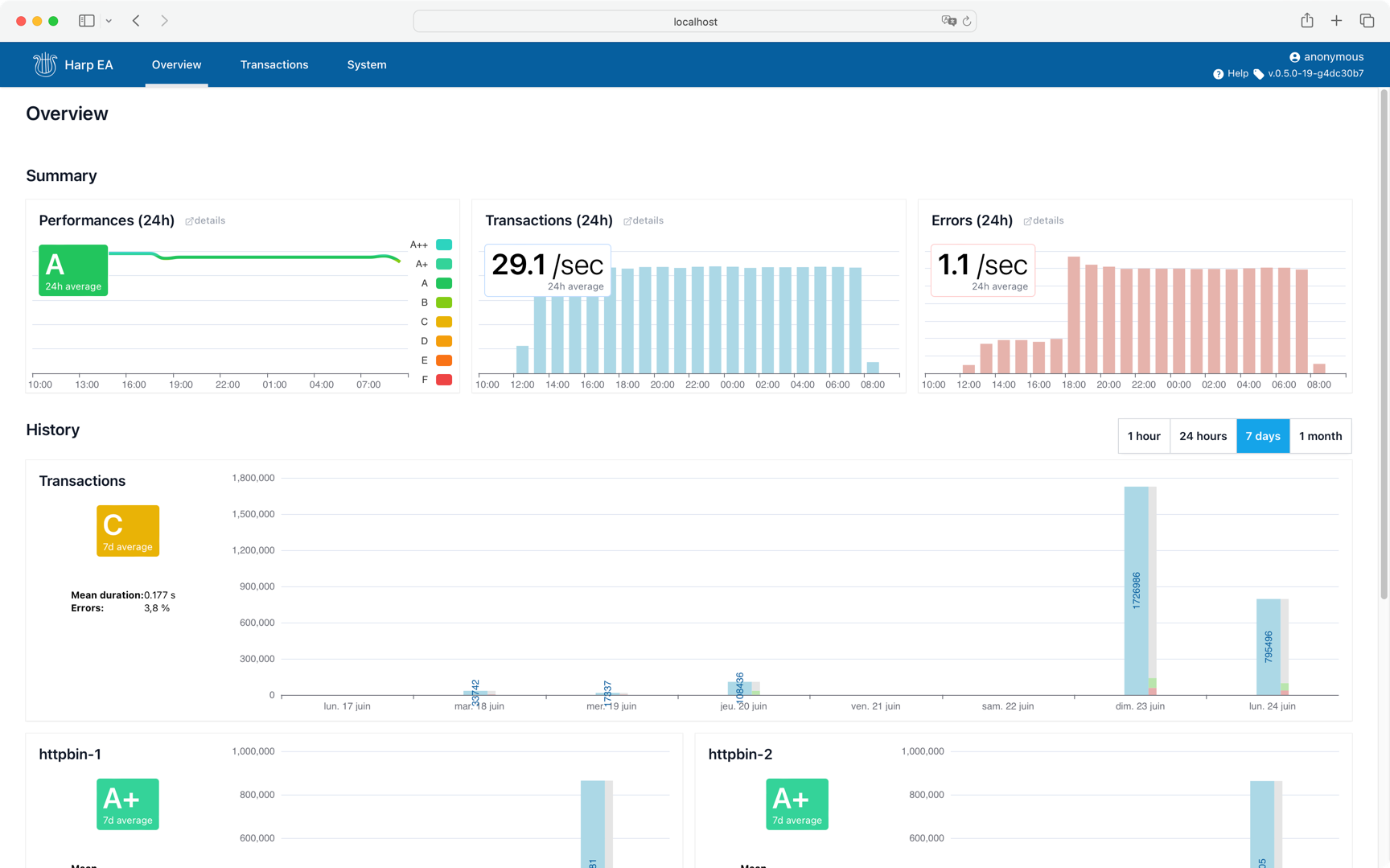
To instantly get insights on how your application is interacting with external services, you get a searchable transaction record, with detailed information on each recorded request and response. Recording is best-effort: under load HARP sheds detail rather than slowing your traffic down, so treat it as an operational view rather than a complete one.
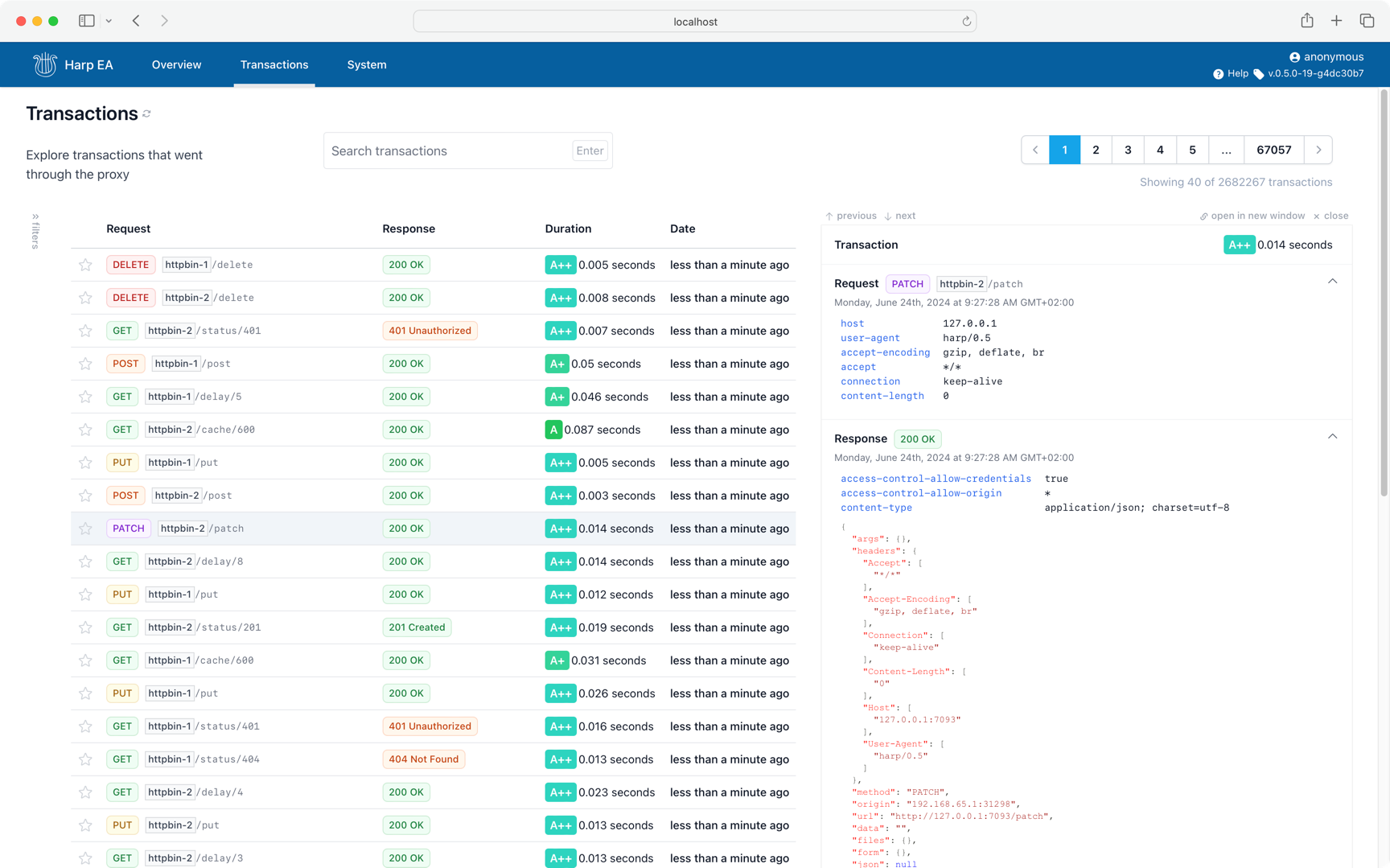
No more doubts about what happened. Now, you *know*.
Getting Started
The quickest way to try HARP is using uvx:
# Run HARP directly with uvx
uvx harp-proxy --help

# Start a proxy with example configuration
uvx harp-proxy server --example sqlite --example proxy:httpbin
For more installation options:
Quick & Easy: Use uvx (shown above) - runs without installing HARP globally
Traditional Python: pip install harp-proxy - for standard Python environments
Containerized: Docker - for production deployments
From Source: Development setup - for contributing
Refer to the Getting Started Guide for detailed instructions.
How it works?
Overview
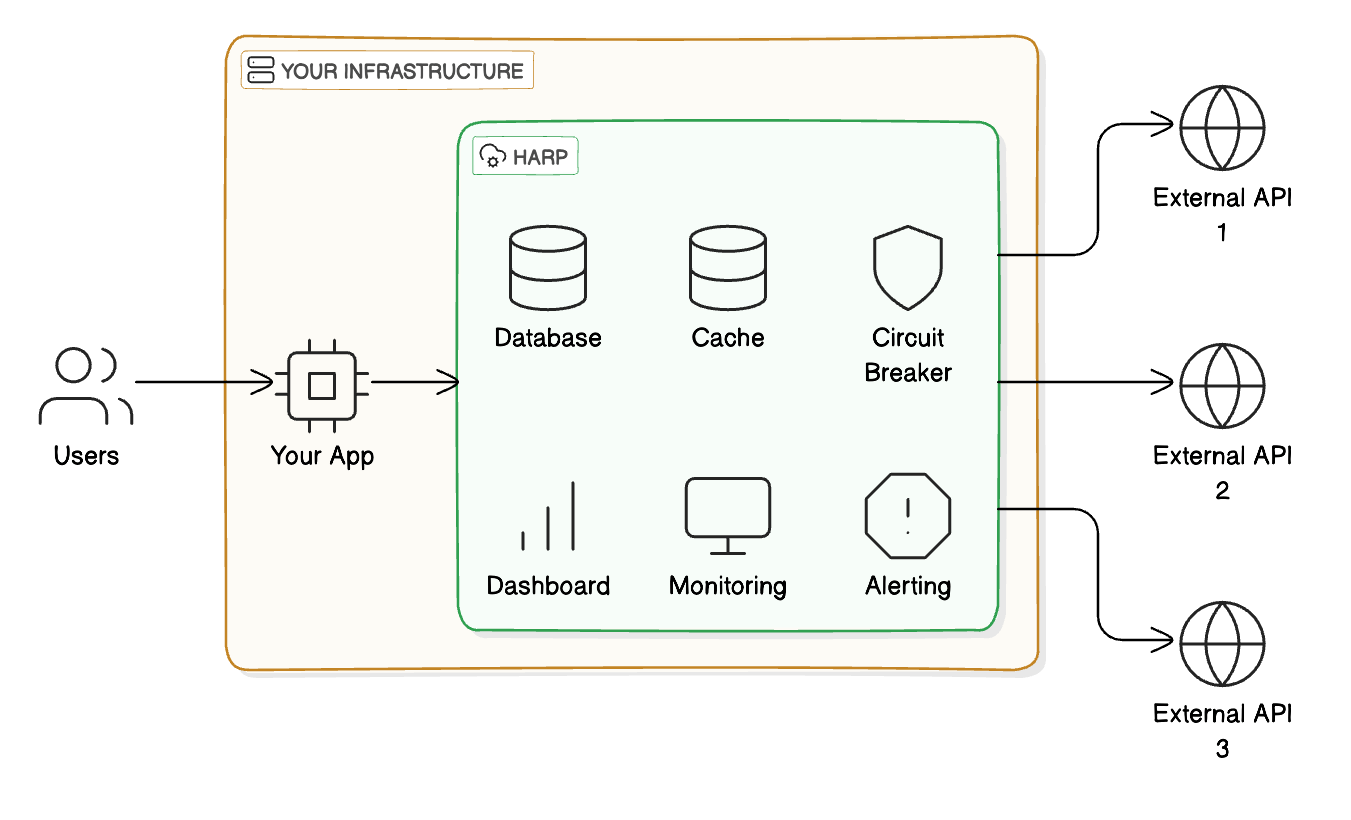
Easy Integration: Integrating with your application is a breeze, because it speaks the same language you already use: HTTP. Simply run the proxy, update your API endpoints, and you’re ready to go. No complex setup or extensive configuration required. Of course, everything is modular and configurable, so you’ll be able to fine-tune for your taste later.
Reduced Network Distance: As a nearline proxy, HARP minimizes the network distance between your application and external services, when possible, using standard techniques like caching or prefetching. This leads to faster response times and improved overall performance of your application, even before any configuration is done.
Simplified Development: HARP eliminates the need for writing extensive code for functionalities such as caching, monitoring, alerting, rate limiting, circuit breaking, retries, tracing, logging, and more. These features can be easily delegated to the proxy, reducing the amount of code you need to write and maintain.
Seamless HTTP Integration: HARP seamlessly integrates with your application using the HTTP protocol. This means that the integration or removal cost is virtually zero, or even negative when considering the reduction in code you won’t need to write.
Hub to external services
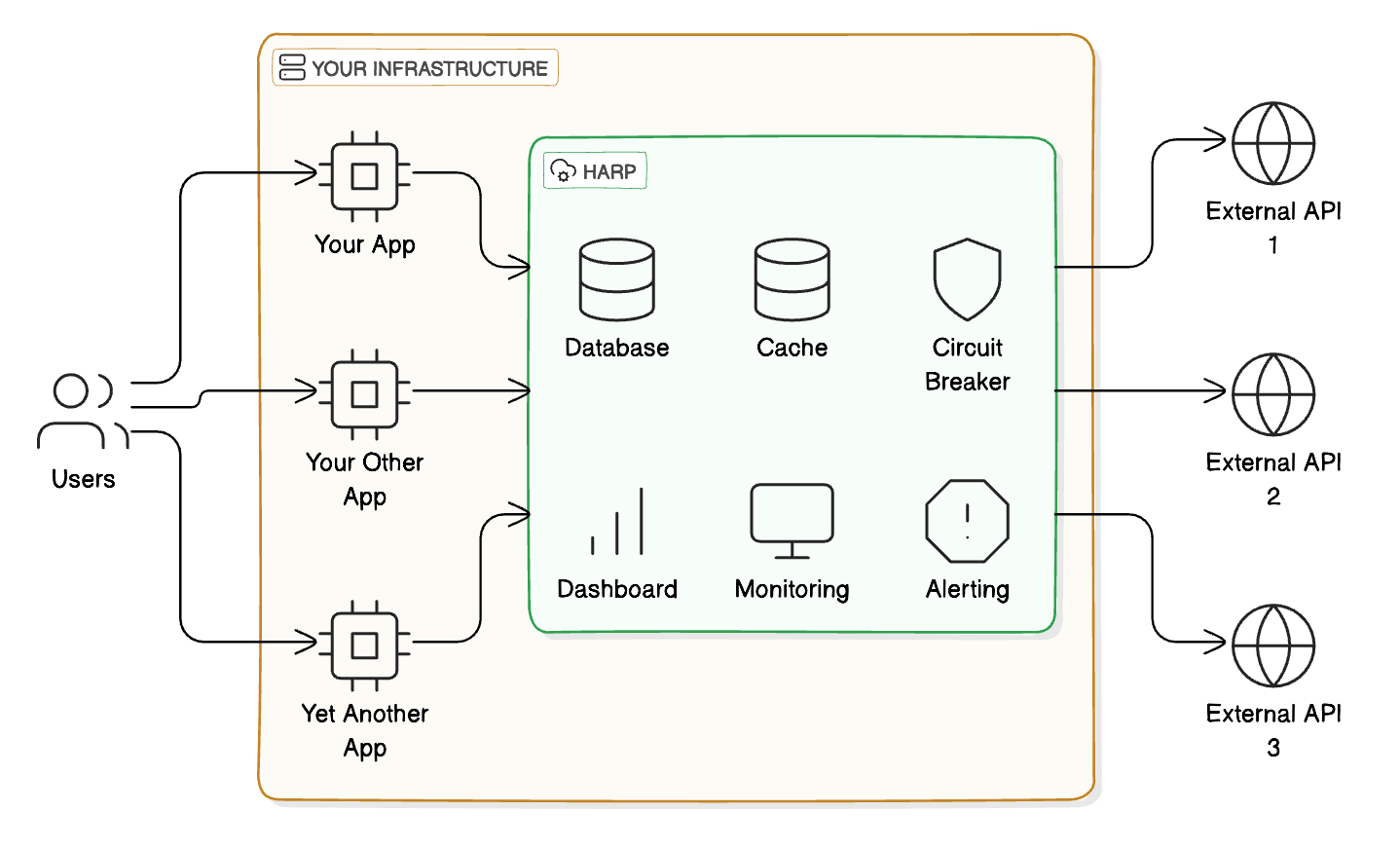
Mutualize Client Logic: Having n API consumers does not mean you have to implement n times each client-side feature. Use HARP as a hub and greatly reduce the amount of client code you need to write and maintain.
Observes and Controls: You get a central place to observe and control all your API interactions.
Grow and Scale: As your company grows and develop new applications, you can leverage the work done on existing external services without having to write a single new line of code.
Service
Within the service, harp runs one or more proxies, each one listening to one port to instrument your external API calls with the features you need (auditing, caching, alerting, circuit breaker switch, health checks, etc.).
Each proxy is configured to intercept and forward requests to a specific external API, with independent configuration.
An additional (optional) port serves a dashboard to observe your proxies in real-time.
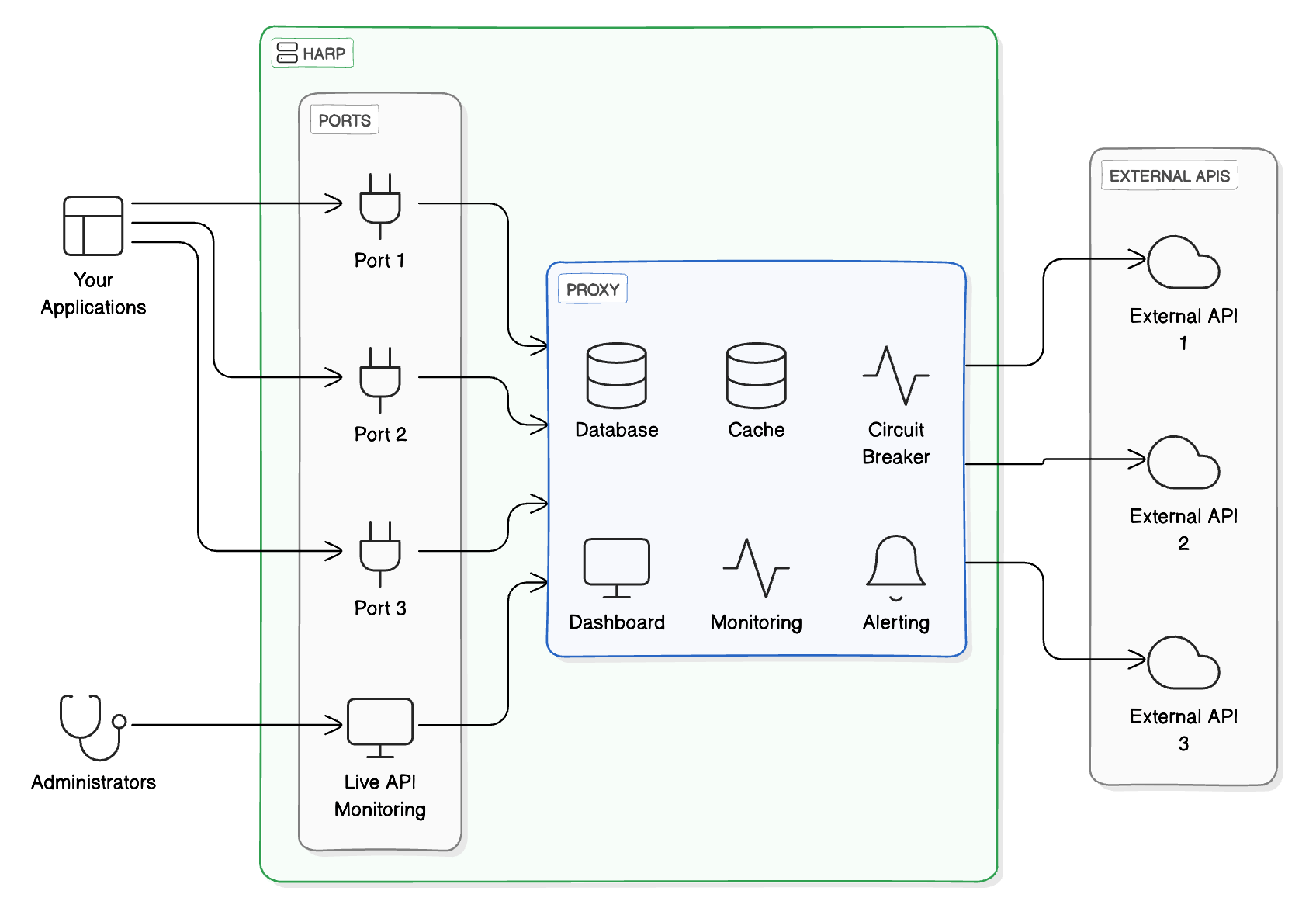
Features: Harp comes builtin with a set of industry-standard client side features that you can leverage with a few lines of configuration.
Flexibility: Each feature is optional, and it’s up to you to chose the setup that fits your needs.
Customizable: You can write code to extend the proxy features, using the same interface as all the builtin features. It guarantees that you can basically implement pretty much anything that make sense inbetween your applications and the external services.
Proxy
As an HTTP Proxy, HARP does not change anything to the way you communicate with the external services. You were speaking HTTP before, you will still speak HTTP. The only change needed in your applications configuration to plug or unplug HARP is the base endpoint of the external services. In a modern 12factor-like application, it usually only means changing an environment variable.
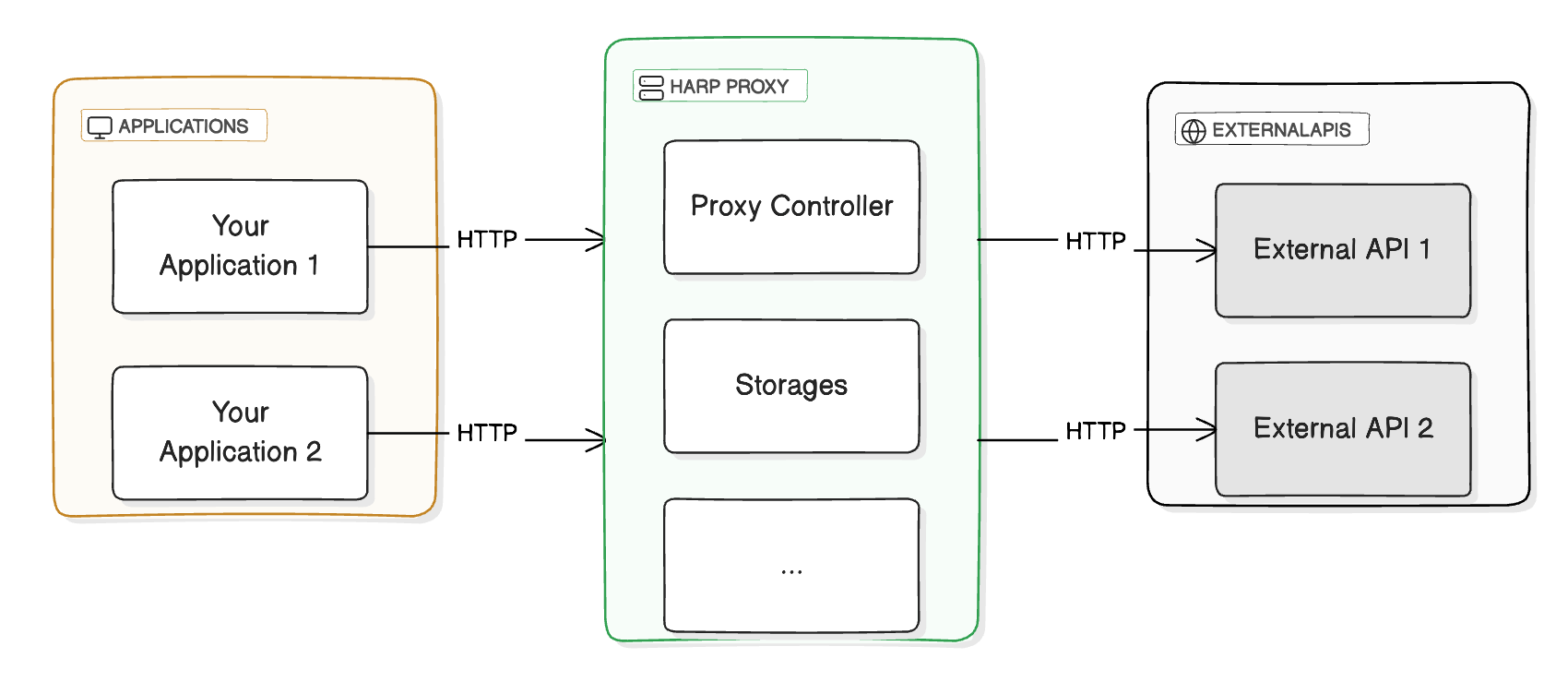
Reversibility: By requiring 0 code change on your application side (except endpoint url configuration, that should be outside the code if you follow the 12factor principles), HARP can be plugged and unplugged at a very low cost. You have absolutely no vendor lock-in.
Sidecar: Harp runs in your infrastructure, implementing the client side features right next to your application. The service is fast, and the minimum network distance between your application and the proxy makes it even faster.
Open Core: Harp is an open software. The core and reference implementation of the proxy is open source, and you can extend it to fit your needs.
Proxy features
Here is a non-exhaustive list of HARP features:
You can read more about all HARP features in the Features Guide.
1 maintainer

Metadata
1 maintainer
Release files for harp-proxy 0.10.0
For a detailed explanation of source distributions (sdists) and built distributions (wheels), please see the package formats documentation.
Source distribution (sdist)
| File | Size | Uploaded | |
|---|---|---|---|
| harp_proxy-0.10.0.tar.gz | 779.3 kB | Details |
Built distribution (wheel)
| File | Interpreter | ABI | Platform | Reset |
|---|---|---|---|---|
| harp_proxy-0.10.0-py3-none-any.whl | Python 3 | none | any | Details |
Total release size: 1.5 MB
Release files / harp_proxy-0.10.0.tar.gz
| Download URL | harp_proxy-0.10.0.tar.gz |
|---|---|
| Size | 779.3 kB |
| Tags | Source |
|
SHA-256 checksum How to use checksums |
a98a77f7184f94908f9e25c6e53cc80300bf171f56ce9ee7ed69535b5ec533cb
|
|
BLAKE2b-256 checksum How to use checksums |
f6fbdfb120e9fcbf5a77411e4cde1602a95c65a3994dd66f644d113767314fe6
|
| Upload date | |
|
Uploaded using Trusted Publishing? What is trusted publishing? |
Yes |
| Uploaded via |
twine/7.0.0 CPython/3.13.14
|
Provenance
Provenance describes where a file came from. On PyPI, provenance is shared via attestations, which provide a verifiable record of the build or publishing details. View details, limitations and caveats.


PyPI Publish Attestation
PyPI verified that this artifact, at this checksum, originated from the publisher listed below.
Signed by GitHub Actions, verified by PyPI on Oct 15, 2026.
Transparency logRelease files / harp_proxy-0.10.0-py3-none-any.whl
| Download URL | harp_proxy-0.10.0-py3-none-any.whl |
|---|---|
| Size | 739.0 kB |
| Tags | Python 3 |
|
SHA-256 checksum How to use checksums |
92f7c88bf46ca5506051a5a7e279a603c015a51969f231b97b9c774c5bd35ede
|
|
BLAKE2b-256 checksum How to use checksums |
bc8f1d488fa07e6486845081fc77e2afc46734c2d7a0f8e58221fdb801008bdd
|
| Upload date | |
|
Uploaded using Trusted Publishing? What is trusted publishing? |
Yes |
| Uploaded via |
twine/7.0.0 CPython/3.13.14
|
Provenance
Provenance describes where a file came from. On PyPI, provenance is shared via attestations, which provide a verifiable record of the build or publishing details. View details, limitations and caveats.
PyPI Publish Attestation
PyPI verified that this artifact, at this checksum, originated from the publisher listed below.
Signed by GitHub Actions, verified by PyPI on Oct 15, 2026.
Transparency log













