
determine the material properties and volume fractions of two materials in a binary mixture to meet a set of desired material properties


Project description
Composites Discoverer: A Computational Tool for the Optimal Design and Discovery of Multi-phase Composite Materials
Overview
The library utilizes the tightest theoretical bounds on the effective properties of composite materials with unspecified microstructure – the Hashin-Shtrikman bounds – to identify candidate theoretical materials, find real materials that are close to the candidates, and determine the optimal volume fractions for each of the constituents in the resulting composite.
A genetic algorithm is used to optimize over the user-specified design space. The algorithm simultaneously minimizes absolute error from the desired composite properties and optimally distributes loads across constituent phases. Once the genetic algorithm has returned theoretical candidate materials, hashin_shtrikman_mp searches for real materials in the Materials Project database with properties close to those suggested by the genetic algorithm.
The library has been designed to handle 2- to 10-phase composite design.
Aim
hashin_shtrikman_mp is a Python library which recommends optimal material combinations to achieve desired composite properties. Composites are ubiquitous in engineering, as they often exhibit enhanced material properties as compared to their individual constituents. This library is intended to be a tool for materials designers who want to explore a new space of materials without incurring huge capital cost.
Installation (🛑 under construction 🛑)
hashin_shtrikan_mp can be installed from PyPi source by running:
pip install hashin_shtrikman_mp
It can also be installed by cloning this repository, then following in the root of the repository:
pip install .
Documentation (🛑 under construction 🛑)
Under construction.
Jupyter Notebook Examples
Example notebooks are included in examples.
Implementation Notes
- Ensure you have valid credentials for the Materials Project API, which you can find by registering yourself with Materials Project – https://next-gen.materialsproject.org/.
- Optimization parameters (number of parents, children, etc.) should be chosen based on the complexity of the desired material properties and computational resources.
- The genetic algorithm's efficiency and effectiveness can vary greatly based on the optimization parameters and the definition of the cost function. Using defaults is recommended.
- Visualization of cost versus generation can provide insights into the convergence behavior of the genetic algorithm. Expect that the exact shape of the convergence plot will change every time the algorithm is run, due to the stochastic nature of the algorithm.
Miscallaneous features
mpi4py support is added to append final_dict 🛑 <-- still true ?? 🛑
To take advantage of mpi parallelization, one can run the following:
pip install mpi4py
In case installation via pip fails, you can use brew + pip instead:
brew install mpi4py
pip install mpi4py
Then run:
mpiexec -n 4 python tests/integration/test_optimization_flow.py
Workflow
User Input
- Collect User Input and instantiate a
UserInputobject with 1) the number of constituent materials desired in the composite, 2) the desired ultimate material properties and 3) upper and lower search bounds for the properties of each constituent material.
Optimization
- Instantiate an
OptimizerObject with Materials Project API credentials and user input. - (Optional) Set Optimization Parameters: The genetic algorithm optimization requires values for the number of parents, children, members in a generation, number of generations, and weights for absolute error and load distribution. It is recommended to use the default settings.
- Set Initial Population: In each generation of the genetic algorithm, instantiate a
Populationobject with the optimization parameters defined in the previous step. Each member of the population represents a candidate set of materials and their respective volume fractions in the composite. - Random Property Assignment: Randomly property values and volume fractions to each member of the population using
Population.set_random_values. Random values are constrained by the bounds provided by the user and by the necessity that the volume fractions sum to unity. - Evaluate Fitness: Evaluate each member according to a cost function which penalizes deviations from desired properties and which penalizes uneven distribution of load. Do this by creating an instance of
Memberfor each member inPopulationand callingMember.get_cost. This concludes generation 1. - Select Top Performers: Sort the members by cost. A lower cost corresponds to a stronger performer and a higher cost to a weak performer. Retain the top
num_parentsmembers and discard the rest. - Breed and Produce Offspring: Pairwise mate the top
num_parentsmembers to producenum_kidsnew members. Once again usingPopulation.set_random_values, augment the population with new, random members to maintain the population size atnum_members. - Evaluate Fitness of New Generation: Evaluate each member according by the same cost function. This concludes generation 2.
- Iterate Over Generations: Repeat the selection of top performers, breeding, and fitness evaluation process for
num_generations.
Visualization and Match Finding
- Obtain Convergence Plot: Observe the monotonic decrease of the lowest cost observed across the population as the generations pass.
- Recommend Theoretical Candidates: After the final generation, for each of the top composite candidates display a table of 1) material properties for each constituent phase, 2) volume fractions for each constituent phase, and 3) the cost of that theoretical candidate.
- Create a Material Properties Dictionary keyed by
mp_idsand their corresponding material properties of interest, gathered using the MP-API. The dictionary will be comprised of real materials that closely resemble the theoretical materials recommended by the genetic algorithm. - Create Populations of Real Composite Candidates: For each set of candidate constituent materials, create a population by varying only the volume fractions of the composite constituents.
- Find the Optimal Volume Fractions by evaluating the population with the same cost function used previously.
- Display of Top-Performing Candidates: Repeat the process for all possible combinations of materials and display the top-performers along with their volume fractions.
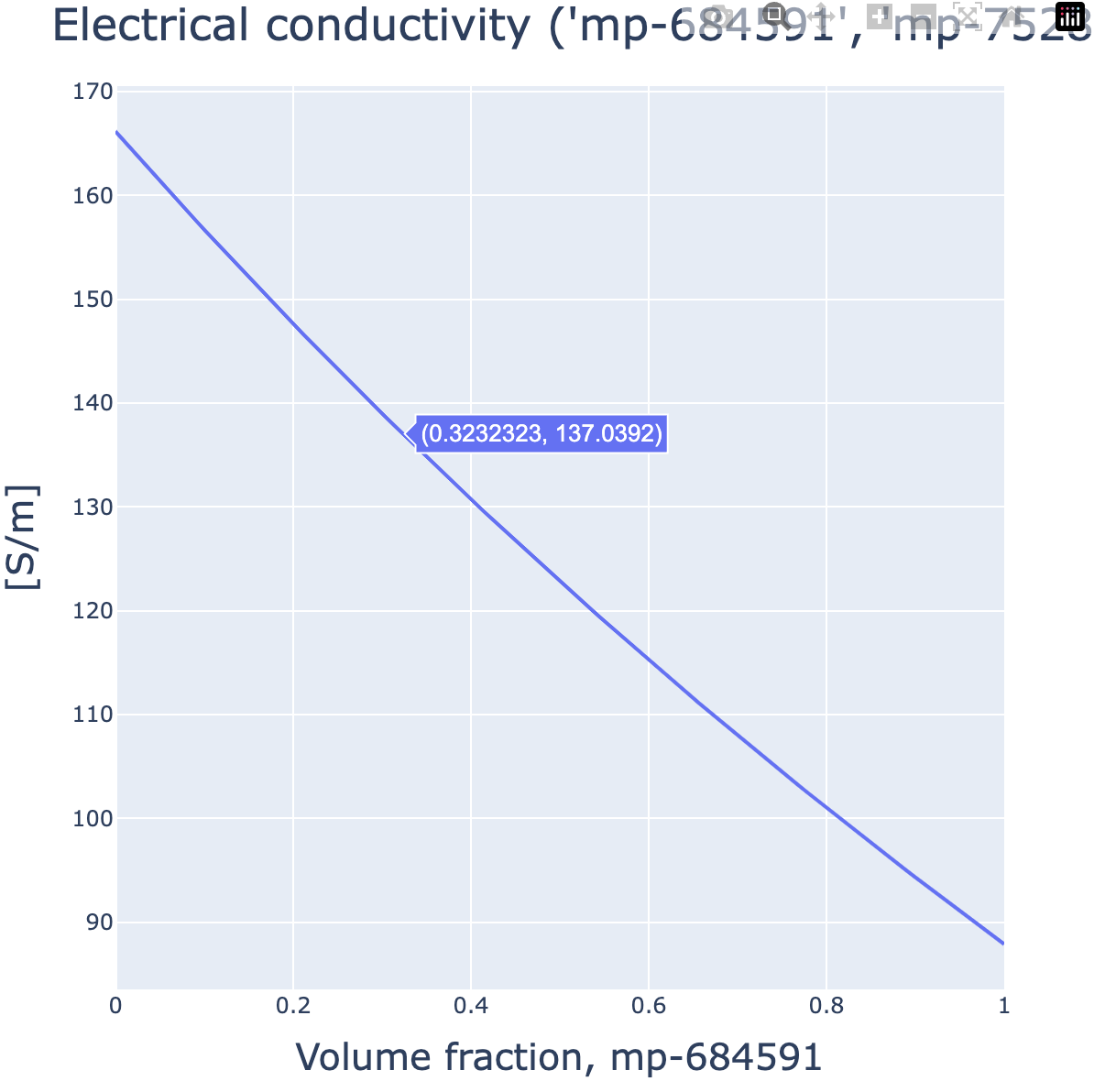
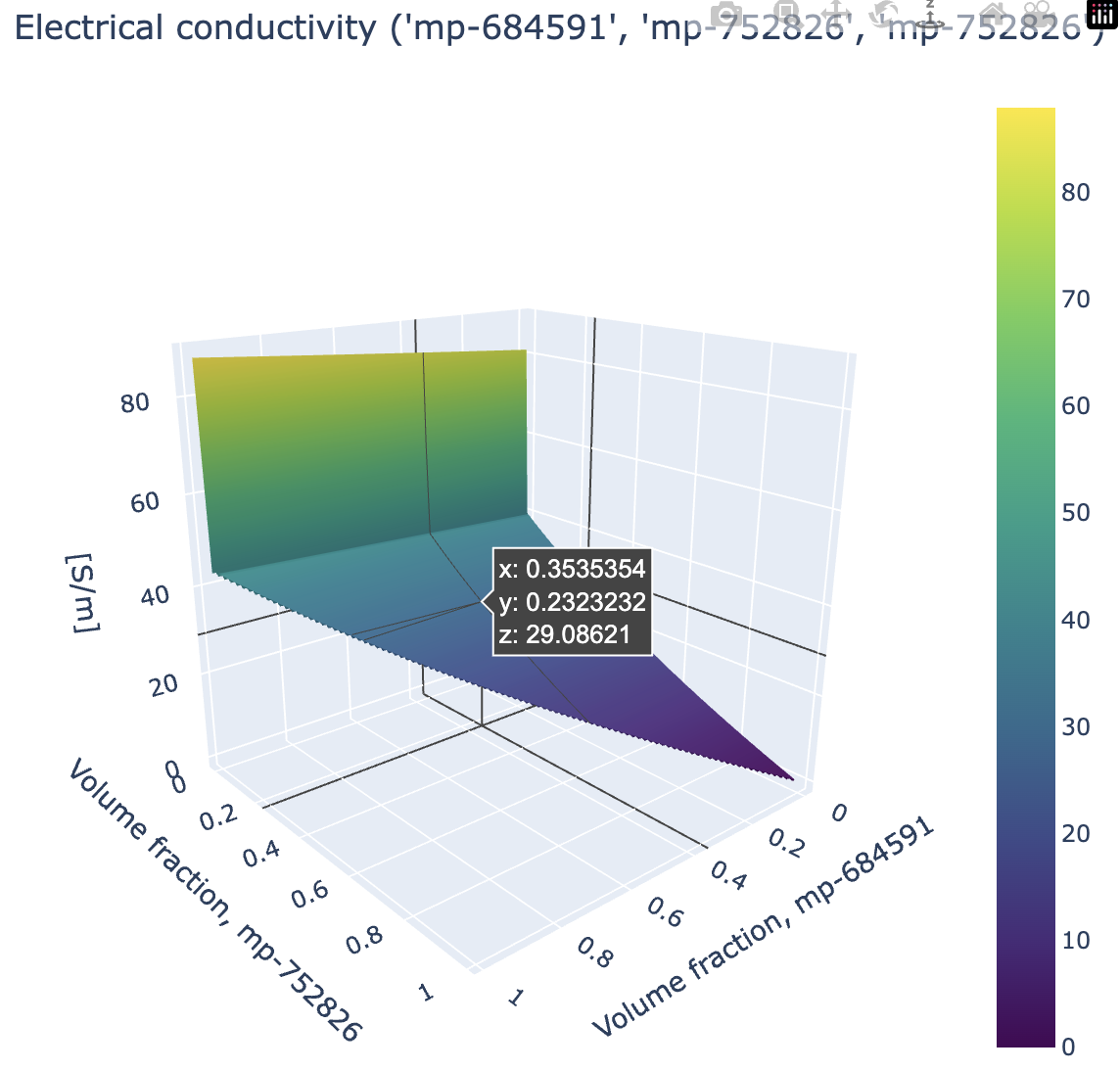
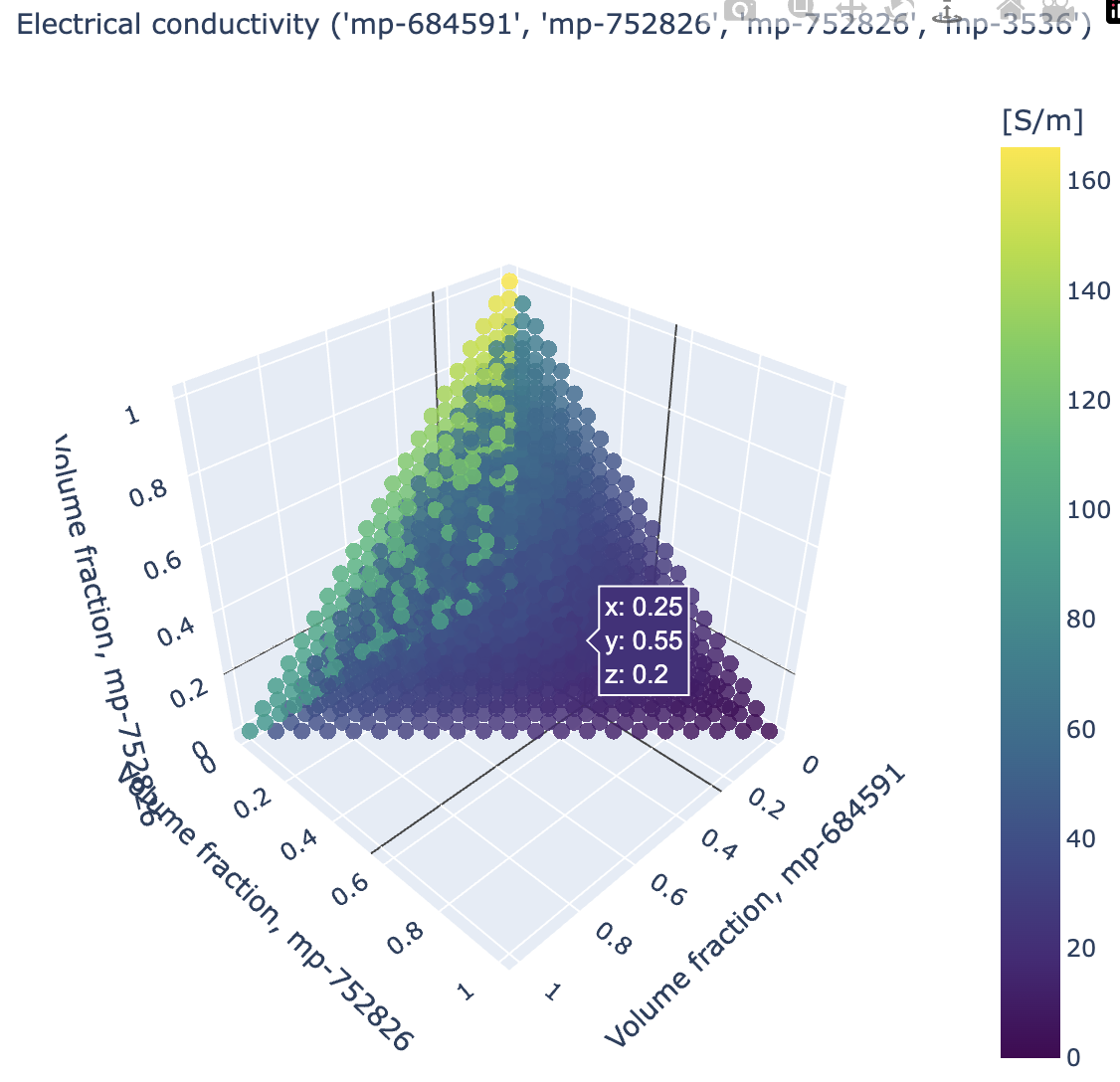
- For 2-, 3-, and 4-phase Composites view the phase diagram for each property of interest and view how changing constituent volume fractions changes the effective composite property.
Example Visualizations
Phase Diagram of Thermal Conductivity for 2-phase Composite
Phase Diagram of Thermal Conductivity for 3-phase Composite
Phase Diagram of Thermal Conductivity for 4-phase Composite
Release history Release notifications | RSS feed


Download files
Download the file for your platform. If you're not sure which to choose, learn more about installing packages.
Source Distribution
Built Distribution
Filter files by name, interpreter, ABI, and platform.
If you're not sure about the file name format, learn more about wheel file names.
Copy a direct link to the current filters
File details
Details for the file hashin_shtrikman_mp-0.1.0.tar.gz.
File metadata
- Download URL: hashin_shtrikman_mp-0.1.0.tar.gz
- Upload date:
- Size: 33.9 kB
- Tags: Source
- Uploaded using Trusted Publishing? No
- Uploaded via: twine/6.1.0 CPython/3.11.10
File hashes
| Algorithm | Hash digest | |
|---|---|---|
| SHA256 |
816e0c485b219a3e27371e843b234b44a6406ce52af09ca642e2b3c39b7e368a
|
|
| MD5 |
4b52fa3bba036d464ce9cea20cb974e4
|
|
| BLAKE2b-256 |
4c689eaa65b14b699691f5c14e16a5c0eff390e6c0bfa1db25c2367025df1eb1
|
File details
Details for the file hashin_shtrikman_mp-0.1.0-py3-none-any.whl.
File metadata
- Download URL: hashin_shtrikman_mp-0.1.0-py3-none-any.whl
- Upload date:
- Size: 38.2 kB
- Tags: Python 3
- Uploaded using Trusted Publishing? No
- Uploaded via: twine/6.1.0 CPython/3.11.10
File hashes
| Algorithm | Hash digest | |
|---|---|---|
| SHA256 |
fceb2e531851331f8abe9d438f5037dc4d1fdfbc7680807bfc0f2c107c2dd7f1
|
|
| MD5 |
30c365b17f28cbb7872a99672a13235b
|
|
| BLAKE2b-256 |
3e251fe0c85a7fb74de0fe562a197e4532bf0fd4b41be2b44efa77d4c052527f
|






