This release is a pre-release and may not be stable for production use.




Haste is a CUDA implementation of fused RNN layers with built-in DropConnect and Zoneout regularization. These layers are exposed through C++ and Python APIs for easy integration into your own projects or machine learning frameworks.
Which RNN types are supported?
What's included in this project?
- a standalone C++ API (
libhaste) - a TensorFlow Python API (
haste_tf) - a PyTorch API (
haste_pytorch) - examples for writing your own custom C++ inference / training code using
libhaste - benchmarking programs to evaluate the performance of RNN implementations
For questions or feedback about Haste, please open an issue on GitHub or send us an email at haste@lmnt.com.
Install
Here's what you'll need to get started:
- a CUDA Compute Capability 3.7+ GPU (required)
- CUDA Toolkit 10.0+ (required)
- TensorFlow GPU 1.14+ or 2.0+ for TensorFlow integration (optional)
- PyTorch 1.3+ for PyTorch integration (optional)
- Eigen 3 to build the C++ examples (optional)
- cuDNN Developer Library to build benchmarking programs (optional)
Once you have the prerequisites, you can install with pip or by building the source code.
Using pip
pip install haste_pytorch
pip install haste_tf
Building from source
make               # Build everything
make haste         # ;) Build C++ API
make haste_tf      # Build TensorFlow API
make haste_pytorch # Build PyTorch API
make examples
make benchmarks
If you built the TensorFlow or PyTorch API, install it with pip:
pip install haste_tf-*.whl
pip install haste_pytorch-*.whl
If the CUDA Toolkit that you're building against is not in /usr/local/cuda, you must specify the
$CUDA_HOME environment variable before running make:
CUDA_HOME=/usr/local/cuda-10.2 make
Performance
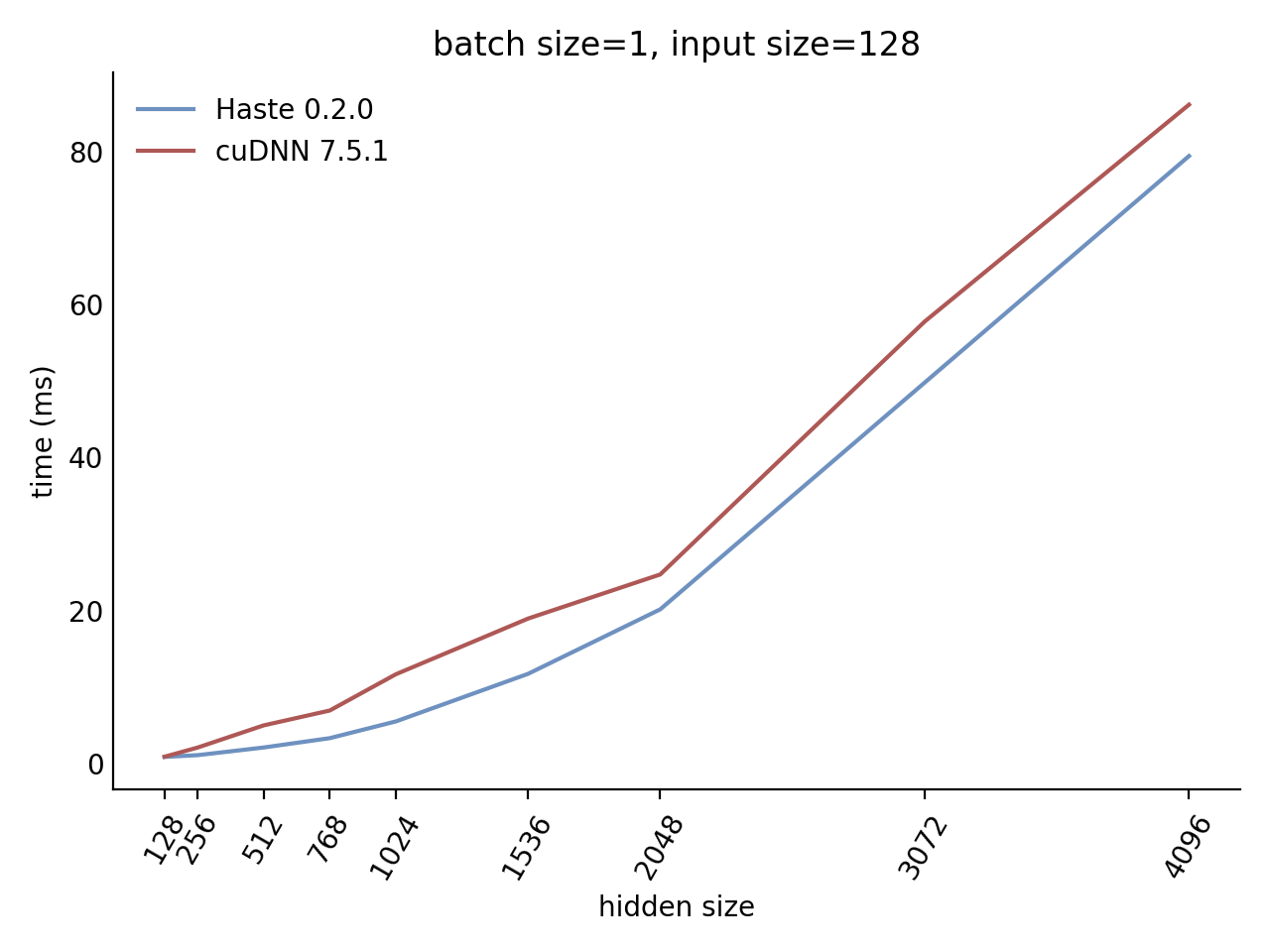
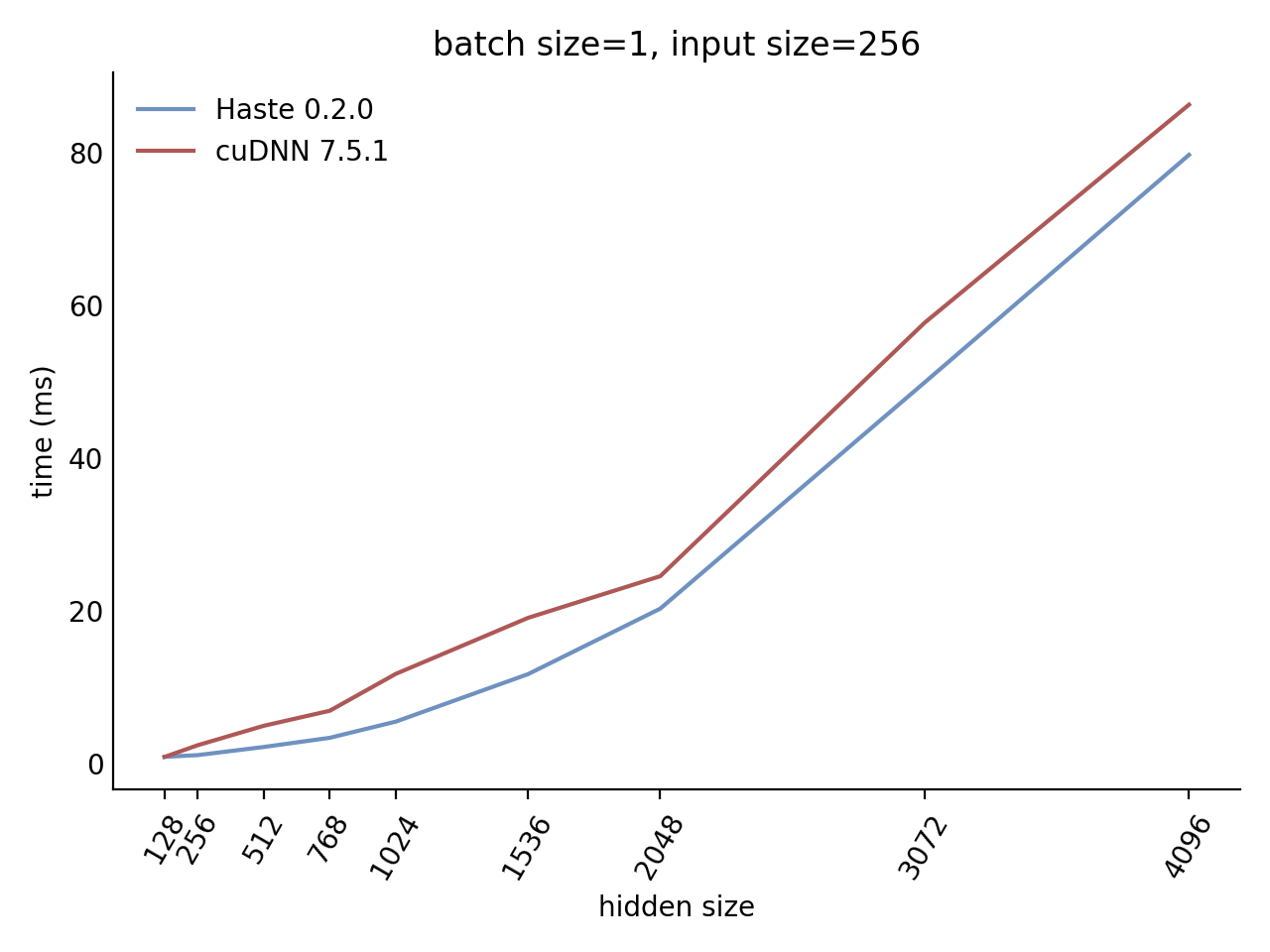
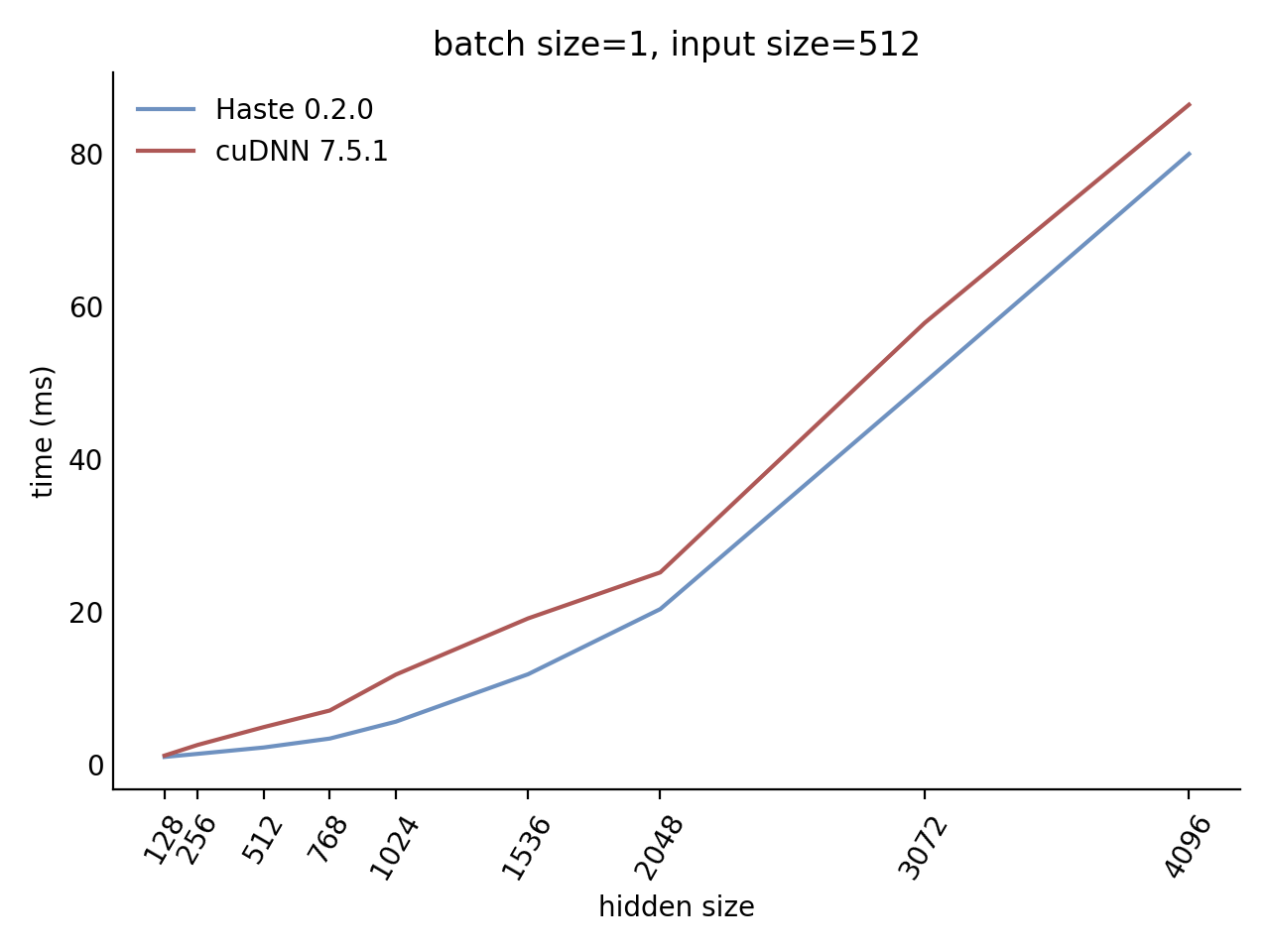
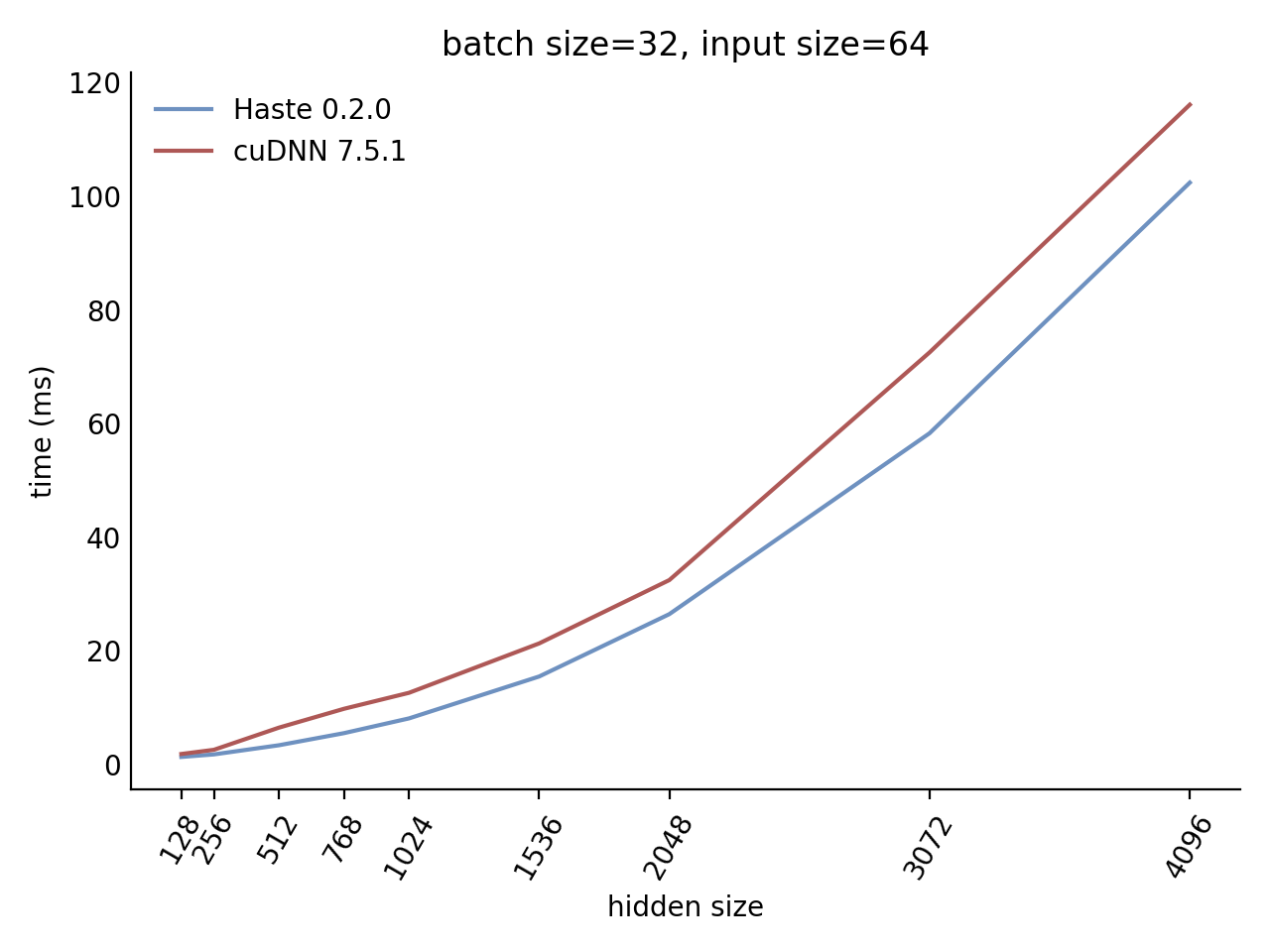
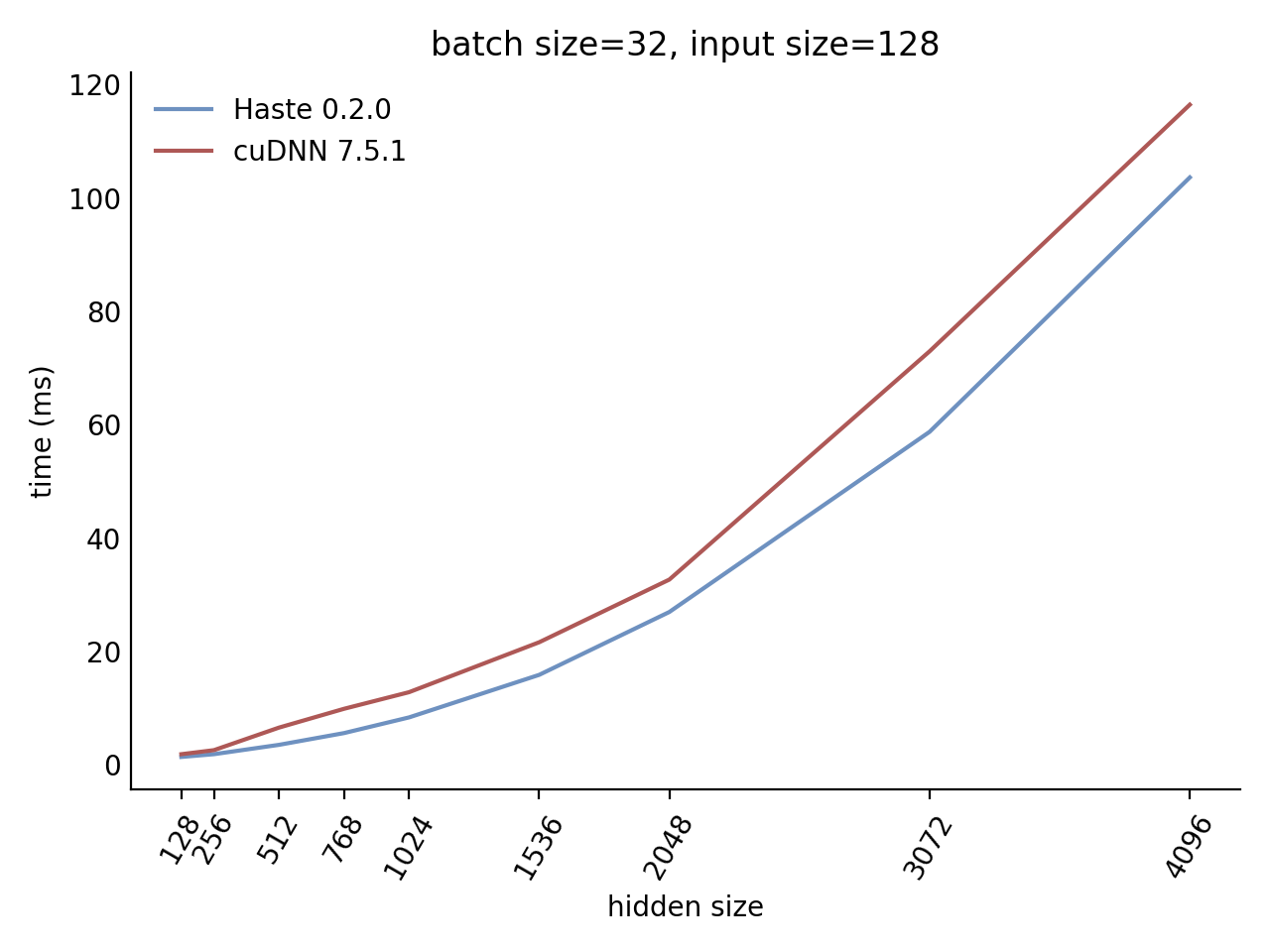
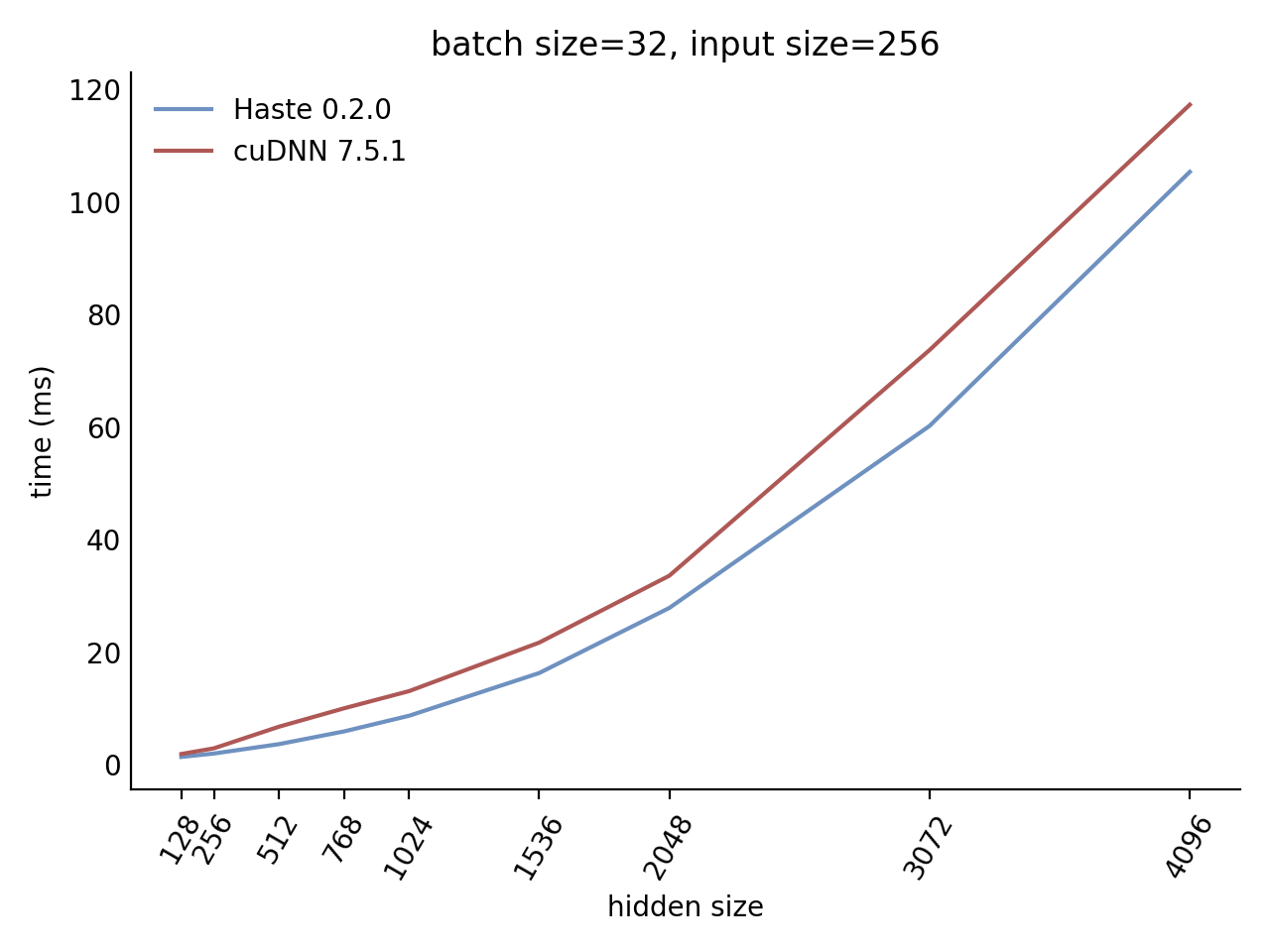
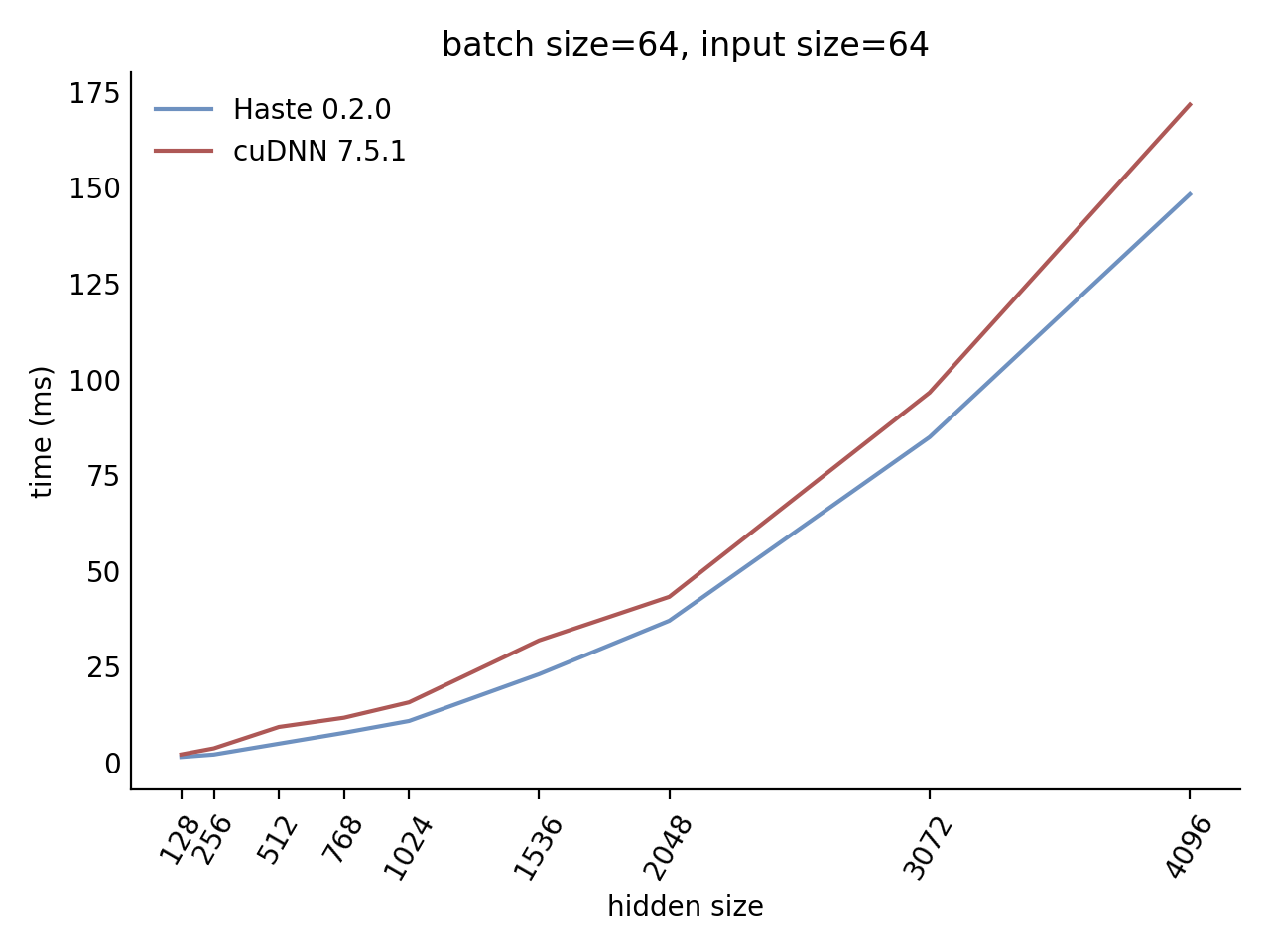
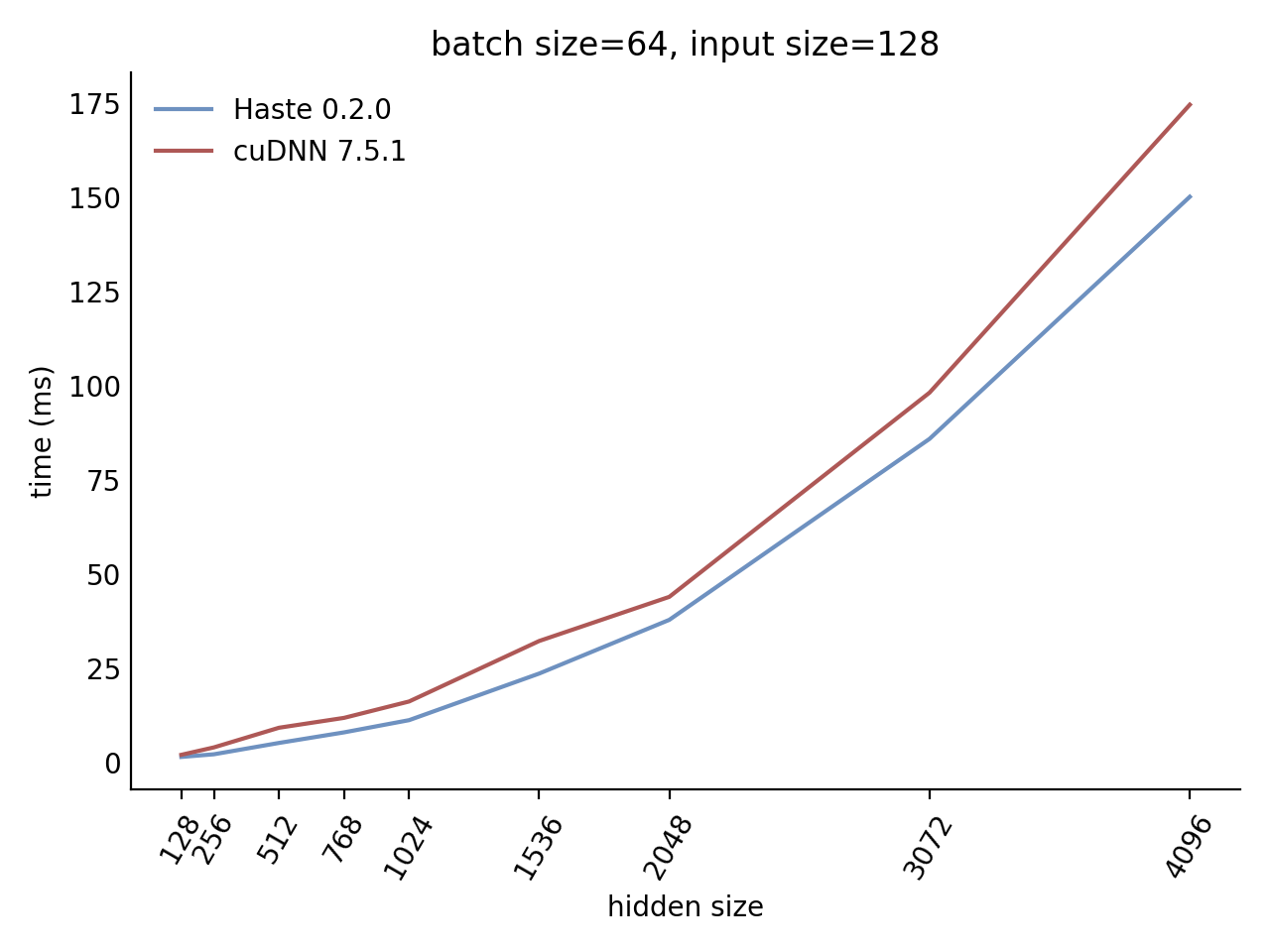
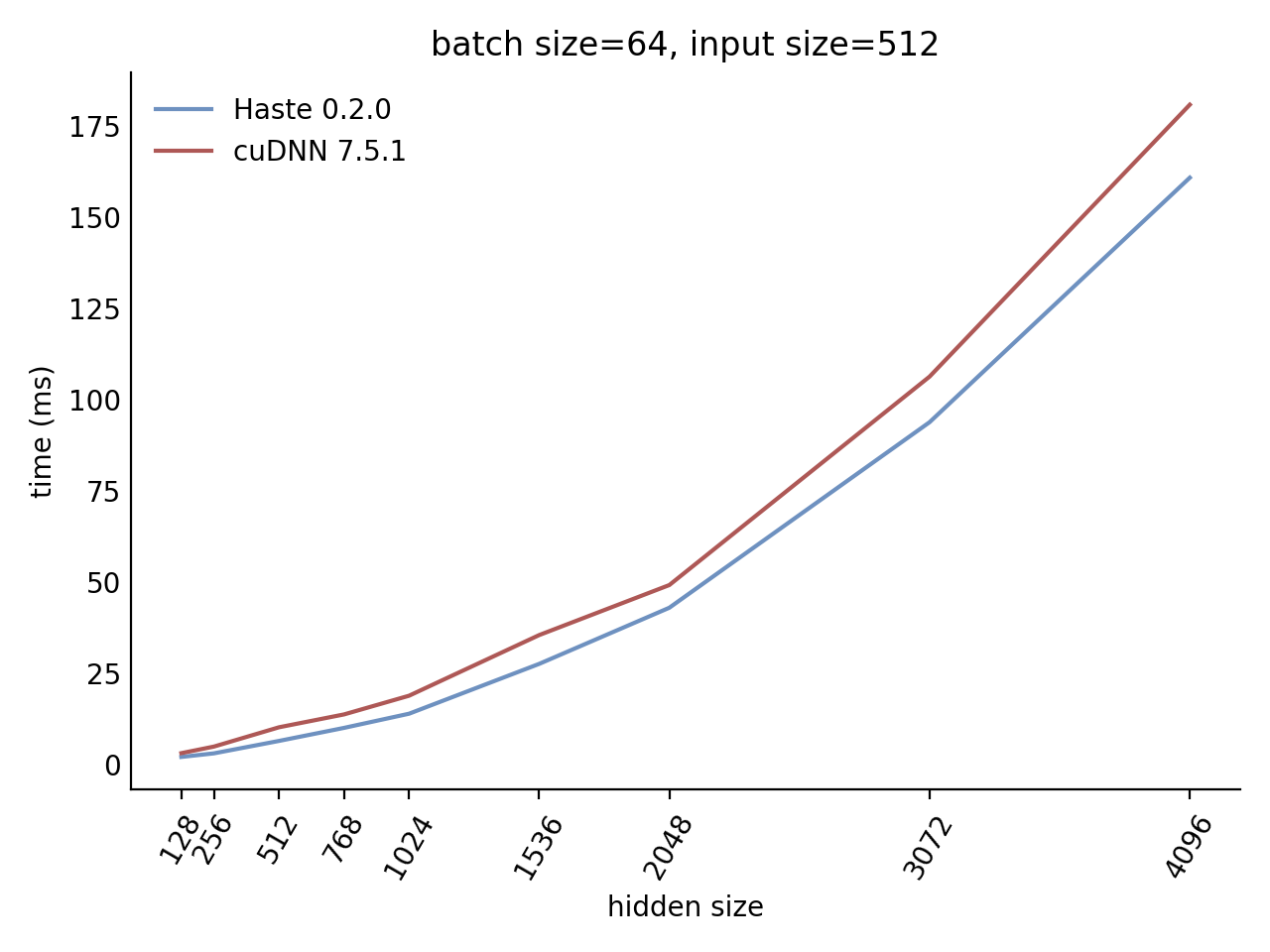
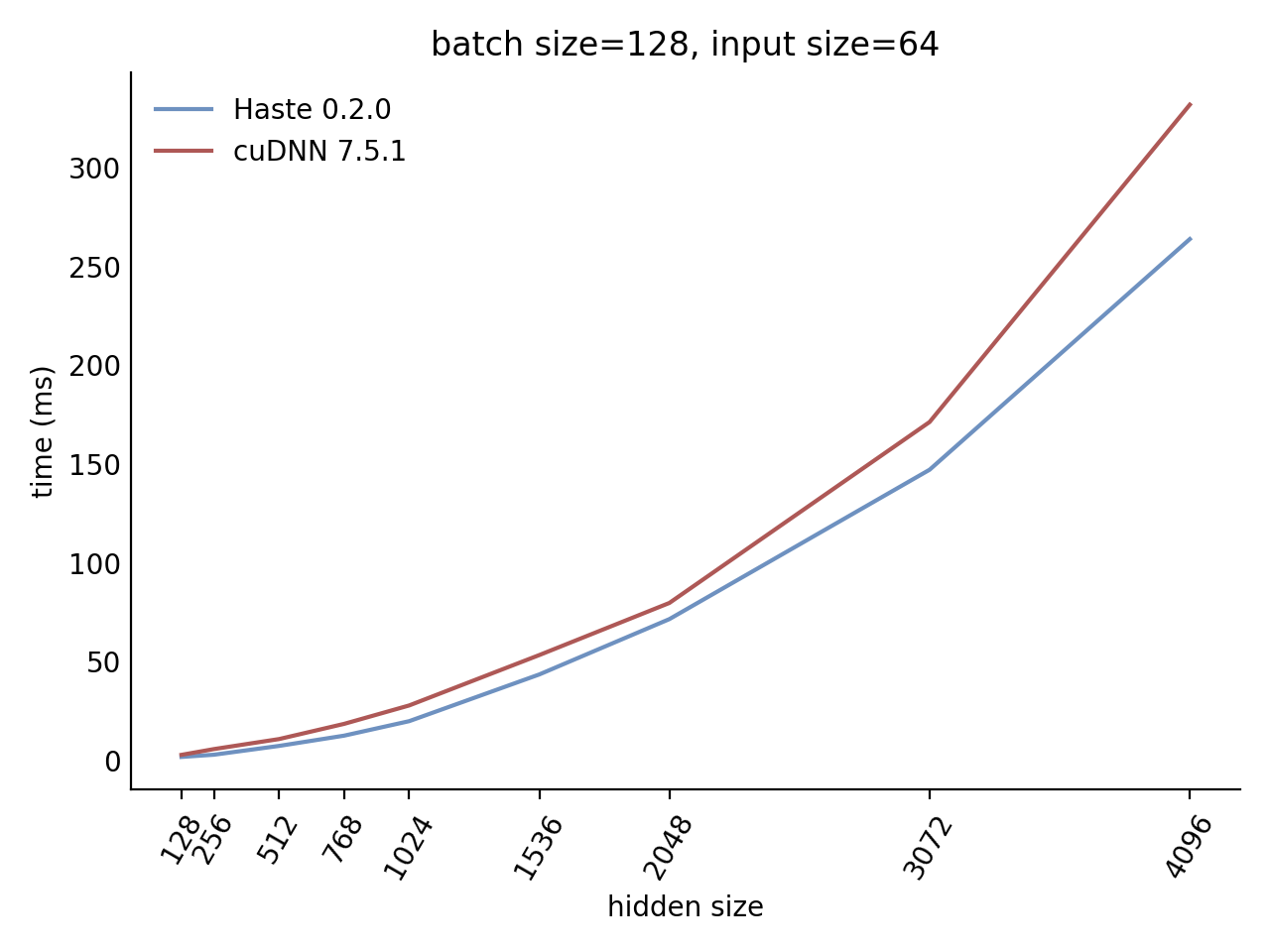
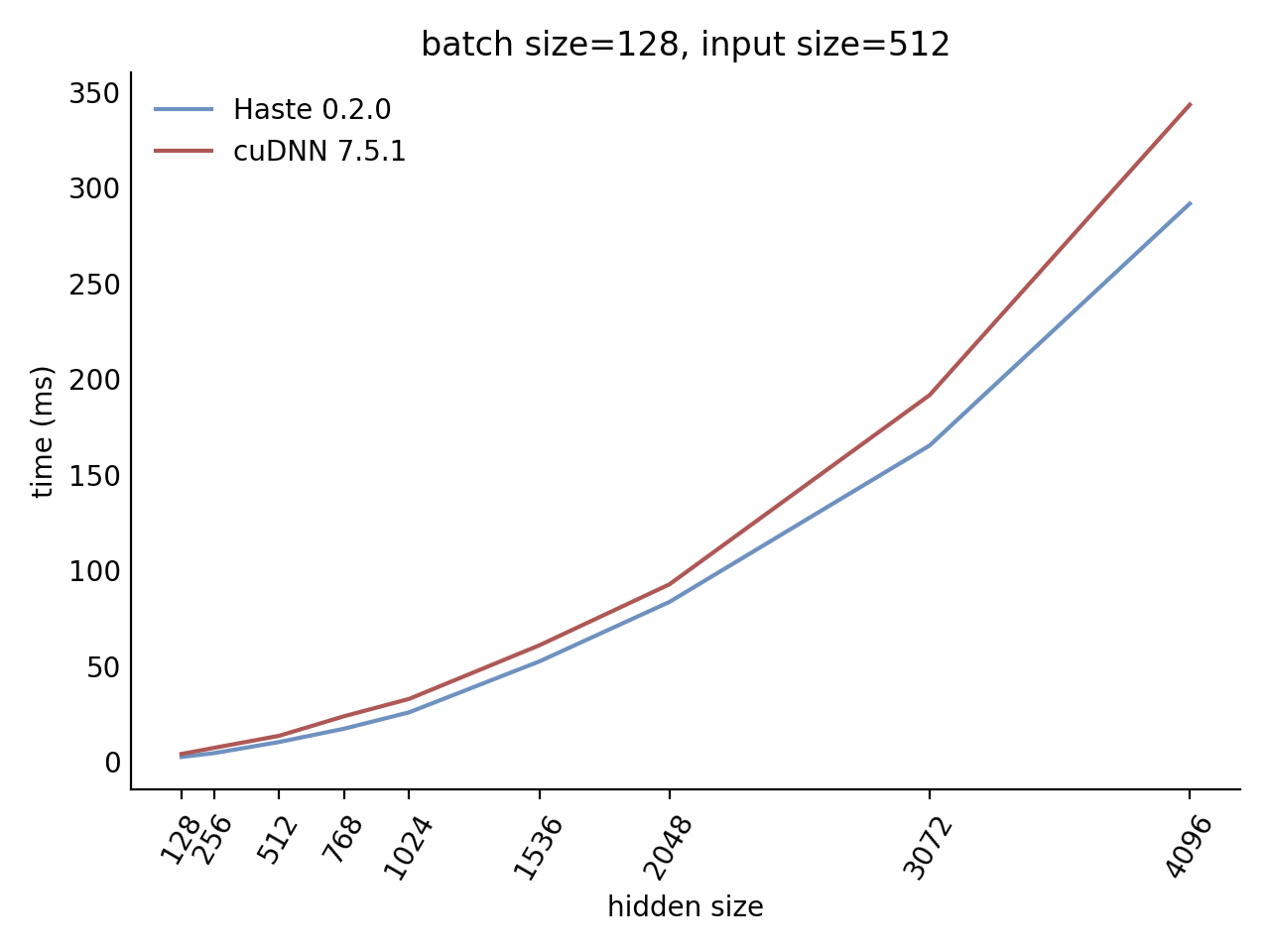
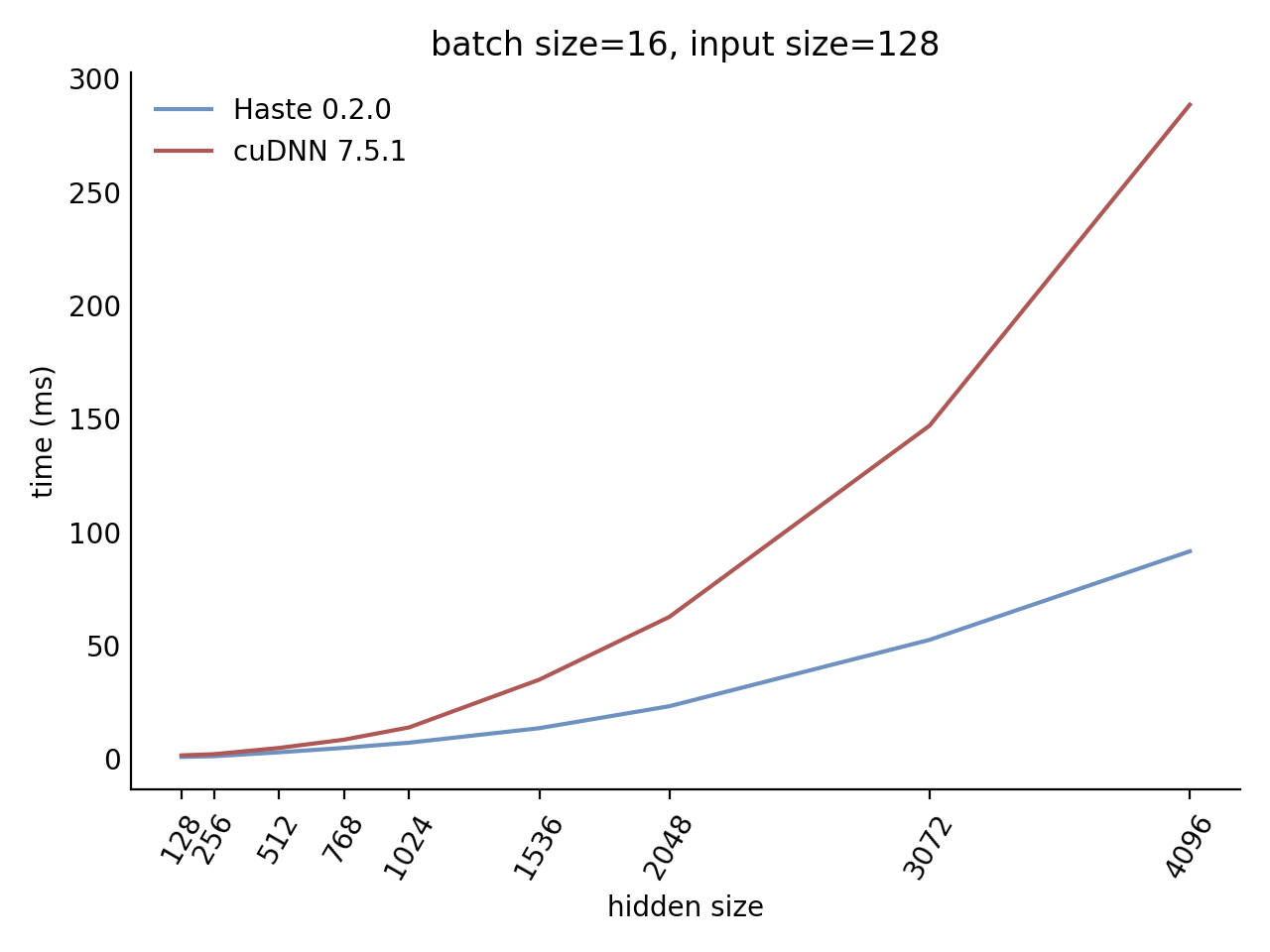
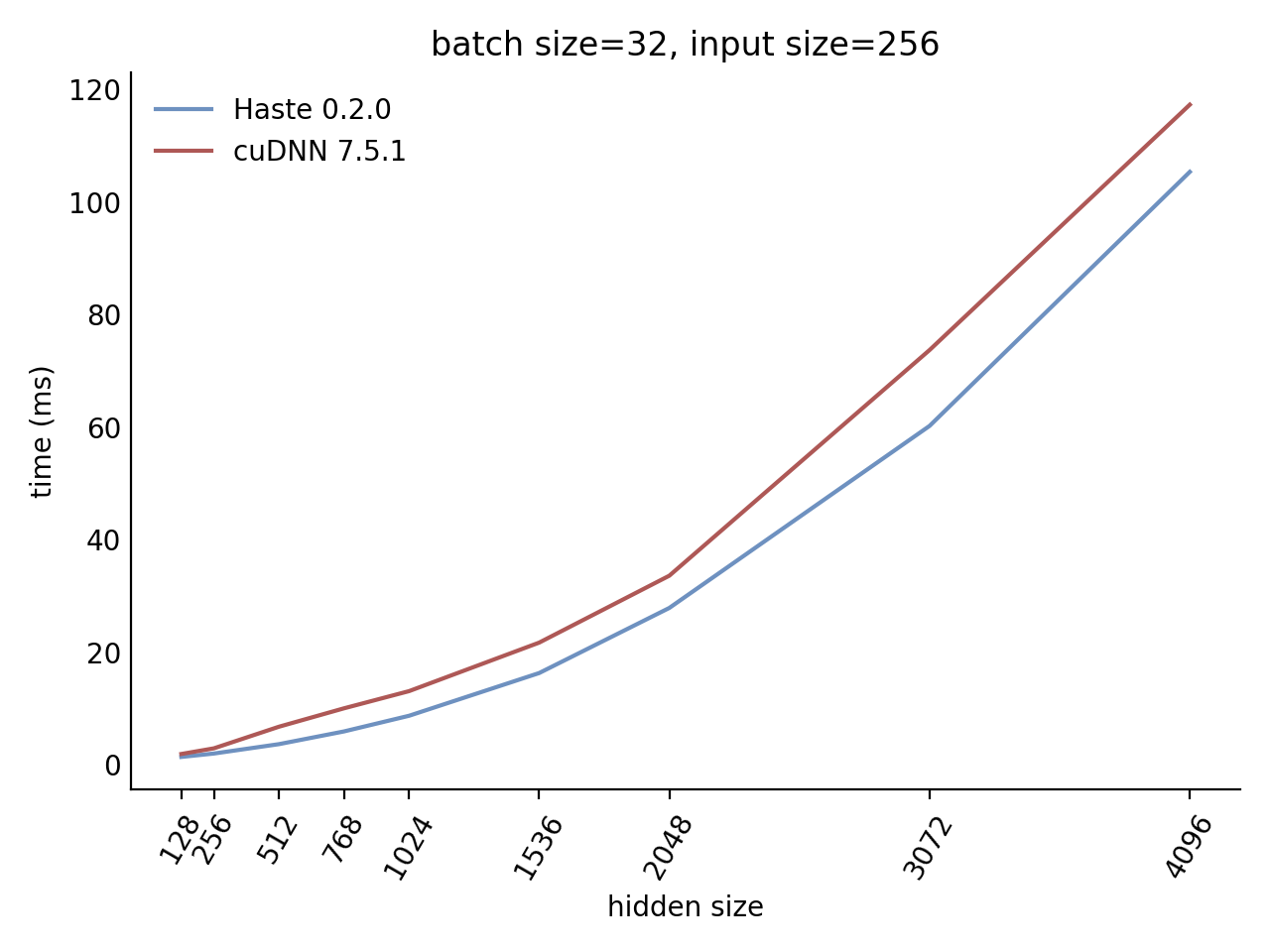
Our LSTM and GRU benchmarks indicate that Haste has the fastest publicly available implementation for nearly all problem sizes. The following charts show our LSTM results, but the GRU results are qualitatively similar.
 |  |
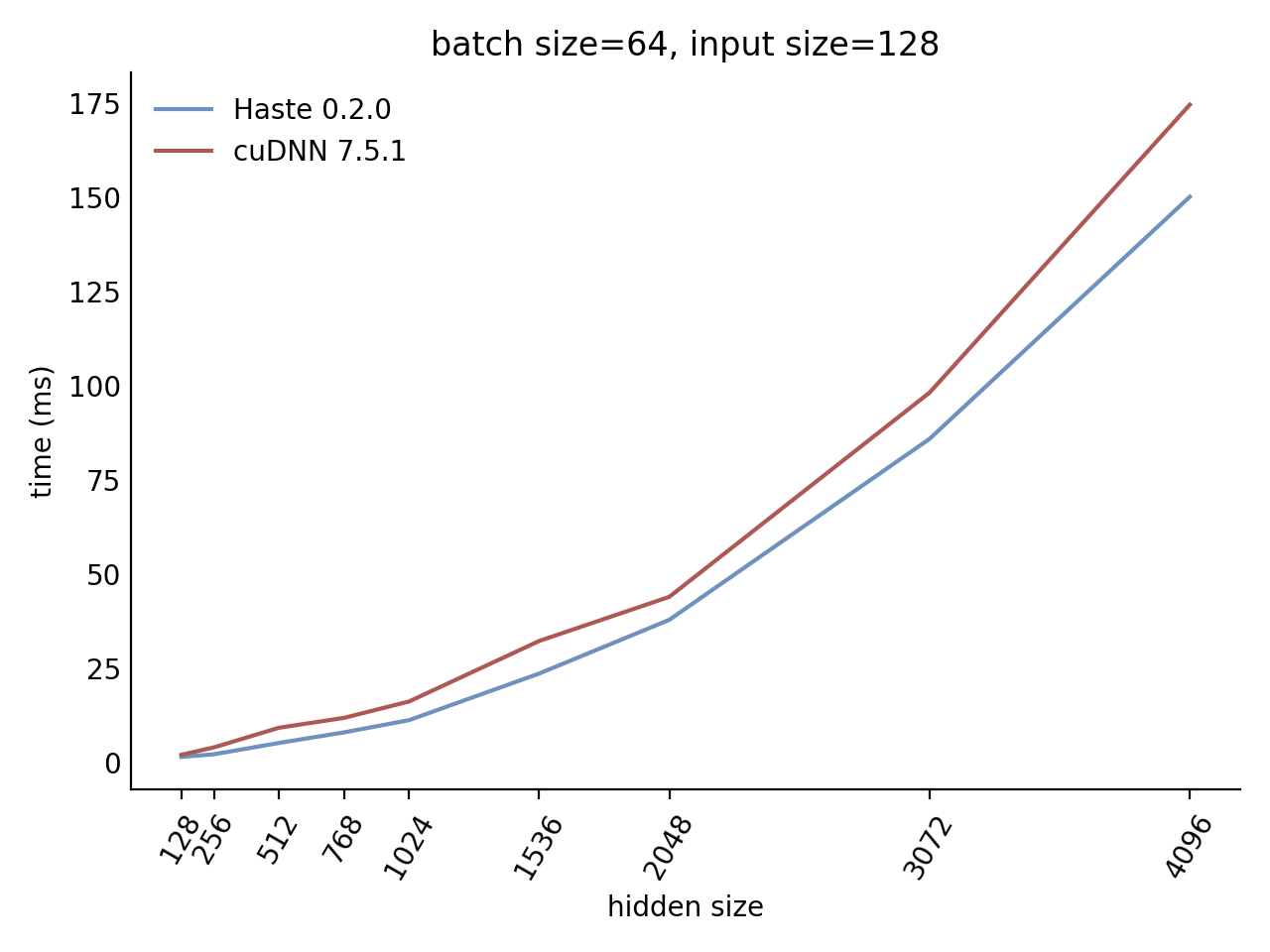 | 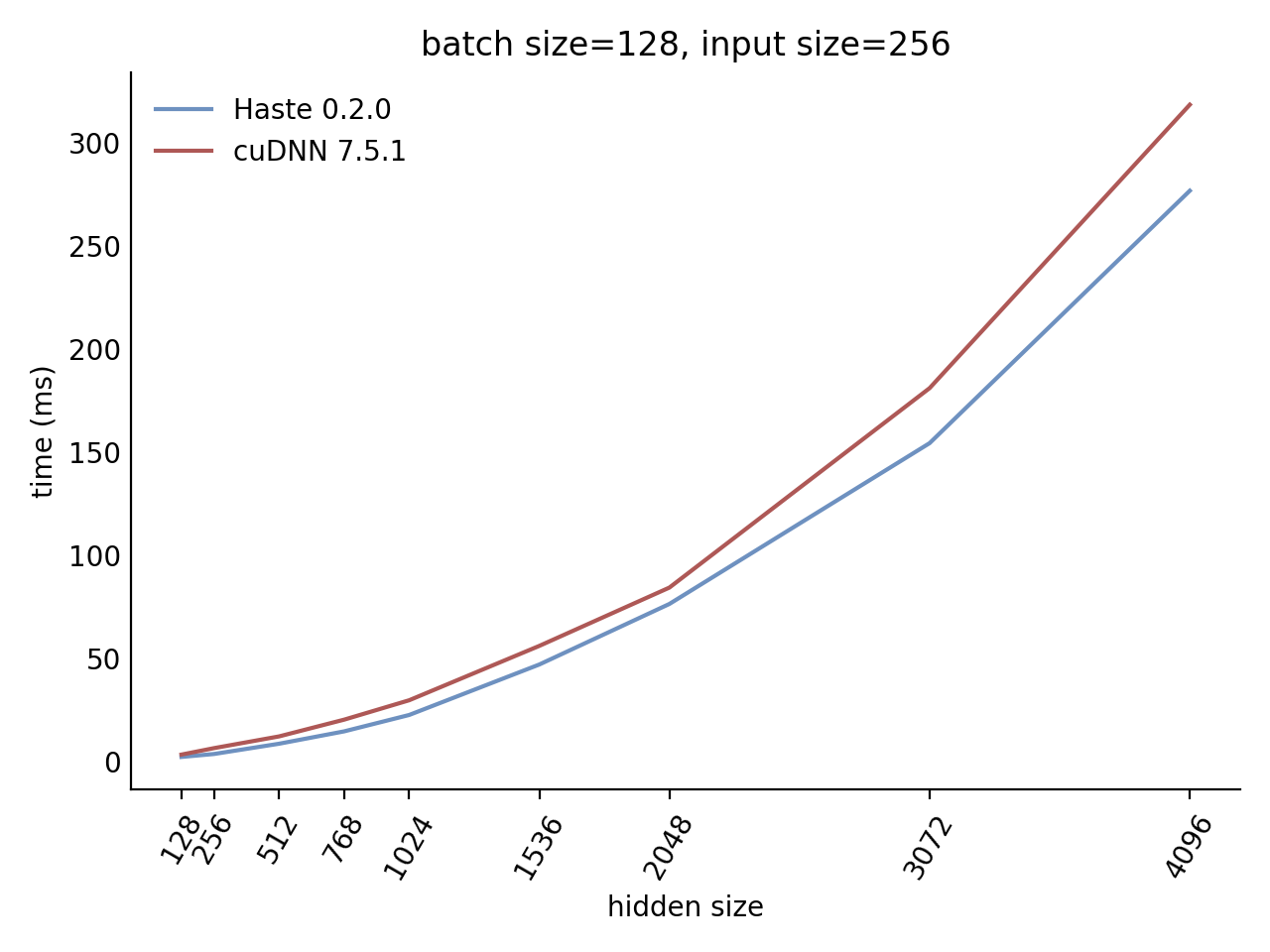 |
Here is our complete LSTM benchmark result grid:
N=1 C=64
N=1 C=128
N=1 C=256
N=1 C=512
N=32 C=64
N=32 C=128
N=32 C=256
N=32 C=512
N=64 C=64
N=64 C=128
N=64 C=256
N=64 C=512
N=128 C=64
N=128 C=128
N=128 C=256
N=128 C=512
Documentation
TensorFlow API
import haste_tf as haste

gru_layer = haste.GRU(num_units=256, direction='bidirectional', zoneout=0.1, dropout=0.05)
indrnn_layer = haste.IndRNN(num_units=256, direction='bidirectional', zoneout=0.1)
lstm_layer = haste.LSTM(num_units=256, direction='bidirectional', zoneout=0.1, dropout=0.05)
norm_gru_layer = haste.LayerNormGRU(num_units=256, direction='bidirectional', zoneout=0.1, dropout=0.05)
norm_lstm_layer = haste.LayerNormLSTM(num_units=256, direction='bidirectional', zoneout=0.1, dropout=0.05)

# `x` is a tensor with shape [N,T,C]
x = tf.random.normal([5, 25, 128])

y, state = gru_layer(x, training=True)
y, state = indrnn_layer(x, training=True)
y, state = lstm_layer(x, training=True)
y, state = norm_gru_layer(x, training=True)
y, state = norm_lstm_layer(x, training=True)
The TensorFlow Python API is documented in docs/tf/haste_tf.md.
PyTorch API
import torch
import haste_pytorch as haste

gru_layer = haste.GRU(input_size=128, hidden_size=256, zoneout=0.1, dropout=0.05)
indrnn_layer = haste.IndRNN(input_size=128, hidden_size=256, zoneout=0.1)
lstm_layer = haste.LSTM(input_size=128, hidden_size=256, zoneout=0.1, dropout=0.05)
norm_gru_layer = haste.LayerNormGRU(input_size=128, hidden_size=256, zoneout=0.1, dropout=0.05)
norm_lstm_layer = haste.LayerNormLSTM(input_size=128, hidden_size=256, zoneout=0.1, dropout=0.05)

gru_layer.cuda()
indrnn_layer.cuda()
lstm_layer.cuda()
norm_gru_layer.cuda()
norm_lstm_layer.cuda()

# `x` is a CUDA tensor with shape [T,N,C]
x = torch.rand([25, 5, 128]).cuda()

y, state = gru_layer(x)
y, state = indrnn_layer(x)
y, state = lstm_layer(x)
y, state = norm_gru_layer(x)
y, state = norm_lstm_layer(x)
The PyTorch API is documented in docs/pytorch/haste_pytorch.md.
C++ API
The C++ API is documented in lib/haste/*.h and there are code samples in examples/.
Code layout
benchmarks/: programs to evaluate performance of RNN implementationsdocs/tf/: API reference documentation forhaste_tfdocs/pytorch/: API reference documentation forhaste_pytorchexamples/: examples for writing your own C++ inference / training code usinglibhasteframeworks/tf/: TensorFlow Python API and custom op codeframeworks/pytorch/: PyTorch API and custom op codelib/: CUDA kernels and C++ APIvalidation/: scripts to validate output and gradients of RNN layers
Implementation notes
- the GRU implementation is based on
1406.1078v1(same as cuDNN) rather than1406.1078v3 - Zoneout on LSTM cells is applied to the hidden state only, and not the cell state
- the layer normalized LSTM implementation uses these equations
References
- Hochreiter, S., & Schmidhuber, J. (1997). Long Short-Term Memory. Neural Computation, 9(8), 1735–1780. https://doi.org/10.1162/neco.1997.9.8.1735
- Cho, K., van Merrienboer, B., Gulcehre, C., Bahdanau, D., Bougares, F., Schwenk, H., & Bengio, Y. (2014). Learning Phrase Representations using RNN Encoder-Decoder for Statistical Machine Translation. arXiv:1406.1078 [cs, stat]. http://arxiv.org/abs/1406.1078.
- Wan, L., Zeiler, M., Zhang, S., Cun, Y. L., & Fergus, R. (2013). Regularization of Neural Networks using DropConnect. In International Conference on Machine Learning (pp. 1058–1066). Presented at the International Conference on Machine Learning. http://proceedings.mlr.press/v28/wan13.html.
- Krueger, D., Maharaj, T., Kramár, J., Pezeshki, M., Ballas, N., Ke, N. R., et al. (2017). Zoneout: Regularizing RNNs by Randomly Preserving Hidden Activations. arXiv:1606.01305 [cs]. http://arxiv.org/abs/1606.01305.
- Ba, J., Kiros, J.R., & Hinton, G.E. (2016). Layer Normalization. arXiv:1607.06450 [cs, stat]. https://arxiv.org/abs/1607.06450.
- Li, S., Li, W., Cook, C., Zhu, C., & Gao, Y. (2018). Independently Recurrent Neural Network (IndRNN): Building A Longer and Deeper RNN. arXiv:1803.04831 [cs]. http://arxiv.org/abs/1803.04831.
Citing this work
To cite this work, please use the following BibTeX entry:
@misc{haste2020,
  title  = {Haste: a fast, simple, and open RNN library},
  author = {Sharvil Nanavati},
  year   = 2020,
  month  = "Jan",
  howpublished = {\url{https://github.com/lmnt-com/haste/}},
}
License
1 maintainer

Metadata
1 maintainer
Release files for haste-tf 0.5.0rc0
For a detailed explanation of source distributions (sdists) and built distributions (wheels), please see the package formats documentation.
Source distribution (sdist)
| File | Size | Uploaded | |
|---|---|---|---|
| haste_tf-0.5.0rc0.tar.gz | 53.6 kB | Details |
Release files / haste_tf-0.5.0rc0.tar.gz
| Download URL | haste_tf-0.5.0rc0.tar.gz |
|---|---|
| Size | 53.6 kB |
| Tags | Source |
|
SHA-256 checksum How to use checksums |
59a2464a1f29e206d70f108e1e008aac073cfb8bdc0cf88c24c2a425db34b9a6
|
|
BLAKE2b-256 checksum How to use checksums |
35b75125b4daee8571e70ca82d3bd812220f04da1c5a4972fac4cd264ebf3721
|
| Upload date | |
|
Uploaded using Trusted Publishing? What is trusted publishing? |
No |
| Uploaded via |
twine/3.2.0 pkginfo/1.5.0.1 requests/2.22.0 setuptools/45.0.0 requests-toolbelt/0.9.1 tqdm/4.32.1 CPython/3.6.9
|