
hea-bench






Open, interpretable tools for computing the standard high-entropy-alloy (HEA) and high-entropy-oxide (HEO) thermodynamic and geometric descriptors and the classic empirical phase-prediction rules, from any composition. Every descriptor is a transparent closed-form expression over a curated element-property table, validated against the primary literature. The fitted predictions (hardness, phase prediction sets) carry calibrated uncertainty and flag alloys unlike their training data.
Try it now: https://dfieser.github.io/hea-bench/. No install, it runs entirely in your browser, and every library feature works there: the calculator for alloys, oxides and ceramics with property and phase predictions, the experimental dataset, alloy search and experiment planning, and the benchmark.
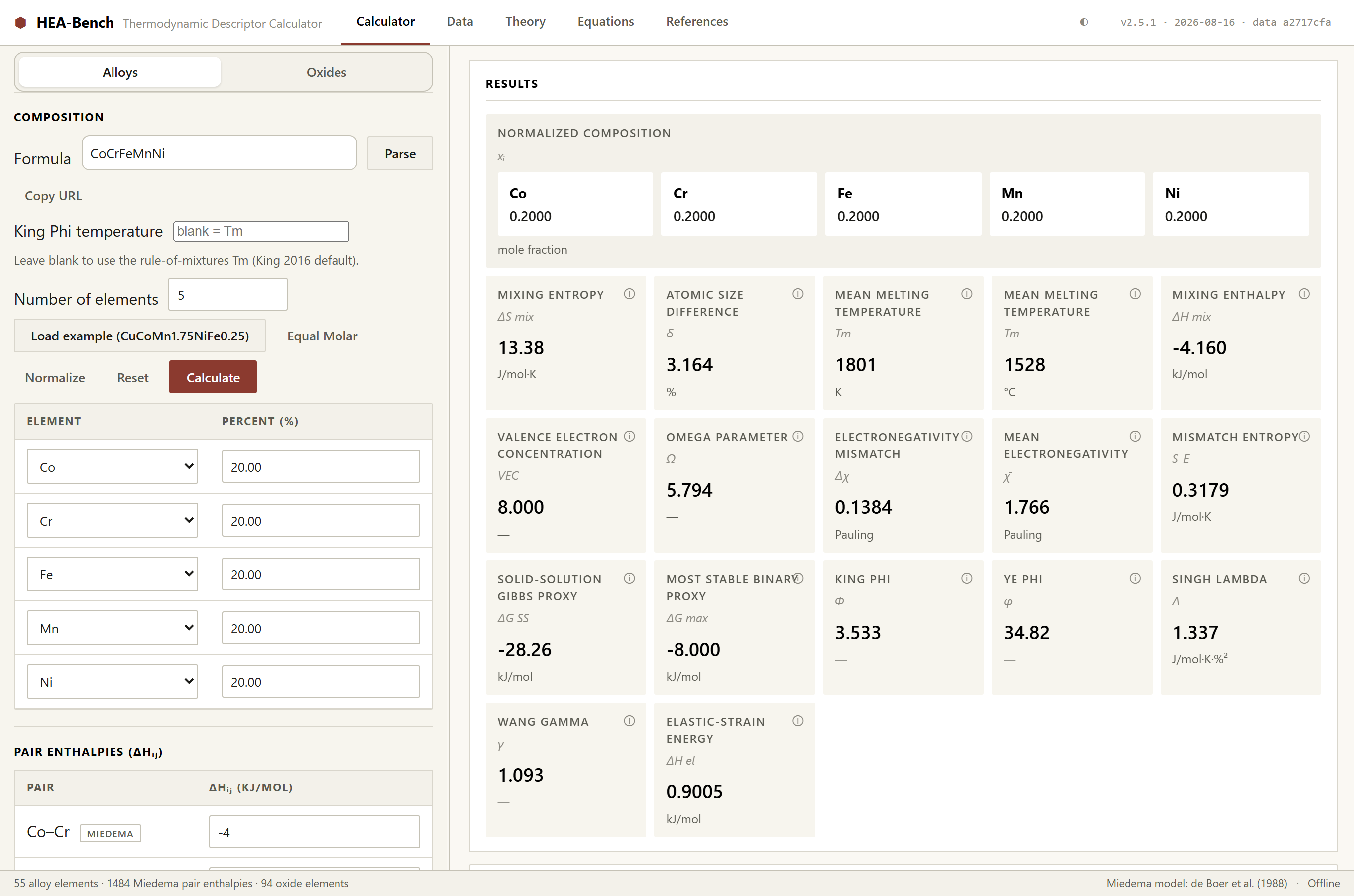
The equimolar Cantor alloy CoCrFeMnNi, as the browser app reports it. The Python library, the desktop app and this page print the same digits, and a parity suite keeps it that way.
Using an AI coding agent to integrate this? See AGENTS.md for a machine-oriented guide to the API, exact return types and units, the fastest path to each task, and the mistakes to avoid.
What it computes
For any composition it reports:
- Core descriptors: mixing entropy ΔSmix, atomic-size mismatch δ, mean melting temperature Tm, Miedema mixing enthalpy ΔHmix, valence-electron concentration VEC, Yang–Zhang Ω, Pauling electronegativity mismatch Δχ, Mansoori excess entropy SE, ΔGss, ΔGmax, King Φ, Ye φ.
- Phase-prediction rules: Yeh entropy, Zhang δ, Guo–Liu VEC, Yang–Zhang Ω, King Φ, Ye φ, Senkov–Miracle κ, the Tsai σ-phase window and Sheikh ductility.
- Miedema formation enthalpies: compound / solid-solution / amorphous, decomposed into chemical, elastic, structural, and topological terms.
- Your own elements and pair values: any descriptor or rule, for a composition with an element or pair enthalpy that is not tabulated.
- High-entropy oxides (
hea_bench.oxides+ the apps' Oxides mode): rock-salt, perovskite, fluorite, and pyrochlore formability descriptors over Shannon ionic radii with automatic charge-balance oxidation-state assignment: per-sublattice configurational entropy, cation size disorder, Goldschmidt t / octahedral μ / Bartel τ, the fluorite radius-dispersion rule, and the pyrochlore radius-ratio window.
Element coverage: 55 elements for alloys (Ag Al Au Be Bi Ca Ce Co Cr Cu Dy Er Fe Ga Gd Ge Hf Ho In Ir La Li Lu Mg Mn Mo Nb Nd Ni Os Pb Pd Pr Pt Re Rh Ru Sb Sc Si Sm Sn Sr Ta Tb Th Ti Tm U V W Y Yb Zn Zr, covering the full experimentally active rare-earth HEA palette plus the nuclear, solder, and HE-BMG corners); the Miedema pair table covers 75 (1484 of our 1485 pairs; the lone Th-U gap is reported, never zeroed); the oxide module's Shannon table covers 94.
How a number gets made
No fitted model sits anywhere in this chain. Each descriptor is a closed-form expression over curated tables, and the report carries the literature source of every input alongside the value.
flowchart LR
    A["Composition<br/>CoCrFeMnNi"] --> B["Curated element tables<br/>55 elements, 1484 Miedema pairs"]
    B --> C["Closed-form descriptors<br/>ΔS, δ, VEC, ΔH, Ω, Φ, φ, Λ, γ, κ"]
    C --> D["Empirical phase rules<br/>Yeh, Zhang, Guo-Liu, Yang-Zhang, King, Ye"]
    C --> E["Report<br/>per-value provenance, content-hashed result ID"]
    D --> E
Four ways to run it, each with every feature
| Part | Where | Best for |
|---|---|---|
| Web app | https://dfieser.github.io/hea-bench/ | anyone, no install |
| Desktop app | one portable .exe, download (no install), the same app in its own window, engine inside, works offline |
Windows users who want it local |
| Python library + CLI | pip install "hea-bench[all]" |
scripts and notebooks |
| MCP server for AI agents | pip install "hea-bench[mcp]", then hea-bench-mcp |
Claude, Cursor and other MCP clients, as 24 tools |
Every feature is in all four parts, so pick whichever suits you and you
lose nothing. That is a standing project rule, and CI enforces it:
tests/test_feature_parity.py fails whenever a public feature lacks
its library function, its MCP tool or a working app surface, a headless
browser uses every tab of the built site, the built desktop exe goes
through the same steps before it is attached to a release, and a
freshly installed wheel answers every MCP tool. pip install hea-bench alone has no dependencies and covers everything except the
fitted models and the MCP server; the [all] extra adds scikit-learn
and the MCP SDK for those.
All four share one calculation core. The browser/desktop
core (web/hea-calculator-core.js) is a pure-JS port of the Python
library, and tests/test_web_parity.py guarantees the two match on all
1484 binary pairs and the canonical multi-element fixtures, while
tests/test_web_oxides_parity.py does the same for the oxide module,
down to identical warning messages. The app's Dataset, Design and
Benchmark tabs and its predictions panel run the Python package itself,
unchanged, inside the page (Pyodide, web/hea-engine-worker.js), and
tests/test_web_engine.py checks that it returns exactly what CPython
returns.
Quick start (Python)
pip install hea-bench
import hea_bench as hb

cantor = {"Co": 0.2, "Cr": 0.2, "Fe": 0.2, "Mn": 0.2, "Ni": 0.2}

hb.smix(cantor)               # 13.381 J/(mol·K)  = R · ln 5
hb.delta(cantor)              # 3.164 % atomic-size mismatch
hb.vec(cantor)                # 8.0 valence electrons
hb.mixing_enthalpy(cantor)    # -4.16 kJ/mol  (Miedema)
hb.omega(cantor)              # 5.79  (Yang–Zhang)
hb.delta_chi(cantor)          # 0.138 Pauling electronegativity mismatch
hb.s_excess(cantor)           # 0.318 J/(mol·K)  (Mansoori excess entropy)
hb.delta_g_max(cantor)        # -8.00 kJ/mol  (most-negative Miedema pair)
hb.phi_king(cantor)           # 3.533 (King 2016 proxy)
hb.phi_ye(cantor)             # 34.82 (Ye 2015 proxy)

# Apply the canonical rules
from hea_bench.rules import guo_vec, king_phi, yang_omega, ye_phi, zhang_delta
zhang_delta.predict(cantor)          # 'single-phase'
yang_omega.predict(cantor)           # 'single-phase'
guo_vec.predict(cantor)              # 'FCC'
king_phi.predict(cantor)             # 'solid_solution'
ye_phi.predict(cantor)               # 'solid_solution'
These Cantor-alloy values are pinned in the test suite as the canonical sanity check. The rules are simple empirical surrogates, fast screens rather than predictions, so treat their output accordingly.
Descriptor backends (optional interop)
Descriptors can also be computed through a pluggable backend. The
default (native) is this package's own stdlib implementation; with
pip install "hea-bench[interop]" the same interface drives an
installed HEACalculator
(GPLv3, installed at the user's choice), so a workflow standardized on
its numbers can keep them while using everything downstream here:
from hea_bench.descriptors.backend import get_backend
get_backend("heacalculator").compute(cantor)   # same names, their reference data
hea-bench describe Al0.3CoCrFeNi --backend native
The two backends vendor different reference data (radius conventions differ most), so same-named values legitimately differ; the measured, per-descriptor comparison lives in docs/backend-agreement.md. Quantities whose implementations differ structurally are deliberately not mapped onto each other, and the benchmark's published baselines use the native backend unchanged.
Quick start (oxides)
from hea_bench import oxides

# Rost 2015 "J14" entropy-stabilized rock salt
j14 = oxides.describe_rock_salt({"Mg": 1, "Co": 1, "Ni": 1, "Cu": 1, "Zn": 1})
j14["descriptors"]["s_config"]       # 13.382 J/(mol·K) = R·ln 5
j14["oxidation_states"]              # all 2+ by charge balance

# Jiang 2018 single-phase high-entropy perovskite
pvk = oxides.describe_perovskite({"Sr": 1}, {"Zr": 1, "Sn": 1, "Ti": 1, "Hf": 1, "Mn": 1})
pvk["descriptors"]["goldschmidt_t"]  # 0.979, inside the 0.92–1.04 window
pvk["verdicts"]["bartel"]            # 'perovskite' (τ = 3.72 < 4.18)
Each describe_* report carries the solved oxidation states, the
Shannon radii actually used, every descriptor, the formability
verdicts with their windows, and any warnings. See
examples/02_oxides_walkthrough.py
for the full tour, including the fluorite and pyrochlore screens and
oxidation-state overrides.
Quick start (ceramics, experimental)
hea_bench.ceramics extends the calculator to rock-salt carbides and
nitrides and AlB2-type diborides, composition-only and honest about
what that buys:
from hea_bench import ceramics

hec = ceramics.describe_rock_salt_carbide({"Ti": 1, "Zr": 1, "Hf": 1, "Nb": 1, "Ta": 1})
hec["vec_per_formula_unit"]        # 8.4, with annotated literature reference points
hec["entropy"]                     # all normalization conventions, labelled
Reports carry the metal-sublattice entropy in every published normalization convention (papers switch between them without warning), VEC with annotated reference points rather than a verdict (the literature marks points, not one window), and explicit notes on what is deferred: the size-mismatch descriptor (the field computes it from DFT binary-cell bond lengths, and adopting a cited table is real curation work), and entropy-forming-ability or DEED, which are DFT-ensemble quantities this package cannot and does not claim to reproduce. Background, citations, and a license audit of candidate ceramics datasets: docs/ceramics.md.
Quick start (AI agents, MCP)
LLM agents hallucinate descriptor values; this server grounds them.
hea_bench.mcp_server exposes every feature of the package over the
Model Context Protocol as 24
deterministic tools. The calculator: parse_composition, batch
alloy_descriptors (with the Miedema enthalpies) and alloy_rules,
both taking custom elements and pair values, omega_sensitivity,
oxide_report, ceramic_report, element_data and
element_coverage. The dataset: corpus_build (once, to build the
corpus locally), corpus_query, corpus_describe, corpus_export and
measured_properties. Predictions: predict_properties with
intervals and predict_phase_set with prediction sets, both carrying
the domain flag, and check_applicability. Design:
design_search, with hard caps on palette, step and candidate count,
and campaign_suggest, on a campaign file or an inline campaign. The
benchmark: benchmark_summary, benchmark_run, benchmark_folds,
benchmark_score and coverage_study. And about. Every response
carries units or uncertainty fields, citation keys
where a parametrization is involved, and the library version, so an
agent's reasoning trace contains auditable receipts rather than bare
floats; about() reports which capabilities are available in the
running environment, and missing optional extras come back as a clear
message naming the exact install.
pip install "hea-bench[mcp]"
Register it with any MCP client (Claude Desktop, Cursor, ...), for
example in claude_desktop_config.json:
{ "mcpServers": { "hea-bench": { "command": "hea-bench-mcp" } } }
The omega_sensitivity tool is worth singling out: it reports the
per-pair Miedema contributions and how far Ω moves when the dominant
element's pair enthalpies are shifted within the spread of published
compilations, so an agent can ask not just for a number but for how
much to trust it.
Quick start (browser, no install)
The app runs entirely client-side. Its tabs:
- Calculator. Every descriptor, all nine phase rules, the Miedema decompositions, the robustness of Ω to the pair table, density, cost, hardness with its interval, the phase prediction set and the domain flag. Oxides and Ceramics (carbides, nitrides, diborides) are modes of the same tab.
- Dataset. The consolidated experimental corpus with every source's label and paper, filters and CSV download, plus the measured hardness and density data.
- Design. Composition search with property limits, rule filters and the Pareto front, and experiment planning from your own measurements.
- Benchmark. The frozen random and family-grouped splits, live baseline reruns, scoring of your own predictions, and the coverage study.
Two ways to open it:
- Open the hosted site: https://dfieser.github.io/hea-bench/.
- Or clone the repo, run
python tools/build_web_engine.pyonce (assembles the pinned in-page engine, about 30 MB), thenpython -m http.server -d weband open http://localhost:8000. Openingweb/index.htmldirectly from disk also works for the calculator, but browsers block the engine onfile://pages, so the other tabs need the local server.
The calculator ships its own documentation: a Theory view deriving
every alloy and oxide formula with citations, a grouped, filterable
Equations reference, and a grouped References bibliography.
Deep links open a view directly (index.html#theory,
#equations, #refs). The parity-critical math lives in
web/hea-calculator-core.js and is regression-checked against Python
by the two parity test suites.
Paired evaluation: the phase-prediction benchmark (experimental)
Published HEA phase-prediction accuracies are mostly measured with
random train/test splits over corpora full of stoichiometric series, so
models are tested on close variants of alloys they trained on. That
largely measures interpolation within known systems.
hea_bench.benchmark ships frozen, family-grouped and random paired
splits over a consolidated experimental corpus (~7,700 alloys) and an
evaluator that reports both side by side:
from hea_bench.benchmark import evaluate, load_benchmark
print(evaluate(my_model, load_benchmark(task="phase4")).table())
A stock random forest over this package's own descriptors scores 0.941
balanced accuracy under the random split and 0.734 under the grouped
one. Neither number is wrong; they answer different questions (new
stoichiometries of known systems versus unseen element systems), and
the gap between them quantifies how much of the random-split score
comes from testing on close relatives of training alloys. For this
interpolation-versus-extrapolation reading of grouped evaluation, see
Li et al., Commun. Mater. 6:9 (2025),
doi:10.1038/s43246-024-00731-w.
Baselines, split digests, and full provenance:
docs/benchmark-baselines.md.
Every source dataset ships with the package under CC BY 4.0 (see
data/raw/README.md), and the corpus is built
from them on your machine, once, with no download.
hea_bench.corpus.build_corpus() checks the largest source against its
pinned SHA-256 and builds every corpus version. The apps and the MCP
server's corpus_build tool do the same.
The corpus as a standalone product
The consolidated experimental corpus behind the benchmark is also addressable directly, with no task or split machinery involved:
from hea_bench.corpus import load_corpus

corpus = load_corpus()                # v0.2.0 (10,290 alloys), every row, full provenance
corpus.describe()                     # counts, families, agreement rate
al_bcc = corpus.query(contains=["Al"], phase="BCC", descriptor_ready=True)
al_bcc.rows[0].raw_labels             # each source's verbatim reported phase
al_bcc.to_csv("al-bcc.csv")
Every row carries per-source canonical and verbatim labels, Borg's
processing route and primary-literature DOI where available, and
upstream record identifiers, so a label can be audited without leaving
the package. Provenance chains, per-source license status,
harmonization rules, and known limitations are documented in the
corpus card. load_corpus() opens the largest
version, v0.2.0, which adds the LLM-extracted Chizhevskiy database.
load_corpus(version="0.1.0") is the hand-curated reference (7,783
alloys) that the benchmark, the phase predictions and the domain flag
always use, so every published number stays put.
Uncertainty and domain of applicability
hea_bench.uncertainty is the trust layer for anything fitted on the
corpus. Conformal prediction wraps any sklearn-style model with
sets or intervals carrying a distribution-free finite-sample coverage
guarantee, and a domain-of-applicability model says whether that
guarantee's exchangeability assumption plausibly holds for your query:
from hea_bench.corpus import load_corpus
from hea_bench.uncertainty import ConformalClassifier, fit_domain

domain = fit_domain(load_corpus(version="0.1.0"))
domain.novelty({"Hf": 0.2, "Nb": 0.2, "Ta": 0.2, "Ti": 0.2, "Zr": 0.2})
# {'element_set_seen': True, 'family_count': ..., 'nearest_family_distance': 0.0,
#  'descriptor_distance': ..., 'element_coverage': True, 'in_domain': True, ...}
The novelty output is several deliberately orthogonal signals plus one
conservative in_domain flag, because the signals fail differently and
a single scalar invites misreading. Empirical coverage of the conformal
sets on unseen alloy systems, in and out of domain and by element
count, is measured in
docs/uncertainty-coverage.md. The
released phase sets calibrate by cross-validation over whole alloy
systems, separately for alloys with fewer than four and with four or
more elements, and their 90 percent sets cover 0.900 of unseen-system
alloys on the single-phase task and 0.884 on the phase-structure task.
Read the flag together with the set size rather than either alone.
These tools describe this package's confidence about your composition
on this corpus, nothing else.
Property predictions, in explicit tiers
hea_bench.properties predicts what experimentalists ask about first,
with the data quality stated in the API rather than implied:
from hea_bench.properties import predict_property

predict_property({"Al": 0.2, "Co": 0.2, "Cr": 0.2, "Fe": 0.2, "Ni": 0.2}, "hardness")
# PropertyPrediction(prop='hardness', value=..., unit='HV',
#                    interval=(low, high), alpha=0.1, tier='B',
#                    in_domain=True, n_training=..., ...)
Tier A (density, melting_temperature, and an explicitly indicative
cost_per_kg over a date-stamped, per-element-sourced price table) is
closed-form arithmetic over cited tables, validated where experiment
exists (docs/property-tier-a.md).
Tier B (hardness, behind pip install "hea-bench[properties]") is a
seeded random forest over this package's descriptors wrapped in a
family-grouped conformal interval and a domain flag; its held-out
error, interval calibration, and the decisions that error does and
does not support are stated in
docs/property-hardness.md. Intervals are
wide because the public data is small and heterogeneous; that is the
honest outcome, shown rather than hidden. Properties whose public data
cannot support a defensible held-out error (yield strength across
uncontrolled test temperatures, ductility, corrosion) are deliberately
not shipped, and the model card says why.
Constrained composition search
hea_bench.design.search answers "what should I make" as a screening
aid: a deterministic composition lattice over your palette, filtered by
rule, property, composition, and domain constraints, returning a Pareto
front where every candidate carries its full receipt:
from hea_bench.design import Maximize, Minimize, PropertyConstraint, search

result = search(
    elements=["Al", "Co", "Cr", "Fe", "Ni"],
    n_elements=(4, 5),
    constraints=(PropertyConstraint("density", max=8.0),),
    objectives=(Maximize("hardness"), Minimize("cost_per_kg")),
    step=0.05,
)
result.candidates[0].properties["hardness"].interval   # every number has one
The domain constraint is on by default (optimizers exploit model error
hardest where data runs out; opting out is explicit), and
optimize_bound="lower" ranks fitted objectives by the conservative
end of their intervals. The search is exhaustive within a hard budget
and refuses loudly rather than sampling silently, so a result is
reproducible by construction. Where measured alloys land relative to a
recovered front is studied honestly in
docs/design-recovery.md; the front is a
prioritization aid, not a set of answers.
Active-learning campaigns (bring your own measurements)
hea_bench.design.campaign.Campaign runs the loop that creates repeat
usage: observe your own measurements, get a ranked next batch, keep
everything in a plain JSON file on your disk (no accounts, no server,
no telemetry):
from hea_bench.design.campaign import Campaign

campaign = Campaign("hardness", ["Al", "Co", "Cr", "Fe", "Ni"])
campaign.observe({"Al": 0.1, "Co": 0.25, "Cr": 0.2, "Fe": 0.25, "Ni": 0.2}, 430.0)
campaign.suggest(n=5)     # each Suggestion prints its interval and domain flag
campaign.save("my-campaign.json")
The surrogate is a seeded random forest. Each suggestion carries a 90 percent conformal interval set from the forest's out-of-bag errors, so calibration costs none of your measurements. Acquisition is expected improvement or UCB with batched picks via the believer heuristic, and hardness campaigns warm start from the Borg records inside your palette so the loop is useful before your tenth sample. Below 10 informative rows it refuses rather than pretending. Two replays on the Borg hardness record, the loop against random selection with the intervals' coverage, and a year-ordered replay on Al-Co-Cr-Fe-Ni, are in docs/campaign-replay.md.
A note on Ω near ΔHmix ≈ 0
Ω = Tm·ΔSmix / |ΔHmix| diverges as ΔHmix → 0, so for
near-ideal alloys (|ΔHmix| ≲ 1–2 kJ/mol) the Ω magnitude is
extremely sensitive to the choice of Miedema pair table (sources
disagree most on Mn). The phase verdict (Ω ≫ 1.1) stays robust even when
the number does not, so read Ω qualitatively in that regime.
Project layout
hea-bench/
├── src/hea_bench/
│   ├── descriptors/     ΔS_mix, δ, VEC, T_m, ΔH_mix, Ω, S_E, φ + data tables
│   ├── rules/           the nine empirical phase-prediction rules
│   ├── oxides/          HEO module: families, oxidation-state solver,
│   │                    Shannon radii (94 elements, vendored from pymatgen)
│   ├── ceramics/        carbides, nitrides, diborides
│   ├── corpus/          the experimental corpus: build_corpus, load_corpus
│   ├── benchmark/       frozen family-grouped + random paired splits and evaluation
│   ├── properties/      density, melting point, cost, hardness
│   ├── uncertainty/     conformal sets and intervals, phase sets, domain flag
│   ├── design/          composition search and campaigns
│   ├── mcp_server.py    the MCP server (hea-bench-mcp)
│   ├── webapp.py        the bridge the in-page engine calls
│   ├── custom.py        custom elements and pair values
│   ├── composition.py   formula parser, normalizer
│   ├── constants.py     R = 8.314
│   └── cli.py           command-line entry point
├── tests/               unit tests + BOTH Python↔JS parity suites
├── web/                 landing page + self-contained calculator (+ MathJax)
├── src-tauri/           native desktop wrapper (Rust/Tauri)
├── examples/            Cantor-alloy and oxides walkthroughs (.py + .ipynb)
└── pyproject.toml
Development
git clone https://github.com/dfieser/hea-bench
cd hea-bench
pip install -e ".[dev]"
python -m pytest tests/ -q          # includes the Python↔JS parity test (needs Node)
The HTML calculator (web/index.html over
web/hea-calculator-core.js) is an independent JavaScript
implementation of the same descriptors and rules. When you modify the
Python descriptor code, update the JS core to match and re-run
tests/test_web_parity.py and tests/test_web_oxides_parity.py so the
surfaces don't drift. The element data tables inside the JS core are
generated from the Python library by tests/data/_sync_js_tables.py
and tests/data/_sync_js_oxide_tables.py. Regenerate them, never
hand-edit them.
License
MIT. The vendored
matminer Miedema data files remain
under their upstream BSD-3-Clause license, preserved at
descriptors/data/LICENSE.matminer.txt.
Contributing and support
Contributions and bug reports are welcome. See CONTRIBUTING.md for development setup and the testing convention.
Report a bug or request a feature in the
issue tracker. Ask a
question or float an idea in
Discussions, where
the Q&A category is the right place for how a descriptor is defined,
which rule applies to a composition, or why two sources disagree.
Answers there stay findable for the next person with the same question.
For direct contact, email the maintainer at davjfies@gmail.com.
Participation is governed by the Code of Conduct.
Acknowledgements
Yen-Ming Horng (@infinitus01),
Independent Researcher, Taiwan. External reproducibility and
documentation review. Reported the delta_g_max documentation contract
mismatch corrected in v2.1.4.
External reviews of this kind cover reproducibility and documentation-to-implementation consistency. They are not a validation or endorsement of the underlying scientific conclusions.
Citation
If you use hea-bench in your work, please cite the paper that describes it:
Fieser, D.; Dewanjee, U.; Hu, A. HEA-Bench: An AI-Agent-Optimized Calculator of High-Entropy Alloy and Oxide Descriptors and Phase-Prediction Rules. Materials 2026, 19, 3075. https://doi.org/10.3390/ma19143075
@article{ma19143075,
  author         = {Fieser, David and Dewanjee, Unmanaa and Hu, Anming},
  title          = {{HEA-Bench}: An {AI}-Agent-Optimized Calculator of High-Entropy Alloy and Oxide Descriptors and Phase-Prediction Rules},
  journal        = {Materials},
  volume         = {19},
  year           = {2026},
  number         = {14},
  article-number = {3075},
  issn           = {1996-1944},
  doi            = {10.3390/ma19143075},
  url            = {https://www.mdpi.com/1996-1944/19/14/3075},
}
Machine-readable metadata, including this preferred citation, is in
CITATION.cff (GitHub's "Cite this repository"
button uses it). To reference the exact software version you used,
additionally cite the Zenodo archive: the concept DOI
10.5281/zenodo.20346287
always resolves to the latest version.
When citing hea-bench, please also cite the primary sources for the parametrizations it implements: de Boer et al. 1988 for the Miedema model, the rule papers (Yeh 2004, Zhang 2008, Guo–Liu 2011, Yang–Zhang 2012, King 2016, Ye 2015), the oxide primaries (Shannon 1976, Goldschmidt 1926, Bartel 2019, Spiridigliozzi 2021, Subramanian 1983), matminer for the vendored pair table, and pymatgen for the Shannon-radius digitization. The full grouped bibliography is in the calculator's References view.
Disclaimer
Descriptor values and rule predictions reported by hea-bench are empirical estimates for research and informational purposes only. The rules and descriptors are semi-empirical surrogates with known limitations. No warranty is made as to accuracy, completeness, fitness for any particular purpose, or suitability for material qualification. Do not use these outputs as the sole basis for engineering design or material qualification without independent verification by validated thermodynamic methods (e.g. CALPHAD or DFT).
Software is provided "as is" under the MIT License.
Vendored Miedema elemental parameters from
matminer remain under
their upstream BSD-3-Clause license; see
src/hea_bench/descriptors/data/LICENSE.matminer.txt.
1 maintainer

Metadata
1 maintainer
Release files for hea-bench 2.9.0
For a detailed explanation of source distributions (sdists) and built distributions (wheels), please see the package formats documentation.
Source distribution (sdist)
| File | Size | Uploaded | |
|---|---|---|---|
| hea_bench-2.9.0.tar.gz | 2.5 MB | Details |
Built distribution (wheel)
| File | Interpreter | ABI | Platform | Reset |
|---|---|---|---|---|
| hea_bench-2.9.0-py3-none-any.whl | Python 3 | none | any | Details |
Total release size: 4.8 MB
Release files / hea_bench-2.9.0.tar.gz
| Download URL | hea_bench-2.9.0.tar.gz |
|---|---|
| Size | 2.5 MB |
| Tags | Source |
|
SHA-256 checksum How to use checksums |
b19da051137f247abd97b046597c05c0bb740009ec46b427825b6b7835d3af47
|
|
BLAKE2b-256 checksum How to use checksums |
de5c71242a2cad83e2393f9cdd6c55e79283d301300000be785e3483f5757bc5
|
| Upload date | |
|
Uploaded using Trusted Publishing? What is trusted publishing? |
Yes |
| Uploaded via |
twine/7.0.0 CPython/3.13.14
|
Provenance
Provenance describes where a file came from. On PyPI, provenance is shared via attestations, which provide a verifiable record of the build or publishing details. View details, limitations and caveats.


PyPI Publish Attestation
PyPI verified that this artifact, at this checksum, originated from the publisher listed below.
Signed by GitHub Actions, verified by PyPI on Oct 8, 2026.
Transparency logRelease files / hea_bench-2.9.0-py3-none-any.whl
| Download URL | hea_bench-2.9.0-py3-none-any.whl |
|---|---|
| Size | 2.4 MB |
| Tags | Python 3 |
|
SHA-256 checksum How to use checksums |
e4c52e0494a94a2d09ea6a1a87b5f86fc7b38cfd14231994dcfff7cd137b6fd8
|
|
BLAKE2b-256 checksum How to use checksums |
8a2a86d0490e29363d9693616e7ed8ff91e05d8ea1fc27e7710eafbf9618e872
|
| Upload date | |
|
Uploaded using Trusted Publishing? What is trusted publishing? |
Yes |
| Uploaded via |
twine/7.0.0 CPython/3.13.14
|
Provenance
Provenance describes where a file came from. On PyPI, provenance is shared via attestations, which provide a verifiable record of the build or publishing details. View details, limitations and caveats.
PyPI Publish Attestation
PyPI verified that this artifact, at this checksum, originated from the publisher listed below.
Signed by GitHub Actions, verified by PyPI on Oct 8, 2026.
Transparency log













